
Part 04 – The Empowerment of People
4-1
Major Purposes of Part Four
Part Four focuses on three important subjects—
leadership authority, the empowerment of people, and
the quality imperative.
Part Four Objectives
After completing Part Four, your students should be able
to better understand:
• The nature of servant leadership;
• The role of participative leadership;
• Formal authority and the use of power;
• The concept of psychological size;
• The quality movement; and
• Practical tips for developing a high performance workplace.
PART FOUR—The Empowerment of People

Part 04 – The Empowerment of People
4-2
NOTES AND ANECDOTES
Empowerment Facilitates Change
Change is an inevitable fact of life in the workplace as new people, processes, and products come
and go. Some changes are caused by forces outside the organization; some originate from within.
The ability to adapt to change is a key characteristic of successful groups. How do they do it?
They recognize that the outcome of a change often depends on how it is introduced and who is
involved. Whenever possible, people are encouraged to participate in decisions that will affect
them. This tends to reduce resistance and resentment. The following, a classic study of
employees in a clothing factory, illustrates the point:
Experimenters divided employees into four groups that differed in terms of how a change in
work group procedures was introduced. Group I was allowed no participation; the employees
were told about the new work procedures, but were given no voice in matters. In Group II,
employee representatives met and discussed the change with management. In Groups III and
IV, all workers were encouraged to participate actively with management in implementing the
change.
The reaction of Group I was very negative. Production decreased immediately
by one-third, expressions of hostility and resentment surfaced, and seventeen
percent of the group quit within forty days. Group II, by allowing participation
through representatives, achieved better results, but the response was not as
positive as that of Groups III and IV. As a result of allowing participation by all
of the workers involved, there was no hostility in Groups III and IV, and none of
the employees quit. Production in these groups dropped initially, but quickly
rose to a level higher than before.
Encouraging broad employee participation was clearly the best method for
overcoming resistance to change, a finding that has been verified by other
studies.
NOTES AND ANECDOTES
Technological advances, global economies, cultural diversity, and speed of change are
important forces that are helping to reshape the American workplace. While all of these may
not be present in any one work environment, some shifting from the “traditional” to the “new”
is occurring in most workplaces. Areas of change include structure, focus, quality, standards,
and leadership. See Table 4.1.

Part 04 – The Empowerment of People
4-3
TABLE 4.1: THE CHANGING WORKPLACE
AREAS OF CHANGE TRADITIONAL NEW
WORKPLACE WORKPLACE
Structure Functional Departments Work Teams
Focus Cost-Focused Customer-Focused
Quality Inspection for Errors Continuous Improvement
Standards Internal Controls World Class Requirements
Leadership Autocratic Democratic
Students can evaluate their current (or former) workplaces regarding structure, focus, quality,
standards and leadership. Are conditions more traditional or new? What policies and actions
do they advise?
NOTES AND ANECDOTES
Empowerment Success Stories
When people come together to accomplish something, certain questions are on their minds.
They want to know:
• What is expected of us?
• Why is this important?
• Who is the work for?
• How will we work together?
• When do the tasks need to be done?
• What constitutes great performance?
• How will we be rewarded?
The effective leader begins by clarifying goals and roles. The task of the leader is to focus and
energize people, inspire creativity, and get the best ideas from everybody.

Part 04 – The Empowerment of People
NOTES AND ANECDOTES
The following are reports on three groups using empowerment efforts to improve
performance results in a steel company. Each group was asked to: (1) identify an operational
bottleneck or problem adversely affecting the quality of work or the quality of work life in the
company; (2) analyze the causes and consequences of the problem; and (3) make
recommendations to solve the problem, including expected costs and benefits.
The “Safety Coil” Group. This example focuses on teamwork among employees of the steel
coil repair department. They identified a safety hazard that had resulted in hand and arm
injuries and even loss of life. This problem had been an industry-wide concern for all coil-
rolling operations. When coiling steel of uneven thickness, the coil must remain round. The
traditional practice had been to insert small slips of paper while winding the coil to keep it
symmetrical. Because the coil spins so fast, centrifugal force creates danger for the worker
inserting the paper slips. After studying the problem, the group offered a three-part solution:
• A safety stick was devised with a slit at the end to hold the small pieces of paper. The team
discovered that the paper slips could be inserted into the spinning coil with this stick, protecting the
worker from injury.
• A training manual was developed that not only included the coil-stick solution, but also addressed
other health and safety problems in the steel coil repair department.
• The group used the manual to present a training program on health and safety procedures to
all workers in the department.
The benefits were substantial: (1) no lost-time accidents have occurred in the steel coil
repair department since the group completed its project twenty years ago; (2) the group
presented its coil stick and training manual to the National Association of Steel Manufacturers
Plant Safety Conference, and both are widely used in industry today; and (3) self-confidence
and group pride were created on the team.
The “Wooden Pallets” Group. This example focuses on teamwork among supervisors from
the manufacturing, maintenance, scheduling, and shipping departments. The problem identified
by the group was loss of time and material in building wooden pallets to store steel sheets and
coils between manufacturing and shipping. The practice had been to build a pallet to fit each
new load, discard it after use, and pay to have the scrap wood hauled away. A study of the
problem by the group resulted in the following recommendations:
• Build storage bins to fit common sizes of four–by-fours and two-by-fours used to make
pallets.
• Locate these bins in a convenient area.
• Store lumber in the bins until needed.
• Disassemble used pallets and return the wood to the appropriate bins for reuse.

Part 04 – The Empowerment of People
4-5
The results were significant: (1) the storage bins saved employees the time and effort of
looking for wood and cutting it to size; (2) reusing the wood resulted in significant savings in
labor, materials, and haul-away costs; and (3) the group project created a sense of teamwork
and pride that carried over to other activities on the job.
The “New Suppliers” Group. This example focuses on teamwork among managers from
sales, manufacturing, engineering, finance, and purchasing. They identified elements critical to
the success of the company: (1) purchasing second-grade and partially damaged steel; (2)
processing this material to meet customer orders for flat steel and steel coils; and (3) delivering
the final product. The problem the group identified was the need to ensure a dependable supply
of raw material at a reasonable cost. Although current suppliers had been satisfactory, the
company was in a vulnerable position without additional sources of supply. As in all recycling
industries, the lifeline begins with the purchase of raw material. The solution was as follows:
• Four additional suppliers were identified.
• The group invited these suppliers to visit the company to learn about its people and products.
• They picked up the suppliers in vans, gave them a tour of the plant and lunch in the company
boardroom, and presented the company’s history and philosophy.
• Members of the group followed up on this effort with personal calls.
What were the results? (1) Three of the four suppliers became dependable new sources of
raw material, thereby increasing the financial security of the company; (2) substantial cost
saving resulted from being able to buy raw material from several sources; (3) top management
reinforced a “can do” attitude among themselves; and (4) the enthusiasm and success of the
management team invigorated the rest of the work force.
NOTES AND ANECDOTES
What is Quality?
The most widely accepted definition of what constitutes quality exists in the criteria for the Malcolm
Baldrige National Quality Award. This annual award, given by the U.S. Commerce Department since
1988, recognizes U.S. companies that excel in quality achievement. To better understand ways to
achieve quality, examine the concepts that serve as the basic criteria for this award.
• Quality is defined by the customer.
• Senior leadership creates clear quality values and builds these values into the way the organization
operates.

Part 04 – The Empowerment of People
4-6
• Quality excellence derives from having well-designed and well-executed systems and processes.
• Continuous quality improvement is part of the management of all systems and processes.
• Goals are developed, as well as strategic and operational plans, to achieve quality leadership.
• Shortening the response time of all operations and processes of the organization is part of the
quality-improvement effort.
• Operations and decisions of the organization are based on facts and data.
• All employees are suitably trained and involved in quality activities.
• Design quality and defect and error prevention are major elements of the quality system.
• Quality requirements are communicated to suppliers and the organization works to elevate supplier
quality performance.

Part 04 – The Empowerment of People
4-7
NOTES AND ANECDOTES
Improving Performance Across Companies
Although bartering and trading can be acceptable when the work performed is simple and occurs at a
discrete point in time, the best approach is to look beyond an isolated exchange and focus instead on
building a long-term relationship. Partners who have mutual trust do not feel the need to check up on
each other. Also, in many organizations, one’s customers are also one’s suppliers as well. Building a
solid trust-based relationship pays dividends to both organizations, as the following example
shows:
After years of relying on a weekly exchange of price incentives and shelf space, two consumer giants, Procter &
Gamble and Wal-Mart, began to develop a trust-based relationship, sharing up-to-the-minute sales information,
long-range buying plans, and current inventory figures. Eliminating a sea of promotional incentives allowed
Procter & Gamble to provide the “everyday low prices” Wal-Mart required, while letting each company achieve a
reasonable profit. At the same time, Wal-Mart agreed to pay invoices as presented and settle accounts at the end
of the year.
Both companies have enjoyed substantial benefits with this new way of working: (1) Conflicts
can be avoided and resolved more easily; (2) communication is more open, timely, and accurate; (3)
Wal-Mart inventories have been cut from 30 days to 2 days, resulting in reduced cost; and (4) Procter &
Gamble reports $500 million in annual savings as a result of the new level of partnership and trust.
Source: Michael Treacy and Fredrik D. Wierseman, The Discipline of Market Leaders: Choose Your
Customers, Narrow Your Focus, Dominate Your Market (Reading, MA: Addison Wesley, l997), 52–
58.

Part 04 – The Empowerment of People
4-8
NOTES AND ANECDOTES
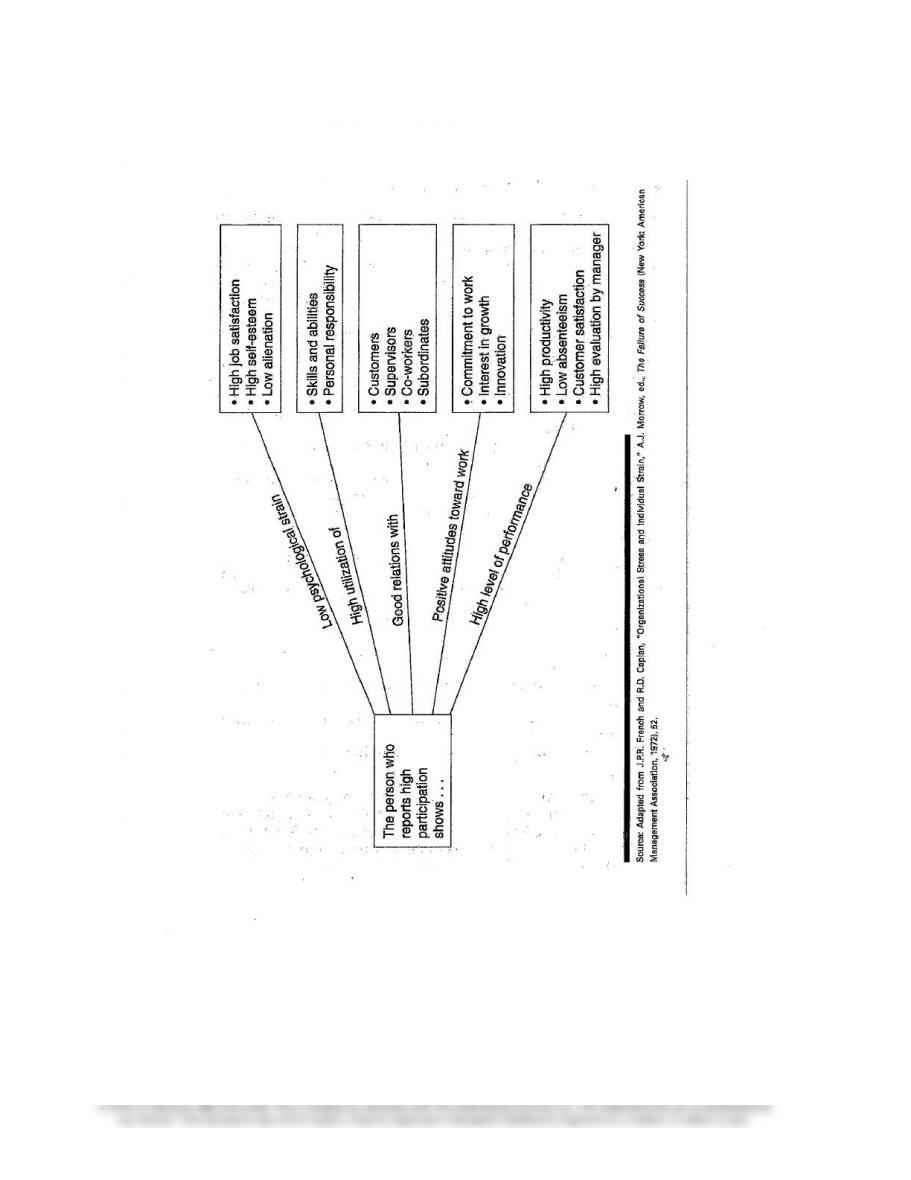
There are two types of benefits of employee involvement and the team concept; end product
benefits and in-process benefits.
End product benefits include improved quality of work and improved profits. It is common for
a quality improvement team to identify and make recommendations to solve between two and six
problems a year, and experience has shown that management adopts 80 percent of these suggestions.
Ninety percent of the recommendations cost little or nothing to implement, and the entire expense of the
program can usually be funded from existing operating budgets. The financial return on employee
involvement efforts can be truly impressive, as the ratio of cost to benefit is usually from 1:3 to 1:6.
In-process benefits from employee involvement are less tangible, yet equally important. These
include better communication and teamwork among co-workers, improved management skills, and
greater employee loyalty. Both the individual and the organization profit as quality improvement teams
help accomplish the following in-process goals:
▪ Raise employee morale. Eighty–four percent of America’s workers say they would work
harder and do a better quality job if they were more involved in decisions affecting them.
Employee involvement allows people to participate in the decision-making process, and in
doing so, find greater satisfaction in their work lives.
▪ Build teamwork. Teamwork results when employees form a closely knit group with a unified
purpose to which everyone is dedicated. Quality improvement teams help accomplish this, as
employees feel they are an important part of the success of the group. This feeling of belonging
and being needed not only helps to satisfy social needs but also encourages employees to accept
responsibility for the activities of the group.
▪ Increase loyalty. Avoidable turnover represents an unnecessary and costly drain on
productivity and profits. A major cause of turnover is lack of loyalty to job, co-workers, and
company. Quality improvement teams help build pride in the work, relationships among co-
workers, and identification with the organization, so that people do not want to change jobs.
▪ Develop leadership ability. Team leaders develop important management skills, such as
motivation, communication, organization, and problem solving, while coordinating the
activities of the quality improvement team. These skills can be applied in many areas of the
typical manager’s job.
▪ Maximize employee potential. Participation in the decision-making process stimulates
employee initiative, creativity, and self-esteem and creates a positive climate for growth and
development. When employees are given the opportunity to suggest and question rather than
being expected to follow rigid instructions, they usually develop into a mature and responsible
work force. Employee involvement to improve quality is an effective vehicle for furthering the
personal and professional development of employees.
In summary, employee involvement provides an effective means for people to participate in the
problem-solving and decision-making process, and this participation is valuable for both the
individual and the organization. Improving quality through member empowerment satisfies two
basic human needs—the need for personal achievement and the need to belong to something great.
This promotes a sense of personal growth as skills are developed, and a sense of contribution as the
employee supports important organizational goals that transcend the individual. Although
employee involvement is not the only way to achieve these aims, it has proven to be a uniquely
simple and effective tool for building community and achieving team excellence.
Part 04 – The Empowerment of People
4-9

Part 04 – The Empowerment of People
4-10
EXERCISE 4.1:
SEEING IS BELIEVING: LOST AT SEA
This exercise shows the value of group participation in problem solving and decision making.
The first task is to solve a problem as an individual; the second is to use the method of group
consensus to solve the same problem. Individual results will be compared with group
performance.
Directions
Carry out the following instructions to complete the exercise.
Step One. Read the “Lost at Sea” problem and solve it as an individual. Try to imagine
yourself in the situation. No talking or sharing answers with others is allowed at this point.
Work at your own pace to complete the task.
Lost at Sea
You are adrift on a private boat in the South Pacific. As a consequence of a fire of
unknown origin, much of the boat and its contents have been destroyed. The boat is now
slowly sinking. Your location is unclear because of the destruction of critical navigational
equipment and because you and the crew were distracted trying to bring the fire under control.
Your best estimate is that you are approximately one thousand miles south-southwest of the
nearest land.
Below is a list of 15 items left intact and undamaged after the fire. In addition to these
articles, you have oars and a serviceable rubber life raft large enough to carry yourself, the
crew, and all the items listed. The total contents of all survivors’ pockets are a package of
cigarettes, several books of matches, and five one-dollar bills.
Your task is to rank the 15 items in terms of their importance to your survival. Place
the number 1 by the most important item, number 2 by the second most important, and so on
through number 15, the least important.
Individual Worksheet
________ Sextant
________ Shaving mirror
________ Five-gallon can of water
________ Mosquito netting
________ One case of U.S. Army C rations

Part 04 – The Empowerment of People
4-11
________ Maps of the Pacific Ocean
________ Seat cushion (flotation device approved by the U.S. Coast Guard)
________ Two-gallon can of oil-gas mixture
________ Shark repellant
_______ Small transistor radio
_______ Twenty square feet of opaque plastic
_______ One quart of 160-proof Puerto Rican rum
_______ Fifteen feet of nylon rope
_______ Two boxes of chocolate bars
_______ Fishing kit
Step Two. Now that you have considered the problem as an individual, join in a group of four
to eight people and decide on a group solution to the same problem. The group should use the
method of group consensus. This means that the ranking for each of the 15 survival items must
be agreed on by each member before it becomes a part of the group decision. With group
consensus, a decision may not be exactly what you personally would prefer, but it should be
one that you can live with.
Consensus is sometimes difficult to reach, particularly when people are emotionally
involved. Therefore, not every ranking will meet with everyone’s complete approval. There
should be, however, a general feeling of acceptance among all members before a decision is
finalized.
Take the time to consider the ideas of all members. Listen in order to understand the
views of others; make your own views known; and be willing to compromise in arriving at a
solution. Try, as a group, to make each ranking one with which all members can at least
partially agree. The following are guidelines to use in reaching group consensus:
• Prepare your own position as thoroughly as possible prior to group discussion.
• View differences of opinion as helpful rather than as a hindrance in the problem-
solving process. Remember, others may know something you do not.
• Avoid arguing for your own individual judgments; approach the task on the basis of
logic.
• Do not change your mind only to avoid conflict, or just to reach agreement. Only
support solutions with which you are personally able to agree, at least partially.
Withstand pressured to yield until you are sure others understand your views.
• Avoid conflict-reducing techniques such as voting, averaging, or trading to reach
decisions.

Part 04 – The Empowerment of People
4-12
• When a stalemate is met, do not take the approach, “Someone must win, and someone
must lose.” Instead, look for the next most acceptable alternative for all members.
The group should take as much time as needed to reach decisions. Put the group
consensus ranking on the list below.
Group worksheet
________ Sextant
________ Shaving mirror
________ Five-gallon can of water
________ Mosquito netting
________ One case of U.S. Army C rations
________ Maps of the Pacific Ocean
________ Seat cushion (flotation device approved by the U.S. Coast Guard)
________ Two-gallon can of oil-gas mixture
________ Shark repellant
_______ Small transistor radio
_______ Twenty square feet of opaque plastic
_______ One quart of 160-proof Puerto Rican rum
_______ Fifteen feet of nylon rope
_______ Two boxes of chocolate bars
_______ Fishing kit
LOST AT SEA ANSWER KEY
AND RATIONALE
Score individual and group answers according to the following key:

Part 04 – The Empowerment of People
4-13
According to experts, the supplies most needed when lost at sea are articles to attract
attention and to aid survival until rescuers arrive. Articles for navigation are of little
importance. Even if a small life raft were capable of reaching land, it would be impossible to
store enough food and water to survive during that period of time. Therefore, of primary
importance are the shaving mirror and two-gallon can of oil-gas mixture. These items could be
used in signaling for an air-sea rescue. Of secondary importance are items such as water and
food, e.g., the case of Army C rations. A brief rationale is provided for the ranking of each
item. These explanations do not represent all of the potential uses for the items, but the
primary importance of each.
15. Sextant: Without tables and chronometer, the sextant is relatively useless.
1. Shaving mirror: This is a critical device in signaling for an air-sea rescue.
3. Five-gallon can of water: Water is necessary to replenish loss by perspiring, etc.
14. Mosquito netting: No mosquitoes live in the mid-Pacific.
4. One case of U.S. Army C rations: C rations meet the need for basic food intake.
13. Maps of the Pacific Ocean: Maps are worthless without additional navigational
equipment. What matters is not where you are, but where the rescuers are.
9. Floating seat cushion: If someone fell overboard, the cushion could function as a life
preserver.
2. Two-gallon can of oil-gas mixture: This would be critical in signaling for rescue. The
oil-gas mixture will float on the water and could be ignited with a dollar bill and a match
(outside of the raft).
12. Small transistor radio: A transistor radio is of little value, since there is no transmitter.
10. Shark repellent: The value is life protection.
5. Twenty square feet of opaque plastic: This can be used to collect rainwater and provide
shelter from the elements.
11. One quart of 160-proof Puerto Rican rum: Containing 80 percent alcohol, this could be
helpful as a potential antiseptic for any injuries incurred. Otherwise, rum would be of
little value, as it will cause dehydration if ingested.
8. Fifteen feet of nylon rope: This could be used to prevent people and equipment from
falling overboard.
6. Two boxes of chocolate bars: This would be valuable as a reserve food supply.
7. Fishing kit: The fishing kit is ranked lower than the candy bars because “a bird in the
hand is worth two in the bush.” There is no assurance that you will catch any fish.
Obtain the score for each item by subtracting your answer from the correct answer. For
example, if you ranked one case of U.S. Army C rations as number 1, the score would be 4 – 1
= 3. If you had it as number 10, the score would be 10 – 4 = 6. If you had it as number 4, the
score would be 4 – 4 = 0, the best score possible. Do not worry about positive or negative
differences; it is the absolute difference that counts. After you have scored all 15 items, add up
the individual scores and place the total here: _______. After the group consensus answers
have been scored, place the total here: _______.
After all individual scores have been obtained, complete the following:
The highest individual score in the group was: ________
The lowest individual score in the group was: _________

Part 04 – The Empowerment of People
4-14
The average individual score in the group was: _______
The group consensus score was: ________
DISCUSSION
Review the exercise by considering the following questions:
1. Which was better—the group consensus solution, or the average individual solution?
Which was better—the group consensus solution, or the best individual solution? The
group consensus solution will usually surpass both the average individual solution and
the best individual solution.
2. Do you think the group would have done better if the participants had more
knowledge about sea lore? As a rule, the individual participants know about the problem,
the more likely it is that group consensus solutions will be superior to individual
solutions.
3. Which solution would the group be more willing to implement—the best individual
solution, or the group consensus solution? How important is follow-through in the
problem-solving process?
4. Were members of the group open to expressing opinions; was respect shown when
others spoke?
5. Did participants play helpful or harmful group membership roles? Discuss.
6. Could problems in your work setting be solved through group consensus? Would this
improve the quality of work and the quality of work life?
Part 04 – The Empowerment of People
4-15
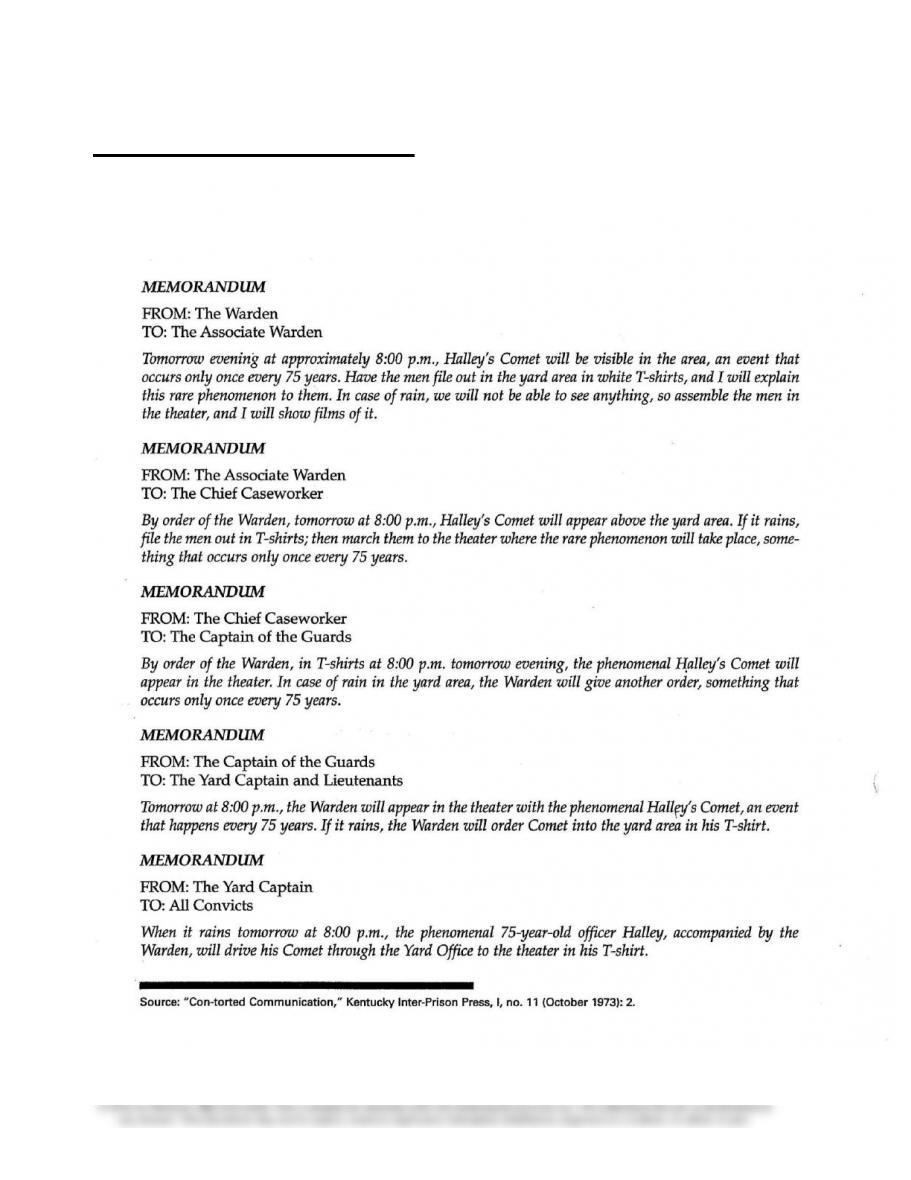
NOTES AND ANECDOTES:COMMUNICATION DISTORTION
Messages can be altered as they pass from one person to another, as this series of memorandums shows.
Part 04 – The Empowerment of People
4-16
Ф APPLICATION
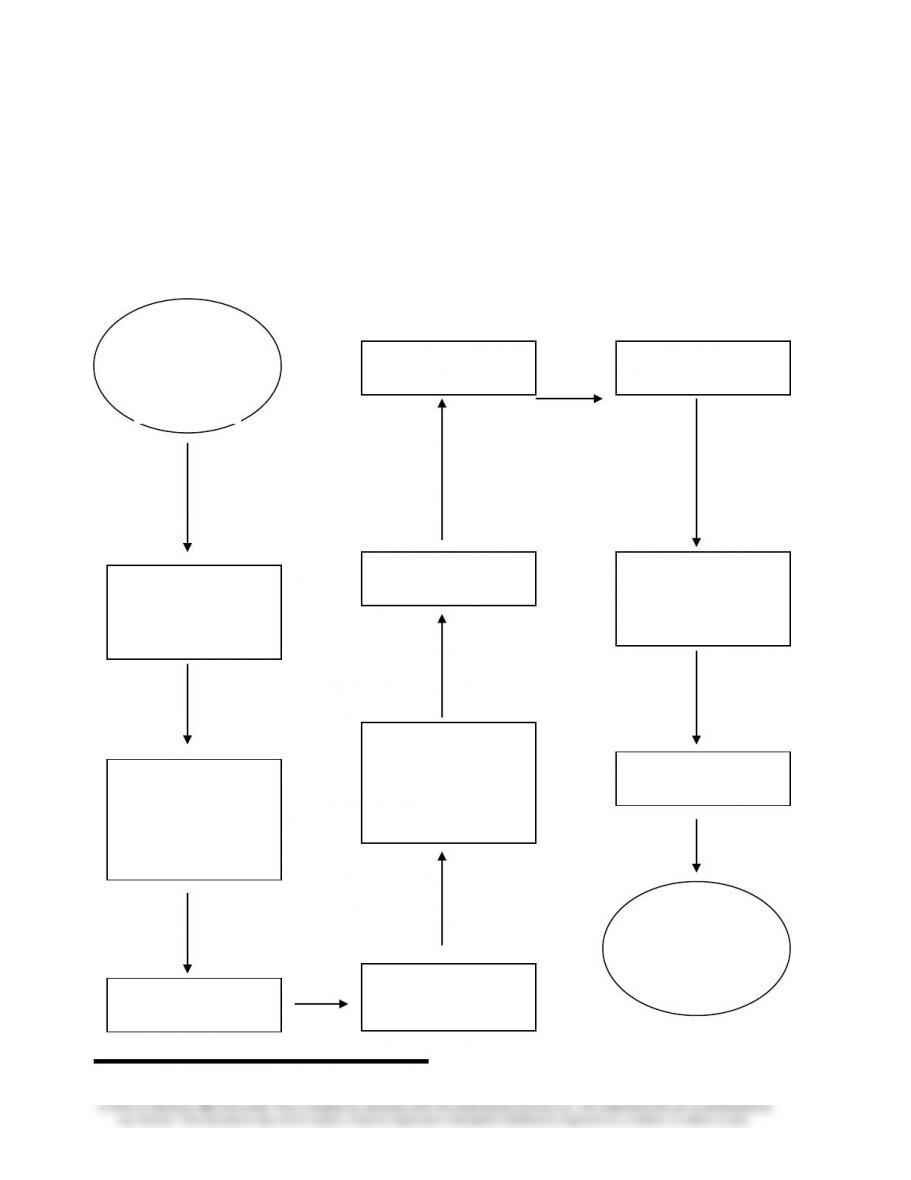
THE BOTTLENECK: QUALITY IMPROVEMENT THROUGH TEAMWORK—THE TEN-
STEP PROCESS
The following is a ten-step process to improve the quality of work and the quality of work life by
making the best use of the people, equipment, materials, and money available.
START
Current
Conditions
1. Assemble a
problem solving
team.
2. Brainstorm
quality of work or
quality of work
life problems and
bottlenecks
3. Select a problem.
7. Choose the best
solution.
8. Avoid ruts. Be
creative.
6. Use Cause and
Effect analysis.
5. Assess the
problem. Gather
information,
display data, and
ask key questions.
4. Define the
problem.
9. Prepare, present,
and implement
solution; include
costs and benefits.
10. Follow up and
evaluate.
Lasting
Solution
End

Part 04 – The Empowerment of People
4-17
Step 1 Assemble a quality improvement team. Note: Kurt Lewin discussed how groups
Step 2 Use Brainstorming to identify problems or bottlenecks that adversely affect the quality
Step 3 Select a problem for the group to solve. First, apply the 80-20 rule: Eighty percent of
Step 4 Define the problem in a short phrase or sentence. State the problem simply and clearly.
Examples are:
Step 5 Assess the problem by gathering facts, displaying data, and asking key questions.
Answer these types of questions:
Why is the present situation a bottleneck or problem?
What is causing the problem?
Where is the problem located?
When did the problem begin?
Who is causing the problem and who can help solve the problem?
How should the problem be solved?
Also question the history and traditions behind present conditions: Are the forms,
materials, and efficiency of operation the best possible for morale and productivity?
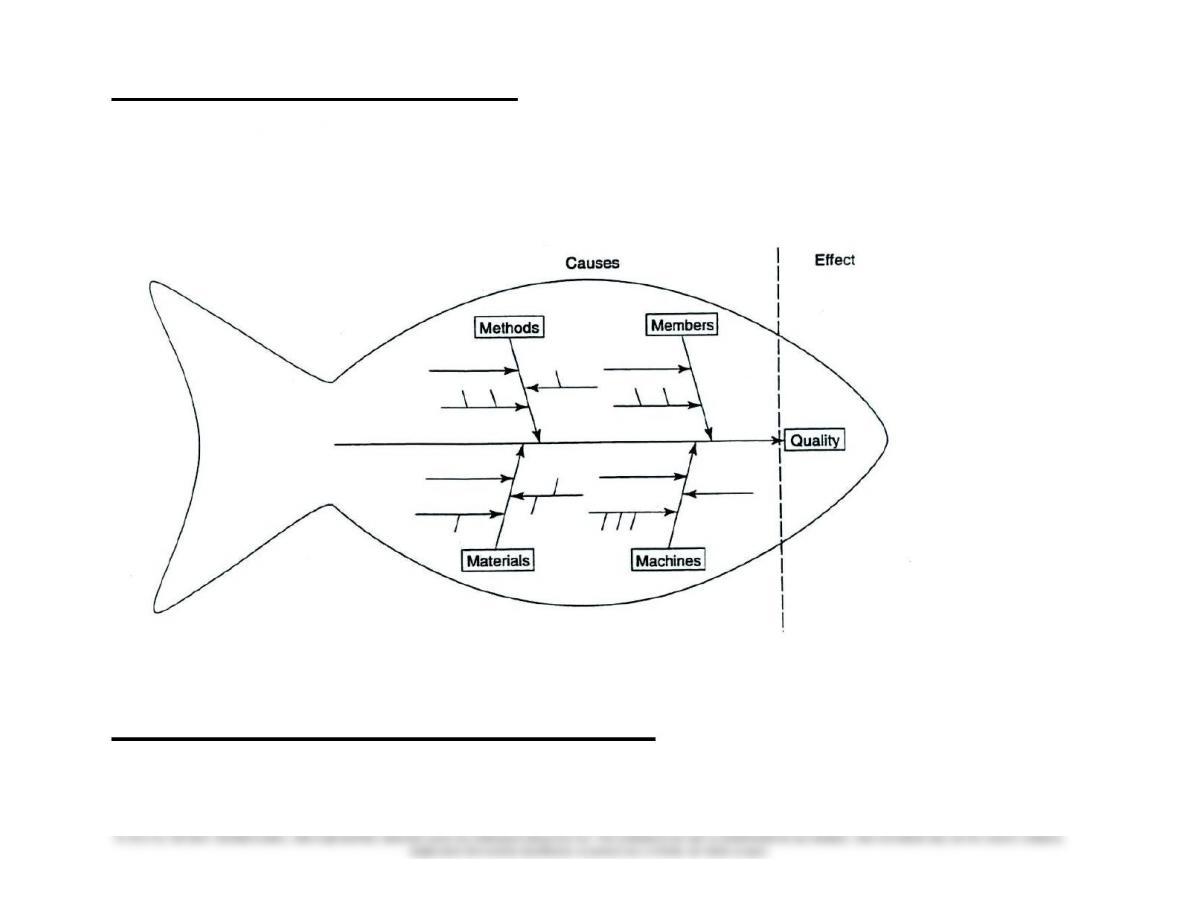
Step 6 Use cause and effect analysis to help solve the problem. The cause-and-effect diagram
There are four steps in the construction and use of a cause-and-effect diagram.

Part 04 – The Empowerment of People
4-18
First. Write the problem in a phrase or sentence and draw an arrow pointing to it. See
Figure 4.3
Second. Use brainstorming to identify specific causes of the problem. Specific causes
are indicated on branches of the four M‘s—Members, Machines, Methods, and
Materials. It may be helpful to use the 4P’S—People, Procedures, Policies, and Plant.
See Figure 4.4.
Third. Use group discussion to select and circle the most likely causes of the problem
(the critical few). Each person identifies all causes considered important (no limit), and
the number received for each is counted. Those causes cited most often are circled.
Usually two to four causes will surface as the most important.
Fourth. Use observation, interviews, and tests to verify that the causes identified in
step three are actually creating the problem. If they are not, select the next most likely
causes and conduct verification for these.
Part 04 – The Empowerment of People
4-19
Part 04 – The Empowerment of People
4-20
Figure 4.2: CAUSE AND EFFECT — FISH BONE ANALYSIS FOR PROBLEM SOLVING