
Part 03 – The Importance of Ethics
3-21
Discussion Questions
Have you ever experienced a moral dilemma while at school or on the job?
How should leaders of organizations be judged?
What values should leaders reflect in moral dilemmas?
What standards should leaders meet?
Φ CASE
Reflections from a Concerned Employee―The Right to Strike
I have to admit that I can see an argument for both sides of the question. On the one hand, I don’t
think it is good for public employees⎯ myself included⎯to go on strike. I keep thinking of
firefighters, police officers, teachers, and, yes, air traffic controllers like me. People need and
depend on us.
But on the other hand, it isn’t right for an employee to go along with conditions that are unsafe
and unfair over the long haul. I think this is what happens if you don’t pay people fairly and if
you don’t provide reasonable working conditions. I don’t refer to conditions that are unavoidably
dangerous; I am talking about things that can be fixed.
Well, that was my view when I joined my fellow employees in a strike to try to correct the
situation.
You know the story; we were unsuccessful on all counts. We didn’t make the skies any safer,
and we lost our jobs. To me, it was a tragedy. I ask you, what would you do?
Discussion Questions
Should public employees have the right to strike over safety and working conditions? How about
wages?
What would you have done if you were president during the air traffic controllers’ strike?
What would you have done if you were an air traffic controller?

Part 03 – The Importance of Ethics
3-22
The 19-Year-Old Bride
A young engineer acquired his degree, a 19-year-old bride, a new job in June, and moved
to the town where the company is located. His job calls for him to test company equipment being
used in nearby installations. The company is young and small, and the people in it are friendly to
the young couple, including them in all the social affairs. The young man and his bride don’t
drink and are uncomfortable around people who are drinking, so they decide not to attend any
more of the parties and not to become obligated to invite people to their house for drinks. The
wife enrolled in some college courses so she could claim heavy assignments as an excuse for
refusing invitations.
The young man’s boss keeps urging him to bring his wife to the parties and become one
of the group. The young man isn’t sure if this is an invitation or an order, so he decides that if he
puts in an appearance himself at the parties, and leaves early, he will be taking care of his
obligations.
QUESTIONS
1. How should the young couple handle the problem?
2. How much should advancement depend on party going and party giving?
R. V.s IN THE PARKING LOT
In forty years, I had never seen anything like it. I had been a labor representative since 1930,
but what we faced in 1970 was a brand new problem.
First of all, we had never seen all those women out there in the plant before. Oh, we had
women working during the war, but it was a different time and women were acting differently.
Secondly, we had never had R. V.’s before. And I can tell you, women and R.V.’s were causing
us a problem.
It all came to a head when a committee of concerned wives showed up demanding to see a
plant manager. They said our company had become a den of iniquity and was causing the
breakdown of families in our community. It seems a habit had developed where men and women
during their lunch breaks, particularly the afternoon and midnight shifts, would go to the parking
lot where they would have get-togethers in their R.V.s. According to the wives, this was a
widespread practice involving more than an isolated few of our 5,000 employees.
As I look back on it, I have to admit the solution to our R.V. problem was masterful. One of
our security guards said the R. V.s were difficult to police because there were so many of them,

Part 03 – The Importance of Ethics
3-23
and they were parked throughout our large parking lot area. His suggestion, which we adopted,
was to fence in a certain section of the lot and require all R.V.s to park in this area. The clear
visibility and constant inspection by security officers soon resulted in an end to R. V. get–
togethers.
Now, looking back at the R.V. incident, I think serious questions were raised during the
women’s liberation movement and the sexual revolution. I think these social movements vastly
changed our country. I know they have changed our company. I am still trying to decide if the
changes have been good.
QUESTIONS
1. Do you think the women’s liberation movement and sexual revolution of the l960s and
l970s helped or hurt our country?
2. Do you think these social movements helped or hurt the business world?
3. What effect has the women’s liberation movement had on family life in the United
States?
4. What effect has the sexual revolution had on you?

Part 03 – The Importance of Ethics
3-24
Φ APPLICATION
Workplace Values and Leadership Actions
As a leader in the workplace, what values would you promote? What actions would you take to
demonstrate and reinforce those values? List workplace values in column 1; list leadership
actions that support those values in column 2.
Workplace Values Leadership Actions
Discussion Questions:
What are the implications of your values and actions? Consider their influence on the quality of
work and the quality of work life in your organization. What happens if values and actions are
inconsistent or out of alignment?
______________________________________________________________________________
______________________________________________________________________________
______________________________________________________________________________
______________________________________________________________________________
______________________________________________________________________________
______________________________________________________________________________

Part 03 – The Importance of Ethics
3-25
Φ APPLICATION
Values Flag
The following is a values clarification exercise. The purpose is to increase self-understanding
and examine current behaviors in light of personal values. Use the questions below to construct
your own Values Flag. Answer each question in the appropriate space on the flag. Use words,
short statements, and symbols as directed.
1, 2, 3, 4. Draw four symbols or pictures that represent your most cherished values in life.
5. Use a sentence or two to answer the question, Who am I?
6. State three peak experiences in your life (most exhilarating).
7. State your three best skills or aptitudes.
8. State your two best physical characteristics or attributes.
9. When most people think of you, what do they say?
10. What three things about yourself would you like to improve?
11. Use a sentence or two to describe your occupational goals.
12. Who have been the three same-sex individuals who have had the most influence on
your life?
13. Who have been the three opposite-sex individuals who have had the most influence
on your life?
14. What are your three biggest fears?
15. What are your three greatest accomplishments to this point in your life?
16. What are your three highest priority life goals?
17. What is the personal motto by which you try to live?

Part 03 – The Importance of Ethics
3-26
VALUES FLAG
1. 2.
3. 4.
17.
16.
(a) (b) (c)
15.
(a) (b) (c)
14.
(a) (b) (c)
13.
(a) (b) (c)
12.
(a) (b) (c)
11.
10.
(a) (b) (c)
9.
8.
(a) (b)
7.
(a) (b) (c)
6.
(a) (b) (c)
5.
Discussion Questions
Ask students to consider their answers on the Values Flag. Are they satisfied with their
experiences, values, and goals to this point in life? Are they satisfied with the directions their
lives seem to be going? A valuable exercise is to use the Values Flag to develop short- and long-
term actions plans. Ask students to concentrate on points 1, 2, 3, 4, 10, 11, and 16 as they fill out
short- and long-term action plans.
Short- and Long-Term Action Plans
Action Plans
Short-term action plan ________________________________________________________
____________________________________________________________________________
Long-term action plan:
Part 03 – The Importance of Ethics
3-27
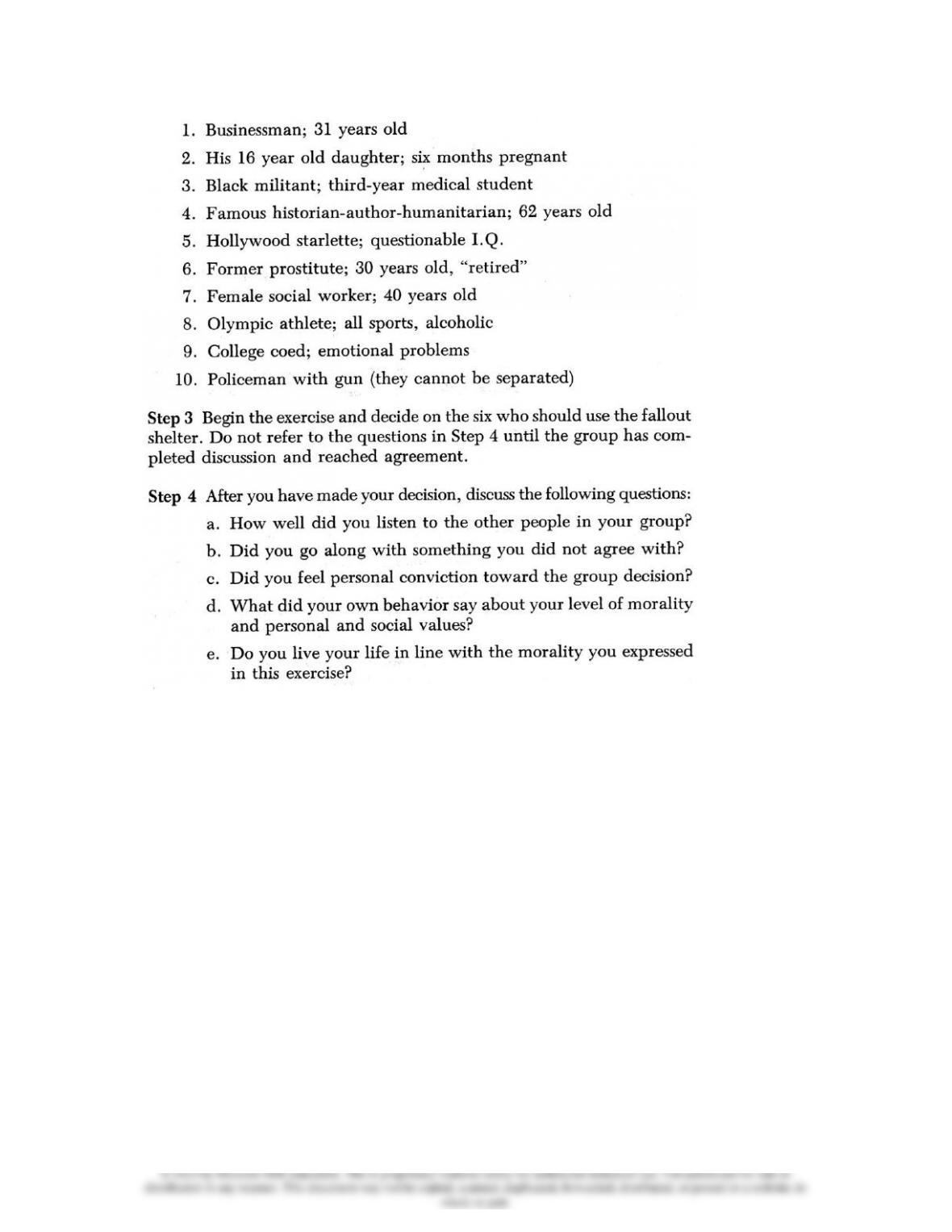
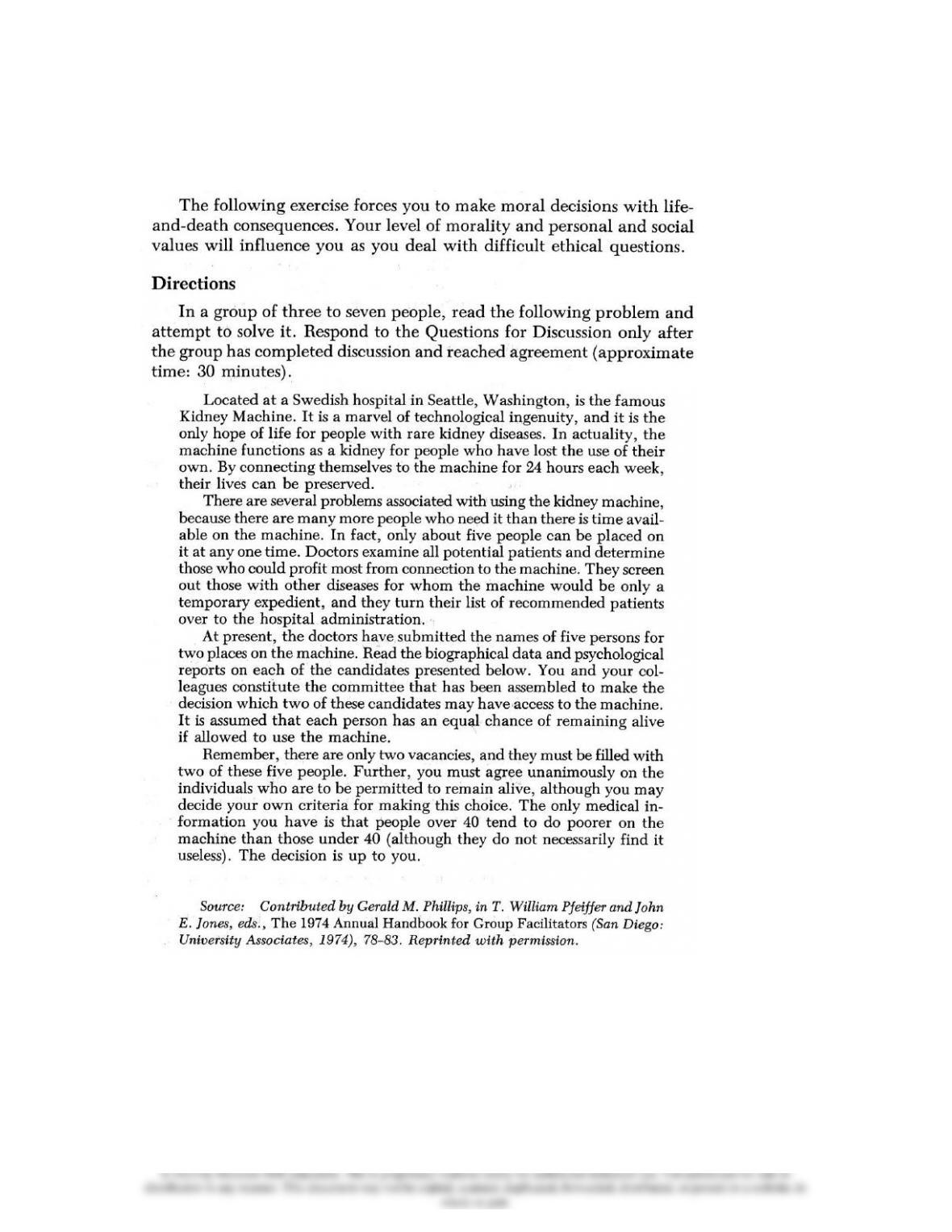
EXERCISE 3.1: The Fallout Shelter
Part 03 – The Importance of Ethics
3-28
Part 03 – The Importance of Ethics
3-29
EXERCISE 3.2: The Kidney Machine

Part 03 – The Importance of Ethics
3-30
James—age 50: It was hard for the staff to get him to talk about his work in terms that
they could understand. Family relations seem strained and have been for some time. The
staff feels that he is a first-rate scientist and scholar who has contributed much and could
contribute more to medical research. But they also believe him to be a mentally fragile
individual who, in time, will probably need psychiatric help.
Bill—age 45: He is a well-balanced person, who does not appear to be swayed by the
blandishments of black extremist groups. He is strongly devoted to his family and
appears to be an excellent husband and father.
Bill’s capacity for growth in his chosen occupation seems limited. His high
school record was poor, although he was always regarded by his teachers as a student
who tried hard. He will probably not succeed with his business plans and will remain
employed at his present level.
His wife is trained as a legal secretary. Her prognosis for employment is good,
although Bill has discouraged her from seeking work because of the mutual agreement to
have her be a full-time mother. Bill seems unaware of the serious implications of his
illness.
Cora—age 40: One of the staff members evaluating Cora described her as a professional
Jew. She is president of the local Hadassah organization and seems able to talk about
nothing but her religion and her children. Although her recently-found interest in interior
decorating may be a sign of change, it was not clear to the staff whether this interest was
real or only generated artificially when she heard of the interview requirement.
She seems resigned to her illness and likely death. Her husband works long
hours, is in good health, and enjoys the respect and love of his children. Cora’s mother,
who also lives with the family, handles most of the child care.
David—age 25: Typical of young student activists, David is a bright, almost straight “A”
student, who enjoys the respect of most of his teachers and friends. But he appears
confused about his future and demonstrates a penchant for jeopardizing it by involving
himself in various student “causes.” Indeed, his college’s Dean of Student Affairs
regards him as an individual who will “demonstrate for anything.”
He is bitter, almost paranoid, about his illness. His father has invested a good
deal of money, time, and emotion in him and has always hoped that David would become
a lawyer. His relations with his father are presently strained, however, and he seems only
mildly concerned about his two sisters, although they still think highly of him. His future
father-in-law, who is a highly successful businessman, expects him to enter the family
enterprise upon college graduation.
Edna—age 35: She is a self-reliant, inner-directed person and a model of the “career
woman.” It was clear to the staff that her natural aggressiveness and combative
tendencies militated against any sort of marital attachment, and it is not impossible that
she has lesbian tendencies.
Her employers regard her as indispensable. Her work record is superb, and her
activities in church and charitable groups have been very effective. She is well regarded
by all who know her, although she seems to have few, if any, close friends. She has

Part 03 – The Importance of Ethics
3-31
indicated that she would prefer to have someone other than herself go on the machine.
Her offer did not seem in the least insincere.
Questions for Discussion
1. From which ethical tradition did you address this problem—religious or secular?
How did this influence your decision?
2. Who played a leadership role in solving this ethical problem? What concept of
good did the leader reflect—greatest good for greatest number, will of God,
allegiance to duty, love of fellowman, etc.?
3. At what level and stage of morality did you approach this problem? For example,
were you primarily influenced by the opinions of others or by your own sense of
right and wrong?
4. How was your ethical behavior in this problem-solving exercise influenced by
your personal values—theoretical, economic, aesthetic, social, political, and
religious—and by your social values—self-interest versus interest of others?
The following questionnaire allows your students to compare their values with those of another
person. This exercise is particularly helpful for team building, both on the job and in the home.

Part 03 – The Importance of Ethics
3-32
EXERCISE 3.3: VALUE COMPATIBLITY⎯DO WE THINK ALIKE?
Directions
Presented below are 21 groups of five personal values. In each grouping, rank the importance of
the five values to you. See Figure 3.1 for a description of each value. Rank the values according
to how you actually feel, not how you think you should feel. In front of each value, place a
number from 1 (the value that is least important) to 5 (the most important value). Give a different
rating to each value. There are no right or wrong answers. Note that each partner should
complete the questionnaire independently.
YOUR PERSONAL VALUES
1. _____ Power
_____ Order
_____ Achievement
_____ Privacy
_____ Helpfulness
8. _____ Independence
_____ Privacy
_____ Leisure
_____ Religious faith
_____ Recognition
15. _____ Human relationships
_____ Religious faith
_____ Love
_____ Order
_____ Leadership
2. _____ Order
_____ Self-expression
_____ Independence
_____ Physical health
_____ Aesthetic values
9. _____ Privacy
_____ Physical health
_____ Human relationships
_____ Material wealth
_____ Naturalness
16. _____ Religious faith
_____ Material wealth
_____ Power
_____ Self-expression
_____ Truth
3. _____ Self-expression
_____ Security
_____ Privacy
_____ Physical pleasure
_____ Love
10. _____ Physical health
_____ Physical pleasure
_____ Religious faith
_____ Responsibility
_____ Achievement
17. _____ Material wealth
_____ Responsibility
_____ Order
_____ Security
_____ Leisure
4. _____ Security
_____ Recognition
_____ Leadership
_____ Power
_____ Physical health
11. _____ Physical pleasure
_____ Leadership
_____ Helpfulness
_____ Independence
_____ Material wealth
18. _____ Responsibility
_____ Helpfulness
_____ Recognition
_____ Human relationships
_____ Self-expression

Part 03 – The Importance of Ethics
3-33
5. _____ Recognition
_____ Naturalness
_____ Physical pleasure
_____ Truth
_____ Order
12. _____ Leadership
_____ Truth
_____ Responsibility
_____ Aesthetic values
_____ Privacy
19. _____ Helpfulness
_____ Aesthetic values
_____ Security
_____ Naturalness
_____ Religious faith
6. _____ Naturalness
_____ Achievement
_____ Self-expression
_____ Leadership
_____ Leisure
13. _____ Truth
_____ Leisure
_____ Physical health
_____ Helpfulness
_____ Love
20. _____ Aesthetic values
_____ Love
_____ Material wealth
_____ Recognition
_____ Achievement
7. _____ Achievement
_____ Independence
_____ Truth
_____ Human relationships
_____ Security
14. _____ Leisure
_____ Human relationships
_____ Aesthetic values
_____ Power
_____ Physical pleasure
21. _____ Love
_____ Power
_____ Naturalness
_____ Independence
_____ Responsibility
EXERCISE 3.3: VALUE COMPATIBLITY⎯DO WE THINK ALIKE? (continued)
YOUR PARTNER’S PERSONAL VALUES
1. _____ Power
_____ Order
_____ Achievement
_____ Privacy
_____ Helpfulness
8. _____ Independence
_____ Privacy
_____ Leisure
_____ Religious faith
_____ Recognition
15. _____ Human relationships
_____ Religious faith
_____ Love
_____ Order
_____ Leadership
2. _____ Order
_____ Self-expression
_____ Independence
_____ Physical health
_____ Aesthetic values
9. _____ Privacy
_____ Physical health
_____ Human relationships
_____ Material wealth
_____ Naturalness
16. _____ Religious faith
_____ Material wealth
_____ Power
_____ Self-expression
_____ Truth
3. _____ Self-expression
_____ Security
_____ Privacy
_____ Physical pleasure
_____ Love
10. _____ Physical health
_____ Physical pleasure
_____ Religious faith
_____ Responsibility
_____ Achievement
17. _____ Material wealth
_____ Responsibility
_____ Order
_____ Security
_____ Leisure

Part 03 – The Importance of Ethics
3-34
4. _____ Security
_____ Recognition
_____ Leadership
_____ Power
_____ Physical health
11. _____ Physical pleasure
_____ Leadership
_____ Helpfulness
_____ Independence
_____ Material wealth
18. _____ Responsibility
_____ Helpfulness
_____ Recognition
_____ Human relationships
_____ Self-expression
5. _____ Recognition
_____ Naturalness
_____ Physical pleasure
_____ Truth
_____ Order
12. _____ Leadership
_____ Truth
_____ Responsibility
_____ Aesthetic values
_____ Privacy
19. _____ Helpfulness
_____ Aesthetic values
_____ Security
_____ Naturalness
_____ Religious faith
6. _____ Naturalness
_____ Achievement
_____ Self-expression
_____ Leadership
_____ Leisure
13. _____ Truth
_____ Leisure
_____ Physical health
_____ Helpfulness
_____ Love
20. _____ Aesthetic values
_____ Love
_____ Material wealth
_____ Recognition
_____ Achievement
7. _____ Achievement
_____ Independence
_____ Truth
_____ Human relationships
_____ Security
14. _____ Leisure
_____ Human relationships
_____ Aesthetic values
_____ Power
_____ Physical pleasure
21. _____ Love
_____ Power
_____ Naturalness
_____ Independence
_____ Responsibility
FIGURE 3.1: VALUE DESCRIPTIONS
Aesthetic values – pertaining to the appreciation of beauty and the beautiful.
Achievement – gains accomplished or fulfilled by work or effort.
Helpfulness – the desire to aid another; making it easier for a person to do something.
Human relationships – the state of being mutually interested or involved with other
people.
Independence – the state of not relying on something else or someone else; not easily
influenced.
Leadership – the ability to guide or direct an operation, activity, or performance in a
specified manner or direction; to guide or direct others with ease.
Leisure – freedom from work or duties; relaxation; free time to do what one chooses to
do.