
Part 02 – The Power of Vision
2-1
Major Purposes of Part Two
Part Two focuses on three important subjects—the power of
vision, the motive to lead, and organizational climate.
Part Two Objectives
After completing Part Two, your students should be able
to better understand:
• The importance of vision for leadership success;
• The leadership qualities needed for steering
organizations through periods of change;
• Strategies for successful leadership;
• Motives for assuming the challenge of leadership;
• The importance of organizational climate; and
• The ethical climates of organizations—profit maximizing,
trusteeship, and quality of life management.
PART TWO—The Power of Vision

Part 02 – The Power of Vision
2-2
NOTES AND ANECDOTES
Strategies For Successful Leadership
There are many models of what it takes to be a good leader. Thomas Neff and James Citrin
provide one that is based on extensive polling, financial analysis, and structured interviews. In
their book Lessons from the Top, they identify seven strategies for effective leadership. Leaders
at all levels of responsibility in all types of organizations can use these strategies to succeed.
• Create a vision. A successful leader goes to the company’s roots, builds on the things the
organization does best, and develops a winning plan.
• Build a great team. Great leaders surround themselves with people whose skills and
experiences complement their own, and whose passion, attitudes, and values are closely
matched to theirs.
• Inspire employees to greatness. Communicate continuously, listen carefully, and genuinely
tolerate failure as a learning experience.
• Create a flexible, responsive organization. The best leaders design their organizations to
make sure decisions can be made fast.
• Use reinforcing reward systems. Make recognition and compensation consistent with
achieving the mission, living the values, and executing the strategy of the organization.
• Retain top performers. Have good perks, memberships, stock options, and other incentives
so top performers won’t leave.
• Lead with integrity. Integrity builds trust in leaders that is critical for high performing
organizations.

Part 02 – The Power of Vision
2-3
NOTES AND ANECDOTES
In 2004 Wal-Mart Stores, Inc. published a vision statement identifying 3 basic values and core
beliefs of the company. These are analogous to IBM’s 3 core values.
• Respect for the Individual
“ ‘Our people make the difference’ is not a meaningless slogan – it’s a reality at Wal–
Mart. We are a group of dedicated, hardworking, ordinary people who have teamed
together to accomplish extraordinary things. We have very different backgrounds,
different colors and different beliefs, but we do believe that every individual deserves to
be treated with respect and dignity.”
Don Soderquist
Senior Vice Chairman, Wal-Mart Stores, Inc. (retired)
• Service to Our Customers
We want our customers to trust in our pricing philosophy and to always be able to find
the lowest prices with the best possible service. We’re nothing without our customers.
“Wal–Mart’s culture has always stressed the importance of Customer Service. Our
Associate base across the country is as diverse as the communities in which we have
Wal-Mart stores. This allows us to provide the Customer Service expected from each
individual customer that walks into our stores.”
Tom Coughlin,
Vice Chairman, Wal-Mart Stores, Inc.
• Strive for Excellence
New ideas and goals make us reach further than ever before. We try to find new and
innovative ways to push our boundaries and constantly improve.
“Sam was never satisfied that prices were as low as they needed to be or that our
product’s quality was as high as they deserved – he believed in the concept of striving for
excellence before it became a fashionable concept.”
Lee Scott,
President and Chief Executive Officer of Wal-Mart Stores, Inc.
Source: 2004 Wal-Mart Stores; www.wal-mart.com

Part 02 – The Power of Vision
2-4
NOTES AND ANECDOTES
Max DePree, management author and retired chairman of Herman Miller, Inc., writes, “Healthy
companies come from healthy leaders.” Just as one takes a physical exam to evaluate personal
health, so can the leader take a Leadership Physical to evaluate leadership performance. The
occasional checkup can be used to reveal strengths and areas for improvement.
Approximately 500 years ago, Niccoló Machiavelli wrote in his classic book The Prince that a
leader should discourage unrequested advice, but he went on to say that a great leader is a great
asker and a patient hearer of the truth. Once a year, the caring leader should visit with someone
who understands leadership, knows his condition, and can provide objective evaluation and
prescription for good leadership performance.
The following exercise includes a brain scan, heart check-up, and fitness test to evaluate
leadership performance. Current status is less important than what the leader does with the data.
What steps are taken to stay great or improve?

Part 02 – The Power of Vision
2-5
EXERCISE 2.1: LEADERSHIP PHYSICAL
Complete the following evaluation of leadership performance. Evaluate the performance of
yourself or someone you know in a position of leadership. Respond to each question by placing a
number from 1 to 15 (1 is low, 15 is high). Also include evidence to support your opinion and
suggestions (Rx) to improve.
BRAIN SCAN: SETTING DIRECTION
By creating a vision and a strategy to succeed, the leader gains the respect and confidence of
followers.
Does the leader
Chart the correct course?
needs acceptable a current
improvement strength
1-5 6-10 11–15
Demonstrate good judgment?
needs acceptable a current
improvement strength
1-5 6-10 11–15
Solve problems effectively?
needs acceptable a current
improvement strength
1-5 6-10 11-15
Cite evidence to support your opinion:
Make suggestions (Rx) to improve performance:

Part 02 – The Power of Vision
2-6
EXERCISE 2.1: LEADERSHIP PHYSICAL (continued)
HEART CHECKUP: CARING ABOUT PEOPLE
By showing consideration for others, the leader gains the trust and loyalty of followers.
Does the leader:
Show respect for all people?
needs acceptable a current
improvement strength
1-5 6-10 11–15
Serve the interests of others?
needs acceptable a current
improvement strength
1-5 6-10 11–15
Follow the golden rule?
needs acceptable a current
improvement strength
1-5 6-10 11-15
Cite evidence to support your opinion:
Make suggestions (Rx) to improve performance:

Part 02 – The Power of Vision
2-7
EXERCISE 2.1: LEADERSHIP PHYSICAL (continued)
FITNESS TEST: ACHIEVING RESULTS
Through attention to detail and persistent hard work, the leader gains credibility and the support
of followers.
Does the leader:
Keep job knowledge
current?
needs acceptable a current
improvement strength
1-5 6-10 11-15
Stay focused on the task?
needs acceptable a current
improvement strength
1-5 6-10 11–15
Have stamina to succeed?
needs acceptable a current
improvement strength
1-5 6-10 11-15
Cite evidence to support your opinion:
Make suggestions (Rx) to improve performance:

Part 02 – The Power of Vision
2-8
Summary Scores and Interpretation
Scores 9 – 53 = Needs improvement in leadership performance
Scores 54 – 90 = Acceptable leadership performance
Scores 91 – 135 = Current strength in leadership performance
Any item rated 1-5 should be addressed and improved for leadership success.
NOTES AND ANECDOTES
ORGANIZATIONS IN PROGRESS
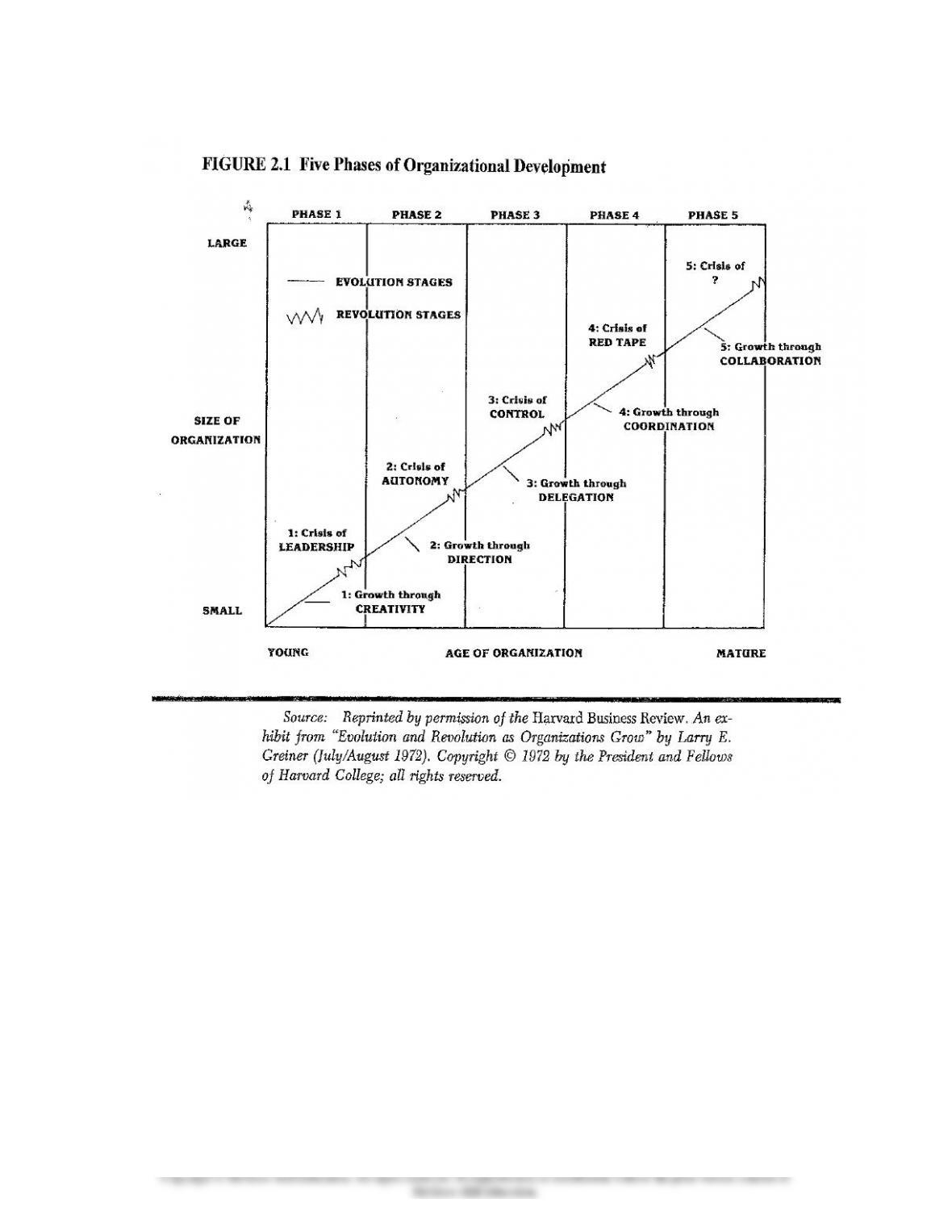
Figure 2-1 shows five phases in the life of an organization. Each phase includes a period of
evolution when growth takes place and a period of revolution when crisis threatens the
continued development and possibly the existence of the organization.
The following is a description of the typical periods of growth and crisis for each of the five
phases:
• Phase 1: Growth through Creativity. In its earliest period, an organization’s activities
are usually centered around the development of products and markets. Top leadership is
devoted to these goals. Communication between leaders and followers is frequent and
informal. People may work long hours for low pay in anticipation of future benefits.
Crisis of Leadership. As the organization grows, it becomes increasingly difficult to
handle the rapidly swelling staff using the old, informal methods. Leaders become
overworked and harried by administrative details. A “crisis of leadership” leads to the
first revolution. Founders, frequently incapable or unwilling to change habits and styles,
may have to step aside in favor of individuals who can focus and organize the
organization’s activities.
• Phase 2: Growth through Direction. Under strong and capable organizers, the
organization may experience a period of sustained growth. A functional structure is
introduced. Accounting systems, budgets, and personnel policies are adopted.
Communication becomes more formal with policies, reports, and memos replacing word-
of-mouth customs. Responsibilities are divided between upper level policy makers and
lower level specialists.
Crisis of Autonomy. Lower level leaders, however, become increasingly frustrated and
demand more autonomy and room to exercise their own initiative. With upper level
leaders reluctant to give up authority, a new revolutionary period is at hand.
Part 02 – The Power of Vision
2-9
• Phase 3: Growth through Delegation. The successful organization will install effective
decentralization and empowerment activities in answer to the crisis of autonomy. Greater
responsibility is given to lower-level leaders. Top executives stay out of day–to-day
operations, often concentrating on acquiring new units for the organization.
Communication from the top is less frequent.
Crisis of Control. Decentralized leaders are able to penetrate new markets, respond
faster to customers, and develop new products. Eventually, however, top leaders may
attempt to return to a centralized structure because of a sense of loss of control. This
attempt brings on a new revolution, the “crisis of control.” The organization must find a
new solution to coordinating problems.
• Phase Four: Growth through Coordination. This evolutionary period is characterized
by the installation of systems for achieving organizational efficiencies and economies.
Under the initiation of top leaders, decentralized units are merged into clusters and

Part 02 – The Power of Vision
2-10
groups, each of which is expected to show satisfactory return on invested capital. Central
staff personnel are added to initiate, control, and review programs for line managers.
Crisis of Red Tape. These changes encourage more efficient use of company
resources, and field leaders learn to justify their actions more carefully to headquarters.
Tension gradually builds, however, between line and staff and between headquarters and
the field. A revolution develops as rules and regulations begin to interfere with problem–
solving activities.
• Phase 5: Growth through Collaboration. In response to the crisis of red tape, a flexible
and pragmatic approach to management develops. Groups and interdivisional teams
perform tasks and solve problems. Headquarters’ staff is held to a minimum, and the
focus of their efforts is to support and facilitate the success of field personnel. Leaders
are trained in behavioral skills so they can improve organizational performance. Many of
today’s organizations are in this stage of evolution.
Crisis Unknown Revolution and crisis may center around the psychological
saturation of members who become emotionally and physically exhausted by the
intensity of teamwork and the heavy pressure for innovative solutions. There may also
be pressure for representation on organizational boards, as already exists in many
European countries. At present, the situation is “crisis unknown.”

Part 02 – The Power of Vision
2-11
NOTES AND ANECDOTES
LEADERSHIP CHALLENGE
At each phase of an organization’s development, effective leadership is necessary to resolve
crises and sustain community.
Herman Maynard, Jr., and Susan Mehrtens, authors of The Fourth Wave, identify the
challenges facing today’s leaders: 1) creating work environments where people feel safe; 2)
fostering truth-telling in all dealings; 3) articulating clear and consistent goals, as well as explicit
values to guide member behavior; and 4) facing and resolving dysfunctional practices within the
community. To meet these challenges, the authors prescribe a structure based on community, a
locus of control based on personal commitment, and an atmosphere that supports freedom of
expression, respect for all people, and lifelong learning.
Part 02 – The Power of Vision
2-12
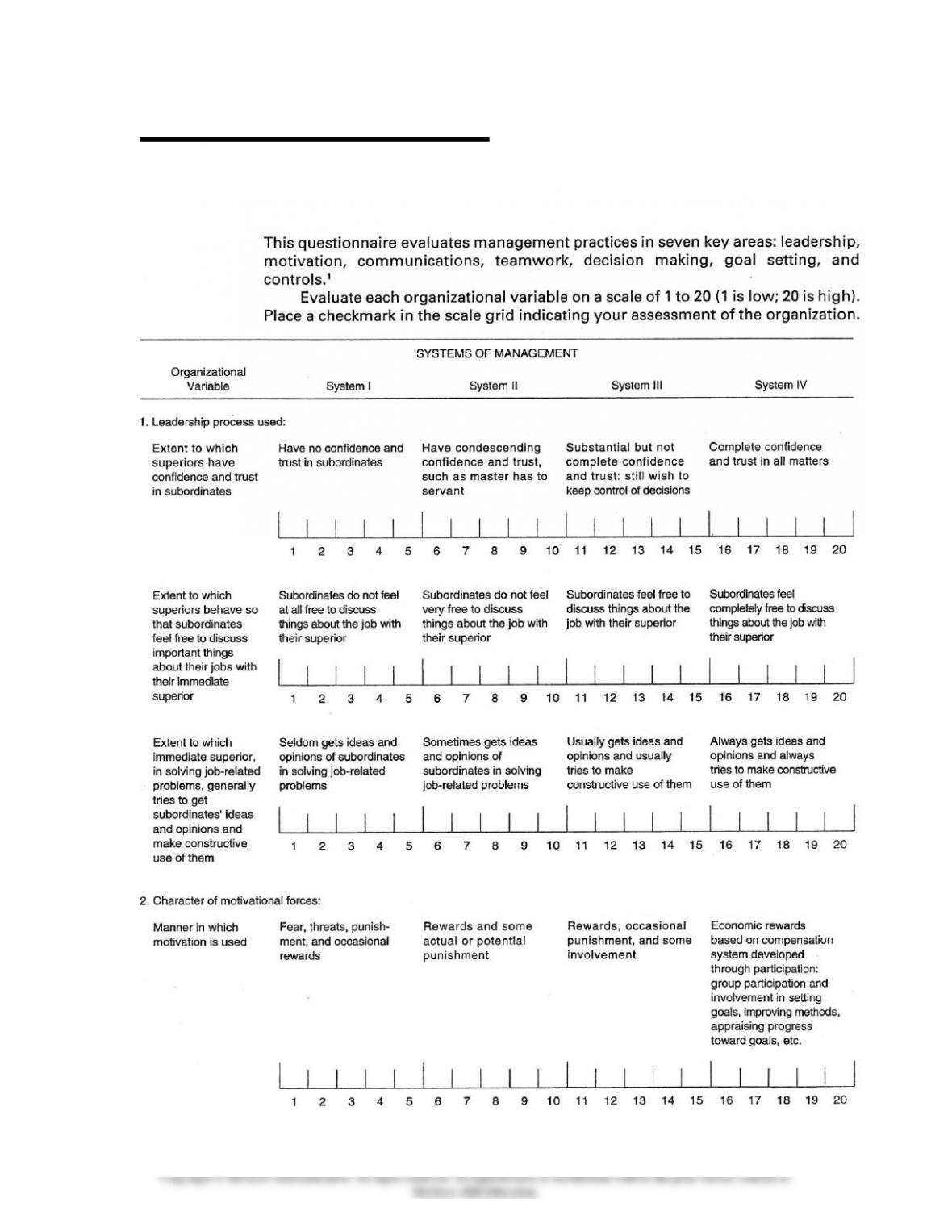
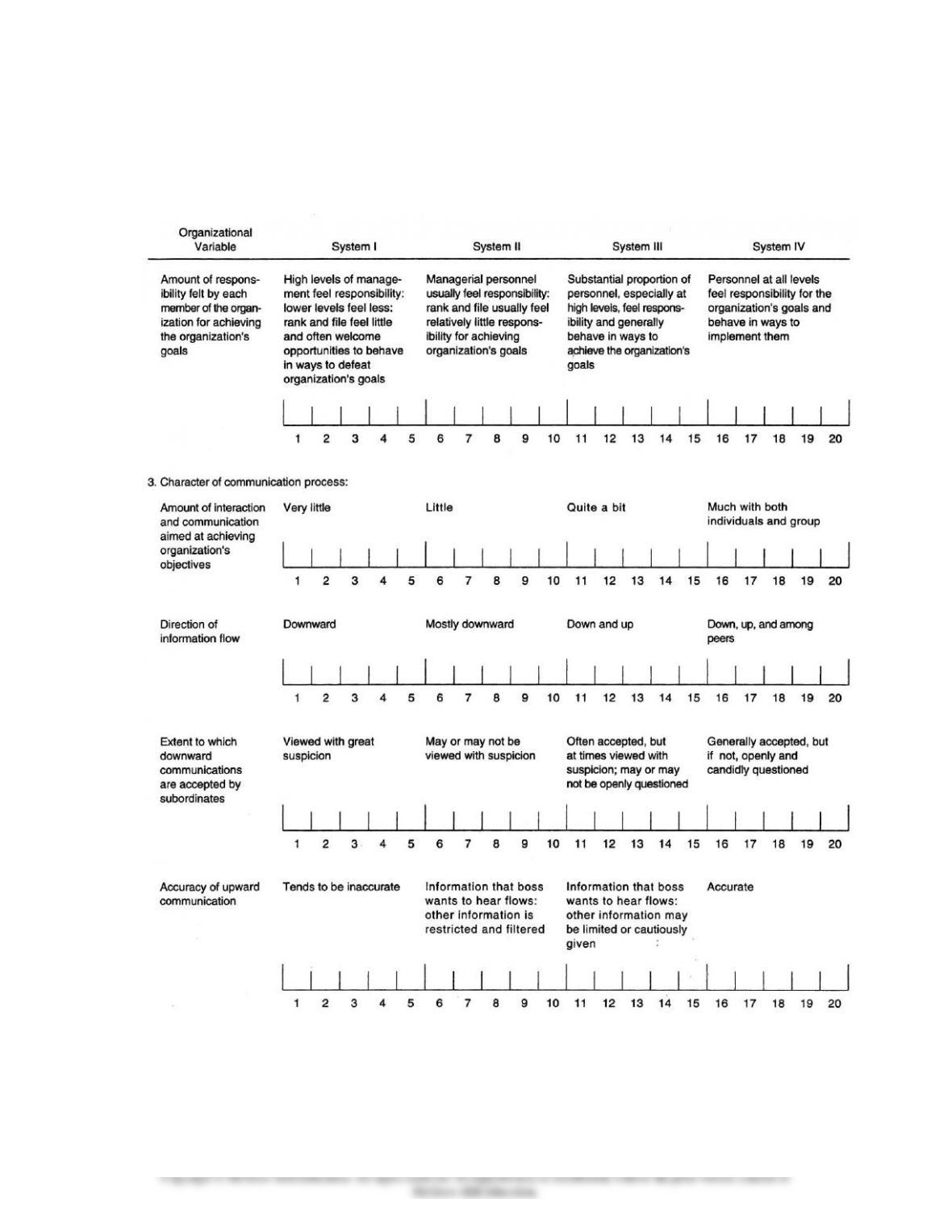
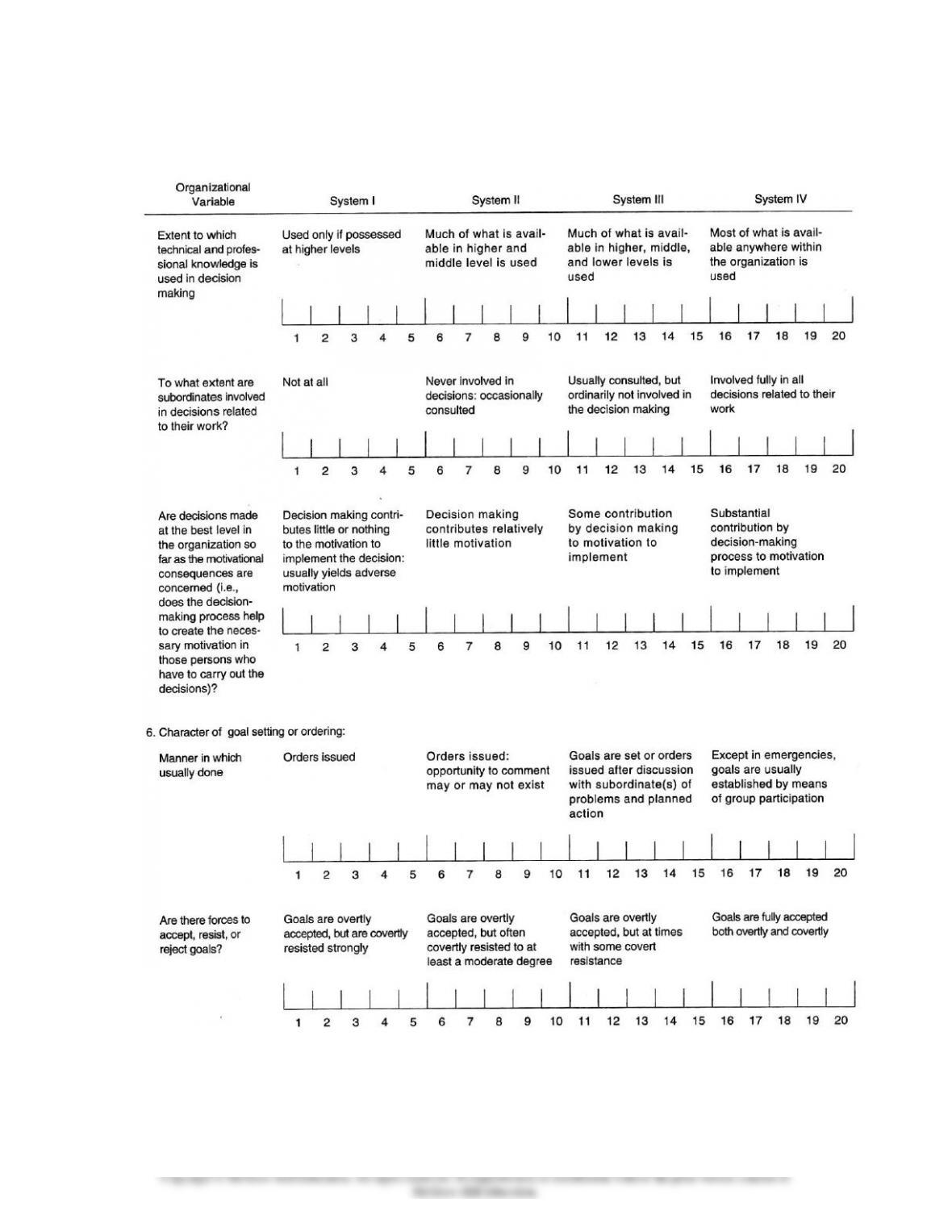
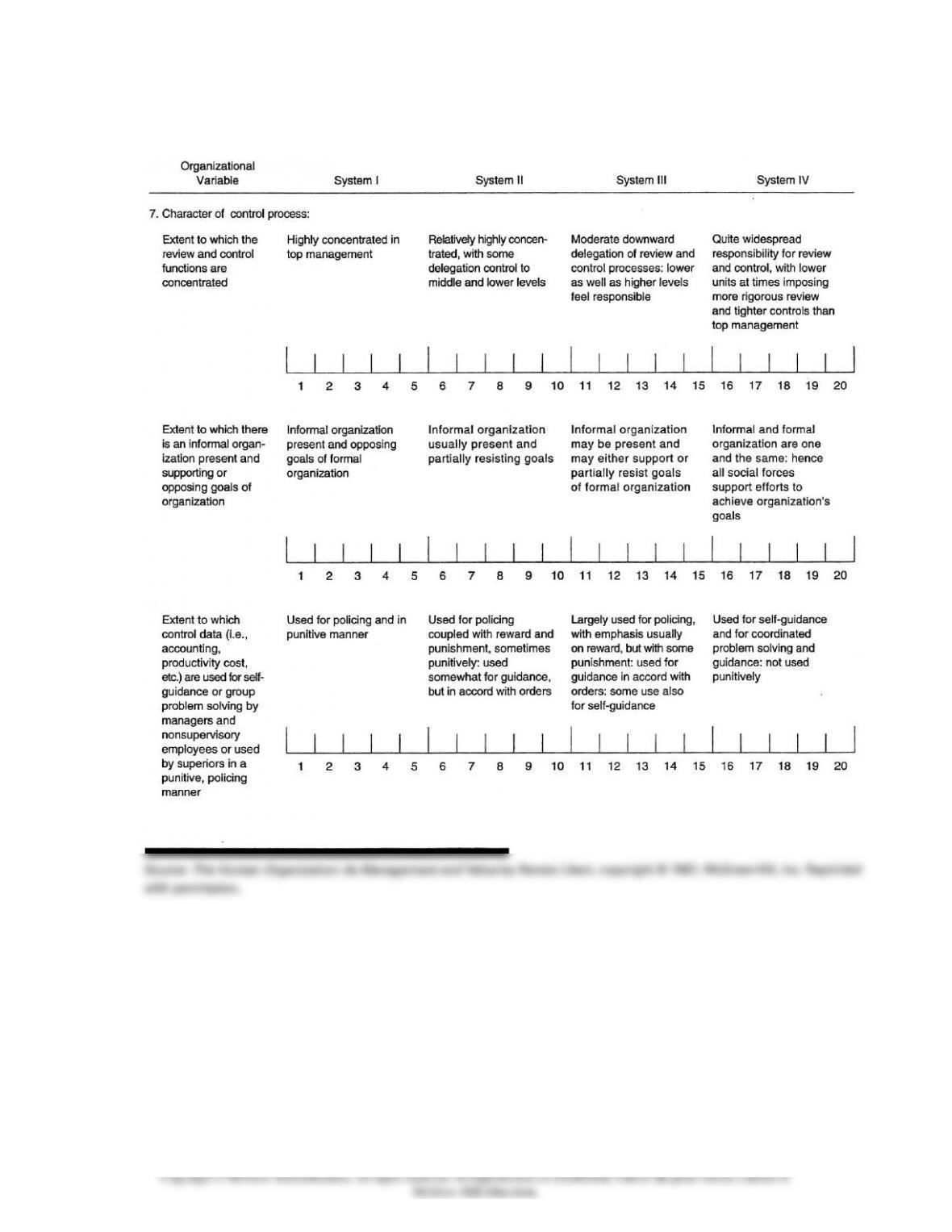
EXERCISE 2.2 Management Systems Questionnaire
Part 02 – The Power of Vision
2-13
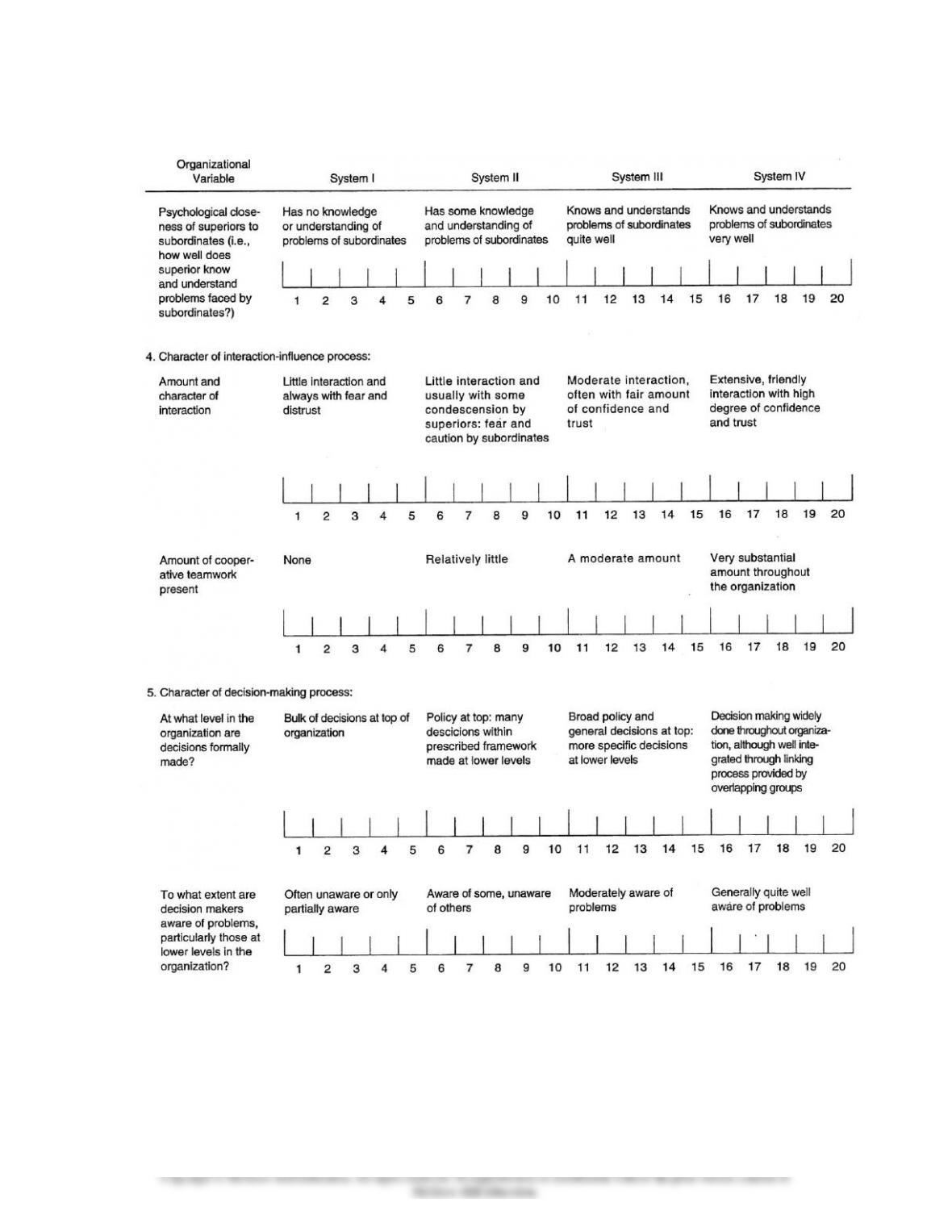
EXERCISE 2.2 Management Systems Questionnaire (continued)
Part 02 – The Power of Vision
2-14
EXERCISE 2.2 Management Systems Questionnaire (continued)
Part 02 – The Power of Vision
2-15
EXERCISE 2.2 Management Systems Questionnaire (continued)
Part 02 – The Power of Vision
2-16
EXERCISE 2.2 Management Systems Questionnaire (continued)
Part 02 – The Power of Vision
2-17
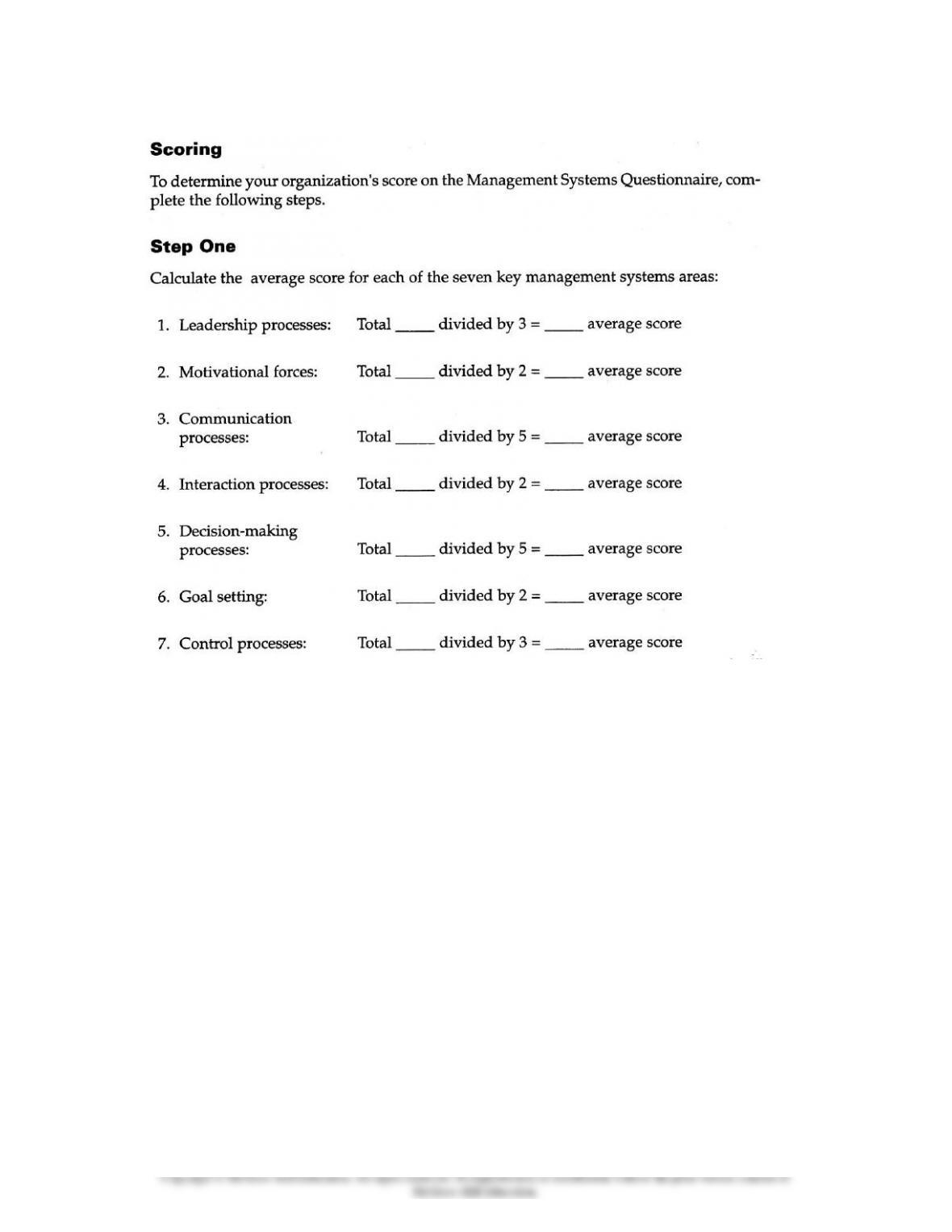
Step Two
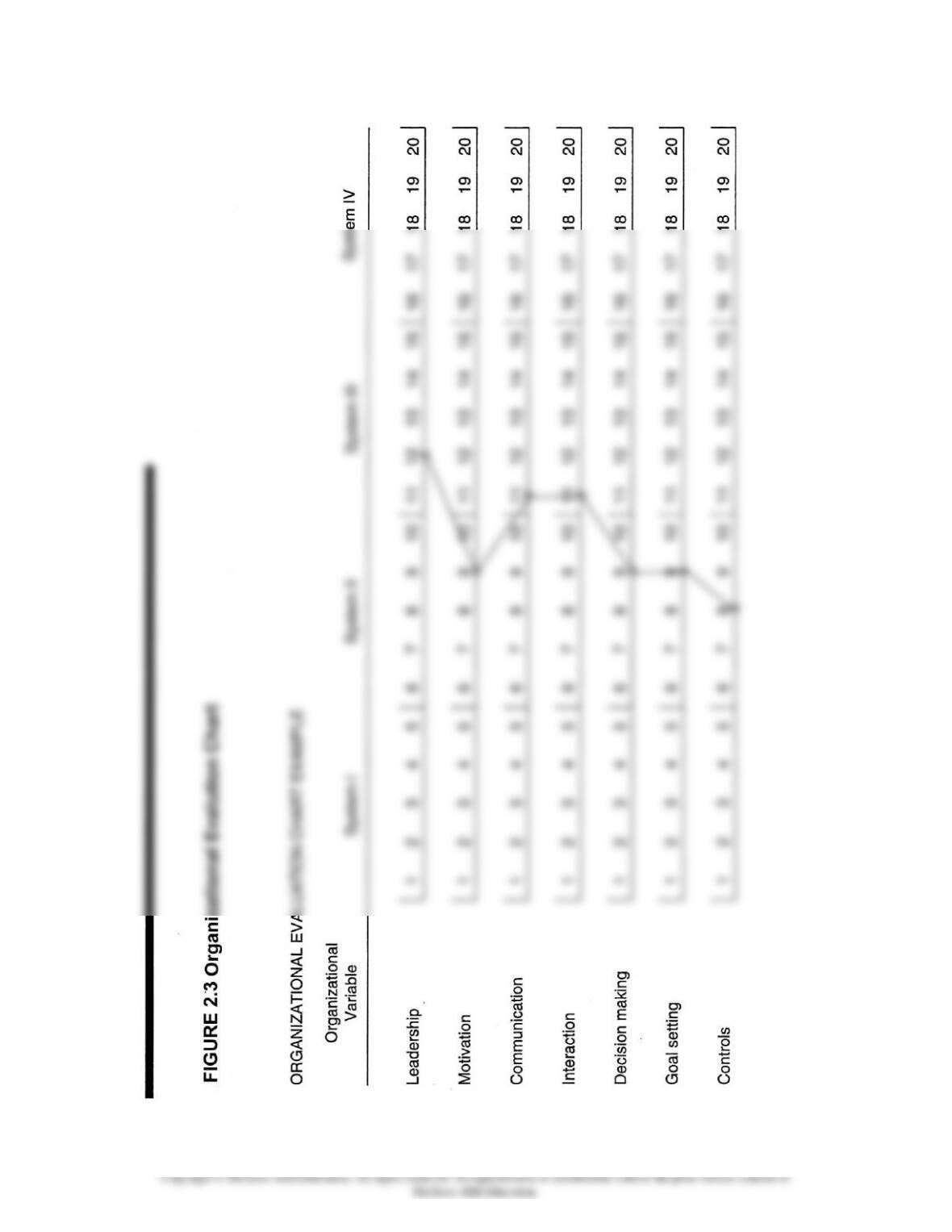
Enter the seven average scores on the Organizational Evaluation Chart, Figure 2.2.
Connect these with straight line to show a pattern of strengths and areas for improvement.
Figure 2.3 shows an example.
Part 02 – The Power of Vision
2-18
Part 02 – The Power of Vision
2-19
Part 02 – The Power of Vision
2-20
Step Three
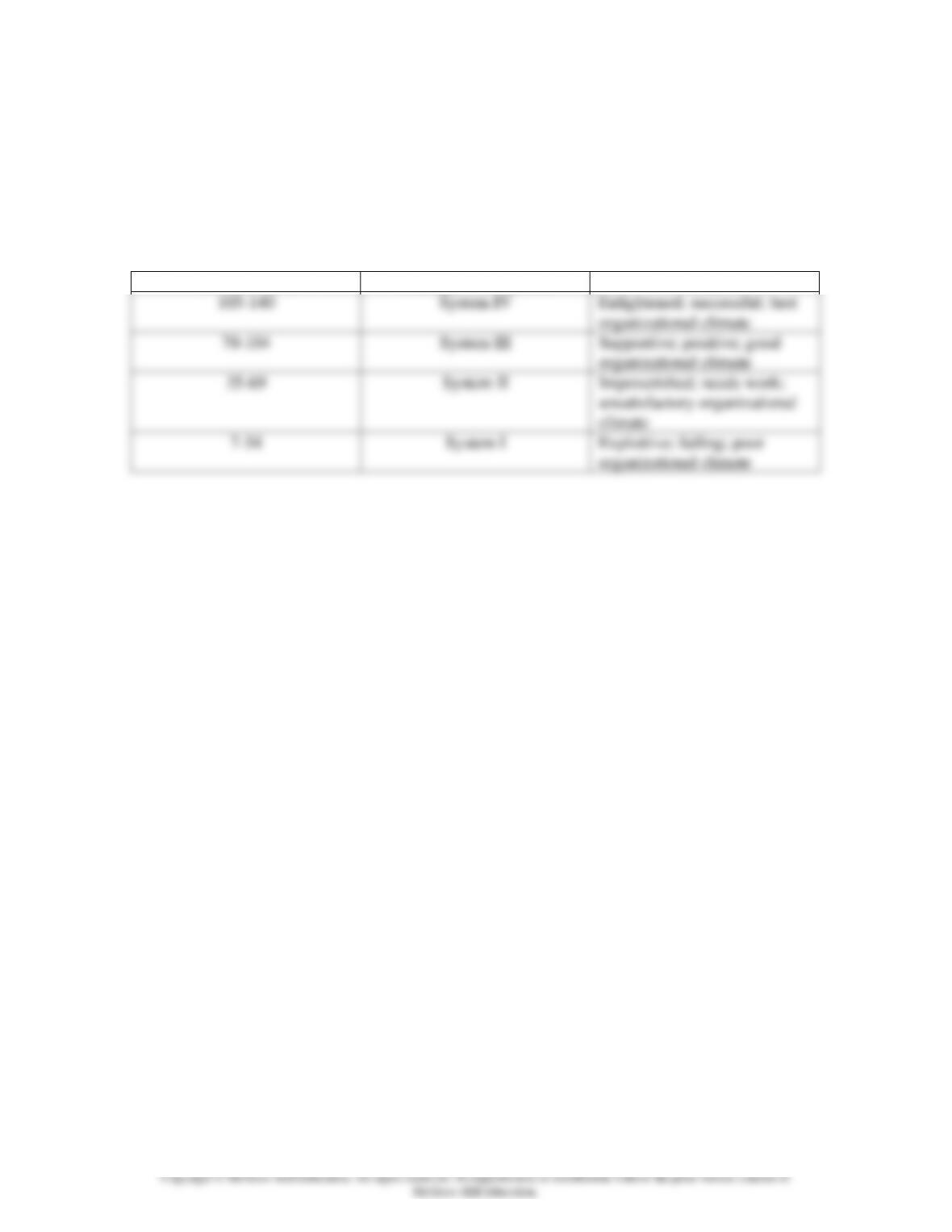
Total the average scores for the seven key areas. Then match the overall score with the
corresponding management system and evaluation.
Overall Score
Management System
Evaluation
105-140
System IV
Enlightened; successful; best
organizational climate
70-104
System III
Supportive; positive; good
organizational climate
35–69
System II
Impoverished; needs work;
unsatisfactory organizational
climate
7-34
System I
Exploitive; failing; poor
organizational climate