
Part 01 – Leadership Variables
1-1
Major Purpose of Part One
Part One focuses on three important subjects —
leadership qualities, characteristics of followers, and
situational factors.
Part One Objectives
After completing Part One, your students should be able
to better understand:
• Trait and behavior theories of leadership;
• Distinguishing qualities of leaders;
• Characteristics of followers relevant to leadership;
• Situational influences on the leadership process; and
• Styles of leadership and styles of following.
PART ONE—Leadership Variables

Part 01 – Leadership Variables
1-2
NOTES AND ANECDOTES
Traits and Human Nature
In 1968 historians Will and Ariel Durant published a definitive and widely acclaimed ten-
volume survey of history, The Story of Civilization. With the completion of this work, they
looked back and asked what history had to say about the nature, conduct, and prospects of
man. In The Lessons of History, Chapter V “Character and History,” they describe human
nature based on a “Table of Character Elements” or traits.
See Table 1.1.
In this analysis, human beings are equipped with six positive and six negative instincts
whose function it is to preserve the individual, the family, the group, and the species. Each
instinct generates habits and is accompanied by feelings. Their totality is the nature of man. In
positive personalities, positive tendencies predominate. It can be argued that the leadership
personality is characterized by an abundance of positive elements or traits. Think of a leader you
admire and the habits and feelings that describe him or her using Table 1.1.
TABLE 1.1: TABLE OF CHARACTER ELEMENTS
INSTINCTS HABITS FEELINGS
Positive Negative Positive Negative Positive Negative
Action Dormancy Play Lethargy Buoyancy Fatigue
Work Sloth Energy Inertia
Curiosity Indifference Eagerness Boredom
Manipulation Hesitation Wonder Doubt
Thought Dreaming Absorption Vacuity
Innovation Imitation Creativity Acceptance
Art Disorder Enjoyment Confusion
Fight Flight Advancement Retreat Courage Anxiety
Competition Timidity Rivalry Fear
Mastery Submission Pride Defeat
Acquisition Avoidance Eating Rejection Satisfaction Hunger
Saving Wasting Conservancy Prodigality
Property Poverty Security Insecurity

Part 01 – Leadership Variables
1-3
Association Withdrawal Communica- Isolation Sociability Secretive-
tion ness
Cooperation Contention Friendliness Animosity
Generosity Selfishness Kindliness Hostility
INSTINCTS HABITS FEELINGS
Positive Negative Positive Negative Positive Negative
Mating Refusal Sexual Sexual Sexual Sexual
activity perversion imagination neurosis
Marriage Celibacy Love Loneliness
Parental Filial Homemaking Filial Parental Filial
care dependence rebellion love resentment
NOTES AND ANECDOTES
Actions of Leaders
Closely related to qualities of leadership are the actions of effective leaders. James Kouzes and
Barry Posner, authors of The Leadership Challenge, studied 500 cases of managers and
concluded that effective leaders rely on five principle actions.
• Leaders challenge the process—they question current conditions and customs, and encourage
those with new and different ideas on products, policies, and procedures. They search for
opportunities; they experiment and take risks. They are not afraid to deviate from the mean.
• Leaders inspire a shared vision—they are enthusiastic, and their enthusiasm ignites the
energy of others to create a positive and future-focused vision of what could and should be
done. They enlist, envision, and execute. They put dreams into action.
• Leaders enable others to act—they are coaches and coordinators who facilitate work versus
perform tasks. Their focus is strategic and relational. They delegate effectively, foster
collaboration, and help others to make contributions. They lift people up and liberate them.

Part 01 – Leadership Variables
1-4
• Leaders model the way—they show others how to behave, especially pertaining to core
values, norms of behavior, and relations with others (customers, co-workers, etc.) They set
the standard, following the motto, “The life you lead is the legacy you leave.” They lead by
example.
• Leaders encourage the heart—they openly and often celebrate accomplishments. This shows
people that they are honored and that their efforts are appreciated. They recognize individual
and group contributions and show that they care.
These five actions can be used to select and develop both new and experienced leaders in all
fields of work. Strengths can be capitalized upon and low points addressed to achieve maximum
leadership effectiveness.
NOTES AND ANECDOTES
Important factors of the leader include:
• Personal preference: Some leaders prefer the formal structure of the directive style; others
enjoy the give-and-take of the participative style; others prefer individualism and free-rein
leadership.
• Versatility: Some leaders have little trouble shifting styles to meet the needs of different
subordinates and the demands of different situations; others are less flexible.
• Assessment of employee competence: If a decision is important and the leader has little
confidence in the judgment of employees, the leader is more likely to be directive.
Important factors of followers include:
• Need for structure: Some employees prefer clear guidelines and step–by-step procedures;
others enjoy discussion and consensus problem solving; others want free-rein leadership with
few rules to follow.
• Knowledge, maturity, and interest: Usually, the higher the knowledge, maturity, and interest
level of the employee, the more appropriate free-rein is as a style of leading.
• Leadership expectations: Some employees want the leader to make decisions and supervise
closely; others respond best to team effort and participative management; others need a high
degree of personal freedom.

Part 01 – Leadership Variables
1-5
Important factors of the situation include:
• Nature of the work: Precision work, such as performing an operation, may require directive
leadership; creative work, such as developing a new product, may need free-rein leadership.
• Emergencies and upper management directives: Generally, the greater the urgency, the more
appropriate is leader-centered as opposed to employee-centered decision making. Leader-
follower behavior may be influenced by dictates and actions of higher level leaders.
• Culture of the workplace: Different industries, companies and times have influence on the
nature of business culture and the focus of effective leadership.
In general, people resist leaders who rely on manipulation and control. They prefer
leaders who are inspiring and empowering. The following vignette from Richard Kerr of United
Technologies challenges leaders to move from the first orientation to the second:
People don’t want to be managed; they want to be led. Whoever heard of a
world manager? World leader, yes. Educational leaders. Political leader.
Religious leaders. Scout leaders. Community leaders. Labor leaders. Business
leader. They lead. They don’t manage. The carrot always wins over the stick.
Ask your horse. You can lead him to water, but you can’t manage him to drink.
If you want to manage somebody, manage yourself. Do that well, and you will
be ready to stop managing and start leading.
NOTES AND ANECDOTES
The following management principles are taught by the U. S. Marine Corps.
1. Aim for the 70-percent solution. It’s better to decide quickly on an imperfect plan than
to roll out a perfect plan when it’s too late.
2. Find the essence. When it comes time to act, even the most complex situations and
missions must be perceived in simple terms.
3. Build a capacity-based organizational mission. Focusing on developing organizational
talents creates opportunities; focusing on particular products and services invites
obsolescence.
4. Orient to speed and complexity. The ability to act quickly and effectively in chaotic
environments usually trumps other competencies.
5. Organize according to the rule of three. In times of stress, most people can efficiently
handle exactly three key responsibilities.
6. Build authority-on-demand into the hierarchy. Retain a strong management pyramid,
but encourage people even at the lowest levels to make whatever decisions are
necessary to accomplish the mission when management guidance isn’t at hand.

Part 01 – Leadership Variables
1-6
7. Focus on the small team. Most of the organization’s critical tasks are accomplished by
the lowest-level managers and their subordinates, so anything done to make them more
effective will have a large payoff
8. Task-organize. The size and make-up of groups within the organization should be
changed according to the needs of each specific mission.
9. Hire via trial by fire. Challenging a prospective employee makes it easier to determine
the fit, and initiates a bond between the hiree and the organization.
10. Employ extreme training. Situations faced on the job shouldn’t seem more daunting
than those faced in training.
11. Breed decision by analogy. Managers can’t be briefed on every possible situation, but
they can be trained to recognize similarities between novel and familiar situations.
12. Cross-train. Running through difficult jobs creates versatile managers who
understand all aspects of the organization, even if at a cost in efficiency.
13. Manage by end state and intent. Tell people what needs to be accomplished and
why, and leave the details to them.
14. Distribute competence. Obsessively and ceaselessly train people at all levels of the
organization.
15. Reward failure. Someone who never fails probably isn’t pushing the envelope.
16. Make personnel functions stepping stones for stars. The development of the most
promising managers should include taking responsibility for hiring, training,
promoting, and transferring people.
17. Glorify the lower levels of the organization. The higher the manager, the harder he
or she should work at making it clear that the rank and file are the heroes.
18. Demand to be questioned. Subordinates should feel free to openly disagree with their
managers, up until it comes time to carry out a final and legitimate decision.
19. Instill values that support the mission. The ability to get the job done can be a
function of shared character.
20. Cultivate opposing traits. Success often requires combining seemingly contradictory
approaches.
21. Establish a core identity. Everyone in the organization should feel they’re performing
an aspect of the same job.
22. Match strength to weakness. Find ways to tilt the playing field to the competition’s
advantage.
23. Surprise and disorient the opposition. A confused and off-balance competitor can be
routed with fewer resources.
24. Make tempo a weapon. Controlling the pace of competition can exhaust and
demoralize the competition.
25. Keep plans simple and flexible. It’s better to have a few options that can be easily
adapted to changing situations than to try to make specific plans for every contingency.
26. Make organizational doctrine a living thing. It’s good to standardize practices, as
long as one of them is to continually refine and occasionally change the practices.
27. Experiment obsessively. Even the most successful organization will eventually stop
winning if it doesn’t explore radically new approaches.
28. Build new tactics around new technology. Fully leveraging technology requires new
styles of competing.
29. Don’t depend on technology. Train to be effective regardless of which technologies
are available.
30. Get an outside perspective. Insights into organizational improvement can often come
from people in seemingly unrelated fields.

Part 01 – Leadership Variables
1-7
Φ APPLICATION
Leader-Follower Relations
Effective leaders generate hope and conviction in followers. They are people others perceive as
being able to make things better. At the emotional level, leaders generate:
• Confidence in people who are frightened
• Certainty in people who are vacillating
• Action where there is hesitation
• Strength where there is weakness
• Expertise where there is floundering
• Courage where there is cowardice
• Optimism where there is cynicism
• Conviction that the future will be better
Describe and discuss a leader you know who fits this description.
Φ APPLICATION
Leadership Poker – Attitude Clarification Exercise (ACE)
Leadership poker is an attitude clarification exercise used to explore the subject of leadership in
the workplace.
Learning Objectives:
• Clarify personal opinions and beliefs regarding leadership in the workplace.
• Stimulate ideas and discussion about leadership philosophy and norms of behavior.
• Develop consensus on core principles and practices.

Part 01 – Leadership Variables
1-8
Directions:
(1) Make 172 cards using the statements shown in Table 1.2. Use one statement for each card.
(2) Shuffle and deal all of the cards in the leadership poker deck—an equal number for each
participant.
(3) Each participant ranks his or her cards from most to least desirable as an ideal belief, attitude,
philosophy, or practice regarding leadership in the workplace (time—5 minutes).
(4) Form participant pairs based on diversity—age, gender, race, and other social differences.
Members of each pair compare cards and create a most preferred leadership hand (time—5
minutes).
(5) Form multiple participant pairs—2 or more. Groups discuss and create the ideal hand that
depicts the most preferred beliefs, attitudes, philosophy, and practices regarding leadership in
the workplace.
(6) Large group report and open discussion follows—discuss the questions found at the end of
this exercise.
Note that the product of the Leadership Poker exercise is an agreed upon leadership philosophy
and norms of behavior that can be used to select future leaders, train current leaders, and hold all
leaders to high standards of performance.
The Leadership Poker exercise can be used as a pre-test and post-test to evaluate change in
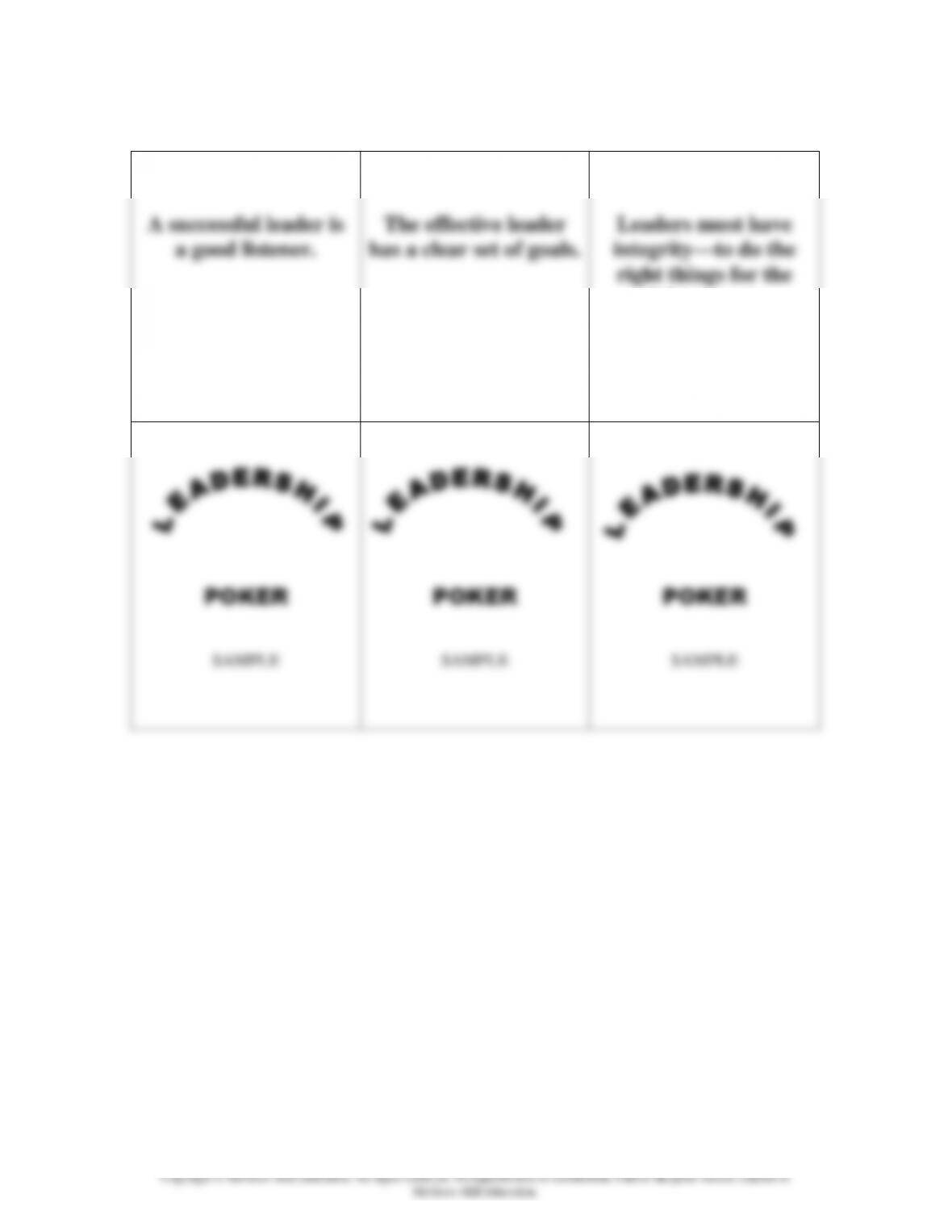
philosophy and values. The deck of cards can be made using a computer. Insert a table and make
three columns and three rows with about 14 spaces in each row. Then in each of the boxes insert
one of the statements from Table 1.2, and number each one consecutively. Using standard paper
or colored construction paper, print the sheets with the cards. If desired, make another set of
boxes and print Leadership Poker and/or a graphic on the reverse side of the sheet as shown
below. Laminate the sheets and cut into individual playing cards that can be used repeatedly.
See the following example.
Part 01 – Leadership Variables
SAMPLE
A successful leader is
a good listener.
1
SAMPLE
The effective leader
has a clear set of goals.
2
SAMPLE
Leaders must have
integrity—to do the
right things for the
right reasons.
3
POKER
SAMPLE
POKER
SAMPLE
POKER
SAMPLE

Part 01 – Leadership Variables
1-10
TABLE 1.2: STATEMENTS FOR LEADERSHIP POKER
The best characteristic of a leader is that of having a
vision for progressive ideas. But he must be able to
communicate effectively those ideas.
The single most important facet of effective
leadership is vision.
Through establishing a position and staying the
course, leadership establishes trust.
The secret of effective leadership is to learn how to
control people.
Individuals must be responsible for themselves and
should not look to leaders for help.
Effective leaders manipulate others to believe their
vision without the appearance of manipulation.
Leadership equals competent charisma.
An effective leader keeps job knowledge current.
To leaders, there is a solution to every problem.
Persistence is the basic trait of an effective leader.
Persons who take a generalist view make better
leaders than specialists.
Effective leaders often develop their vision of the
future from the past.
Effective leaders need a certain distance between
themselves and their followers in order to create an
air of mystery.
Effective leaders do not shun conflict.
A major activity of leaders is to raise followers up
to the level of leaders.
An effective leader has a clear set of goals.
Effective leaders do not seek help outside the work
group.
An effective leader has to be a dreamer.
The effective leader is one who is willing to give
unselfishly of his time and abilities for others.
The effective leader is a giver rather than a taker.
The effective leader must personify the vision she is
attempting to communicate.
The effective leader should be a definer of values.
The effective leader’s most important task is
satisfying the needs of the group.
The effective leader must learn to manage herself
before she can lead others.

Part 01 – Leadership Variables
1-11
TABLE 1.2: STATEMENTS FOR LEADERSHIP POKER (continued)
An effective leader surrounds herself with advisors
who are more intelligent than she.
The effective leader pays attention to detail.
Effective leaders align the reward system to support
the objectives of the group.
The leader must be in love with his vision.
Leaders are askers, they seek advice.
If a leader becomes too much of a buddy with her
followers, she ceases to be an effective leader.
A leader can successfully promote an idea only if
the followers feel an ownership of that idea.
A leader may sometimes be a great person but not a
good person.
A leader is a person who achieves a high level of
self-respect, yet always remains sympathetic to the
needs of the people around him.
A leader must have an abundance of goodness to be
effective.
Leaders are born and not created.
Leadership is primarily inspirational.
A leader should be able to build “bonfires” under
apathetic people.
Leaders must set a good example for their
followers.
Leaders must be able to stir things up and encourage
healthy conflict.
Leaders make the right decisions and carry those
decisions through with a vision.
The best leaders have integrity—they are honest in
their dealings with people.
A good leader is committed, a planner, a goal-setter,
and carries through with plans.
A successful leader converts followers into leaders.
A great leader has personal humility plus fierce
resolve.
A good leader has vision that he can communicate
to others.
Leadership is inseparable from followers’ needs and
goals.
Leadership requires balance of life and skills.
Leadership requires more than a vision; it requires
action to make that vision attainable.
Leadership is best understood as a relationship with
those being led, not as a characteristic of an
individual.
Leadership is taking a vision and giving it direction
and drive.

Part 01 – Leadership Variables
1-12
TABLE 1.2: STATEMENTS FOR LEADERSHIP POKER (continued)
Leadership consists primarily of being innovative.
Leadership is important at all levels of
responsibility—from the boardroom to the shop
floor.
Good leadership and good management are
essentially the same.
Leadership is primarily a matter of being
manipulative.
Leadership requires the mobilization of followers.
Leadership is lighting the path and burning the heels
to make a difference.
The primary concern of leaders should be the
acquisition of power.
The primary responsibility of the leader is to
determine what is the ideal, and then work toward
achieving the possible.
The primary role of the leader is to make conscious
what lies unconscious among the followers.
The primary focus of organizational development
should be economic development.
The primary concern of the leader should be to
mobilize those people in the organization who are
without power.
Organizations should strive to be self-sufficient and
use outside resources sparingly.
Leadership development is primarily the
responsibility of professionals.
Effective leaders must often act independently of
the majority wishes.
Organizational change tends to introduce more
troubles than it solves.
Good leaders are more likely to borrow and adapt
than they are to invent.
Organizational development should enhance the
power of the front-line people.
Leadership development is first and foremost an
“education-for-action” process.
The effective leader is a teacher and developer of
people.
Actual leadership development does not involve the
concerns and issues of common people. It focuses
primarily on the issues and concerns of the leaders.

Part 01 – Leadership Variables
1-13
TABLE 1.2: STATEMENTS FOR LEADERSHIP POKER (continued)
Meaningful change is not possible without conflict.
A good organization must continually recruit and
train leaders.
Leaders are often tripped-up by their own egos.
Leadership requires a belief in oneself and
contagious enthusiasm.
The effective organization should be led by a
relatively small group of deeply committed leaders.
Effective leadership is imperative for organizational
success.
Leadership is more art than science.
If everybody is satisfied, nothing changes.
An essential characteristic of an effective leader is
to be a good listener.
Prepackaged programs for leadership development
are less likely to succeed than individually tailored
programs.
Leaders must have integrity— to do the right things
for the right reasons.
The secret to effective leadership is not to control
people but to empower them.
The effective leader is one who can meet goals and
objectives by influencing the behavior of others.
If people are aware of problems, they will be willing
to work for their solution.
Leaders must be able to resolve conflict.
The success of a leader can best be measured by the
extent of change produced as a result of his or her
actions.
Self-interest is often a powerful motivator to cause
people to be attracted to group activities including
leadership.
All people, even leaders, usually act in their own
best self-interest.
The effective leader must consider carefully the
worst possible alternatives as well as the best.
Leadership requires commitment to a task and
concern for people.
A successful leader is a good listener.
A leader must have empathy or understanding of
those he leads.
People should have the right to participate in
decisions that affect their well-being.
Most people will never become involved in
leadership development.

Part 01 – Leadership Variables
1-14
TABLE 1.2: STATEMENTS FOR LEADERSHIP POKER (continued)
The primary responsibility of leaders is to help
people help themselves.
Leaders must have goals and visions and be able to
relate and communicate these goals and visions.
Leadership requires trust between the leader and the
follower.
A leader understands that it‘s not necessarily the
direction that counts, but sticking reasonably to the
direction you choose.
Effective leaders decentralize decision-making to
the front-line employee.
The effective leader keeps the group informed of the
action plan.
A leader tries to allow the group enough time for
meaningful communication.
An effective leader values diversity.
A good leader avoids the temptation to protect
members of the group from themselves.
A great leader focuses on possibilities rather than
problems, and seeks to guide rather than to control.
Leadership involves making decisions and
expecting followers to comply without question.
Good leaders show confidence and trust in others.
Supportive leadership shows a great deal of interest
and confidence in members.
Enlightened leadership delegates power to the
logical focus of interest and concern for a problem.
Good leaders ask for ideas and try to use others’
suggestions.
A great leader views human resources as the
organization’s greatest asset.
Great leaders treat every individual with
understanding, dignity, warmth, and support.
Great leaders tap the constructive power of groups
through visioning and team building.
Great leaders set high performance goals at every
level of the organizations.
Supportive leadership involves broad member
participation and involvement in decision-making
activities.
Effective leaders understand that people need
contact and support.
Trust is the highest form of human motivation.
The key to effective leadership is delegation.
Effective leaders conduct regular communication
sessions about goals, working conditions, and work-
related issues.

Part 01 – Leadership Variables
1-15
TABLE 1.2: STATEMENTS FOR LEADERSHIP POKER (continued)
The good leader helps members take ownership of
an idea and perform at their very best.
Good leadership recognizes individual differences
and provides a variety of learning experiences.
Great leaders recognize talented people as the key
to success in successful organizations.
Introducing dramatic change is the only way to alter
attitudes.
A good leader begins with an end in mind.
An effective leader shares power and information,
solicits input, and rewards people.
Good leadership provides opportunities for growth.
Good leadership delegates responsibility to those
who have the ability to do the work.
A good leader clearly communicates expectations,
asks questions to increase understanding, and shows
respect through listening.
In an open community, social differences do not
divide people; instead, diversity is welcome.
A good leader develops communication across
cultures and language differences.
Leadership without purpose is immoral in nature.
A good leader provides ongoing feedback with
sensitivity to individual differences.
A good leader encourages decision making by
consensus rather than by formal voting.
A successful organization agrees on core values and
norms of behavior that determine the rightness and
wrongness of conduct.
Productive organizational development focuses
attention and effort on the mission.
The atmosphere of a good organization is warm and
supportive. Creativity is encouraged, and success is
expected.
Great leaders have the ability to accept people as
they are, not as they would like them to be.
A great leader has the capacity to approach
relationships and problems in terms of the present
rather than the past.
Great leaders have the ability to treat those who are
close to them with the same courteous attention that
they extend to strangers and casual acquaintances.
Great leaders have the ability to trust others, even if
the risk seems great.
A good leader is decisive.
A wise leader does not place undue emphasis on
being a “good guy.”
The word “failure” is not in the vocabulary of good
leaders.

Part 01 – Leadership Variables
1-16
The accumulation of trust is a measure of the
legitimacy of leadership.
Trust is the emotional glue that binds followers and
leaders together.
A leader must have courage of conviction.
The ability to predict outcomes with a high
probability of success generates and maintains trust.
The leader’s vision must be clear, attractive, and
attainable.
An effective leader makes her position clear.
Great leaders have the ability to translate intention
into reality and maintain it.
The way to tell an effective leader is not by what
happens when he is there, but by what happens
when he is not.
The best way to develop responsibility in people is
to give them responsibility.
Leading by force is often more effective than
leading by example.
A good leader knows that reasonable failure should
never be received with anger.
A good leader is a facilitator, teambuilder, and
champion of his group.
A good leader has the ability to do without constant
approval and recognition from others.
Leadership consists primarily of a set of traits that
clearly make a leader.
The best leaders are both idea-generators and
problem solvers.
The best leaders are standard setters and
uncompromising in holding performance to
requirements.

Part 01 – Leadership Variables
1-17
Φ APPLICATION
Food for Thought
Take your pick:
It is time to elect a world leader, and your vote counts. Here is the information on the three
leading candidates:
Candidate A:
Associates with ward heelers and consults with astrologists. He has had two mistresses,
chain-smokes, and drinks 8 to 10 martinis a day.
Candidate B:
Was kicked out of office twice.
Sleeps until noon.
Used opium in college.
Drinks a quart of brandy every evening.
Candidate C:
Is a decorated war hero.
Is a vegetarian.
Doesn’t smoke.
Drinks an occasional beer.
Hasn’t had any illicit affairs.
Which of these candidates is your choice?
EXERCISE 1.1:
WHAT TYPE OF FOLLOWER ARE YOU?
Directions: Answer the following questions, keeping in mind what you have done, or
think you would do, in the situations described.
Yes
No
1. When assigned a task, do you like to have the details spelled out thoroughly?
___
___
2. Do you think that most supervisors are bossier than they need to be?
___
___
3. Would you say that personal initiative is one of your stronger points?
___
___
4. Do you feel that a supervisor should avoid getting personally involved with
subordinates?
___
___
5. In general, would you prefer working with others, as opposed to working alone?
___
___

Part 01 – Leadership Variables
6. Do you tend to prefer the pleasures of solitude (reading, writing, thinking) more
than the pleasures of being with others (parties, get-togethers, etc)?
___
___
7. Do you tend to be loyal toward those who supervise you?
___
___
8. Do you often lend a helping hand to others in your work group?
___
___
9. When you work on a project, do you prefer using your own ideas, as opposed to
your supervisor’s ideas to solve problems?
___
___
10. Would you prefer a supervisor who is knowledgeable over one who comes to
you to solve problems?
___
___
11. Do you feel it is appropriate for a supervisor to be friendlier with some
employees than with others?
___
___
12. Would you prefer assuming full responsibility for the outcome of your work,
rather than sharing the responsibility with others?
___
___
13. Do you think that having men and women in the same work group creates more
problems than having all men or all women?
___
___
14. Do you think a supervisor should discuss new procedures with employees before
implementing them?
___
___
15. Do you insist upon doing what you, yourself, feel is right or important?
___
___
16. Would you agree that a supervisor who could not keep your loyalty should not
be supervisor?
___
___
17. Would you be upset with a supervisor who fails to have regular staff meetings?
___
___
18. Do rules and prescribed guidelines inhibit your creativity?
___
___
SCORING
On the scoring matrix below, place a check mark (✓) next to each question you answered
Yes. Add up the checks for each column and put the totals in the appropriate spaces.
Scoring Matrix
1. ___
2. ___
3. ___
4. ___
5. ___
6. ___
7. ___
8. ___
9. ___
10.___
11. ___
12. ___
13.___
14. ___
15. ___
16.___
17. ___
18. ___
Directive Total_____ Participative total _____ Free-rein total _____
Source: Naomi Miller, Northern Kentucky University, 1981; based on Auren Uris,
“Techniques of Leading—Techniques of Following,” in Techniques of Leadership (New
York: McGraw-Hill, Inc., 1953), 49-52, 78-89. Reprinted with permission.

Part 01 – Leadership Variables
1-19
DISCUSSION QUESTIONS AND ACTIVITIES
To personalize the subject of leadership variables, ask your students to consider questions such
as these:
1. What are the qualities that make a good leader?
2. Name a leader from your experience who made you feel more powerful and raised your
capabilities. What enabled him or her to accomplish this?
3. What type of intelligence do you possess? Have you provided leadership in this special area?
4. Discuss the benefits and drawbacks of the directive, participative, and free-rein styles of
leadership.
5. Discuss how your style of leadership would be the same or different from your manager’s
style.
6. What are the variables that determine leadership effectiveness?
7. Do you possess the ten qualities that distinguish a leader?
8. How susceptible are you to leadership influence?