Chapter 6
Bonds, Bond Prices, and the Determination of Interest
Rates
Conceptual and Analytical Problems
1. Consider a U.S. Treasury Bill with 270 days to maturity. If the annual yield is 3.8
percent, what is the price? (LO1)
Answer:
24.97$
)038.01(
100$
12/9
P
2. *You are an officer of a commercial bank and wish to sell one of the bank’s assets—a
car loan—to another bank. Using equation A5 in the Appendix to Chapter 4, compute
the price you expect to receive for the loan if the annual interest rate is 6 percent, the
car payment is $430 per month, and the loan term is five years. (LO1)
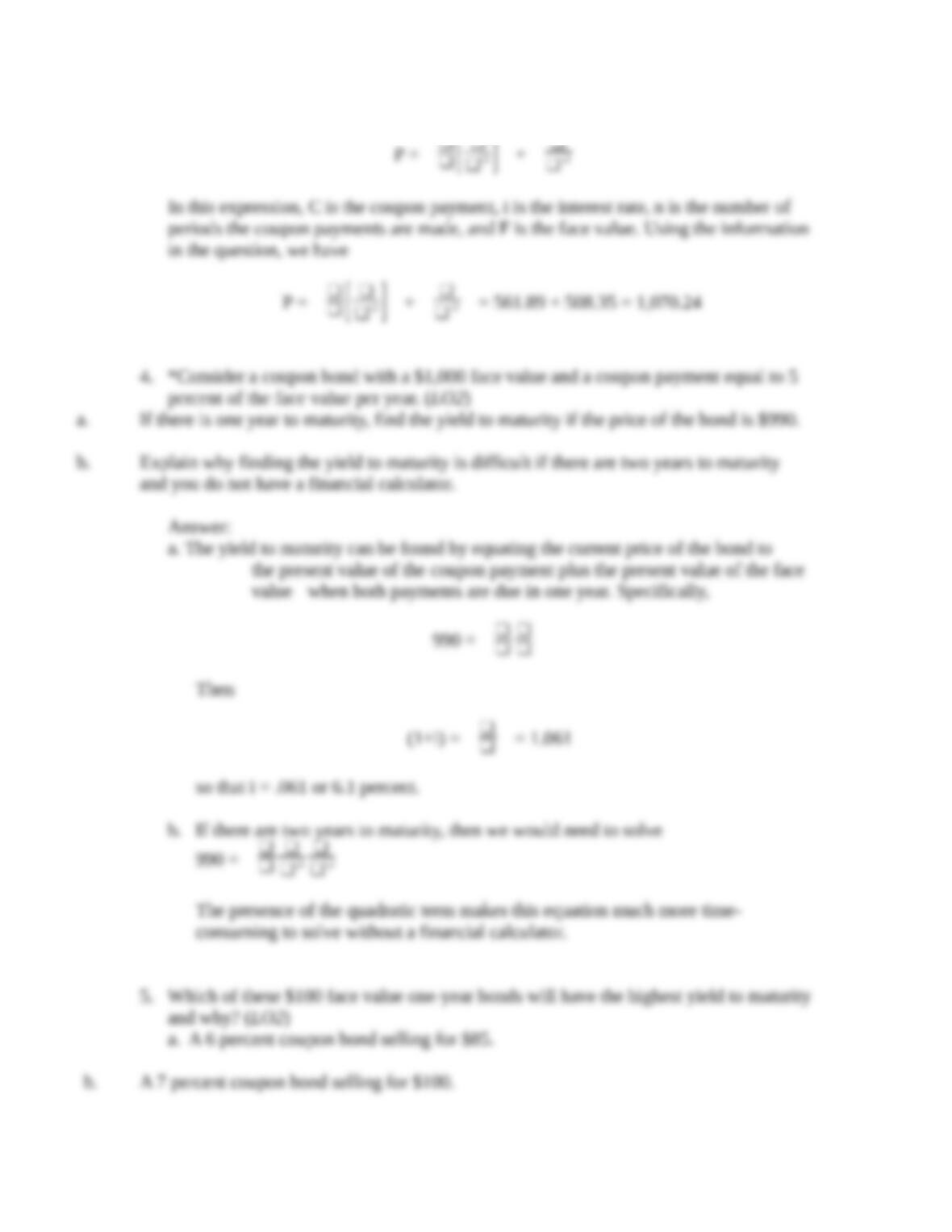
Answer: The present value of the payments can be found by using equation A5 in the
appendix to Chapter 4:
❑
❑
❑
❑
❑
Answer:
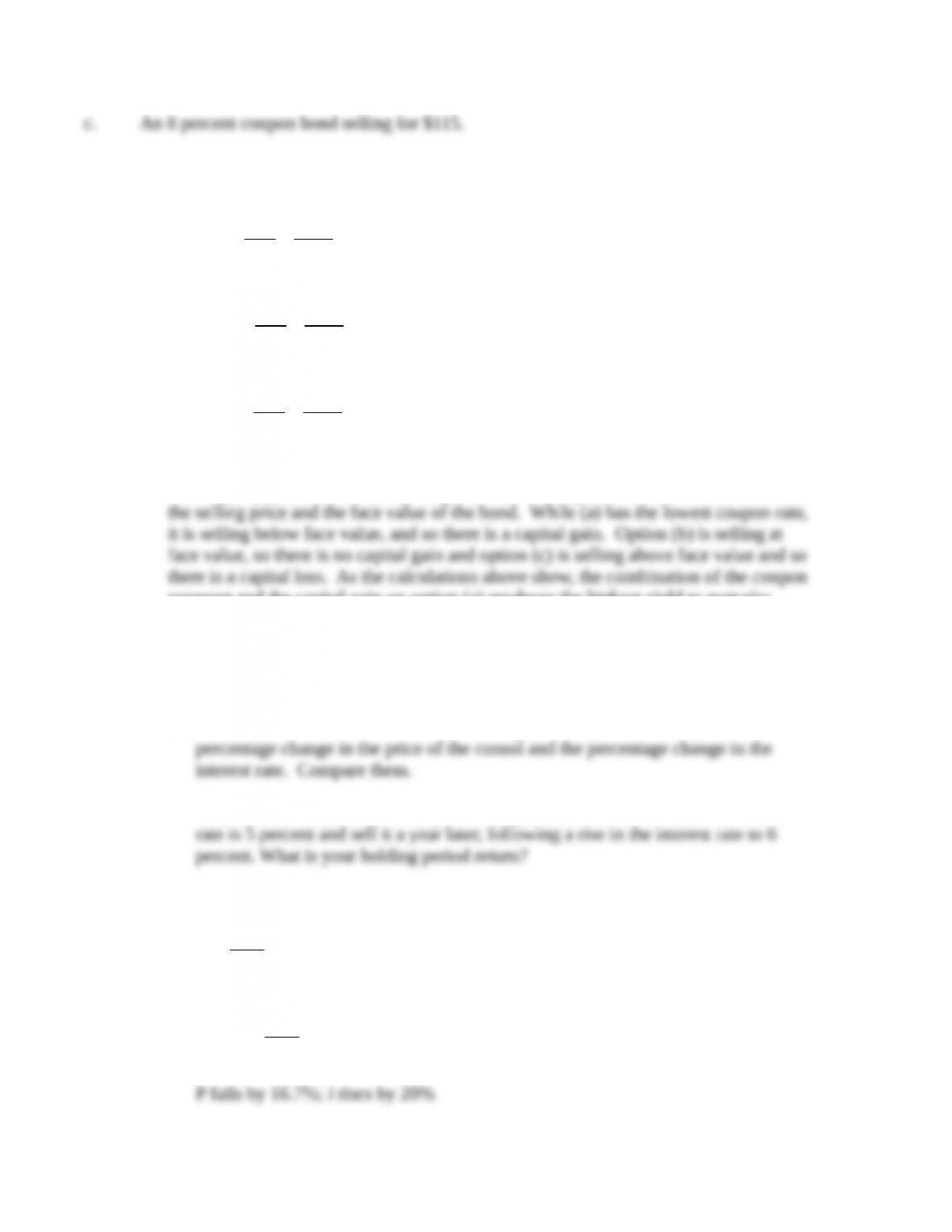
a.
%71.24
1
100$
1
6$
85$
i
ii
b.
%7
1
100$
1
7$
100$
i
ii
c.
%1.6
1
100$
1
8$
115$
i
ii
Option (a) has the highest yield to maturity. The yield to maturity depends both on
the coupon payment and any capital gain or loss arising from the difference between
the selling price and the face value of the bond. While (a) has the lowest coupon rate,
it is selling below face value, and so there is a capital gain. Option (b) is selling at
face value, so there is no capital gain and option (c) is selling above face value and so
there is a capital loss. As the calculations above show, the combination of the coupon
payment and the capital gain on option (a) produces the highest yield to maturity.
6. You are considering purchasing a consol that promises annual payments of $4. (LO2)
a. If the current interest rate is 5 percent, what is the price of the consol?
b. You are concerned that the interest rate may rise to 6 percent. Compute the
c. Your investment horizon is one year. You purchase the consol when the interest
Answer:
a.
80$
05.0
4$ P
b.
67.66$
06.0
4$ newP
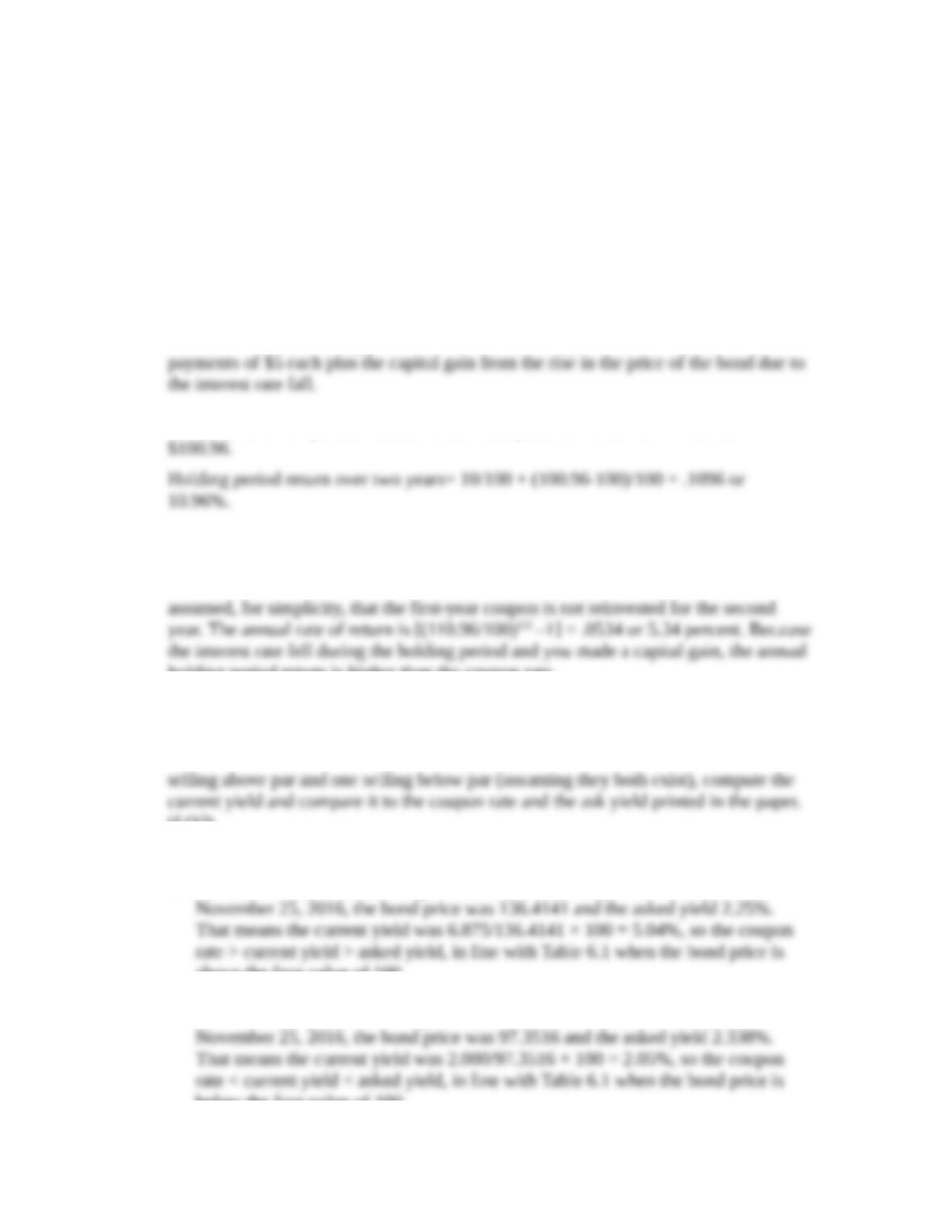
c.
%7.11
80$
80$67.66$
80$
4$
7. *Suppose you purchase a 3-year, 5-percent coupon bond at par and hold it for two
years. During that time, the interest rate falls to 4 percent. Calculate your annual
holding period return. (LO2)
Answer: The total holding period return over the two years consists of two coupon
payments of $5 each plus the capital gain from the rise in the price of the bond due to
the interest rate fall.
The price at which you sell the bond after two years will be 5/1.04 +100/1.04 =
The total payoff on the bond for which you paid $100 is $110.96.
To calculate the annual rate of return, we refer to the footnote on p. 140. It is
holding period return is higher than the coupon rate.
8. In a recent issue of the Wall Street Journal (or on www.wsj.com or an equivalent
financial website), locate the prices and yields on U.S. Treasury issues. For one bond
(LO2)
Answer:
a. For the Treasury bond due August 15, 2025 with a coupon of 6.875%, on
above the face value of 100.
b. For the Treasury bond due August 15, 2025 with a coupon of 2.000%, on
below the face value of 100.
9. In a recent issue of the Wall Street Journal (or on www.wsj.com), locate the yields on
yield was below the Treasury yield. What might account for these differences in
yields? (LO4)
Answer: As of Thursday, December 1, 2016, the 10-year U.S. Treasury yield was
expectations, with inflation in Germany expected to be lower than in the United
States, while inflation in Australia is expected to be a bit higher.
10. A 10-year zero-coupon bond has a yield of 6 percent. Through a series of unfortunate
inflation, compute the change in the price of the bond.
b. Suppose that expected inflation is still 2 percent, but the probability that it will
move to 3 percent has risen. Describe the consequences for the price of the bond.
Answer:
a. Price (with 2% expected inflation) = 100/(1.06)10 = $55.84
b. There is increased inflation risk. Investors will require compensation for taking
11. As you read the business news, you come across an advertisement for a bond
mutual fund – a fund that pools the investments from a large number of people and
recollection is correct. Explain the logic behind the mutual fund’s claim in the
advertisement. (LO2)
Answer: There are two possible explanations for the high return. The first is that
far exceeded the interest rate.
Remember that when interest rates fall, the prices of bonds rise, giving the owner a
to be followed by a low or even negative return when interest rates rise.
12. You are sitting at the dinner table and your father is extolling the benefits of
investing in bonds. He insists that as a conservative investor he will only make
right or wrong. (LO4)
Answer: Like most people, your father believes that the government guarantee
means that he will get his investment back. He’s right that the U.S. Treasury is
fluctuate with inflation. So, the bond is not risk free.
13. *Consider a one-year, 10-percent coupon bond with a face value of $1,000 issued
by a private corporation. The one-year risk-free rate is 10 percent. The
most $775 for the bond, is that investor risk-neutral or risk averse? (LO4)
Answer: If the bond were risk free, it would pay off $1,100 in one year’s time – $100
The present value of $880 in one year’s time is $880/1.1 = $800. This would be the
If the investor is willing to pay at most $775 for the bond, he or she requires
14. If, after one year, the yield to maturity on a multi-year coupon bond that was
issued at par is higher than the coupon rate, what happened to the price of the bond
during that first year? (LO2)
Answer: The price of the bond fell below par. When a bond is at par, the yield to
is higher than the coupon rate alone.
15. Use your knowledge of bond pricing to explain under what circumstances you
annual coupon payments for 10 years. (LO1, LO2)
Answer: The price you are willing to pay for a bond reflects the present value of
the payment flows from the bond. In this case, if i = 5%, the present value of the
are certain that rates will be lower in ten years, you would prefer the consol.
16. *You are about to purchase your first home and receive an advertisement regarding
adjustable-rate mortgages (ARMs). The interest rate on the ARM is lower than
term. Why might an ARM not be the right mortgage for you? (LO4)
Answer: There are several factors to consider. First, with a fixed rate mortgage, your
payments are fixed over the life of the loan. The interest rate on this mortgage is
higher because the lender is assuming the interest rate risk. The ARM has a lower
amortization if your payments don’t cover the interest costs of your loan. Shortages
are added to the principal of your loan, pushing up your costs.
17. Use the model of supply and demand for bonds to illustrate and explain the impact
of each of the following on the equilibrium quantity of bonds outstanding and on
equilibrium bond prices and yields: (LO3)
a. A new website is launched facilitating the trading of corporate bonds with
c. The government removes tax incentives for investment and spends additional
funds on a new education program. Overall, the changes have no effect on the
response of bond issuers dominates that of bond purchasers.
Answer:
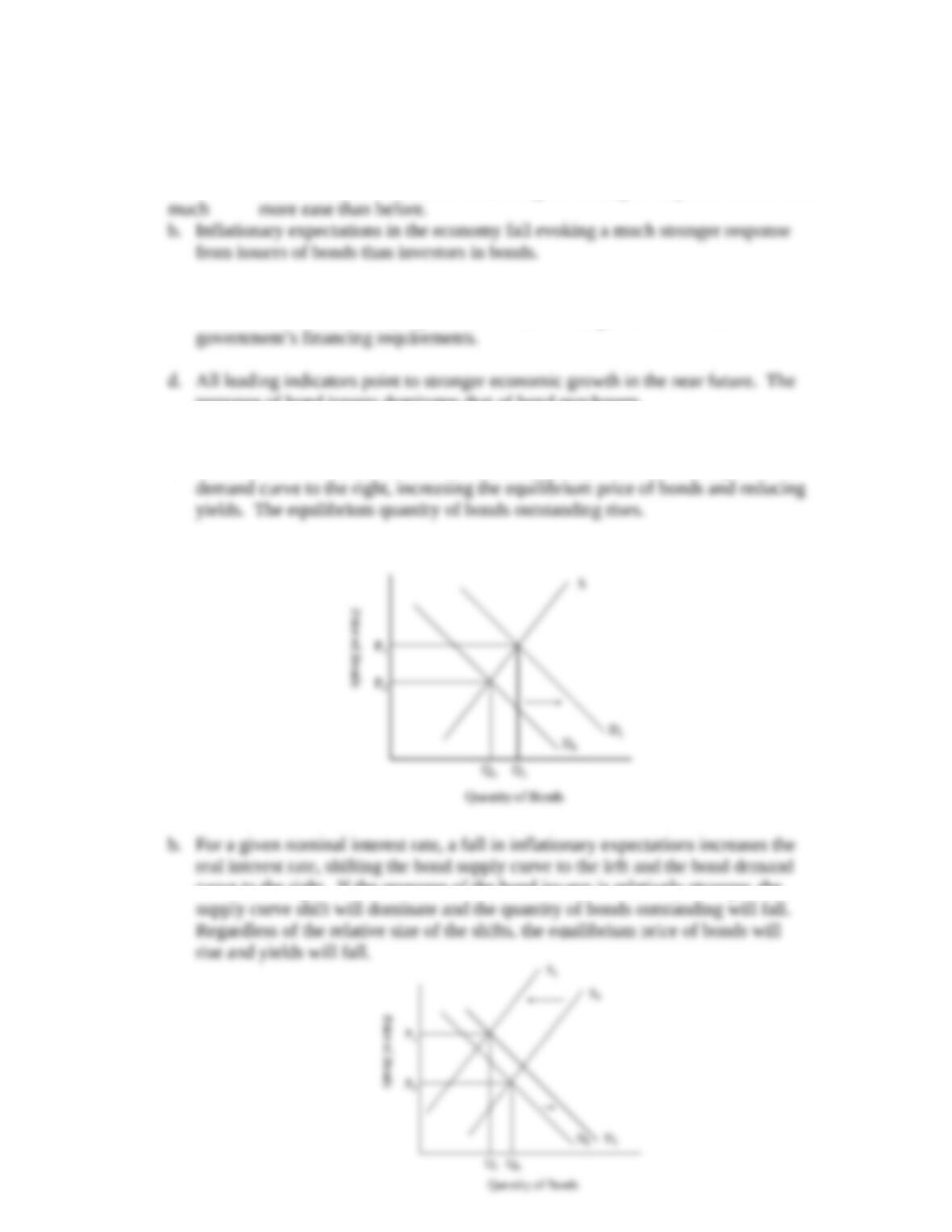
a. The new website would increase the relative liquidity of bonds, shifting the bond
curve to the right. If the response of the bond issuers is relatively stronger, the
Quantity of Bonds
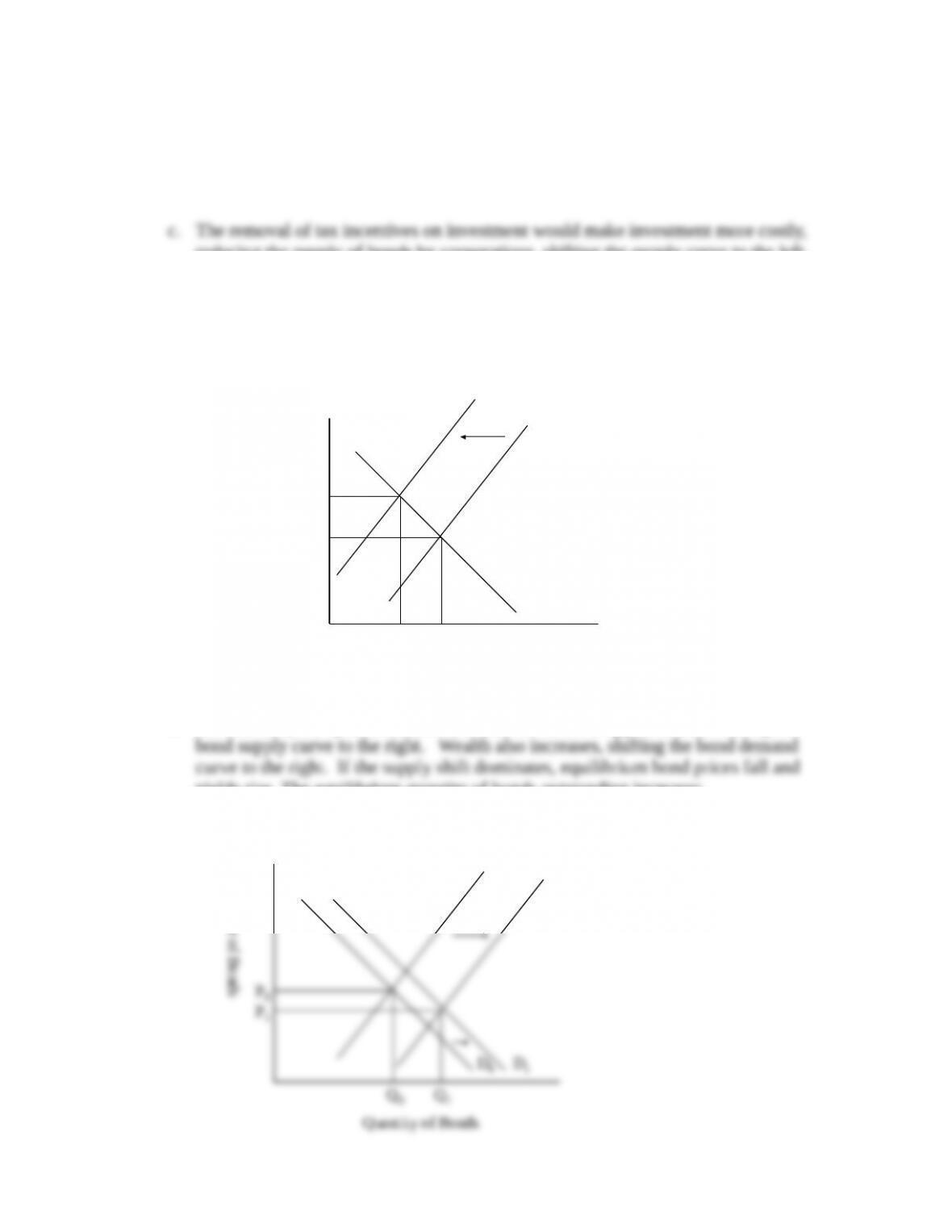
reducing the supply of bonds by corporations, shifting the supply curve to the left.
As there is no change in the financing requirements of the government, the supply
of government bonds doesn’t change. Equilibrium quantity falls. Equilibrium
bond prices rise and yields fall.
d. A business cycle upturn increases business investment opportunities, shifting the
yields rise. The equilibrium quantity of bonds outstanding increases.
Price of Bonds
Quantity of Bonds
D0
S0
P0
P1
S1
Q0
Q1
Price of Bonds
S0
S1