Case 8 Teaching Note Under Armour’s Strategy in 2016
11
3. Does Under Armour have any resource strengths or competitive capabilities that qualify as
a distinctive competence?
We do not see any credible evidence that any of UA’s resource strengths and capabilities have developed
4. What does a SWOT analysis reveal about the overall attractiveness of Under Armour’s
situation?
Under Armour’s Resource Strengths and Competitive Assets
A growing lineup of product offerings—the company has a growing array of moisture-wicking apparel
items in many designs and styles for wear in nearly every type of climatic conditions. Indeed, Under
Armour’s diverse product offerings in 2012 consisted of apparel, footwear, and accessories (gloves,
socks, headwear, bags, knee-pads, custom-molded mouth guards, and eyewear) for men, women,
and youths marketed at multiple price levels in a variety of styles and fits intended to regulate body
temperature and enhance comfort, mobility, and performance regardless of weather conditions.
Growing global awareness of the Under Armour brand name, combined with growing appeal of Under
Armour products worldwide.
Under Armour’s Resource Weaknesses and Competitive Liabilities
Weaker brand name recognition and reputation than key competitors—Nike and The adidas Group
Smaller product line breadth compared to Nike and The adidas Group
Case 8 Teaching Note Under Armour’s Strategy in 2016
12
Under Armour’s Market Opportunities
Under Armour has significant opportunities to expand the company’s still relatively limited product
lineup and brand name appeal into product categories where it currently had little or no market
The External Threats to Under Armour’s Future Well-Being
Intensifying competition from rival designers/marketers of performance sports apparel—see Exhibit 4
for major competitors and brands
Conclusions regarding the attractiveness of UA’s overall situation: Under Armour’s overall
situation is highly attractive. UA is an up-and-coming company with increasingly potent resource strengths
5. What are the key elements of Under Armour’s strategy?
Class members should be expected to identify the following key elements of Under Armour’s strategy:
Broaden the company’s product offerings to men, women, and youths for wear in a widening variety of
sports and recreational activities
Market the company’s ever-expanding lineup of performance products to additional consumer segments
in 2014 and 6.3 percent in 2012 (see Exhibit 3B). UA’s internal efforts to secure international sales
were accelerating. The company had 48 Factory Houses and Brand Houses in Brazil, China, Chile, and
Mexico at year-end 2015. Plans called for having some 800 such stores in 40+ countries outside North
America by year-end 2018. Exhibit 4 shows UA’s geographic expansion plan.
Case 8 Teaching Note Under Armour’s Strategy in 2016
13
Utilize endorsements and advertising to drive consumer demand for its products and build awareness of
Under Armour as a leading performance athletic brand
• Sponsoring an assortment of collegiate and professional sports events
• Selling Under Armour products directly to team equipment managers and to individual athletes
Use high-tech fabrics produced by third parties (fabric manufacturers) that were developed in
collaboration with the company’s product development team.
• Under Armour favored the use of superior, technically advanced fabrics, produced to its specifications
• The company regularly upgraded its products as next-generation fabrics when better performance
characteristics became available and as the needs of athletes changed
• UA strived to qualify multiple manufacturers for particular product types and fabrications and to
seek out vendors that could perform multiple manufacturing stages, such as procuring raw materials
and providing finished products—management believed this helped UA control its cost of goods
sold.
Case 8 Teaching Note Under Armour’s Strategy in 2016
14
• The amounts of seasonal products it ordered from manufacturers were based on current bookings,
the need to ship seasonal items at the start of the shipping window in order to maximize the floor
space productivity of retail customers, the need to adequately stock its Factory House and Brand
House stores, and the need to fill customers’ orders placed at the company’s website.
• Excess inventories of particular products were either shipped to UA’s Factory House outlet stores
or earmarked for sale to third-party liquidators.
6. Which one of the five generic competitive strategies discussed in Chapter 5 most closely
approximates the competitive approach that Under Armour is employing?
We think UA’s strategy most closely approximates a broad differentiation strategy. The company’s
7. What is impressive about Under Armour’s financial performance during the 2011-2015
period (as shown in case Exhibit 1)?
You should push class members to use the financial ratios in Table 4.1 of Chapter 4 in performing calculations
to determine what aspects of UA’s financial performance might qualify as impressive. In addition to the
ratios in Table 4.1, they will also need to calculate compound average growth rates (CAGR) for certain
financial measures. The formula for calculating CAGR (in percentage terms) is as follows:
There are several things that class members should be expected to identify as being impressive aspects (or
at least very good aspects) of UA’s financial performance since 2011:
From 2011 through 2015, Under Armour’s compound average growth rate in net revenues was a strong
28.1%.
Under Armour has financed its rapid growth during the 2011-2015 period without incurring burdensome
debt, as reflected by its $669 million in total debt and capital lease obligations versus $1.67 billion in
stockholders’ equity at the end of fiscal 2015 and its very modest annual interest expenses throughout
2011-2015.

Case 8 Teaching Note Under Armour’s Strategy in 2016
15
8. How does Under Armour’s competitive strength compare against that of Nike and The
adidas Group? Do a weighted competitive strength assessment using the methodology
presented in Table 4.4 in Chapter 4 to support your answer. Based on your assessment
and calculations, does Under Armour have a net competitive advantage or disadvantage in
competing against Nike and The adidas Group?
There is ample information in the Under Armour case for students to do a competitive strength assessment
and practice using the methodology presented in Table 4.4 in Chapter 4. We urge spending about 10-15
minutes of class time drilling students on proper use of this tool.
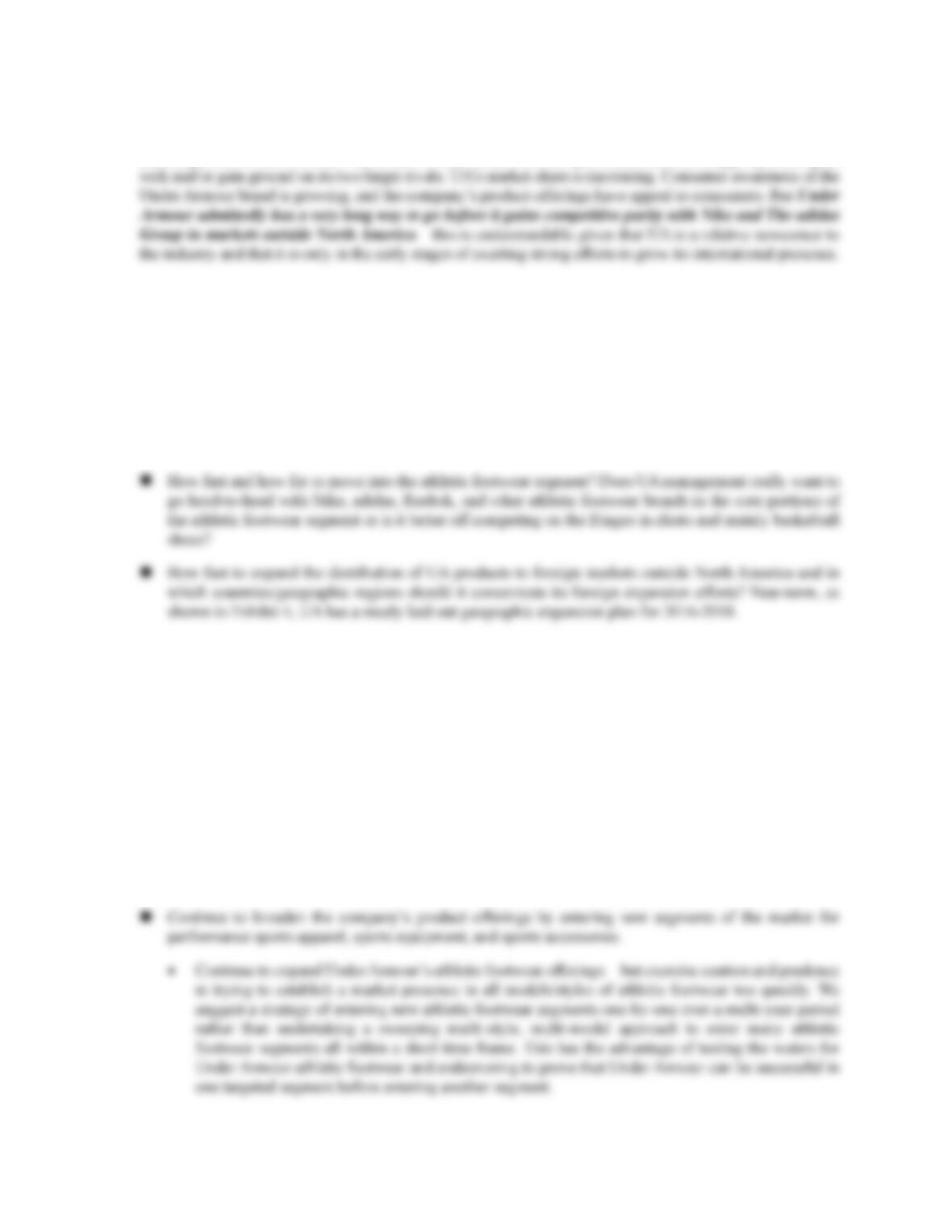
A representative competitive strength analysis of Under Armour, Nike, and The adidas Group is presented
in the table below.
Competitive Strength Assessments of Under Armour, Nike, and The adidas Group
(Rating scale for each strength measure: 1 = very weak; 5 = average; 10 = very strong)
Competitive Strength
Measures
Importance
Weight
Under Armour Nike adidas Group
Strength
Rating
Weighted
Score
Strength
Rating
Weighted
Score
Strength
Rating
Weighted
Score
Product line breadth 0.20 61.20 10 2.00 91.80
Product design,
technical innovation,
and new product
development 0.10 80.80 10 1.00 90.90
Geographic market
coverage 0.10 40.40 90.90 10 1.00
The competitive strength ratings in the above table indicate that Nike has the greatest competitive strength
of the 3 companies—in our view, it is clearly a formidable competitor on every one of the strength measures
However, had the competitive strength ratings been done for only the North American market where UA’s
revenues are concentrated, then UA’s strength ratings would have been higher and the ratings for The adidas
Group would have been below those for Under Armour.
Case 8 Teaching Note Under Armour’s Strategy in 2016
16
a net competitive edge over both The adidas Group and Under Armour. Worldwide, The adidas Group
seems at a “small” net competitive disadvantage vis-à-vis Nike and at a currently sizable net competitive
advantage over Under Armour. Yet, Under Armour is far from being so weak that it is struggling to compete
9. What 3-4 top priority issues do Kevin Plank and Under Armour management need to
address?
We think it is always a good idea to push the class for their assessment of what issues management needs
to address before proceeding to ask for action recommendations. Issue identification (or compilation of a
“worry list”) is a way for students to draw conclusions from all the preceding analysis, plus it sets the stage
for what actions need to be taken.
In Under Armour’s case, we see several high-priority issues that merit top management consideration:
10. What recommendations would you make to Under Armour CEO Kevin Plank? At a minimum,
your recommendations should cover what to do about each of the top priority issues
identified in question 9?
Students should be pressed to offer practical action recommendations to address the issues identified
in the prior question. But you should appreciate that coming up with good action recommendations for
Under Armour that go beyond what management is already doing is likely to prove challenging to many
class members. Under Armour seems very clearly to be on the right strategic path and all key elements
of its strategy are working well. No major strategy changes seem to be needed since there are no obvious
shortcomings or flaws in Under Armour’s present strategy.
The following recommendations seem to us to be on target and actions that students should propose be part
of Under Armour’s strategy:
Case 8 Teaching Note Under Armour’s Strategy in 2016
17
• We very much like UA’s strategy of focusing on premium running shoes and basketball shoes for the
time being—running shoes is a segment where competition from Nike is relatively weak (because
it is not a segment that is truly important to Nike) and UA’s NBA celebrity endorser Stephen Curry
has opened the door for UA to make inroads in basketball shoes with its Stephen Curry collections.
Continue to build consumer awareness of the Under Armour brand and to enhance the company’s brand
reputation by:
• Signing additional appealing celebrities to endorse and promote Under Armour products.
• Sponsoring growing numbers of highly visible sporting events.
Continue to use contract manufacturers to produce Under Armour products—integrating backward into
Epilogue
In April 2016, UA announced a 10-year partnership agreement with the University of California, Berkley and
whereby UA would not only exclusively design and supply the footwear, apparel and equipment for the athletic
department’s wide range of men’s and women’s sports, but also connect directly with the broader campus
community by providing student internships, employment opportunities for UC Berkeley graduates, charitable
partnerships and exclusive product discounts for campus departments, among other offerings.
One month later UA announced a 15-year partnership agreement with the University of California, Los Angeles
(UCLA) whereby Under Armour would exclusively design and supply the footwear, apparel and equipment for
training and game-day uniforms for all 25 of UCLA’s men’s and women’s varsity athletic teams.
Due to the bankruptcy and closure of The Sport Authority’s business and retail stores in early 2016 (that resulted
in UA only being able to recognize $43 million of the originally planned $163 million in revenues with The Sports
Authority for 2016), UA announced on May 31, 2016, that it now expected 2016 net revenues of approximately
$4.925 billion, representing growth of 24% over 2015, and 2016 operating income of approximately $440
million to $445 million.
Case 8 Teaching Note Under Armour’s Strategy in 2016
18
Management said it expected UA would report full-year 2016 net revenues of approximately $4.925 billion (up
24% over 2015) and operating income in the range of approximately $440 million to $445 million, representing
growth of 8% to 9% over 2015.
In commenting on UA’s results for Q3 2016, CEO Kevin Plank said:
As we think about the many dimensions of growth for our company, we’re incredibly confident
in the opportunity we see for our North America business. Consider this, our two largest
competitors generated approximately $18 billion in revenue in North America over just the
past 12 months. So, while we recognize that our trailing 12 month North American revenues of
$3.95 billion is 85% of our business, it is just a fraction of the opportunity that we believe exists
for our brand. Whether it’s through share gains, market growth, new distribution or sheer brand
heat, we know we have tremendous runway in our home market.
….recently I pulled together the top leaders in the company and discussed the strategic growth
and direction of Under Armour. We came away with three key areas of focus….. First, getting
big fast. Second, making retail a core competency. And third, getting more shoes on feet.
….we have succeeded over the past 20 years by consistently punching above our weight and
that will not change. But our growth now gives us opportunities to move up in weight class and
we find ourselves well-positioned at this moment in time to compete for long-term relationships
with athletes, teams and league affiliations that we previously could not justify.
Case 8 Teaching Note Under Armour’s Strategy in 2016
19
Plank’s announcements (1) that UA was lowering its long-term growth rate expectations for apparel revenues
(due to a noticeable slowing of North America apparel growth across the industry) and (2) that UA’s operating
For the latest information on developments at Under Armour, please visit the Investor Relations section at
www.underarmour.com and check out the company’s recent press releases and financial results.