Communication Case 8–4
Suggested Grading Concepts and Grading Scheme:
Content (70%)
_______ Prices are increasing.
_______ Prices are decreasing.
_______ The actual physical flow of product.
_______ The better match of expenses with revenues
provided by LIFO.
_______ The effect on the balance sheet.
_______ The effect on reported income and income
taxes.
_______ The cost of implementation of LIFO.
a company using LIFO to present supplemental
non-LIFO disclosures.
_______
________ 70 points
Writing (30%)
_______ Introduction that states purpose.
_______ Paragraphs that separate main points.
_______ Sentences grammatically clear and well organized,
concise.
_______ Word selection.
_______ Spelling.
_______ Grammar and punctuation.
_______
Communication Case 8–5
LIFO produces a higher cost of goods sold, lower taxable income, and
therefore lower income taxes currently payable than FIFO only in periods when the
costs of the company’s products are rising. When costs are decreasing, LIFO
results in lower cost of goods sold, higher taxable income, and a higher current tax
liability than FIFO. In the case of the electronics client, you would explain this to
the intern concluding that the costs of the client’s products must be decreasing, as
frequently occurs in this industry.
Judgment Case 8–6
At the end of a reporting period it is important to ensure that a proper
inventory cutoff is made. A proper cutoff involves the determination of the
ownership of goods that are in transit between the company and its customers as
well as the company and its suppliers. If the shipment is made f.o.b. shipping
point, then ownership is transferred to the buyer when the goods reach the common
carrier. If the shipment is made f.o.b. destination, then ownership is transferred to
the buyer when the goods arrive at the buyer’s location.
In this case, John is incorrect if the goods were shipped f.o.b. destination. If
so, even though the company is not in physical possession of the goods, they
should be included in ending inventory because the shipment had not reached the
buyer’s location by the end of the reporting period.
Ethics Case 8–7
Requirement 1
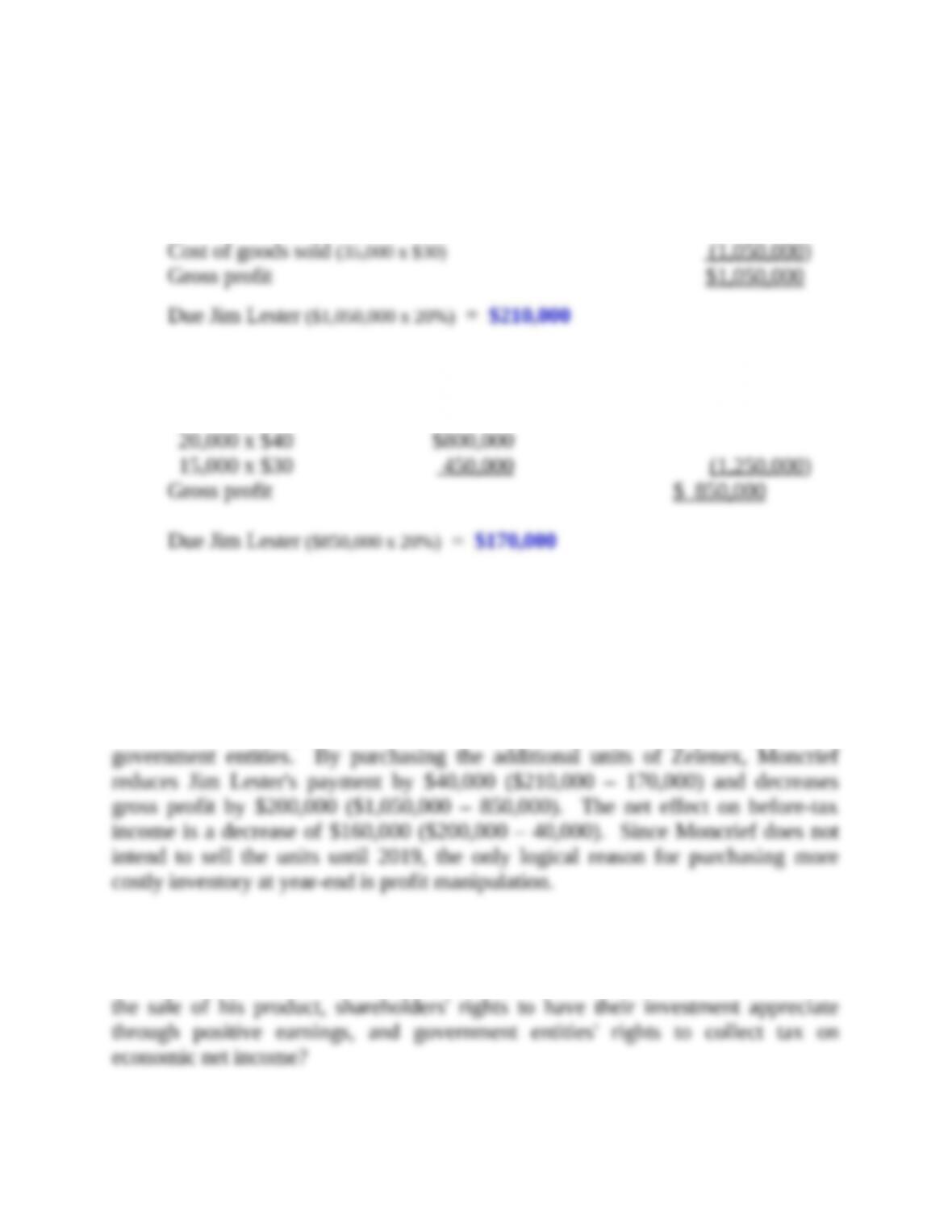
Without purchase of the additional units:
Sales (35,000 @ $60) $2,100,000
With purchase of the additional units:
Sales $2,100,000
Cost of goods sold:
Requirement 2
Discussion should include these elements.
Facts:
If Moncrief purchases the additional units at the end of the year under a
periodic LIFO inventory system, the transaction results in a reduced payment to
Jim Lester, reduced profits to shareholders, and reduced income tax payments to
Ethical Dilemma:
Should Moncrief exercise its right to purchase inventory at will, resulting in a
reduction in net income, or recognize the rights of Jim Lester to receive profit for

Real World Case 8–8
Requirement 1
The LIFO conformity rule permits LIFO users to present disclosures that
Requirement 2
January 2, 2016
Ending Beginning
Inventory Inventory
($ in millions)
Requirement 3
Cost of goods sold for the fiscal year ended January 2, 2016, would have been
$1.9 million lower had Wolverine used FIFO for its entire inventory. The increase

Real World Case 8–9
Requirement 3
The following is based on Whole Foods’ 2015 financial statements.
Answers will vary depending on the financial statement dates chosen.
a. Whole Foods uses the last-in, first-out (LIFO) method for approximately
b. Assuming that current cost approximates FIFO cost, the inventory disclosure
note indicates that, if FIFO had been used to value LIFO inventories,
inventories would have been higher than reported by $49 million at the end
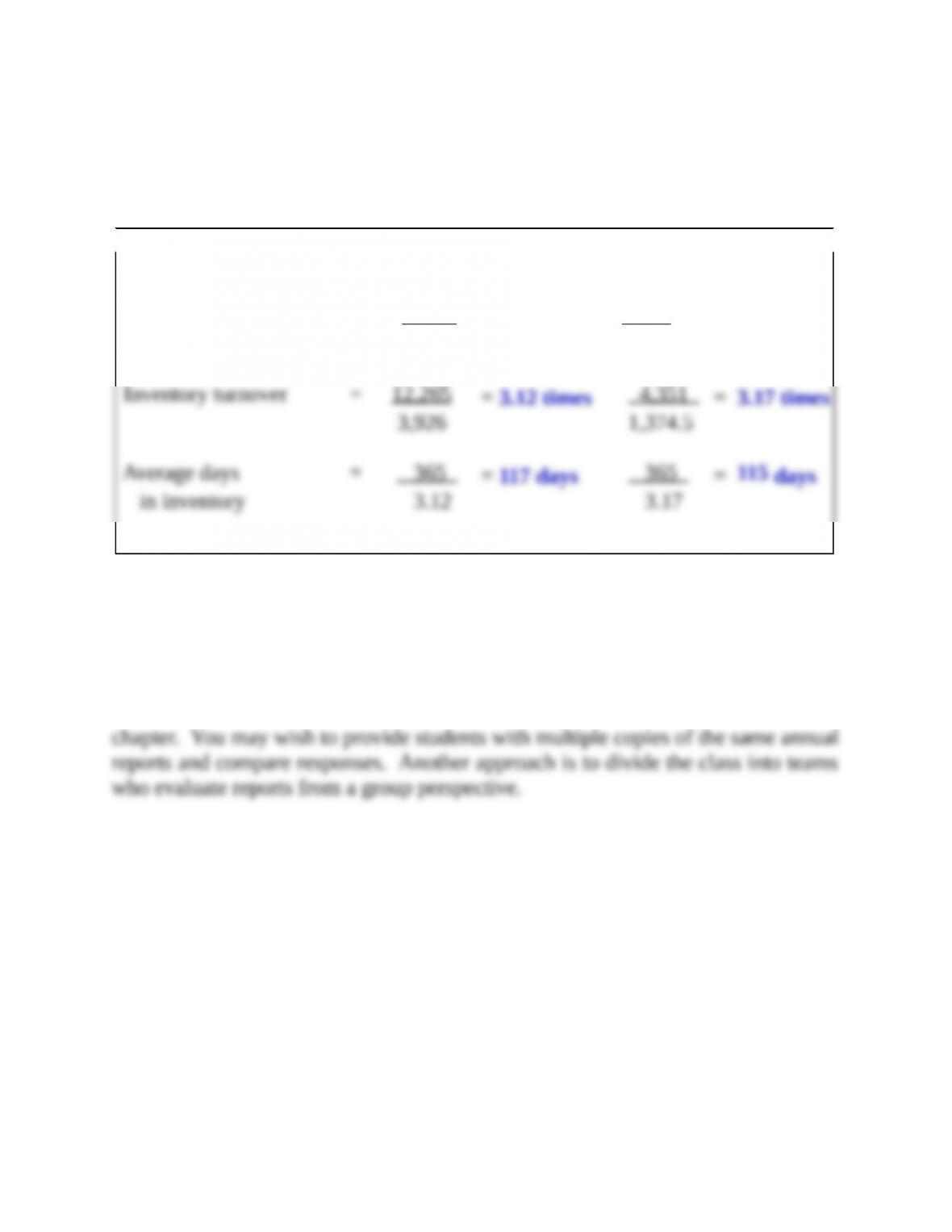
c. Inventory turnover = cost of goods sold divided by average inventory
($ in millions)

Communication Case 8–10
The dollar-value LIFO inventory estimation technique begins with the
determination of the current year’s ending inventory valued in terms of year-end
The next step is to convert the ending inventory from year-end costs to base
year costs. This usually is accomplished by dividing the ending inventory at
The next step in the procedure is to identify the layers in ending inventory
with the years they were created by comparing ending inventory at base year cost
The final step converts the layers identified to cost by multiplying the layers at
Research Case 8–11
Requirement 1
The FASB’s codification citation that provides guidance for determining
Requirement 2
The FASB’s codification citation that addresses the recognition of a product
Requirement 3
The appropriate accounting treatment for this type of arrangement is for the
sponsor to record a liability at the time the proceeds are received from the other
entity. The sponsor does not record the transaction as a sale and does not remove
Requirement 4
Journal entry to record the “sale” (cash receipt):
Journal entry to record the repurchase:

Research Case 8–11 (concluded)
*The treatment of these costs depends on the accounting policies of the sponsor.
Analysis Case 8–12
Requirement 1
($ in millions)
KOHL’SDILLARDS
Gross profit ratio = 6,939 = 36.1% 2,404 = 35.6%
19,204 6,755
The gross profit ratios for the two companies are similar, as are their turnover
ratios.
Requirement 2
The objective of this requirement is to motivate students to obtain hands-on
familiarity with actual annual reports and to apply the techniques learned in the
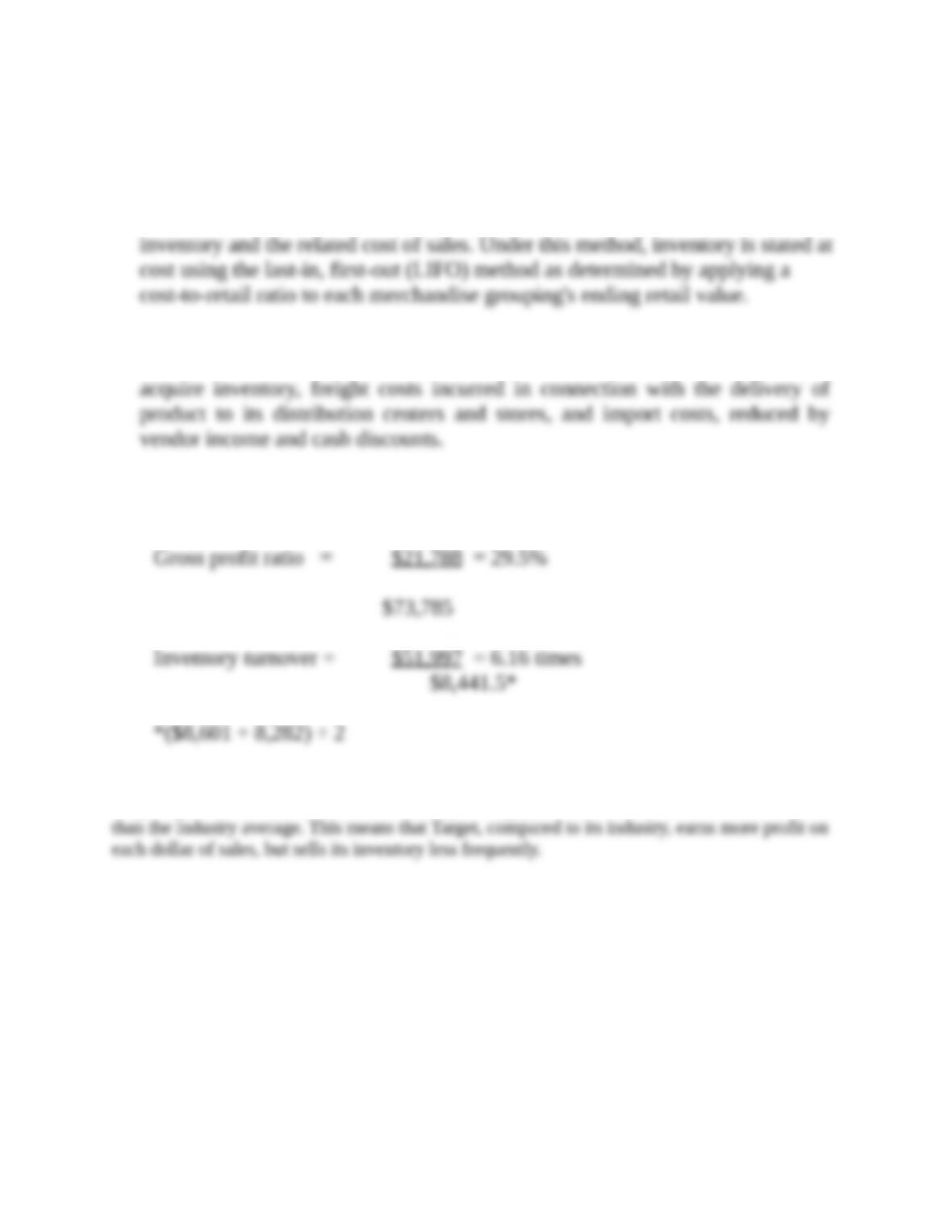
Target Case
Requirement 1
Target uses the retail inventory method to account for the majority of its
Requirement 2
The cost of inventory includes the amount Target pays to its suppliers to
Requirement 3
($ in millions)
Target’s gross profit ratio is above the industry average, and its inventory turnover ratio is lower