Question 8–1
Question 8–2
Question 8–3
Perpetual System Periodic System
(1) Purchase of merchandise debit inventory debit purchases
Solutions Manual, Vol.1, Chapter 8 8–1
Copyright © 2015 McGraw-Hill Education. All rights reserved. No reproduction or distribution without the prior written consent
of McGraw-Hill Education.
Chapter 8 Inventories: Measurement
QUESTIONS FOR REVIEW OF KEY TOPICS
Inventory for a manufacturing company consists of (1) raw materials, (2) work in
process, and (3) finished goods. Raw materials represent the cost, primarily purchase
price plus freight charges, of goods purchased from suppliers that will become part of
Beginning inventory plus net purchases for the period equals cost of goods
available for sale. The main difference between a perpetual and a periodic
Answers
to Questions (continued)
Question 8–4
Question 8–5
Question 8–6
Question
8–7
8–2 Intermediate Accounting, 8/e
Copyright © 2015 McGraw-Hill Education. All rights reserved. No reproduction or distribution without the prior written consent
of McGraw-Hill Education.
Inventory shipped f.o.b. shipping point is included in the inventory of the
purchaser when the merchandise reaches the common carrier. Laetner
A consignment is an arrangement under which goods are physically transferred to
another company (the consignee), but the transferor (consignor) retains legal title. If
By the gross method, purchase discounts not taken are viewed as part of
Answers to Questions (continued)
Question 8–8
Question 8–9
Question 8–10
Solutions Manual, Vol.1, Chapter 8 8–3
Copyright © 2015 McGraw-Hill Education. All rights reserved. No reproduction or distribution without the prior written consent
of McGraw-Hill Education.
1. Beginning inventory — increase
2. Purchases — increase
Four methods of assigning cost to ending inventory and cost of goods sold are (1)
specific identification, (2) first-in, first-out (FIFO), (3) last-in, first-out (LIFO), and
(4) average cost. The specific identification method requires each unit sold during the
When costs are declining, LIFO will result in a lower cost of goods sold and

Answers
to Questions (continued)
Question 8–11
Question 8–12
Question 8–14
8–4 Intermediate Accounting, 8/e
Copyright © 2015 McGraw-Hill Education. All rights reserved. No reproduction or distribution without the prior written consent
of McGraw-Hill Education.
Proponents of LIFO argue that it provides a better match of revenues and
expenses because cost of goods sold includes the costs of the most recent
purchases. These are matched with sales that reflect a current selling price.
Many companies choose the LIFO inventory method to reduce income taxes in
periods when prices are rising. In periods of rising prices, LIFO results in a higher
cost of goods sold and therefore a lower net income than the other methods. The
The gross profit, inventory turnover, and average days in inventory ratios are
designed to monitor inventories. The gross profit ratio is calculated by dividing
Answers to Questions (concluded)
Question 8–15
Beginning inventory $186,000
To record the purchase of inventory on account.
To record sales on account and cost of goods sold.
Solutions Manual, Vol.1, Chapter 8 8–5
Copyright © 2015 McGraw-Hill Education. All rights reserved. No reproduction or distribution without the prior written consent
of McGraw-Hill Education.
The dollar-value LIFO method has important advantages. First, it simplifies the
recordkeeping procedures compared to unit LIFO because no information is needed
about unit flows. Second, it minimizes the probability of the liquidation of LIFO
After determining ending inventory at year-end cost, the following steps remain:
1. Convert ending inventory valued at year-end cost to base year cost.
2. Identify the layers in ending inventory with the years they were created.
3. Convert each layer’s base year cost measurement to layer year cost measurement
using the layer year’s cost index and then sum the layers.
Question 8–16
BRIEF EXERCISES
Brief Exercise 8–1
Brief Exercise 8–2
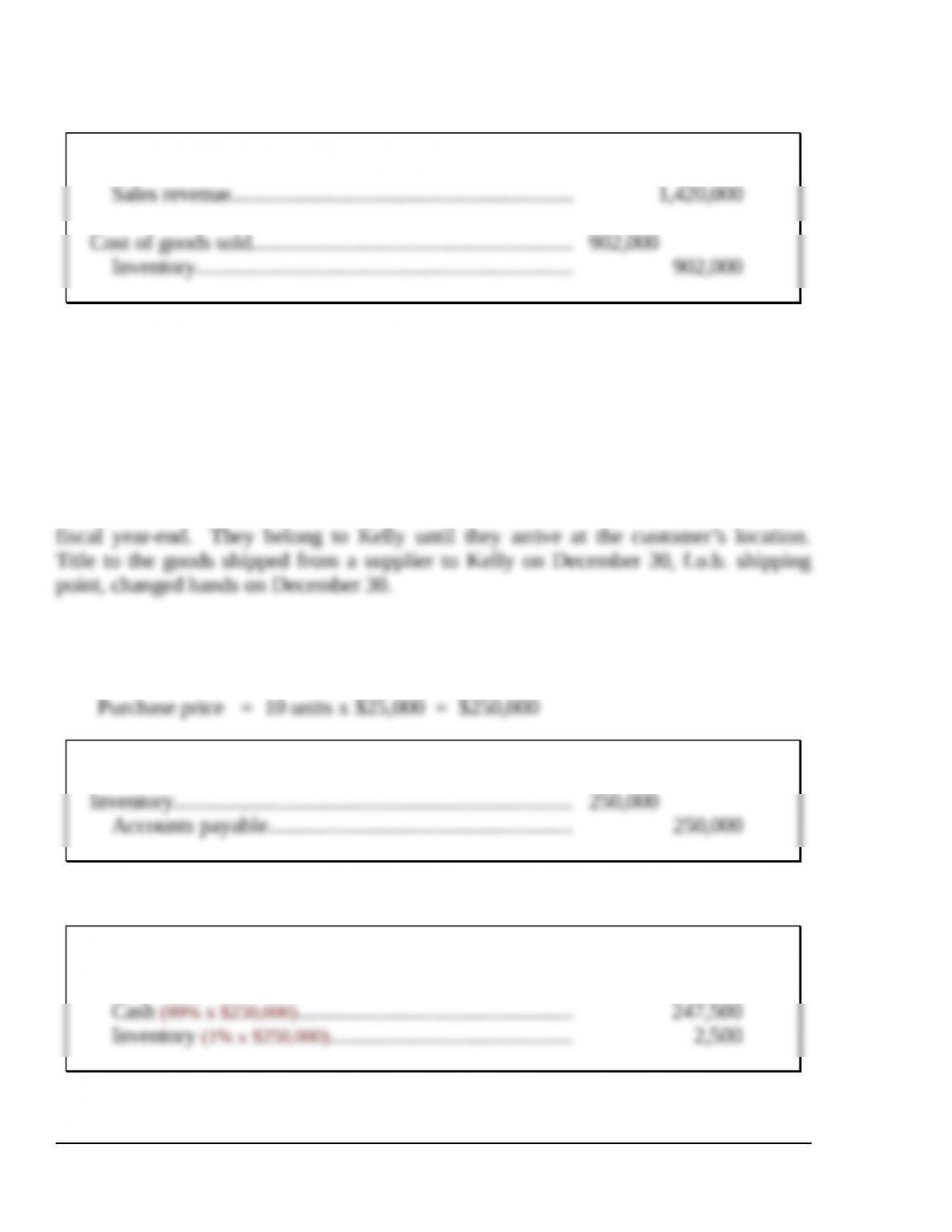
Accounts receivable………………………………………………..1,420,000
Both shipments should be included in inventory. The goods shipped to a
customer f.o.b. destination did not arrive at the customer’s location until after the
December 28, 2018
January 6, 2019
Accounts payable…………………………………………………… 250,000
8–6 Intermediate Accounting, 8/e
Copyright © 2015 McGraw-Hill Education. All rights reserved. No reproduction or distribution without the prior written consent
of McGraw-Hill Education.
Brief Exercise 8–3
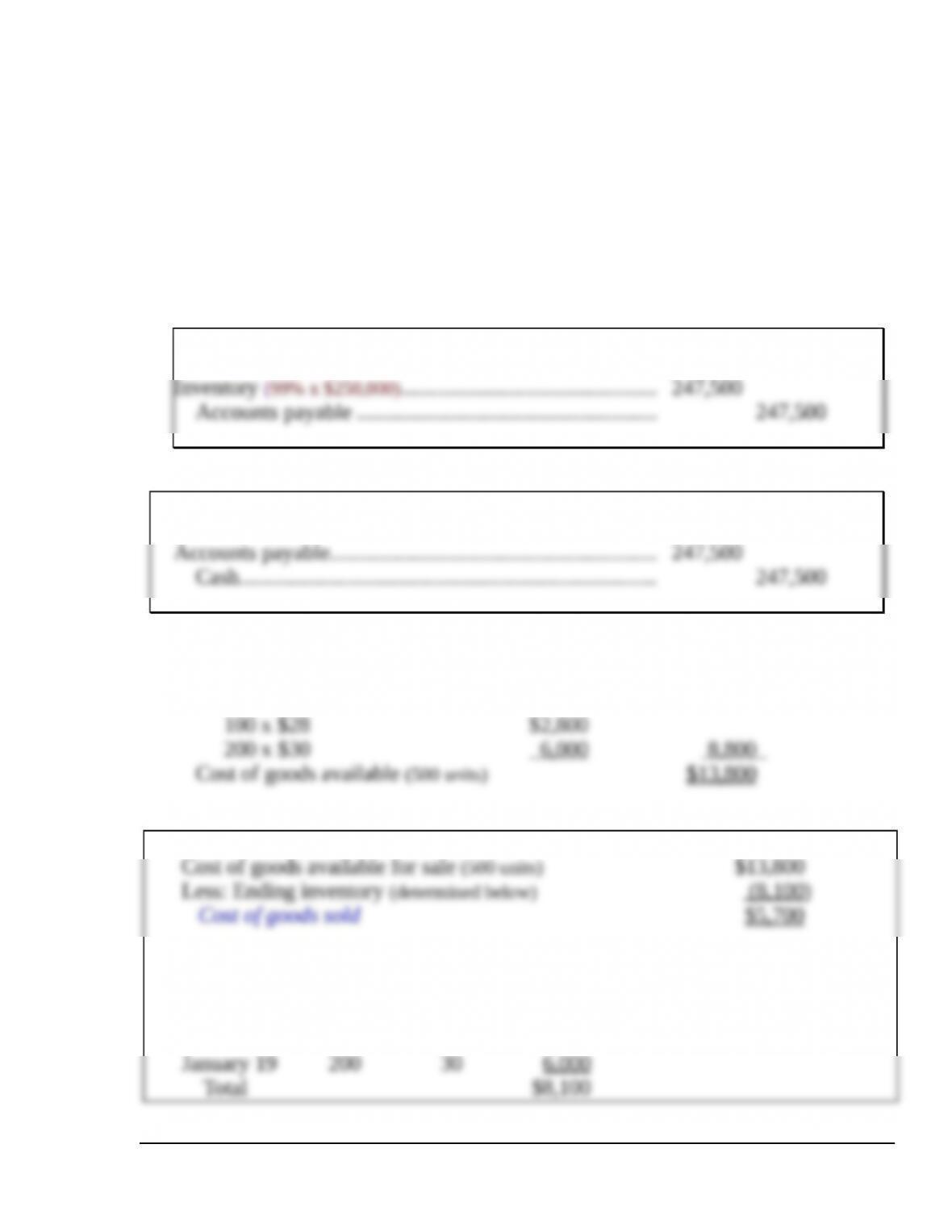
December 28, 2018
January 6, 2019
Cost of goods available for sale:
Beginning inventory (200 x $25) $5,000
Purchases:
First-in, first-out (FIFO)
Cost of ending inventory:
Date of
purchase Units Unit cost Total cost
January 8 75 $28 $2,100
Solutions Manual, Vol.1, Chapter 8 8–7
Copyright © 2015 McGraw-Hill Education. All rights reserved. No reproduction or distribution without the prior written consent
of McGraw-Hill Education.
Brief Exercise 8–5
Brief Exercise 8–6
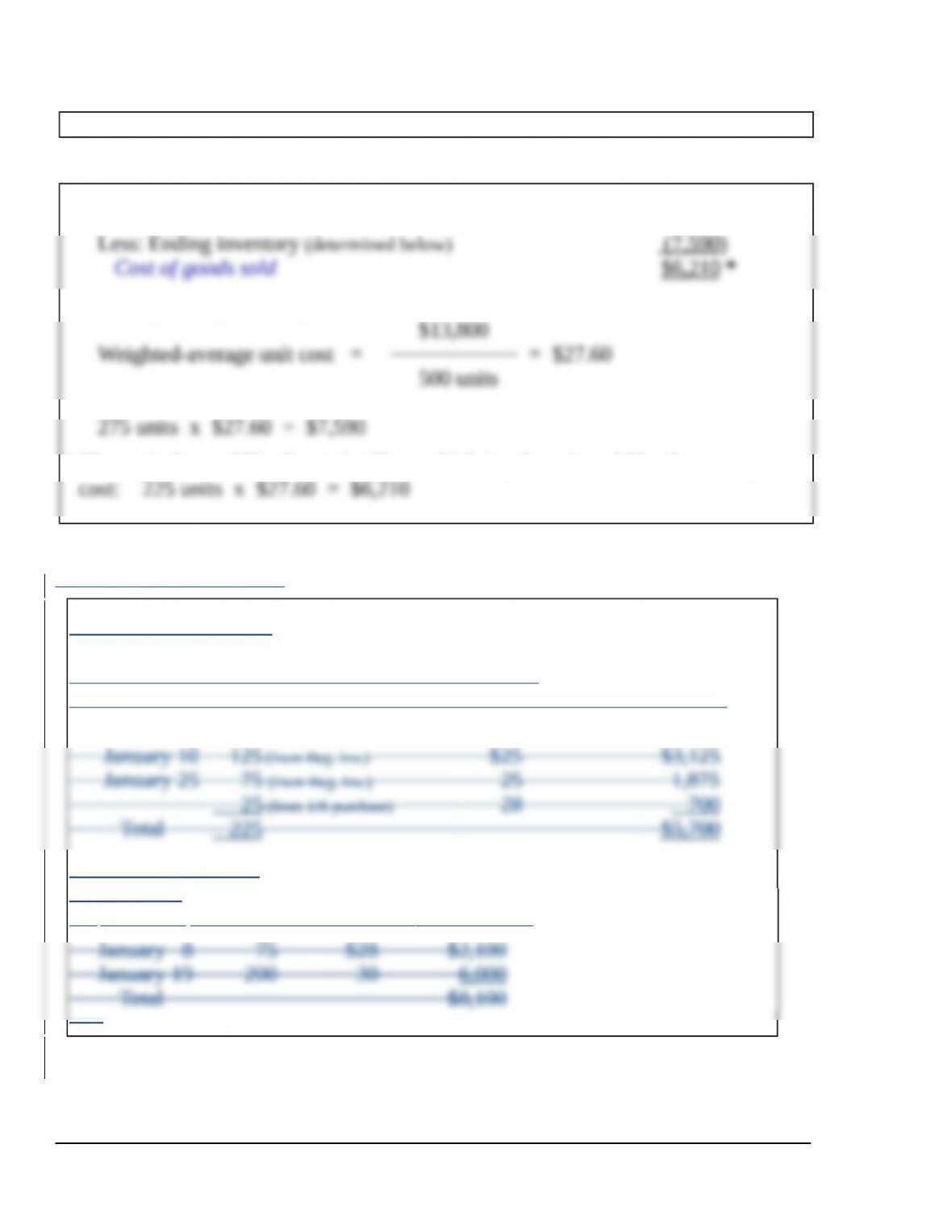
Average cost
Cost of goods available for sale (500 units) $13,800
Cost of ending inventory:
* Alternatively, could be determined by multiplying the units sold by the average
First-in, first-out (FIFO)
Cost of goods sold:
Date of Cost of
Sale Units Sold Units Sold Total Cost
Ending inventory:
Date of
Purchase Units Unit Cost Total Cost
8–8 Intermediate Accounting, 8/e
Copyright © 2015 McGraw-Hill Education. All rights reserved. No reproduction or distribution without the prior written consent
of McGraw-Hill Education.
Brief Exercise 8–7
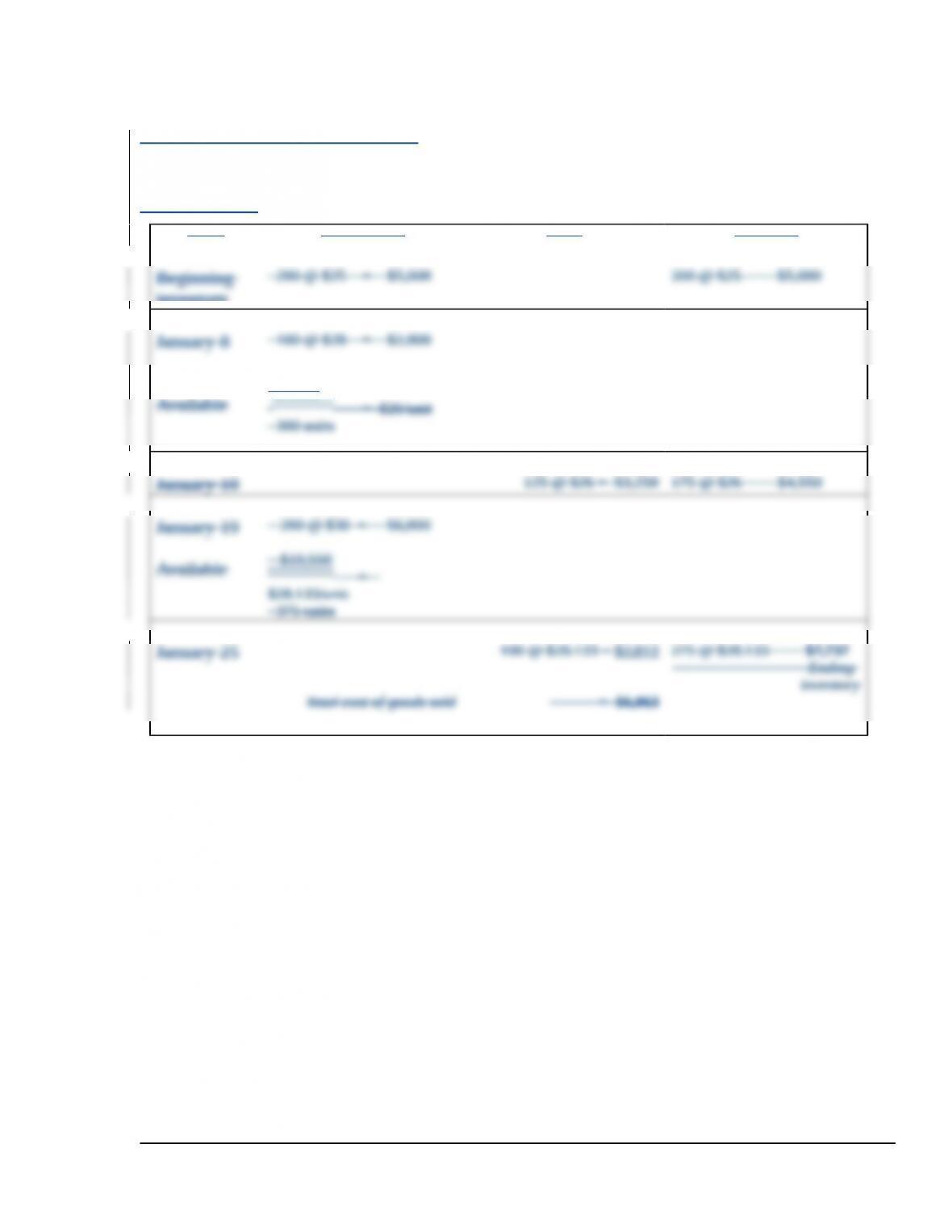
Brief Exercise 8–7 (concluded)
Average cost
Date Purchased Sold Balance
inventory
$7,800
Solutions Manual, Vol.1, Chapter 8 8–9
Copyright © 2015 McGraw-Hill Education. All rights reserved. No reproduction or distribution without the prior written consent
of McGraw-Hill Education.
Cost of goods available for sale:
Cost of goods sold without year-end purchase:
Units purchased during the year: 60,000 x $18 $1,080,000
If FIFO were used instead of LIFO, the year-end purchase would have no effect
on income before income taxes. FIFO cost of goods sold with or without the purchase
would consist of the 10,000 units from beginning inventory and 54,000 units
purchased during the year at $18:
8–10 Intermediate Accounting, 8/e
Copyright © 2015 McGraw-Hill Education. All rights reserved. No reproduction or distribution without the prior written consent
of McGraw-Hill Education.
Brief Exercise 8–8
Brief Exercise 8–9
Cost of goods sold for the year ended August 31, 2015, would have been $200
million lower had Walgreens used FIFO for its LIFO inventory. While beginning
inventory would have been $2,300 million higher, ending inventory also would have
been higher by $2,500 million. An increase in beginning inventory causes an increase
in cost of goods sold, but an increase in ending inventory causes a decrease in cost of
goods sold. Purchases for the year are the same regardless of the inventory valuation
method used.
Cost of goods sold Average inventory = Inventory turnover
Solutions Manual, Vol.1, Chapter 8 8–11
Copyright © 2015 McGraw-Hill Education. All rights reserved. No reproduction or distribution without the prior written consent
of McGraw-Hill Education.
Brief Exercise 8–11
Ending Inventory Inventory Layers Inventory Layers Inventory
Date at Base Year Cost at Base Year Cost Converted to Cost DVL Cost
8–12 Intermediate Accounting, 8/e
Copyright © 2015 McGraw-Hill Education. All rights reserved. No reproduction or distribution without the prior written consent
of McGraw-Hill Education.
Brief Exercise 8–13
1. To record the purchase of inventory on account and the payment
of freight charges.
2. To record purchase returns.
3. To record cash sales and cost of goods sold.
1. To record the purchase of inventory on account and the payment
of freight charges.
Solutions Manual, Vol.1, Chapter 8 8–13
Copyright © 2015 McGraw-Hill Education. All rights reserved. No reproduction or distribution without the prior written consent
of McGraw-Hill Education.
EXERCISES
Exercise 8–1
Exercise 8–2
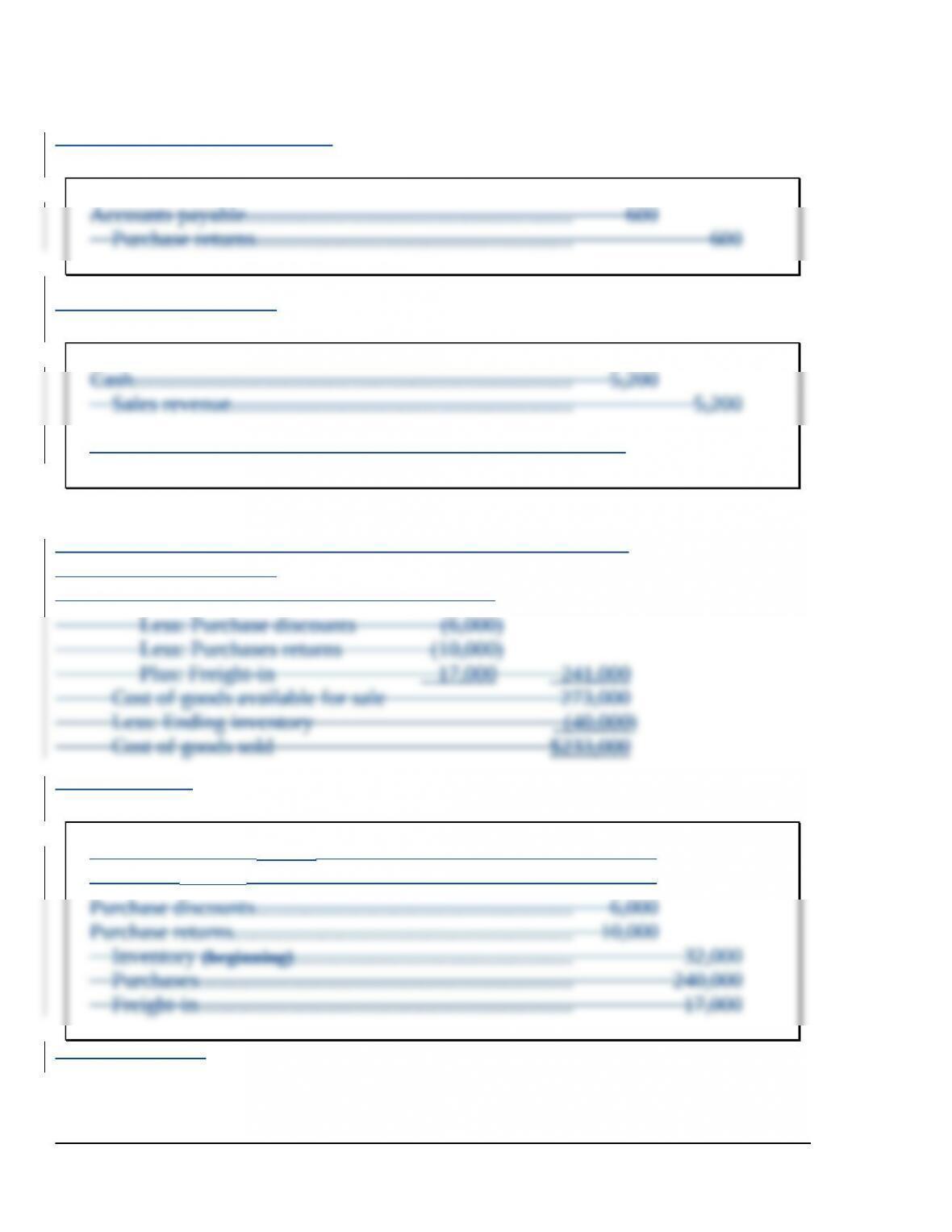
2. To record purchase returns.
3. To record cash sales.
NO ENTRY IS MADE FOR THE COST OF GOODS SOLD.
Requirement 1
Beginning inventory $ 32,000
Plus net purchases:
Purchases $240,000
Requirement 2
Cost of goods sold (above) ……………………………………….. 233,000
Inventory (ending) …………………………………………………… 40,000
8–14 Intermediate Accounting, 8/e
Copyright © 2015 McGraw-Hill Education. All rights reserved. No reproduction or distribution without the prior written consent
of McGraw-Hill Education.
Exercise 8–3
Exercise 8–4
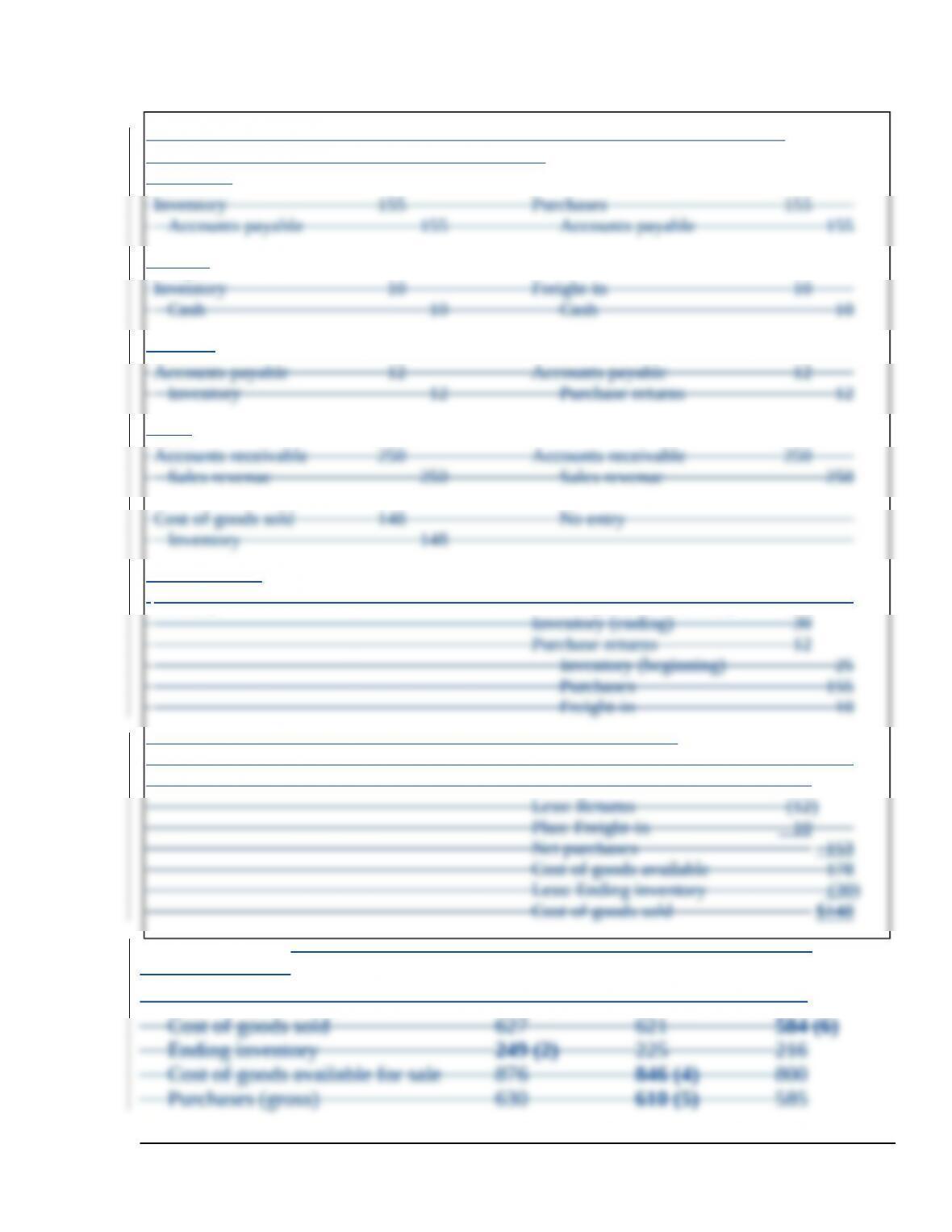
PERPETUAL SYSTEM PERIODIC SYSTEM
($ in 000s)
Purchases
Freight
Returns
Sales
End of period
No entry Cost of goods sold (below) 148
Cost of goods sold:
Beginning inventory $25
Purchases $155
2018 2019 2020
Beginning inventory 275 (1) 249 (3) 225
Solutions Manual, Vol.1, Chapter 8 8–15
Copyright © 2015 McGraw-Hill Education. All rights reserved. No reproduction or distribution without the prior written consent
of McGraw-Hill Education.
Exercise 8–5

Net purchases = Purchases (gross) – Purchase returns – Purchase discounts + Freight-in
Beginning inventory + Net purchases = Cost of goods available for sale
Cost of goods available for sale – Ending inventory = Cost of goods sold
2018:
(1) Cost of goods available for sale – Net purchases = Beginning inventory
(2) Cost of goods available for sale – Cost of goods sold = Ending inventory
2019:
(3) 2019 beginning inventory = 2018 ending inventory = 249
(4) Cost of goods sold + Ending inventory = Cost of goods available for sale
(5) Cost of goods available for sale – Beginning inventory = Net purchases
Net purchases + Purchases discounts + Purchase returns – Freight-in = Purchases(gross)
2020:
(6) Cost of goods available for sale – Ending inventory = Cost of goods sold
8–16 Intermediate Accounting, 8/e
Copyright © 2015 McGraw-Hill Education. All rights reserved. No reproduction or distribution without the prior written consent
of McGraw-Hill Education.
Exercise 8–5 (concluded)
(7) Cost of goods available for sale – Beginning inventory = Net purchases
Purchases (gross) – Purchase returns + Freight-in – Net purchases = Purchase discounts
Inventory balance before additional transactions
$165,000
Add:
Inventory balance before additional transactions
$210,000
Add:
1. Excluded
2. Included
3. Included
Requirement 1
Solutions Manual, Vol.1, Chapter 8 8–17
Copyright © 2015 McGraw-Hill Education. All rights reserved. No reproduction or distribution without the prior written consent
of McGraw-Hill Education.
Exercise 8–6
Exercise 8–7
Exercise 8–8
Exercise 8–9
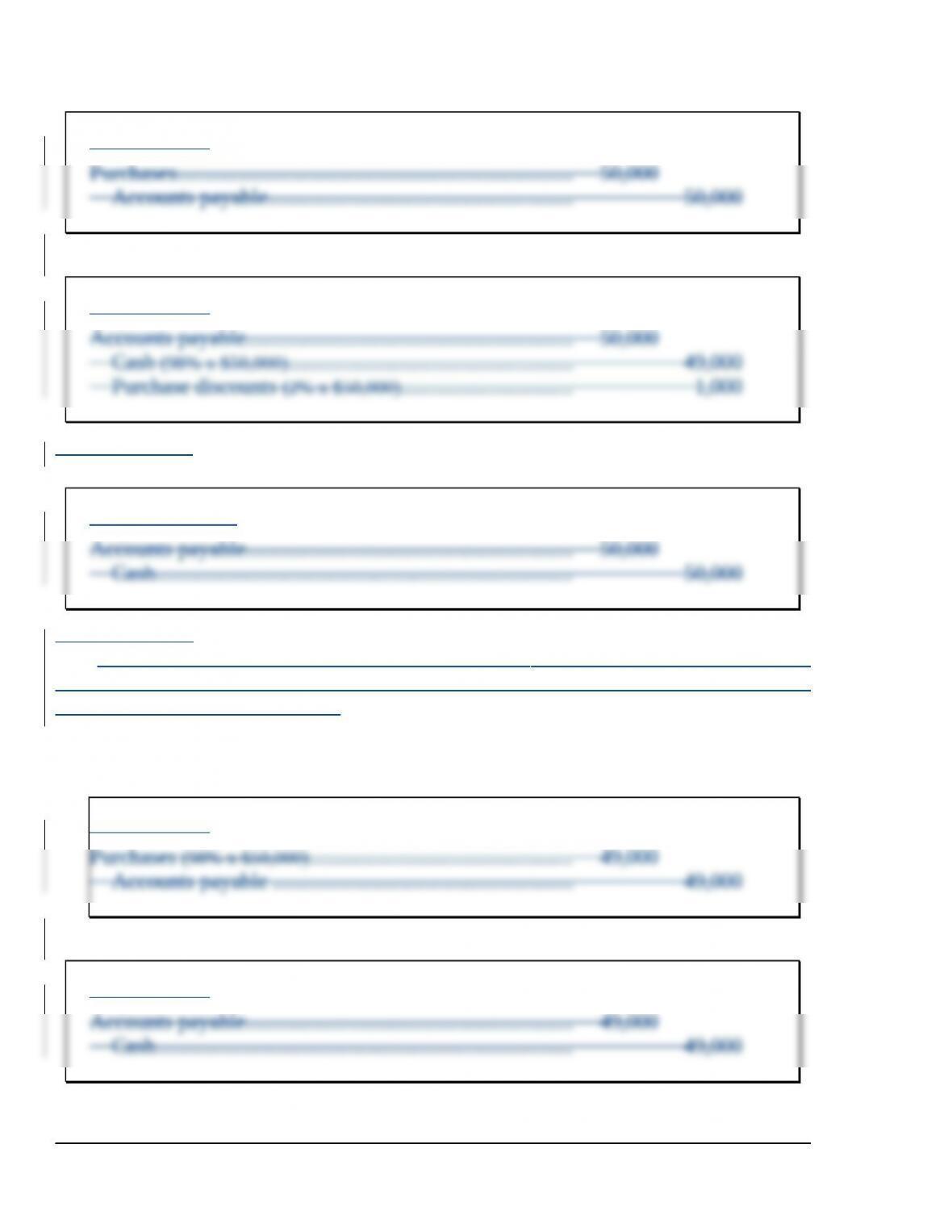
July 15, 2018
July 23, 2018
Requirement 2
August 15, 2018
Requirement 3
The July 15 entry would include a debit to the inventory account instead of to
purchases, and the July 23 entry would include a credit to the inventory account
instead of to purchase discounts.
Requirement 1
July 15, 2018
July 23, 2018
8–18 Intermediate Accounting, 8/e
Copyright © 2015 McGraw-Hill Education. All rights reserved. No reproduction or distribution without the prior written consent
of McGraw-Hill Education.
Exercise 8–10
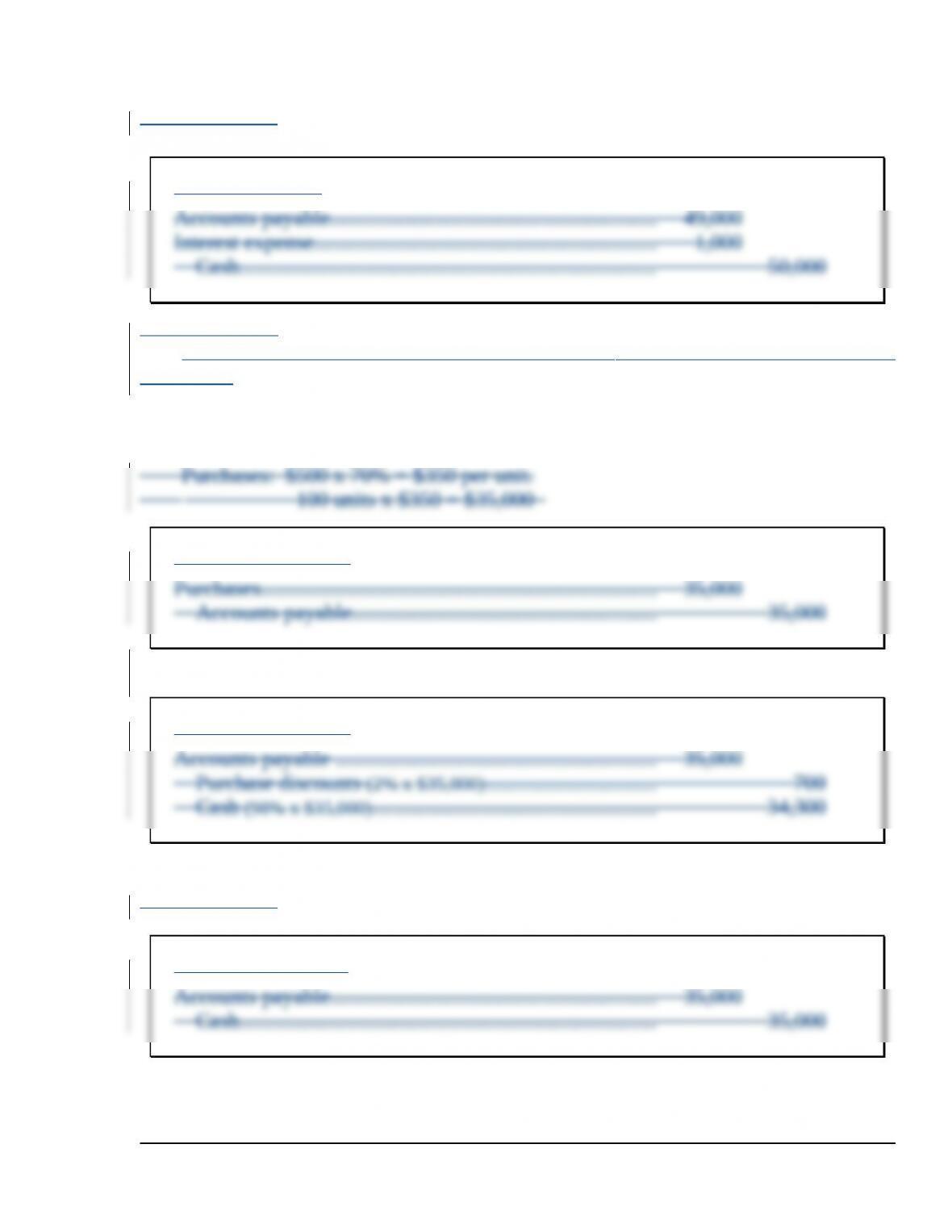
Requirement 2
August 15, 2018
Requirement 3
The July 15 entry would include a debit to the inventory account instead of to
purchases.
Requirement 1
November 17, 2018
November 26, 2018
Requirement 2
December 15, 2018
Solutions Manual, Vol.1, Chapter 8 8–19
Copyright © 2015 McGraw-Hill Education. All rights reserved. No reproduction or distribution without the prior written consent
of McGraw-Hill Education.
Exercise 8–11
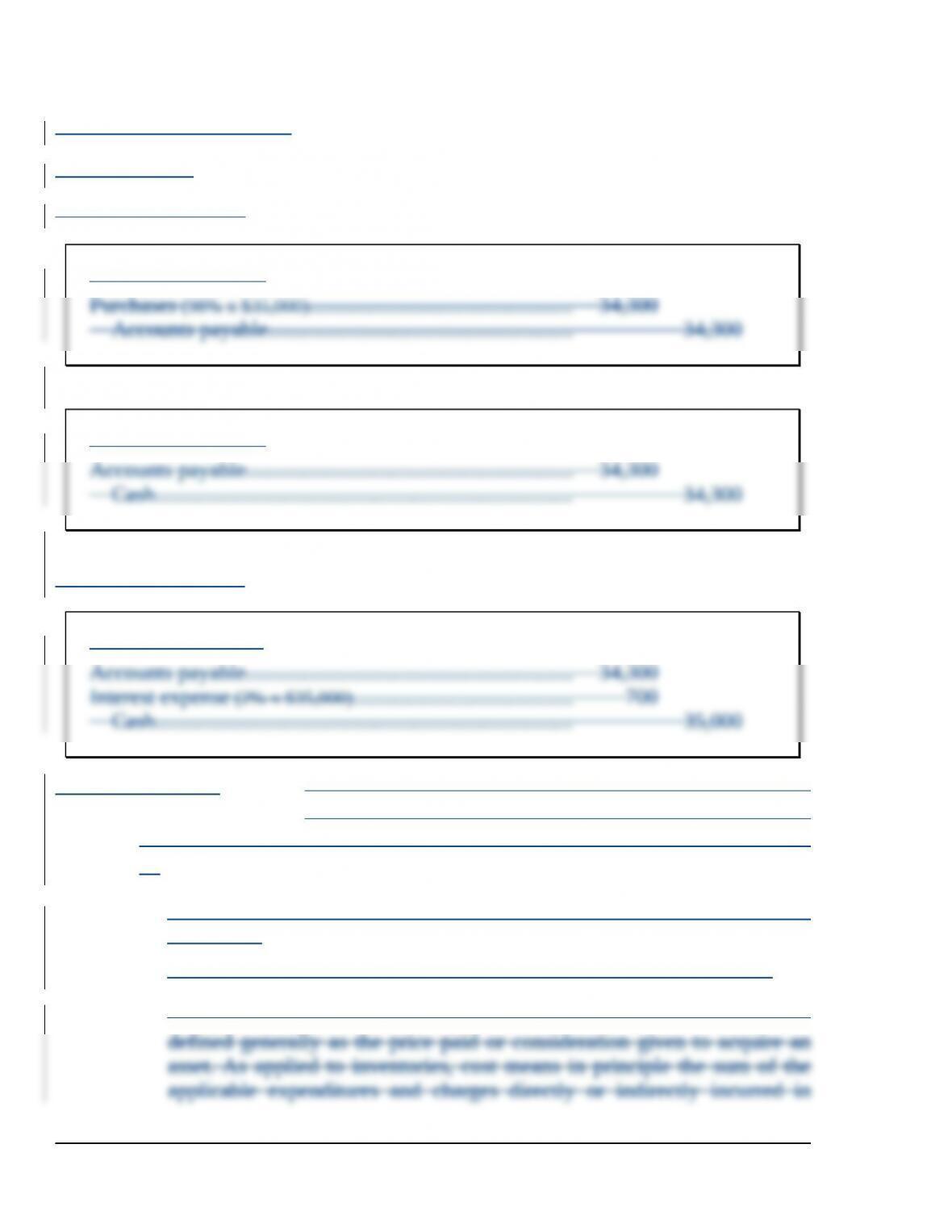
Exercise 8–11 (concluded)
Requirement 3
Requirement 1:
November 17, 2018
November 26, 2018
Requirement 2:
December 15, 2018
The FASB Accounting Standards Codification® represents
the single source of authoritative U.S. generally accepted
accounting principles. The specific citation for each of the following items
is:
1. Define the meaning of cost as it applies to the initial measurement of
inventory.
FASB ASC 330–10–30–1: “Inventory–Overall–Initial Measurement.”
The primary basis of accounting for inventories is cost, which has been
8–20 Intermediate Accounting, 8/e
Copyright © 2015 McGraw-Hill Education. All rights reserved. No reproduction or distribution without the prior written consent
of McGraw-Hill Education.
Exercise 8–12
2. Indicate the circumstances when it is appropriate to initially
measure agricultural inventory at fair value.
FASB ASC 905–330–30–1: “Agriculture–Inventory–Initial
Measurement.”
Exceptional cases exist in which it is not practicable to determine an
appropriate cost basis for products. A market basis is acceptable if the
products meet all of the following criteria:
a. They have immediate marketability at quoted market prices that
cannot be influenced by the producer.
Solutions Manual, Vol.1, Chapter 8 8–21
Copyright © 2015 McGraw-Hill Education. All rights reserved. No reproduction or distribution without the prior written consent
of McGraw-Hill Education.
Exercise 8–12 (concluded)
3. What is a major objective of accounting for inventory?
FASB ASC 330–10–10–1: “Inventory–Overall–Objectives.”
4. Are abnormal freight charges included in the cost of inventory?
FASB ASC 330–10–30–7: “Inventory–Overall–Initial Measurement.”
Unallocated overheads shall be recognized as an expense in the period in which
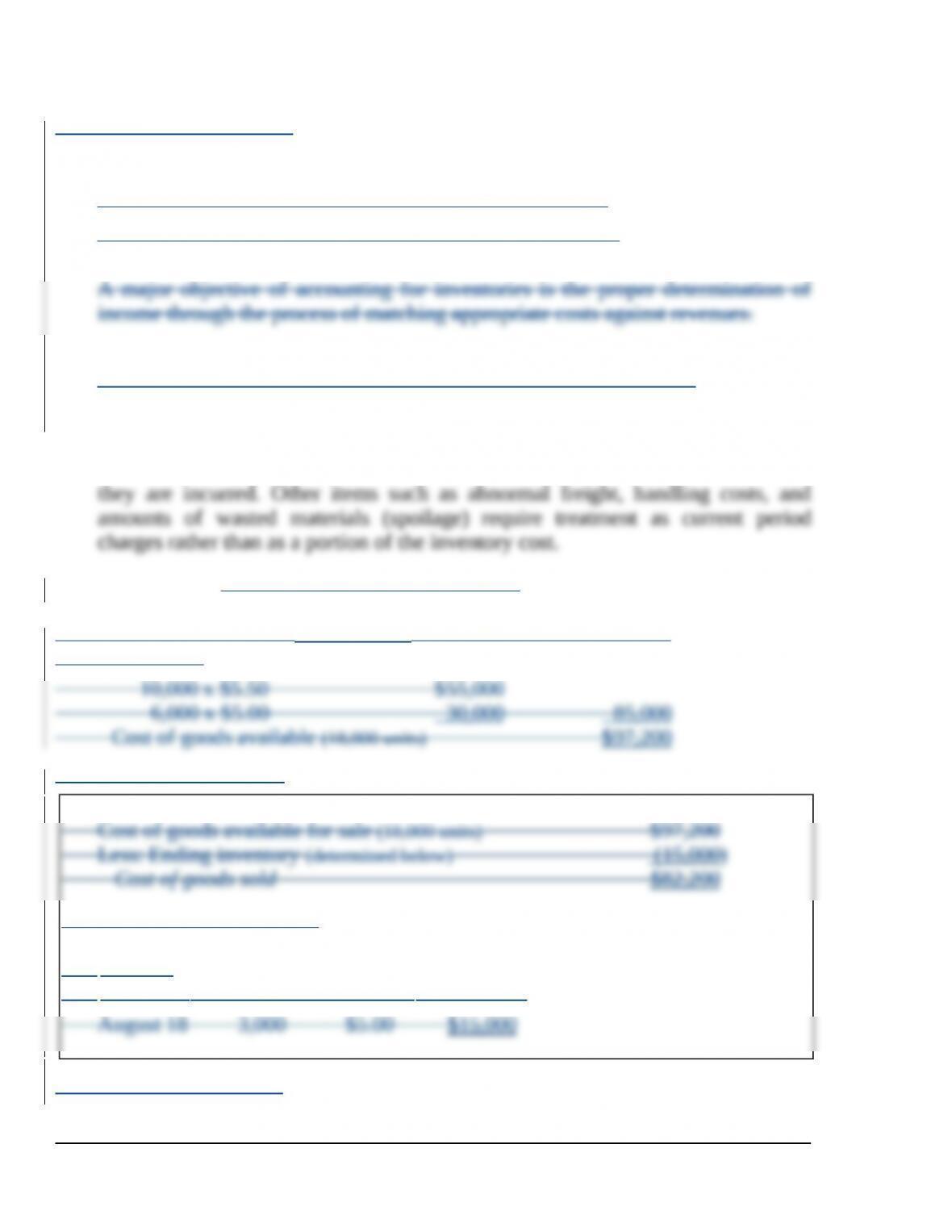
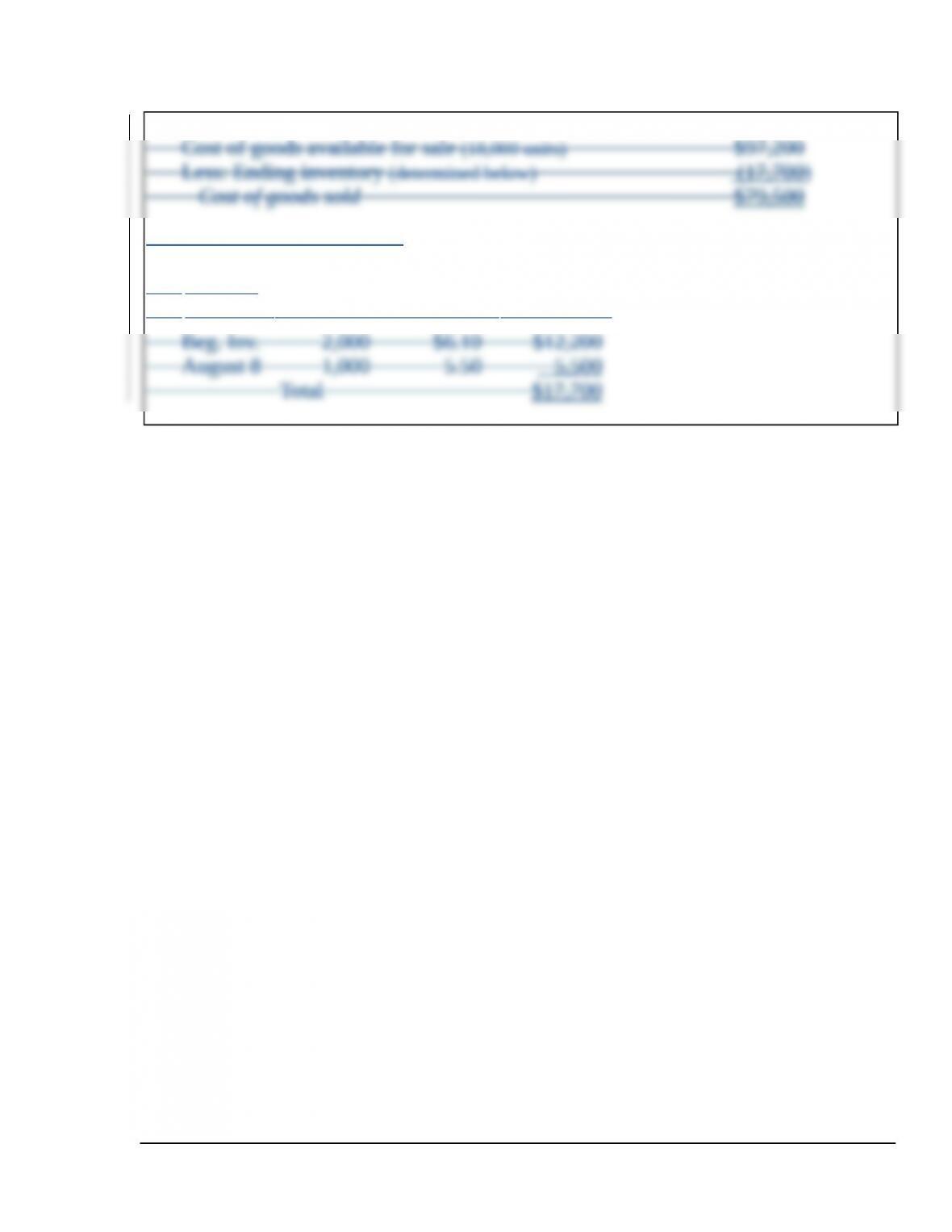
Cost of goods available for sale:
Beginning inventory (2,000 x $6.10) $12,200
Purchases:
First-in, first-out (FIFO)
Cost of ending inventory:
Date of
purchase Units Unit cost Total cost
Last-in, first-out (LIFO)
8–22 Intermediate Accounting, 8/e
Copyright © 2015 McGraw-Hill Education. All rights reserved. No reproduction or distribution without the prior written consent
of McGraw-Hill Education.
Exercise 8–13
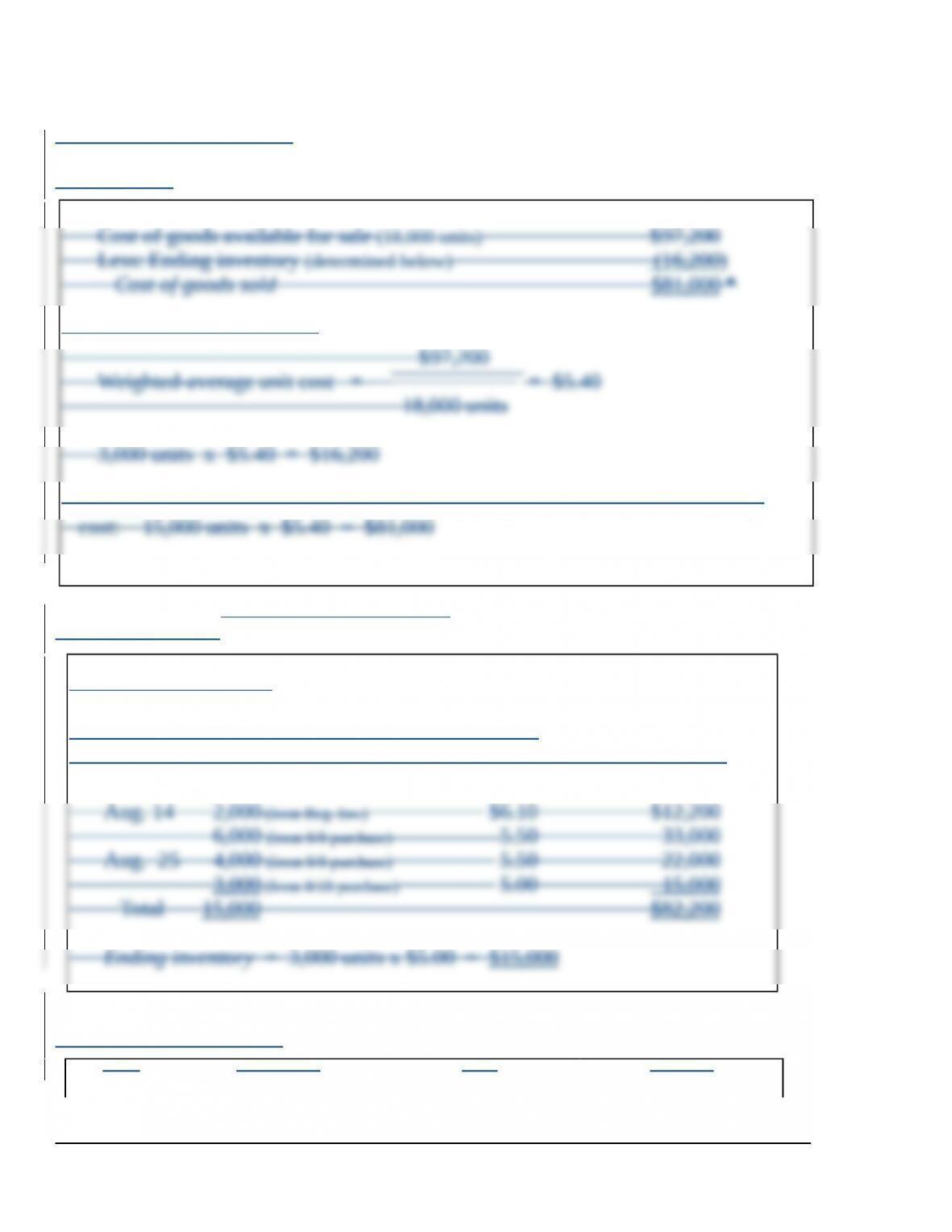
Cost of ending inventory:
Date of
purchase Units Unit cost Total cost
Solutions Manual, Vol.1, Chapter 8 8–23
Copyright © 2015 McGraw-Hill Education. All rights reserved. No reproduction or distribution without the prior written consent
of McGraw-Hill Education.
Exercise 8–13 (concluded)
Average cost
Cost of ending inventory:
* Alternatively, could be determined by multiplying the units sold by the average
First-in, first-out (FIFO)
Cost of goods sold:
Date of Cost of
Sale Units Sold Units Sold Total Cost
Last-in, first-out (LIFO)
Date Purchased Sold Balance
8–24 Intermediate Accounting, 8/e
Copyright © 2015 McGraw-Hill Education. All rights reserved. No reproduction or distribution without the prior written consent
of McGraw-Hill Education.
Exercise 8–14
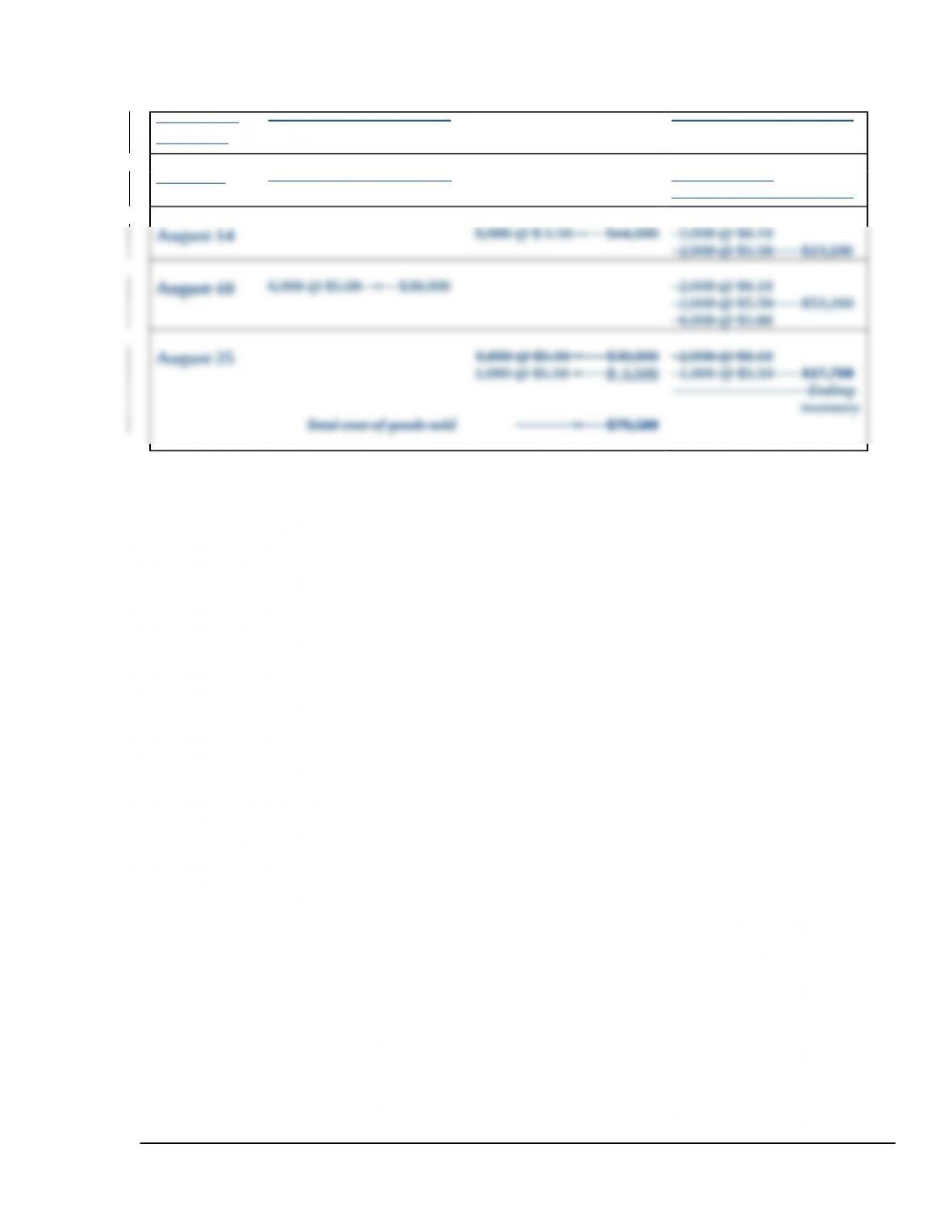
Beginning
inventory
2,000 @ $6.10 = $12,200 2,000 @ $6.10 $12,200
August 8 10,000 @ $5.50 = $55,000 2,000 @ $6.10
10,000 @ $5.50 $67,200
Solutions Manual, Vol.1, Chapter 8 8–25
Copyright © 2015 McGraw-Hill Education. All rights reserved. No reproduction or distribution without the prior written consent
of McGraw-Hill Education.
Exercise 8–14 (concluded)
(Note: the perpetual inventory LIFO results in this exercise are the same as
periodic LIFO results, due to the timing of sales and purchases. The same LIFO layers
are on hand at the end of the period under each method. This is unusual. LIFO
perpetual and LIFO periodic normally produce different results for ending inventory
and cost of goods sold.)
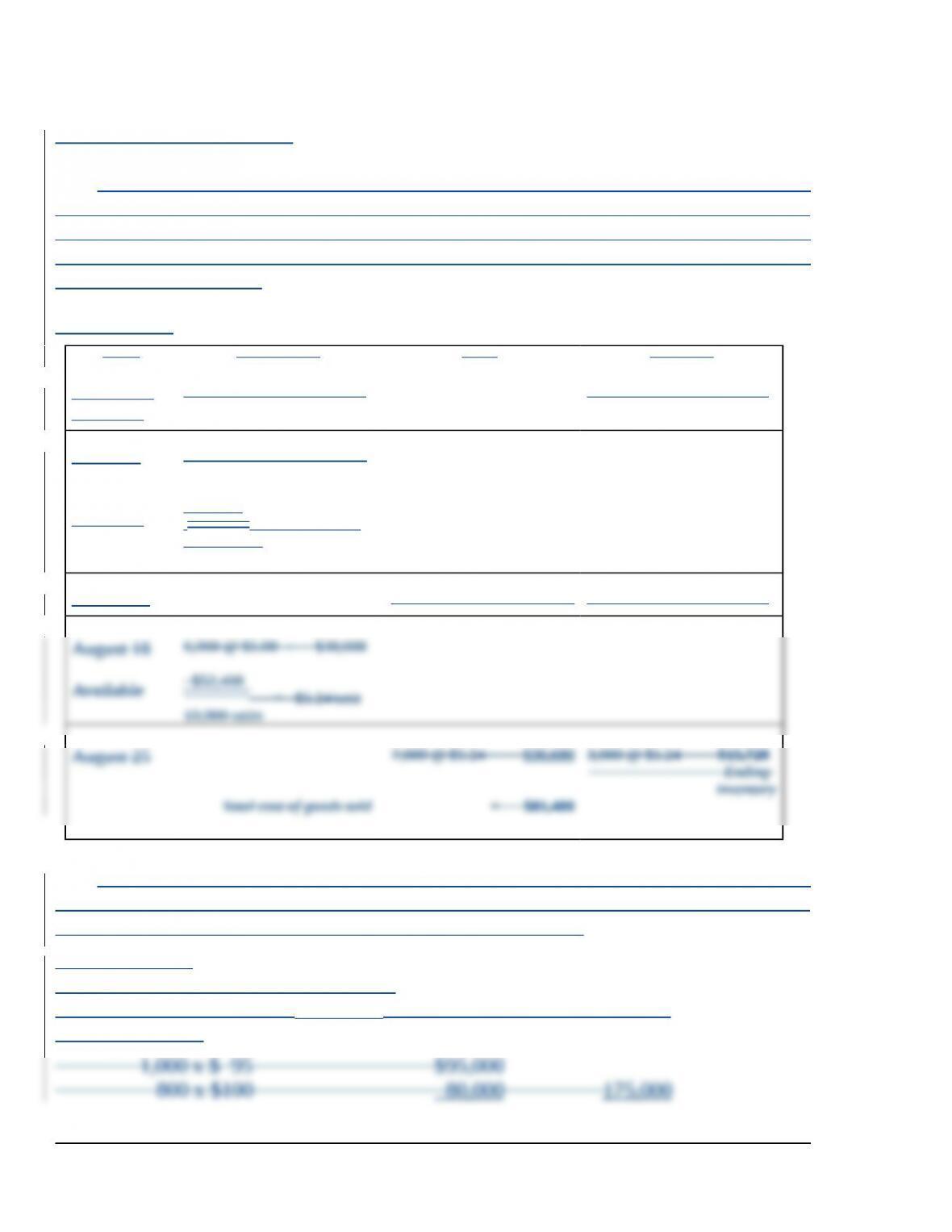
Average cost
Date Purchased Sold Balance
Beginning
inventory
2,000 @ $6.10 = $12,200 2,000 @ $6.10 $12,200
August 8
Available
10,000 @ $5.50 = $55,000
$67,200
= $5.60/unit
12,000 units
August 14 8,000 @ $5.60 = $44,800 4,000 @ $5.60 $22,400
Requirement 1
LIFO will result in the highest cost of goods sold figure because both the cost of
merchandise and the quantity of merchandise rose during the period. FIFO will result
in the highest ending inventory balance for the same reasons.
Requirement 2
Cost of goods available for sale:
Beginning inventory (600 x $80) $ 48,000
Purchases:
8–26 Intermediate Accounting, 8/e
Copyright © 2015 McGraw-Hill Education. All rights reserved. No reproduction or distribution without the prior written consent
of McGraw-Hill Education.
Exercise 8–15
First-in, first-out (FIFO)
Cost of ending inventory:
Date of
purchase Units Unit cost Total cost
Last-in, first-out (LIFO)
Cost of ending inventory:
Date of
purchase Units Unit cost Total cost
Requirement 1
Cost of goods available for sale:
Beginning inventory (5,000 x $10.00) $ 50,000
Purchases:
Solutions Manual, Vol.1, Chapter 8 8–27
Copyright © 2015 McGraw-Hill Education. All rights reserved. No reproduction or distribution without the prior written consent
of McGraw-Hill Education.
Exercise 8–16
Cost of ending inventory:
* Alternatively, could be determined by multiplying the units sold by the average
8–28 Intermediate Accounting, 8/e
Copyright © 2015 McGraw-Hill Education. All rights reserved. No reproduction or distribution without the prior written consent
of McGraw-Hill Education.
Exercise 8–16 (concluded)
Requirement 2
Date Purchased Sold Balance
Beginning
inventory
5,000 @ $10.00 = $50,000 5,000 @ $10.00 $50,000
Requirement 1
FIFO cost of goods sold:
Requirement 2
LIFO cost of goods sold:
Calculations to determine cost per unit of year 2018 purchases:
Cost of goods sold
Solutions Manual, Vol.1, Chapter 8 8–29
Copyright © 2015 McGraw-Hill Education. All rights reserved. No reproduction or distribution without the prior written consent
of McGraw-Hill Education.
Exercise 8–17
= Weighted-average cost per unit
Number of units sold
= $6 = Cost per unit of year 2018 purchases
Cost of goods available for sale:
Requirement 1
January 31, 2016 ($ in
thousands)
Requirement 2
8–30 Intermediate Accounting, 8/e
Copyright © 2015 McGraw-Hill Education. All rights reserved. No reproduction or distribution without the prior written consent
of McGraw-Hill Education.
Exercise 8–18
Requirement 1
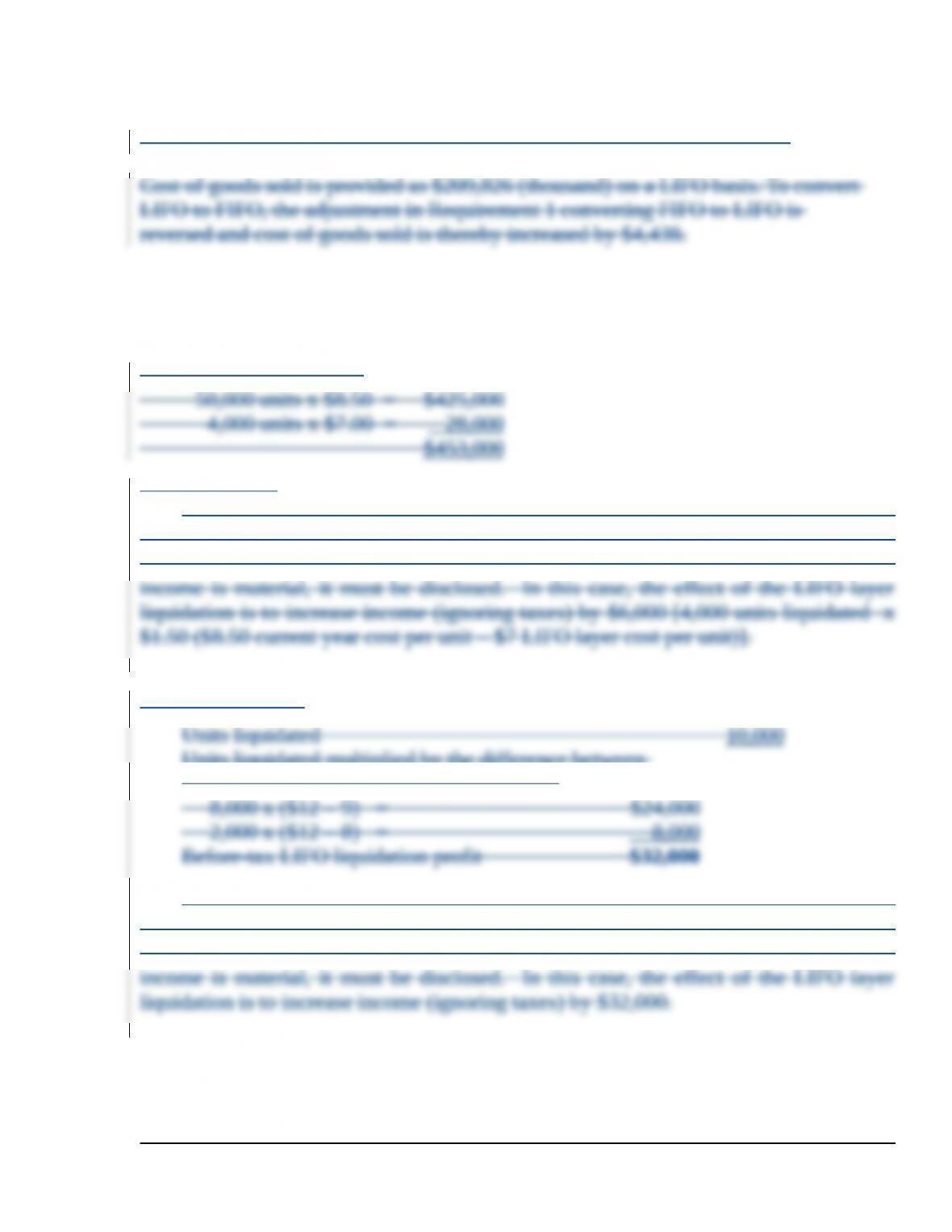
Cost of goods sold:
Requirement 2
When inventory quantity declines during a reporting period, liquidation of LIFO
inventory layers carried at different costs prevailing in prior year’s results in
noncurrent costs being matched with current selling prices. If the resulting effect on
Units liquidated multiplied by the difference between
their current cost and acquisition cost:
When inventory quantity declines during a reporting period, liquidation of LIFO
inventory layers carried at different costs that prevailed in prior year’s results in
noncurrent costs being matched with current selling prices. If the resulting effect on
Solutions Manual, Vol.1, Chapter 8 8–31
Copyright © 2015 McGraw-Hill Education. All rights reserved. No reproduction or distribution without the prior written consent
of McGraw-Hill Education.
$209,826 + $4,438 = $214,264 thousand cost of goods sold under FIFO.
Exercise 8–19
Requirement 2
The specific citation that describes the disclosure requirements that must be made
by publicly traded companies for a LIFO liquidation is FASB ASC 330–10–S99–3:
“Inventory–Overall–SEC Materials–LIFO Liquidations.”
Requirement 3
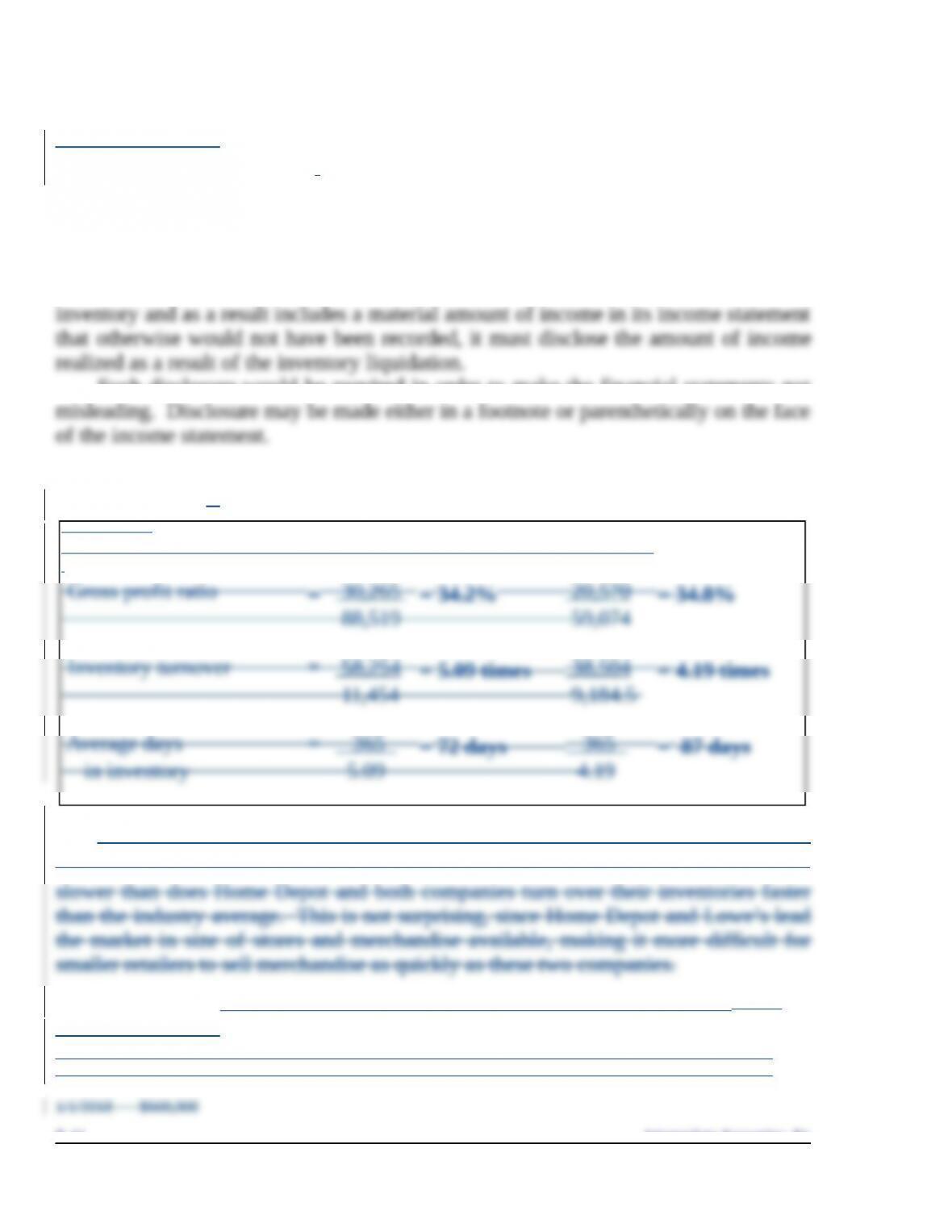
When a company using LIFO liquidates a substantial portion of its LIFO
Such disclosure would be required in order to make the financial statements not
($ in millions)
HOME DEPOT LOWE’S
The gross profit ratios for the two companies are similar and both slightly exceed
the industry average of 33%. On average, Lowe’s turns over its inventory 15 days
Ending
Ending Inventory Inventory Layers Inventory Layers Inventory
Date at Base Year Cost at Base Year Cost Converted to Cost DVL Cost
8–32 Intermediate Accounting, 8/e
Copyright © 2015 McGraw-Hill Education. All rights reserved. No reproduction or distribution without the prior written consent
of McGraw-Hill Education.
Exercise 8–21
Exercise 8–22
Exercise 8–23

1.00
12/31/2018 $690,000
12/31/2019 $760,000
Ending
Ending Inventory Inventory Layers Inventory Layers Inventory
Date at Base Year Cost at Base Year CostConverted to Cost DVL Cost
12/31/2018 $200,000
12/31/2019 $231,000
12/31/2020 $299,000
Index
12/31/2021 $300,000
= $250,000 Index = 1.20
Index
Set the base year, 1/1/2018, equal to 1.00.
Ending Inventory Inventory Layers Inventory Layers Inventory
Date at Base Year Cost at Base Year CostConverted to Cost DVL Cost
1/1/2018 $720,000
Solutions Manual, Vol.1, Chapter 8 8–33
Copyright © 2015 McGraw-Hill Education. All rights reserved. No reproduction or distribution without the prior written consent
of McGraw-Hill Education.
Exercise 8–24
Exercise 8–25
1.00
12/31/2018 $880,000
List A List B
i 1. Perpetual inventory a. Legal title passes when goods are
system delivered to common carrier.
l 2. Periodic inventory system b. Goods are transferred to another company
but title remains with transferor.
8–34 Intermediate Accounting, 8/e
Copyright © 2015 McGraw-Hill Education. All rights reserved. No reproduction or distribution without the prior written consent
of McGraw-Hill Education.
Exercise 8–26

Requirement 1
a. To record the purchase of inventory on account and the payment of freight
charges.
October 12, 2018
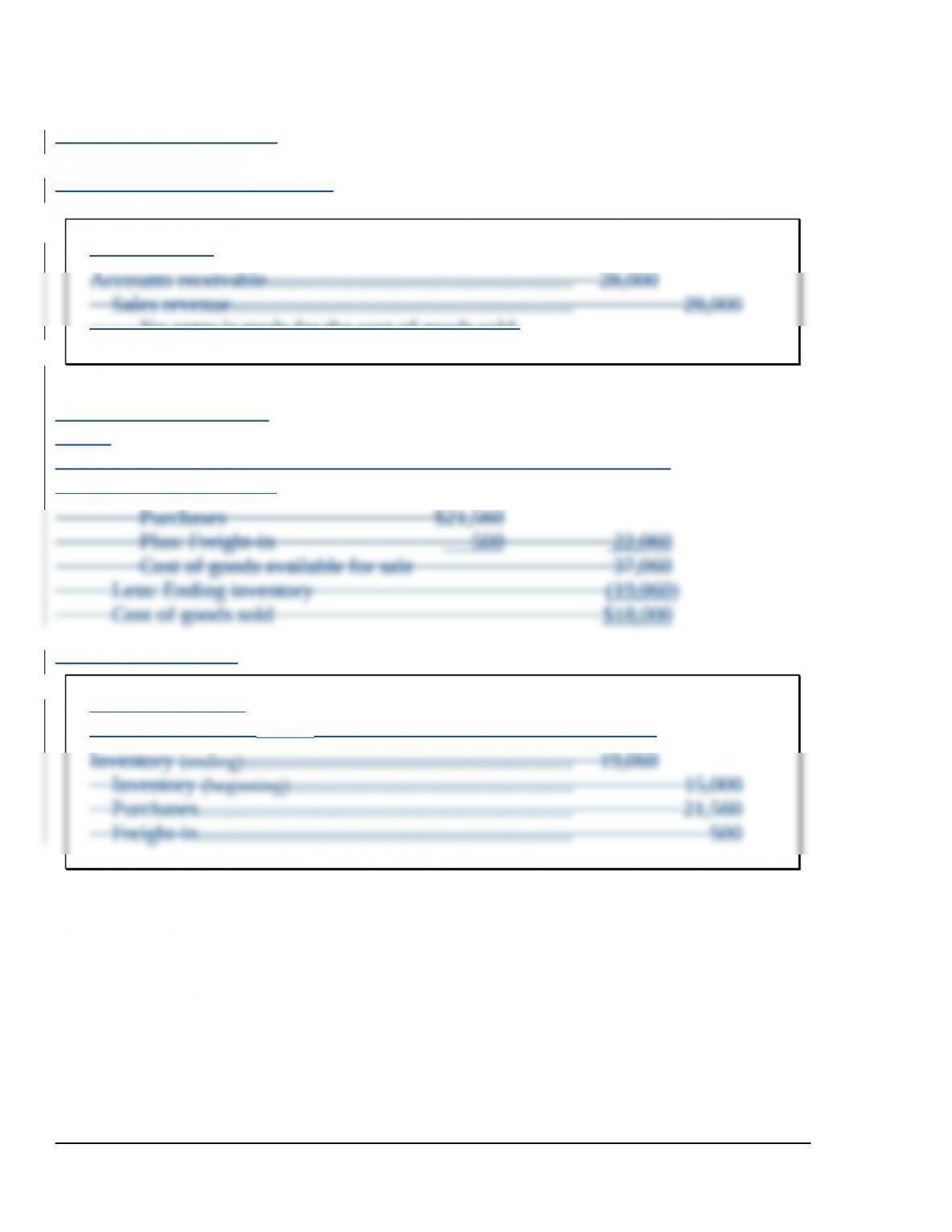
Purchases (98% x $22,000) ………………………………………… 21,560
b. To record payment of accounts payable.
October 31, 2018
Solutions Manual, Vol.1, Chapter 8 8–35
Copyright © 2015 McGraw-Hill Education. All rights reserved. No reproduction or distribution without the prior written consent
of McGraw-Hill Education.
PROBLEMS
Problem 8–1
Problem 8–1 (continued)
c. To record sales on account.
October 2018
No entry is made for the cost of goods sold.
Cost of goods sold:
Beginning inventory $15,000
Plus net purchases:
Adjusting entry:
October 31, 2018
Cost of goods sold (above) ……………………………………….. 18,000
8–36 Intermediate Accounting, 8/e
Copyright © 2015 McGraw-Hill Education. All rights reserved. No reproduction or distribution without the prior written consent
of McGraw-Hill Education.

Problem 8–1 (concluded)
Requirement 2
a. To record the purchase of inventory on account and the payment of freight
charges.
October 12, 2018
Inventory (98% x $22,000) ………………………………………… 21,560
b. To record payment of accounts payable.
October 31, 2018
Accounts payable …………………………………………………… 21,560
c. To record sales on account.
October 2018
Accounts receivable ……………………………………………….. 28,000
1. The transaction is not correctly accounted for. Inventory held on
consignment by another company should be included in the
inventory of the consignor. Rasul should include this
merchandise in its 2018 ending inventory.
2. The transaction is not correctly accounted for. Legal title to merchandise shipped
Solutions Manual, Vol.1, Chapter 8 8–37
Copyright © 2015 McGraw-Hill Education. All rights reserved. No reproduction or distribution without the prior written consent
of McGraw-Hill Education.
Problem 8–2
3. The transaction is not correctly accounted for. Since the merchandise was shipped
4. The transaction is correctly accounted for. Merchandise held on consignment from
5. The transaction is correctly accounted for. Since the merchandise was shipped
Accounts
Inventory Payable Sales
Initial amounts $1,250,000 $1,000,000 $9,000,000
Adjustments – increase (decrease):
1. (155,000) (155,000) NONE
2. (22,000) NONE NONE
3. NONE NONE 40,000
Requirement 1
Beginning inventory (10,000 x $8.00) $ 80,000
Net purchases:
Purchases (50,000* units x $10.00) $500,000
* The 5,000 units purchased on December 28 are not included. The
merchandise was shipped f.o.b. destination and did not arrive at Johnson’s
warehouse until 2019.
8–38 Intermediate Accounting, 8/e
Copyright © 2015 McGraw-Hill Education. All rights reserved. No reproduction or distribution without the prior written consent
of McGraw-Hill Education.
Problem 8–3
Problem 8–4
Cost of ending inventory:
Date of
purchase Units Unit cost Total cost
Requirement 2
Sales (45,000 units x $18.00) $810,000
Less:
Cost of goods available for sale for periodic system:
Purchases:
1. FIFO, periodic system
Cost of ending inventory:
Date of
purchase Units Unit cost Total cost
Alternatively, cost of goods sold can be determined by adding the cost of the 6,000
units in beginning inventory ($48,000) and the 3,000 units from the January 10
Solutions Manual, Vol.1, Chapter 8 8–39
Copyright © 2015 McGraw-Hill Education. All rights reserved. No reproduction or distribution without the prior written consent
of McGraw-Hill Education.
Problem 8–5
Problem 8–5 (continued)
2. LIFO, periodic system
Cost of ending inventory:
Date of
purchase Units Unit cost Total cost
Alternatively, cost of goods sold can be determined by adding the cost of the 6,000
8–40 Intermediate Accounting, 8/e
Copyright © 2015 McGraw-Hill Education. All rights reserved. No reproduction or distribution without the prior written consent
of McGraw-Hill Education.
Problem 8–5 (continued)
3. LIFO, perpetual system
Date Purchased Sold Balance
Beginning
inventory
6,000 @ $8.00 = $48,000 6,000 @ $8.00 $48,000
January 5 3,000 @ $8.00 = $24,000 3,000 @ $8.00 $24,000
January 10 5,000 @ $9.00 = $45,000 3,000 @ $8.00
4. Average cost, periodic system
Cost of goods available for sale (17,000 units) $153,000
Cost of ending inventory:
Alternatively, cost of goods sold could be determined by multiplying the units
Solutions Manual, Vol.1, Chapter 8 8–41
Copyright © 2015 McGraw-Hill Education. All rights reserved. No reproduction or distribution without the prior written consent
of McGraw-Hill Education.
Problem 8–5 (concluded)
5. Average cost, perpetual system
Date Purchased Sold Balance
$69,000
Ending
inventory
Requirement 1
Cost of goods available for sale for periodic system:
Purchases:
5,000 x $4.00 $20,000
a. FIFO
8–42 Intermediate Accounting, 8/e
Copyright © 2015 McGraw-Hill Education. All rights reserved. No reproduction or distribution without the prior written consent
of McGraw-Hill Education.
Problem 8–6
Cost of ending inventory:
Date of
purchase Units Unit cost Total cost
b. LIFO
Cost of ending inventory:
Date of
purchase Units Unit cost Total cost
Solutions Manual, Vol.1, Chapter 8 8–43
Copyright © 2015 McGraw-Hill Education. All rights reserved. No reproduction or distribution without the prior written consent
of McGraw-Hill Education.
Problem 8–6 (concluded)
c. Average cost
Cost of ending inventory:
* Alternatively, could be determined by multiplying the units sold by the average
Gross Profit ratio:
*Sales less cost of goods sold
Requirement 2
In situations when costs are rising, LIFO results in a higher cost of goods sold
and, therefore, a lower gross profit ratio than FIFO.
Requirement 1
Purchases:
211 $63,000
8–44 Intermediate Accounting, 8/e
Copyright © 2015 McGraw-Hill Education. All rights reserved. No reproduction or distribution without the prior written consent
of McGraw-Hill Education.
Problem 8–7
Ending inventory:
Requirement 2
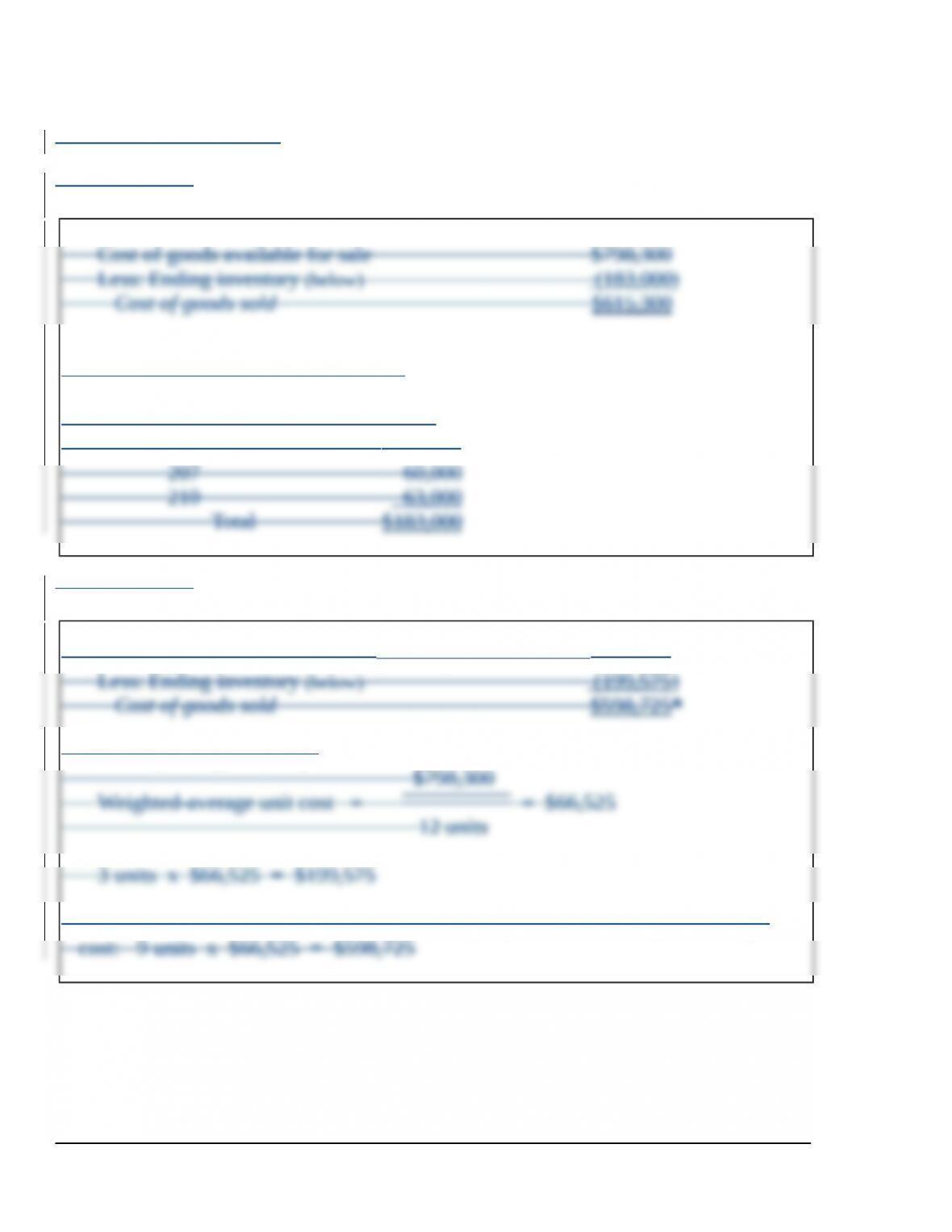
Cost of ending inventory (3 autos):
Car ID Cost
219 $ 75,000
Solutions Manual, Vol.1, Chapter 8 8–45
Copyright © 2015 McGraw-Hill Education. All rights reserved. No reproduction or distribution without the prior written consent
of McGraw-Hill Education.
Problem 8–7 (concluded)
Requirement 3
Cost of ending inventory (3 autos):
Car ID Cost
203 $ 60,000
Requirement 4
Cost of goods available for sale (12 units) $798,300
Cost of ending inventory:
* Alternatively, could be determined by multiplying the units sold by the average
8–46 Intermediate Accounting, 8/e
Copyright © 2015 McGraw-Hill Education. All rights reserved. No reproduction or distribution without the prior written consent
of McGraw-Hill Education.
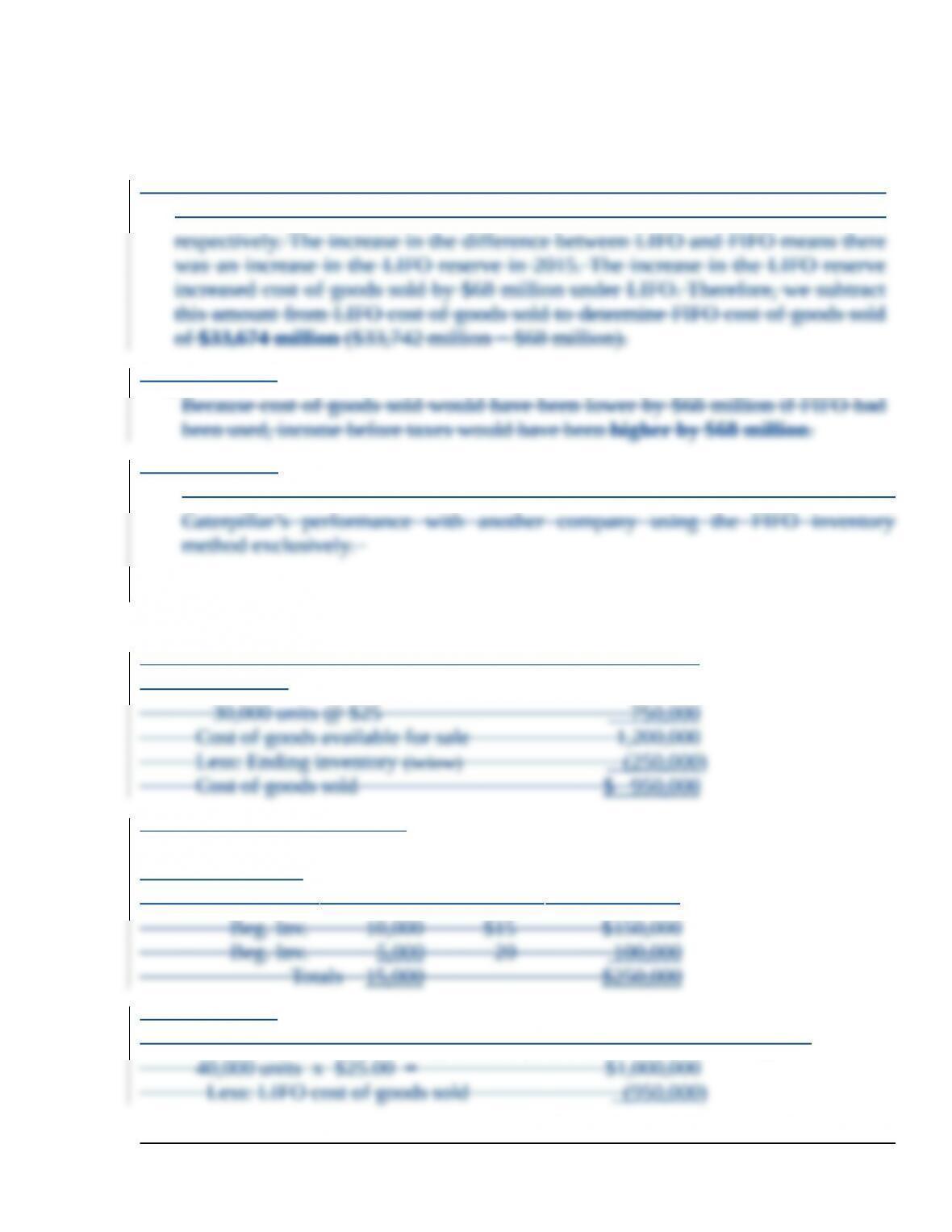
Requirement 1
The note indicates that if the company had used FIFO, inventory would have
been higher by $2,498 million and $2,430 million at the end of 2015 and 2014,
increased cost of goods sold by $68 million under LIFO. Therefore, we subtract
Requirement 3
The information might be useful to a financial analyst interested in comparing
Requirement 1
Beginning inventory $ 450,000
Purchases:
Cost of ending inventory:
Date of
purchase Units Unit cost Total cost
Requirement 2
Cost of goods sold assuming all units purchased at the year 2018 price:
Solutions Manual, Vol.1, Chapter 8 8–47
Copyright © 2015 McGraw-Hill Education. All rights reserved. No reproduction or distribution without the prior written consent
of McGraw-Hill Education.
Problem 8–8
Problem 8–9

Requirement 3
Requirement 1
Cost of goods sold:
2018: 1,000 x $16 = $ 16,000
2019: 1,500 x $16 = $ 24,000
2020: 1,000 x $12 = $ 12,000
Requirement 2
LIFO liquidation before-tax profit or loss:
2018: 1,000 units x $2 ($18 – 16) = $2,000 profit
Requirement 3
Disclosure note:
During fiscal 2020, 2019, and 2018, inventory quantities in certain LIFO layers were
reduced. These reductions resulted in a liquidation of LIFO inventory quantities
8–48 Intermediate Accounting, 8/e
Copyright © 2015 McGraw-Hill Education. All rights reserved. No reproduction or distribution without the prior written consent
of McGraw-Hill Education.
Problem 8–10
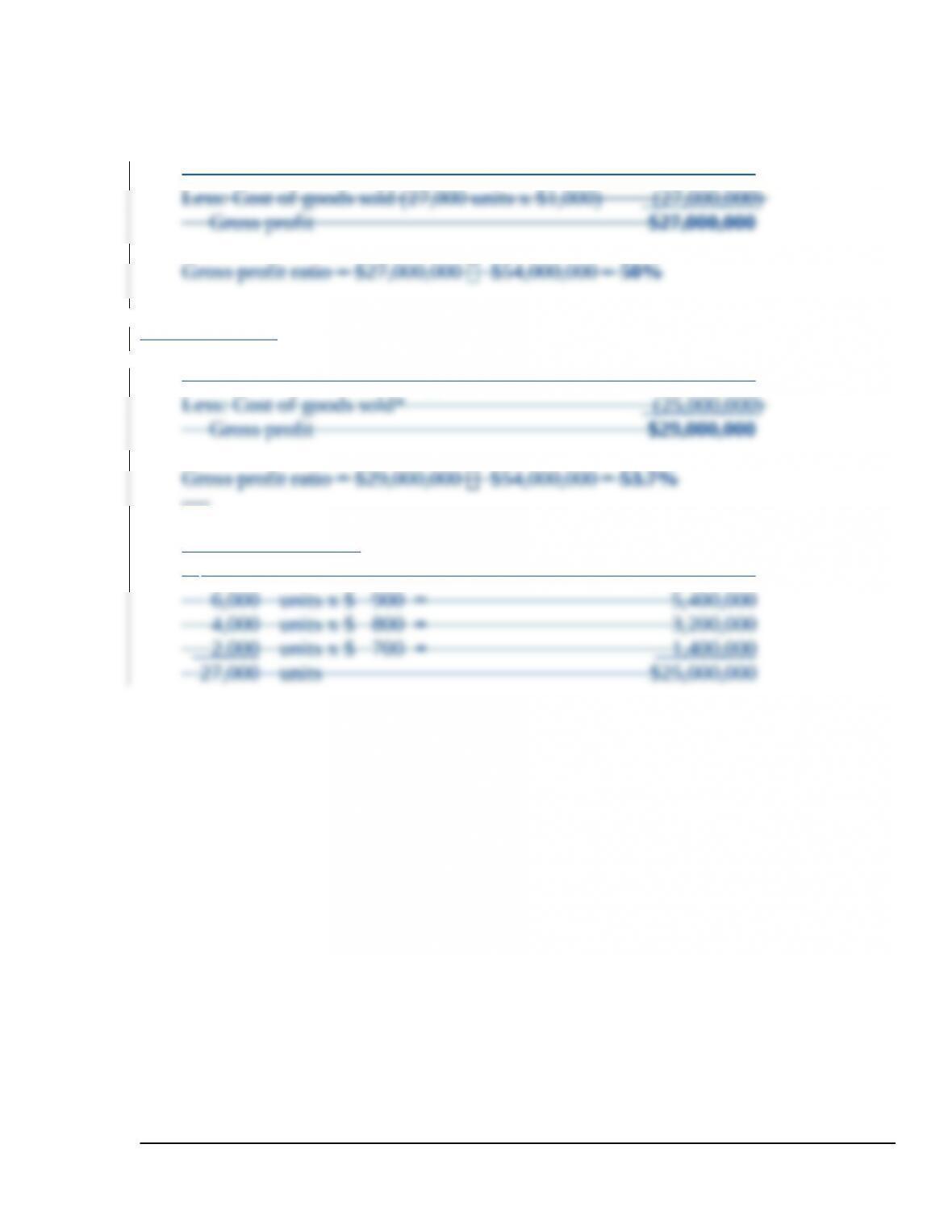
Requirement 1
Sales (27,000 units x $2,000) $54,000,000
Requirement 2
Sales (27,000 units x $2,000) $54,000,000
*Cost of goods sold:
15,000 units x $1,000 = $15,000,000
Solutions Manual, Vol.1, Chapter 8 8–49
Copyright © 2015 McGraw-Hill Education. All rights reserved. No reproduction or distribution without the prior written consent
of McGraw-Hill Education.
Problem 8–11
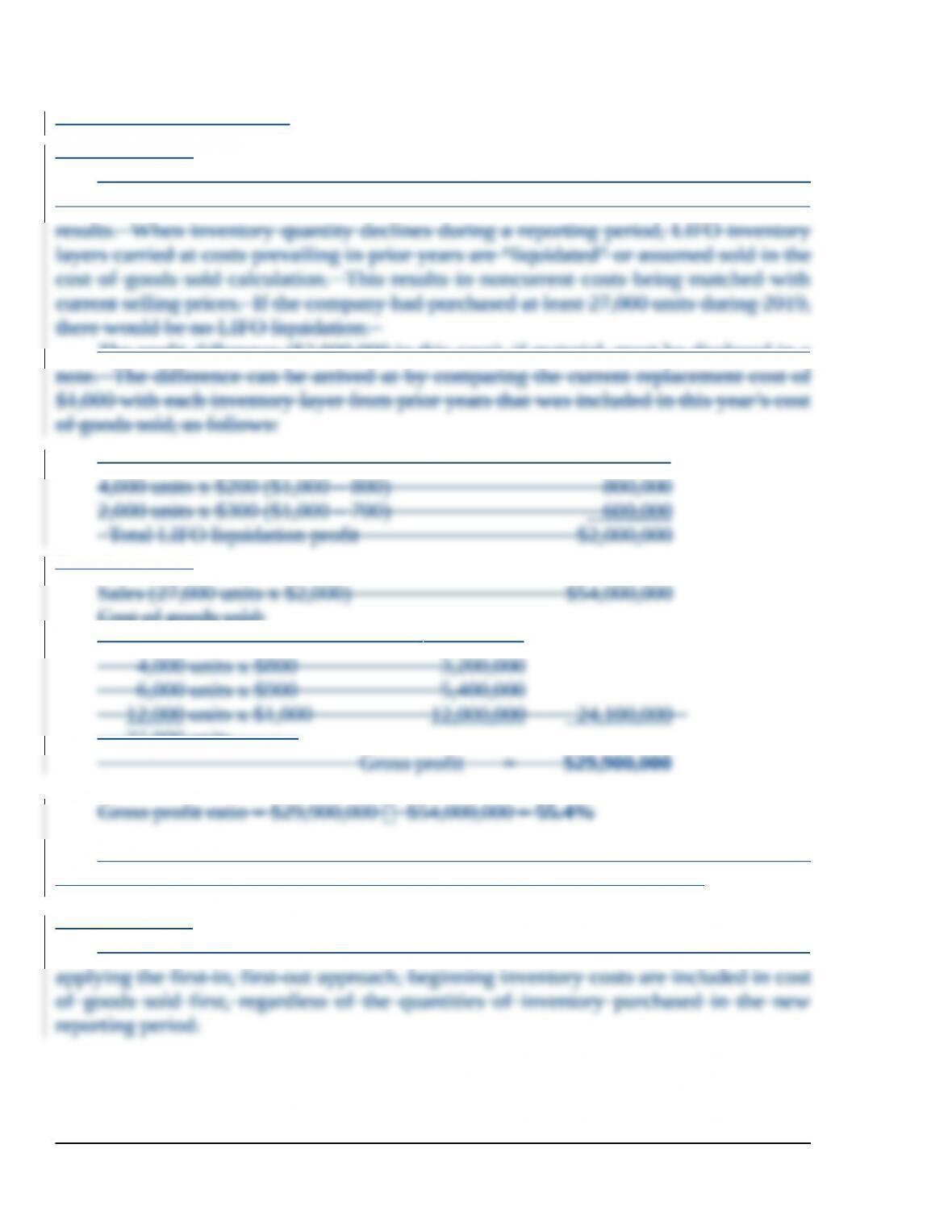
Problem 8–11 (concluded)
Requirement 3
The gross profit and gross profit ratio are higher applying the requirement 2
assumption of 15,000 units purchased because of the LIFO liquidation profit that
The profit difference ($2,000,000 in this case), if material, must be disclosed in a
6,000 units x $100 ($1,000 – 900) $ 600,000
Requirement 4
Cost of goods sold:
5,000 units x $700 $ 3,500,000
27,000 units
If only 15,000 units are purchased, cost of goods sold, gross profit, and the gross
profit ratio would be exactly the same as when 28,000 units are purchased.
Requirement 5
The number of units purchased has no effect on FIFO cost of goods sold. When
8–50 Intermediate Accounting, 8/e
Copyright © 2015 McGraw-Hill Education. All rights reserved. No reproduction or distribution without the prior written consent
of McGraw-Hill Education.
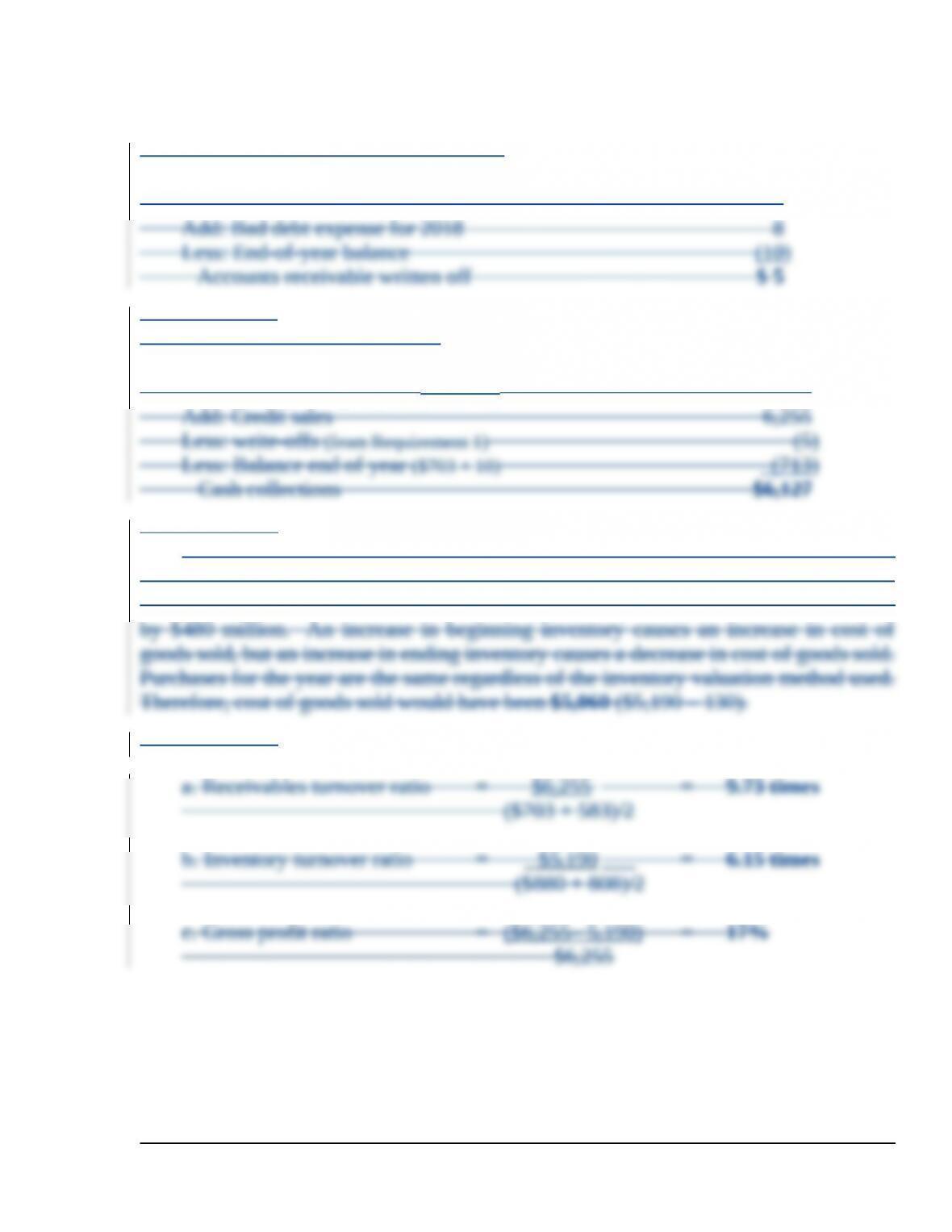
Requirement 1
Allowance for uncollectible accounts
Balance, beginning of year $7
Requirement 2
Accounts receivable analysis:
Balance, beginning of year ($583 + 7) $ 590
Requirement 3
Cost of goods sold for 2018 would have been $130 million lower had Inverness
used the average cost method for its entire inventory. While beginning inventory
would have been $350 million higher, ending inventory also would have been higher
Requirement 4
Solutions Manual, Vol.1, Chapter 8 8–51
Copyright © 2015 McGraw-Hill Education. All rights reserved. No reproduction or distribution without the prior written consent
of McGraw-Hill Education.
Problem 8–12
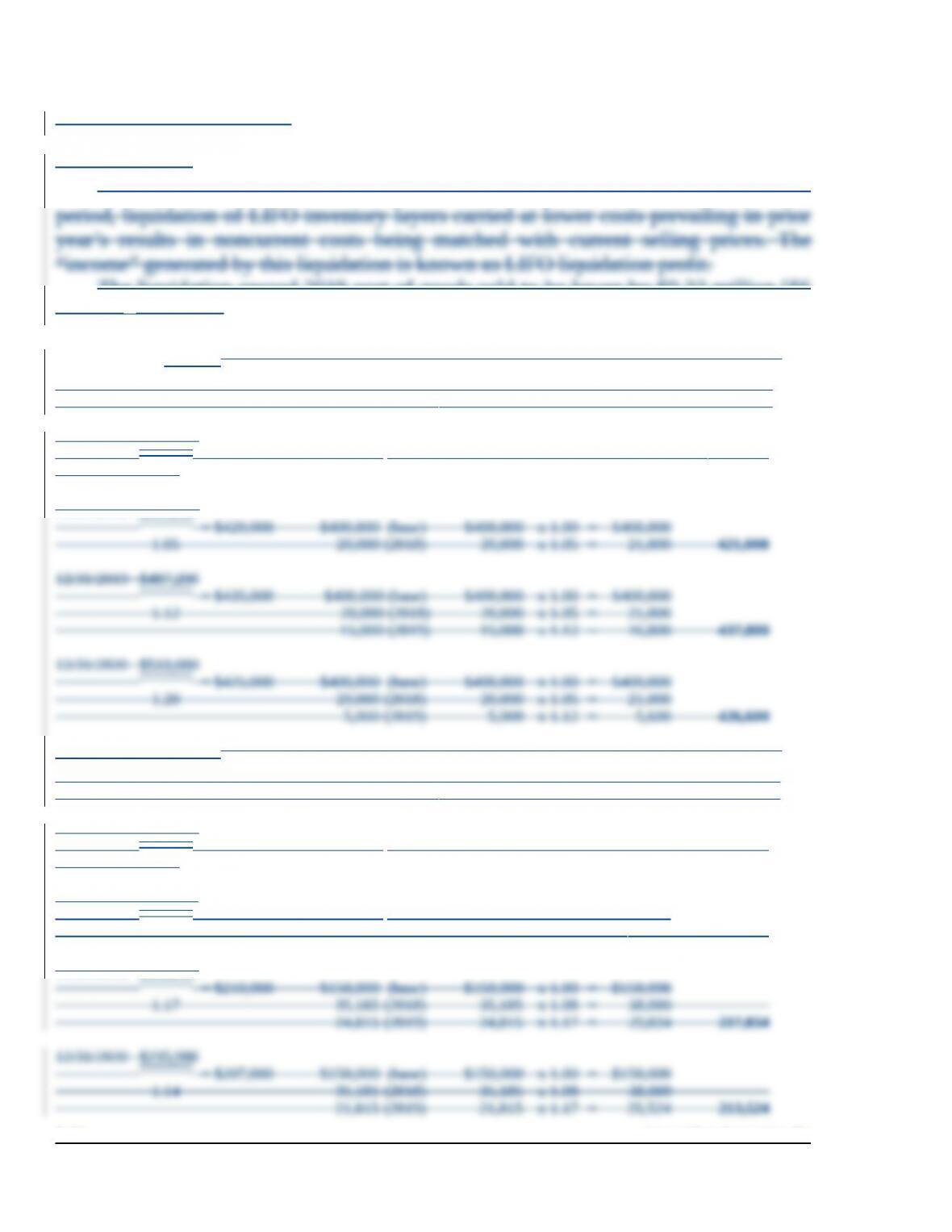
Problem 8–12 (concluded)
Requirement 5
If inventory costs are increasing, when inventory quantity declines during a
The liquidation caused 2018 cost of goods sold to be lower by $9.23 million [$6
million (1 – .35)]
Ending
Ending Inventory Inventory Layers Inventory Layers Inventory
Date at Base Year Cost at Base Year CostConverted to Cost DVL Cost
1/1/2018 $400,000
= $400,000 $400,000 (base) $400,000 x 1.00 = $400,000 $400,000
1.00
12/31/2018 $441,000
Ending
Ending Inventory Inventory Layers Inventory Layers Inventory
Date at Base Year Cost at Base Year Cost Converted to Cost DVL Cost
1/1/2018 $150,000
= $150,000 $150,000 (base) $150,000 x 1.00 = $150,000 $150,000
1.00
12/31/2018 $200,000
= $185,185 $150,000 (base) $150,000 x 1.00 = $150,000
1.08 35,185 (2018) 35,185 x 1.08 = 38,000 188,000
12/31/2019 $245,700
8–52 Intermediate Accounting, 8/e
Copyright © 2015 McGraw-Hill Education. All rights reserved. No reproduction or distribution without the prior written consent
of McGraw-Hill Education.
Problem 8–13
Problem 8–14

12/31/2021 $228,800
Solutions Manual, Vol.1, Chapter 8 8–53
Copyright © 2015 McGraw-Hill Education. All rights reserved. No reproduction or distribution without the prior written consent
of McGraw-Hill Education.
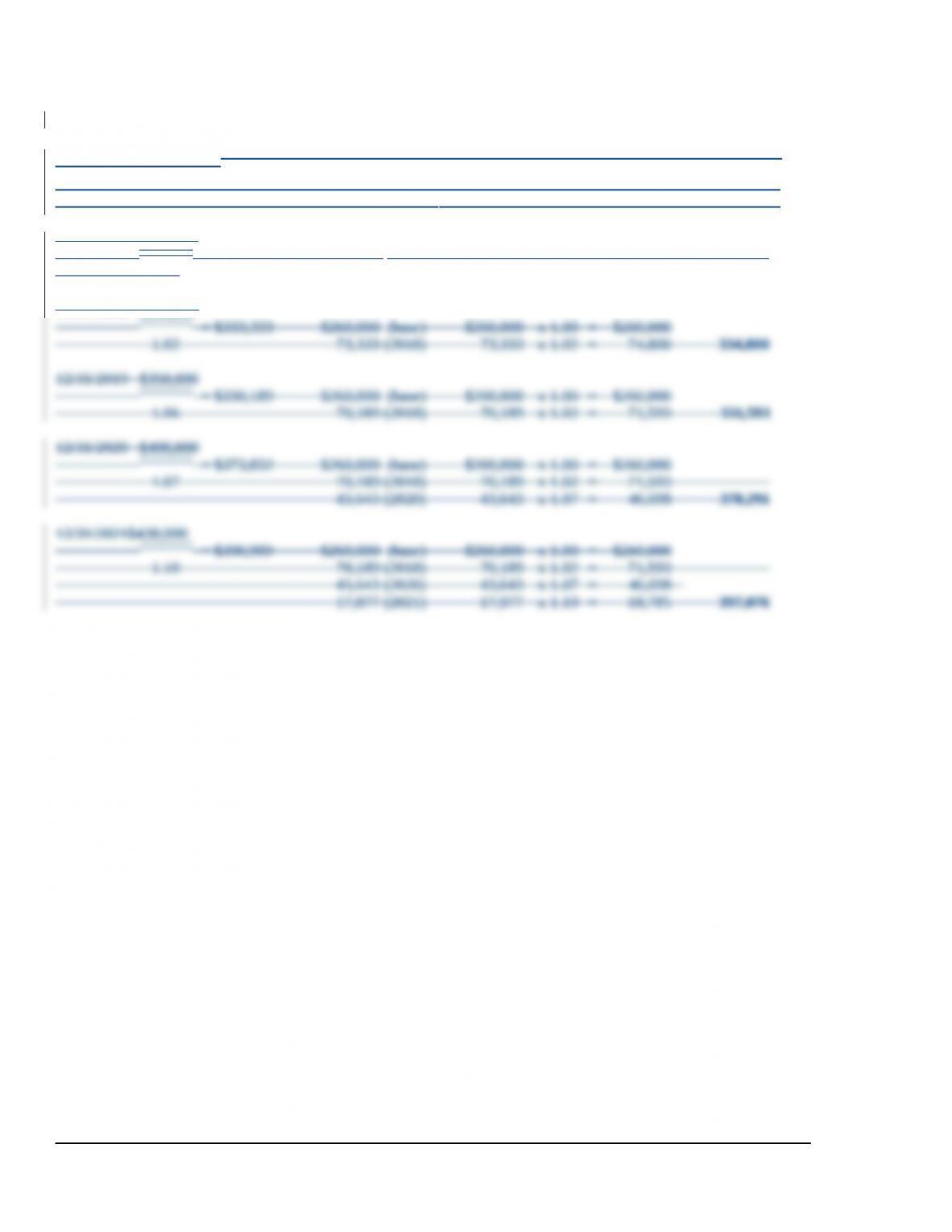
Ending
Ending Inventory Inventory Layers Inventory Layers Inventory
Date at Base Year Cost at Base Year Cost Converted to Cost DVL Cost
1/1/2018 $260,000
= $260,000 $260,000 (base) $260,000 x 1.00 = $260,000 $260,000
1.00
12/31/2018 $340,000
8–54 Intermediate Accounting, 8/e
Copyright © 2015 McGraw-Hill Education. All rights reserved. No reproduction or distribution without the prior written consent
of McGraw-Hill Education.
Problem 8–15

Ending
Ending Inventory Inventory Layers Inventory Layers Inventory
Date at Base Year Cost at Base Year Cost Converted to Cost DVL Cost
1/1/2018 $84,000
= $84,000 $84,000 (base) $84,000 x 1.00 = $84,000 $84,000
1.00
12/31/2018 $100,800
= $96,000 $84,000 (base) $84,000 x 1.00 = $84,000
1.05 12,000 (2018) 12,000 x 1.05 = 12,600 96,600
12/31/2019 $136,800
(1) $150,000 $125,000 = 1.20 (2020 cost index)
(2) $133,710 – 129,960 = $3,750
Solutions Manual, Vol.1, Chapter 8 8–55
Copyright © 2015 McGraw-Hill Education. All rights reserved. No reproduction or distribution without the prior written consent
of McGraw-Hill Education.
Problem 8–16
Advance warning of the company’s impending
bankruptcy existed at the date of the financial statements.
As a rule, inventories should rise in tandem with sales. If
inventories rise faster, it may be because the goods simply aren’t selling. This is
particularly true of companies in faddish or seasonal businesses—Merry-Go-Round’s
world.
The company’s report showed that inventories on January 30 were $82.2 million,
up 37 percent from $60 million a year earlier. That’s well above the 15 percent sales
growth in the same period, to $877.5 million from $761.2 million. This alone should
have been a major cause for concern. It indicated the company’s goods simply weren’t
selling as rapidly as it expected, causing its inventories to bulge. The increase in
receivables from $6,195 to over $6 million should also have been cause for concern.
Requirement 1
Identifying items that should be included in inventory is difficult due to goods in
transit, goods on consignment, and sales returns.
Goods in transit. Inventory shipped f.o.b. shipping point is included in the
purchaser’s inventory as soon as the merchandise is shipped. On the other hand,
Goods on consignment. Goods held on consignment are included in the
Sales returns. When the right of return exists, a seller must be able to estimate
Requirement 2
In addition to the direct acquisition costs such as the price paid and transportation
Requirement 3
Sport Chalet considers cost to include the direct cost of merchandise and inbound
8–56 Intermediate Accounting, 8/e
Copyright © 2015 McGraw-Hill Education. All rights reserved. No reproduction or distribution without the prior written consent
of McGraw-Hill Education.
CASES
Judgment Case 8–1
Real World Case 8–2
1. a. The specific identification method requires each
unit to be clearly distinguished from similar units either by
description, identification number, location, or other
characteristic. Costs are accumulated for specific units and expensed as the units are
b. It is appropriate for Happlia to use the specific identification method
because each appliance is expensive, and easily identified by number and description.
2. a. Happlia should include in inventory carrying amounts all necessary and
reasonable costs to get an appliance into a useful condition and place for sale.
b. Examples of inventoriable costs include the unit invoice price, plus an
3. The 2018 income statement should report in cost of goods sold all
Suggested Grading Concepts and Grading
Scheme:
Content (70%)
________ 20 Describes the differential effect on ending inventory
________ 25 Discusses the various motivating factors that
Solutions Manual, Vol.1, Chapter 8 8–57
Copyright © 2015 McGraw-Hill Education. All rights reserved. No reproduction or distribution without the prior written consent
of McGraw-Hill Education.
Judgment Case 8–3
Communication Case 8–4

_______ The better match of expenses with revenues
________ 10 Discusses briefly the methods available to
simplify LIFO.
________ 15 Discusses the IRS conformity rule with respect to
_______
Writing (30%)
________ 6 Terminology and tone appropriate to the audience of
a company president.
LIFO produces a higher cost of goods sold,
lower taxable income, and therefore lower income
taxes currently payable than FIFO only in periods
when the costs of the company’s products are
rising. When costs are decreasing, LIFO results in
lower cost of goods sold, higher taxable income, and a higher current tax liability than
FIFO. In the case of the electronics client, you would explain this to the intern
concluding that the costs of the client’s products must be decreasing, as frequently
occurs in this industry.
At the end of a reporting period it is important to
ensure that a proper inventory cutoff is made. A proper
cutoff involves the determination of the ownership of goods
that are in transit between the company and its customers as well as the company and
its suppliers. If the shipment is made f.o.b. shipping point, then ownership is
transferred to the buyer when the goods reach the common carrier. If the shipment is
8–58 Intermediate Accounting, 8/e
Copyright © 2015 McGraw-Hill Education. All rights reserved. No reproduction or distribution without the prior written consent
of McGraw-Hill Education.
Communication Case 8–5
Judgment Case 8–6
made f.o.b. destination, then ownership is transferred to the buyer when the goods
arrive at the buyer’s location.
In this case, John is incorrect if the goods were shipped f.o.b. destination. If so,
even though the company is not in physical possession of the goods, they should be
included in ending inventory because the shipment had not reached the buyer’s
location by the end of the reporting period.
Requirement 1
Without purchase of the additional units:
Sales (35,000 @ $60) $2,100,000
With purchase of the additional units:
Sales $2,100,000
Cost of goods sold:
Requirement 2
Discussion should include these elements.
Facts:
If Moncrief purchases the additional units at the end of the year under a periodic
LIFO inventory system, the transaction results in a reduced payment to Jim Lester,
reduced profits to shareholders, and reduced income tax payments to government
Ethical Dilemma:
Should Moncrief exercise its right to purchase inventory at will, resulting in a
Solutions Manual, Vol.1, Chapter 8 8–59
Copyright © 2015 McGraw-Hill Education. All rights reserved. No reproduction or distribution without the prior written consent
of McGraw-Hill Education.
Ethics Case 8–7
Requirement 1
The LIFO conformity rule permits LIFO users to present disclosures that report,
Requirement 2
January 2, 2016
Ending Beginning
Inventory Inventory
($ in millions)
Requirement 3
Cost of goods sold for the fiscal year ended January 2, 2016, would have been
Requirement 3
The following is based on Whole Foods’ 2015 financial statements. Answers
will vary depending on the financial statement dates chosen.
a. Whole Foods uses the last-in, first-out (LIFO) method for approximately 92.2%
b. Assuming that current cost approximates FIFO cost, the inventory disclosure
note indicates that, if FIFO had been used to value LIFO inventories, inventories
would have been higher than reported by $49 million at the end of 2015 and $48
c. Inventory turnover = cost of goods sold divided by average inventory
8–60 Intermediate Accounting, 8/e
Copyright © 2015 McGraw-Hill Education. All rights reserved. No reproduction or distribution without the prior written consent
of McGraw-Hill Education.
Real World Case 8–8
Real World Case 8–9
($ in millions)
The dollar-value LIFO inventory estimation
technique begins with the determination of the
current year’s ending inventory valued in terms
of year-end costs. It is not necessary for a company using DVL to track the cost of
purchases during the year. All that is needed is to take the physical quantities of goods
on hand at the end of the year and apply year-end costs.
The next step is to convert the ending inventory from year-end costs to base year
costs. This usually is accomplished by dividing the ending inventory at year-end costs
by the year’s cost index. The cost index reflects the change in cost from a base year to
the current year. The ending inventory has been deflated for cost changes from the
base year to the end of the current year.
The next step in the procedure is to identify the layers in ending inventory with
the years they were created by comparing ending inventory at base year cost to the
beginning inventory at base year cost. Applying the LIFO concept, if inventory has
increased, ending inventory at base year cost consists of the beginning inventory layer
plus a current year layer.
The final step converts the layers identified to cost by multiplying the layers at
base year cost by the layer’s cost index. The costs are totaled to obtain ending
inventory at DVL cost.
Requirement 1
The FASB’s codification citation that provides guidance for determining whether
Requirement 2
The FASB’s codification citation that addresses the recognition of a product
Requirement 3
The appropriate accounting treatment for this type of arrangement is for the
Solutions Manual, Vol.1, Chapter 8 8–61
Copyright © 2015 McGraw-Hill Education. All rights reserved. No reproduction or distribution without the prior written consent
of McGraw-Hill Education.
Communication Case 8–10
Research Case 8–11
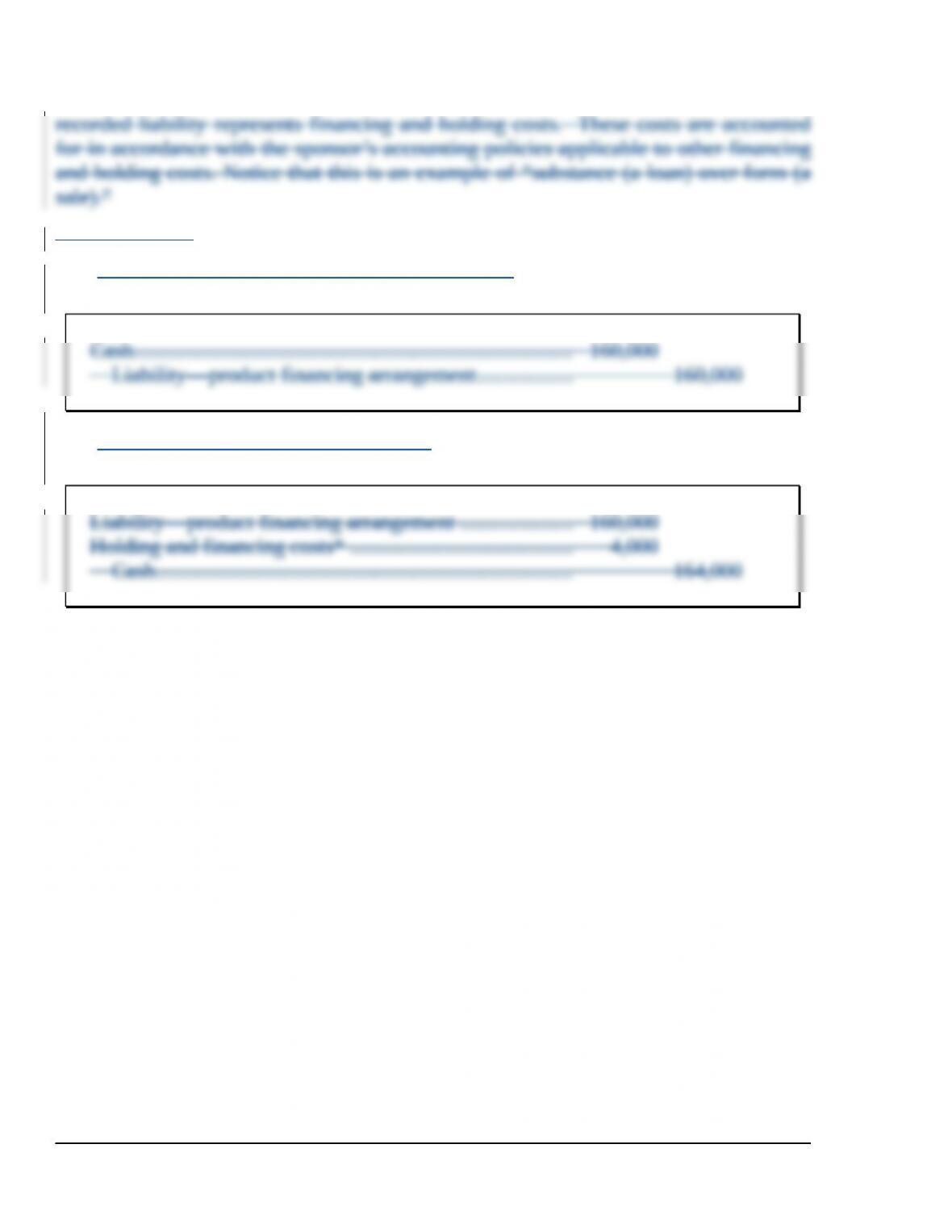
Requirement 4
Journal entry to record the “sale” (cash receipt):
Journal entry to record the repurchase:
8–62 Intermediate Accounting, 8/e
Copyright © 2015 McGraw-Hill Education. All rights reserved. No reproduction or distribution without the prior written consent
of McGraw-Hill Education.
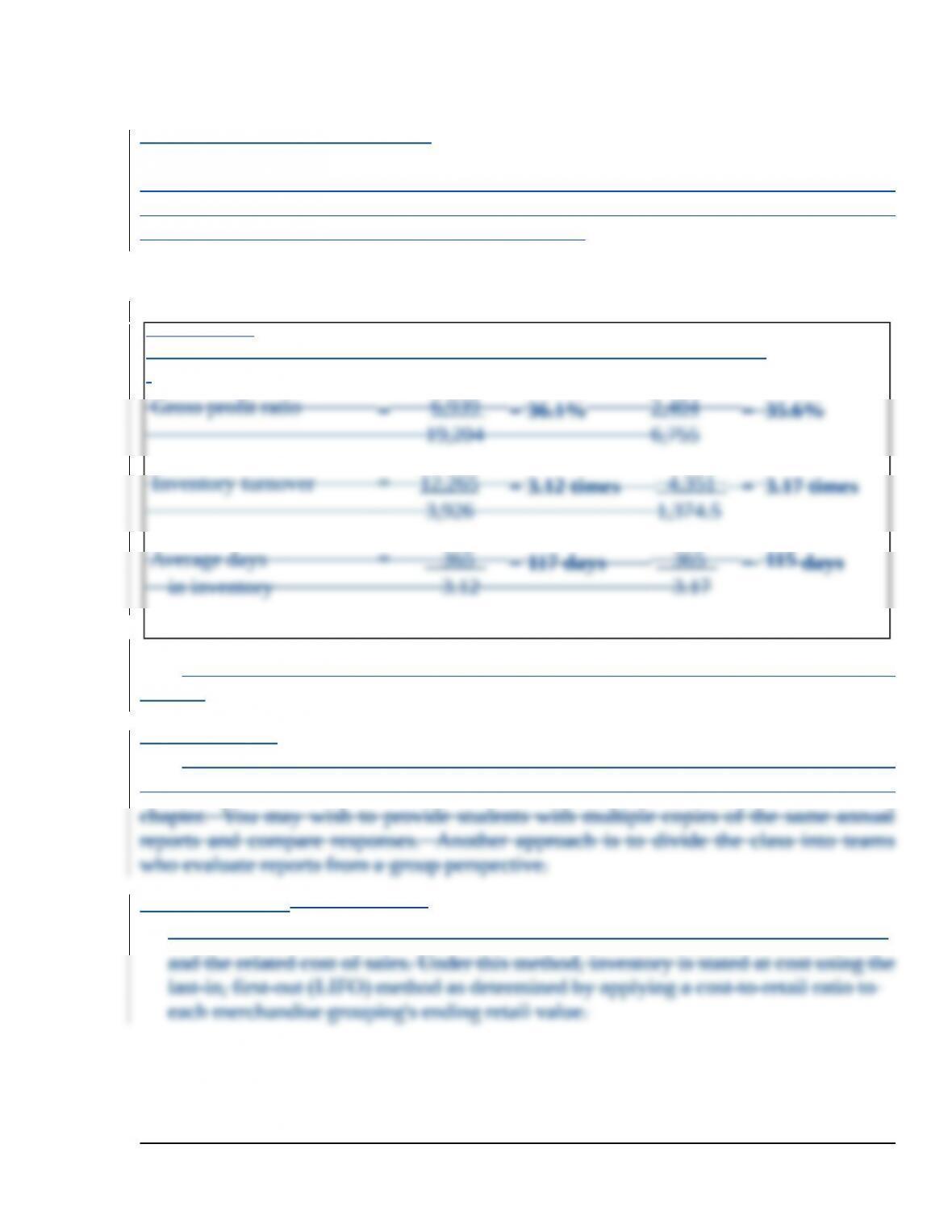
Research Case 8–11 (concluded)
*The treatment of these costs depends on the accounting policies of the sponsor. For
example, if these costs normally are expensed as period costs, then the debit in this
case would be to an expense account (or accounts).
Requirement 1
($ in millions)
KOHL’S DILLARDS
The gross profit ratios for the two companies are similar, as are their turnover
ratios.
Requirement 2
The objective of this requirement is to motivate students to obtain hands-on
familiarity with actual annual reports and to apply the techniques learned in the
Requirement 1
Target uses the retail inventory method to account for the majority of its inventory
Solutions Manual, Vol.1, Chapter 8 8–63
Copyright © 2015 McGraw-Hill Education. All rights reserved. No reproduction or distribution without the prior written consent
of McGraw-Hill Education.
Analysis Case 8–12
Target Case
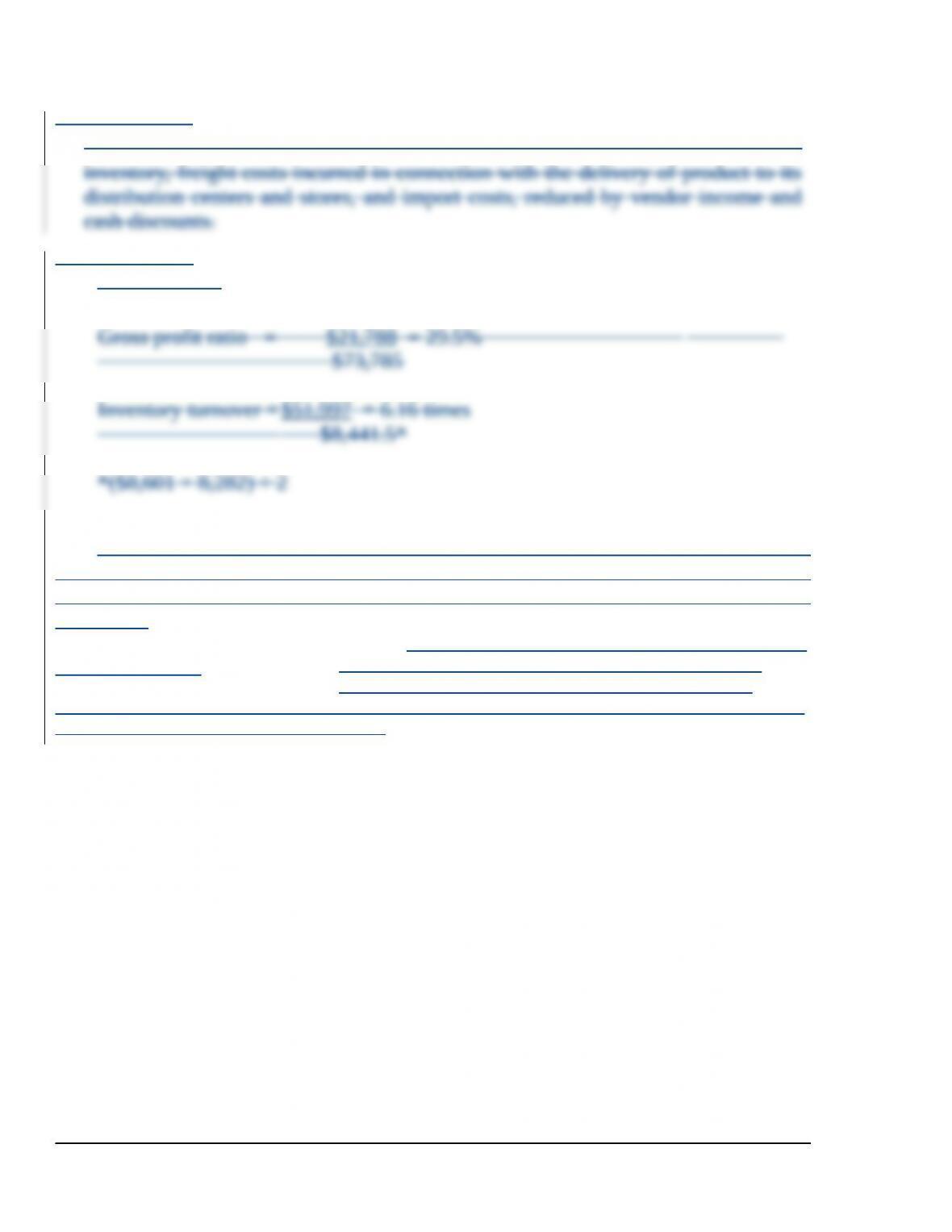
Requirement 2
The cost of inventory includes the amount Target pays to its suppliers to acquire
Requirement 3
($ in millions)
Target’s gross profit ratio is above the industry average, and its inventory turnover
ratio is lower than the industry average. This means that Target, compared to its
industry, earns more profit on each dollar of sales, but sells its inventory less
frequently.
Per note 4.16, AF uses the weighted-average method to value
its inventory. Under IFRS, the FIFO (first-in, first-out)
method also can be used. However, the LIFO (last-in,
first-out) method, which can be used under U.S. GAAP in addition to the average cost method and
the FIFO method, is prohibited under IFRS.
8–64 Intermediate Accounting, 8/e
Copyright © 2015 McGraw-Hill Education. All rights reserved. No reproduction or distribution without the prior written consent
of McGraw-Hill Education.
Air France–KLM Case