
Integrating Case 7–8
McLaughlin’s underestimation of bad debts is treated as a change in
accounting estimate. Changes in estimates are accounted for prospectively. When
a company revises a previous estimate, prior financial statements are not restated.
Analysis Case 7–9
Requirement 1
These methods can be described by one of two basic arrangements:
1. A secured borrowing, or
2. A sale of receivables.
When a company chooses between a borrowing and a sale, the critical element
is the extent to which it (the transferor) is willing to surrender control over the
assets transferred. Specifically, the transferor is determined to have surrendered
control over the receivables if and only if three sale conditions are met.
Secured borrowings usually take the form of an assignment of receivables.
An assignment of receivables is a promise by the borrower (the owner of the
receivables) that any failure to repay debt owed to the lender in accordance with
Two popular arrangements used for the sale of receivables are factoring and
securitization. A factor is a financial institution that buys receivables for cash,
Another popular arrangement used to sell receivables is a securitization. In a
typical accounts receivable securitization, the company creates a Special Purpose
Similar to accounts receivable, a note receivable can be used to obtain
Case 7–9 (concluded)
Requirement 2
In an assignment of specific receivables, usually the amount borrowed is less
than the amount of receivables assigned. The difference provides some protection
No special accounting treatment is needed for an assignment of receivables in
general, and the arrangement is simply described in a disclosure note.
The specific accounting treatment for the sale of receivables using factoring
When a company sells accounts receivable without recourse, the buyer
assumes the risk of uncollectibility. This means the buyer has no recourse to the
seller if customers don’t pay the receivables. In that case, the seller simply
When a company sells accounts receivable with recourse, the seller retains the
risk of uncollectibility. In effect, the seller guarantees that the buyer will be paid
even if some receivables prove to be uncollectible. Even if receivables are sold
Real World Case 7–10
Requirement 1
Sanofi-Aventis uses the terms “provision for impairment” and “impairment”
Requirement 2
Sanofi-Aventis has recently engaged in factoring and/or securitizing its
receivables. We know this because note D.10 states, “Some Sanofi subsidiaries
Requirement 3
a. Accounts receivable would be reduced in the period of change, as
b. Cash flow from operations would be increased in the period of change, as
c. Accounts receivable would be stable at a relatively low level, as
d. Cash flow from operations would return to approximately its former level,
Requirement 4
The answers to requirement 3 highlight that decisions to increase or decrease
the extent of securitization create one-time changes in receivables and cash flows
Research Case 7–11
Requirement 1
When a company sells accounts receivable without recourse, the buyer
Requirement 2
FASB ASC 860–10–40–5: “Transfers and Servicing—Overall—Derecognition—
Criteria for a Sale of Financial Assets.”
The transferor is determined to have surrendered control over the receivables
if and only if all of the following conditions are met:
a. The transferred assets have been isolated from the transferor—put
b. Each transferee has the right to pledge or exchange the assets it received.
c. The transferor does not maintain effective control over the transferred assets
(These criteria were included in Statement of Financial Accounting Standards
No. 140, “Accounting for Transfers and Servicing of Financial Assets and
Case 7–11 (concluded)
Requirement 3
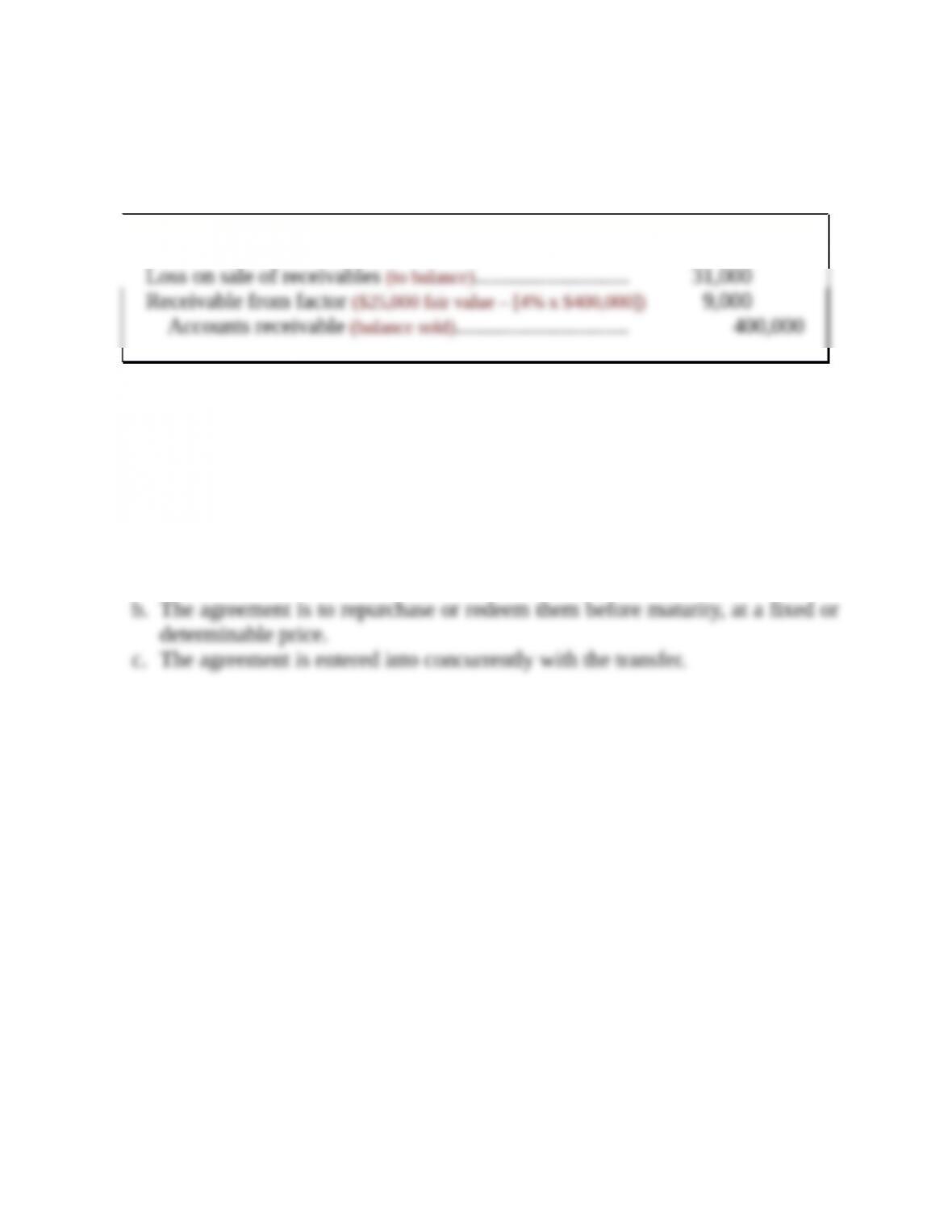
Cash (90% x $400,000)………………………………………………. 360,000
Requirement 4
FASB ACS 860–10–40–24: “Transfers and Servicing—Overall—Derecognition –
Effective Control Through Both a Right and an Obligation (previously paragraph
47 of SFAS No. 140) lists the following conditions:
a. The assets to be repurchased or redeemed are the same or substantially the
same as those transferred.
Analysis Case 7–12
Requirement 1
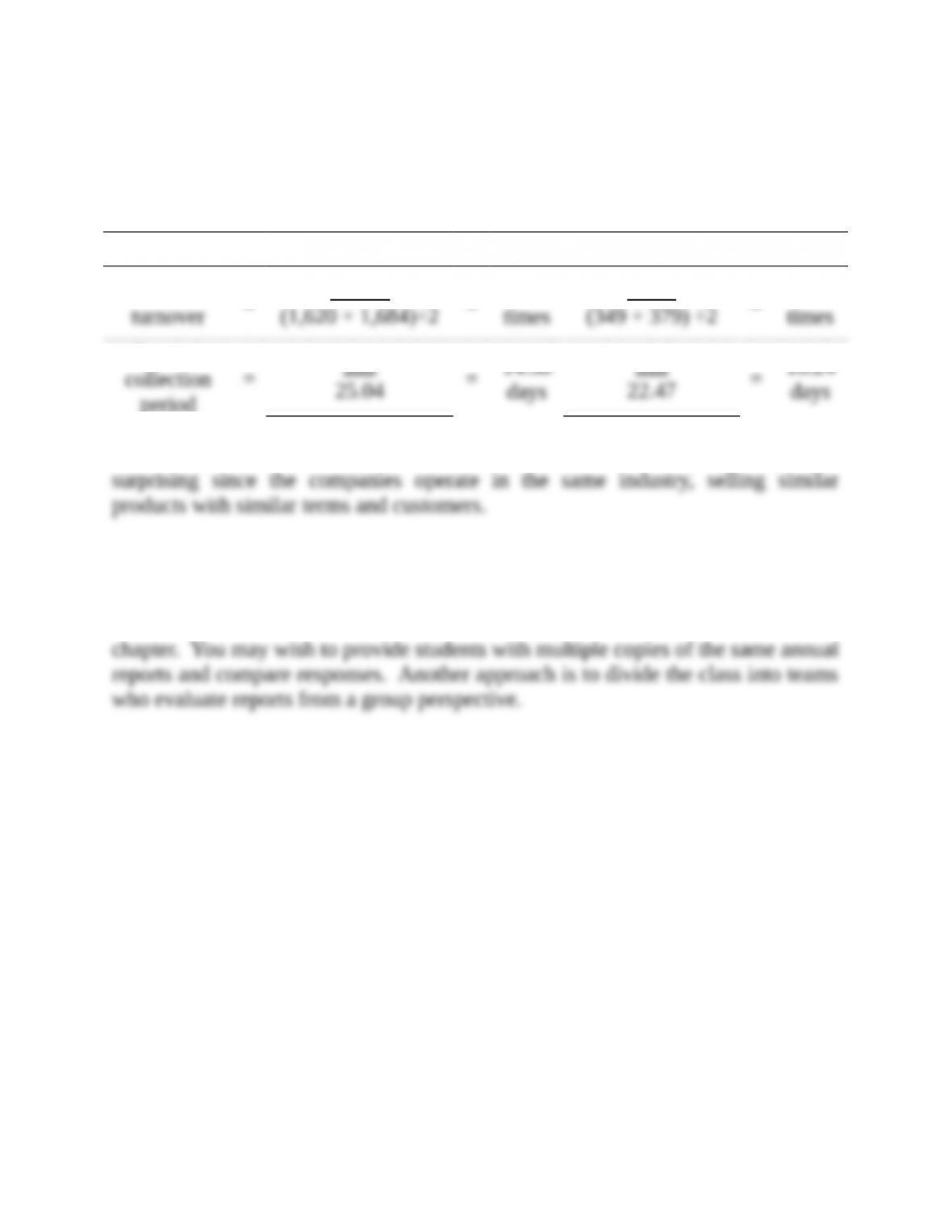
Tyson Pilgrim’s Pride
Receivables
8,180 =22.47
Average
period
365 =16.24
The receivable turnover ratios are reasonably close to each other. This is not
Requirement 2
The objective of this requirement is to motivate students to obtain hands-on
familiarity with actual annual reports and to apply the techniques learned in the
Target Case
LO2 LO4 LO5
Requirement 1
From note 11: “Cash equivalents include highly liquid investments with an
Requirement 2
Requirement 3
“Generally, guests may return national brand merchandise within 90 days of
Requirement 4
Target does not show any accounts receivable on its balance sheet. Per note 9,
it sold its credit card portfolio to TD Bank Group. However, per note 11, $375
Air France–KLM Case
Requirement 1
AF indicates the following:
“4.11 Valuation of trade receivables and non-current financial
assets:
Trade receivables, loans and other non-current financial assets
This approach is consistent with U.S. GAAP. The receivables are recorded initially
at their fair value (their value when the sales transaction occurs). If they are
Requirement 2
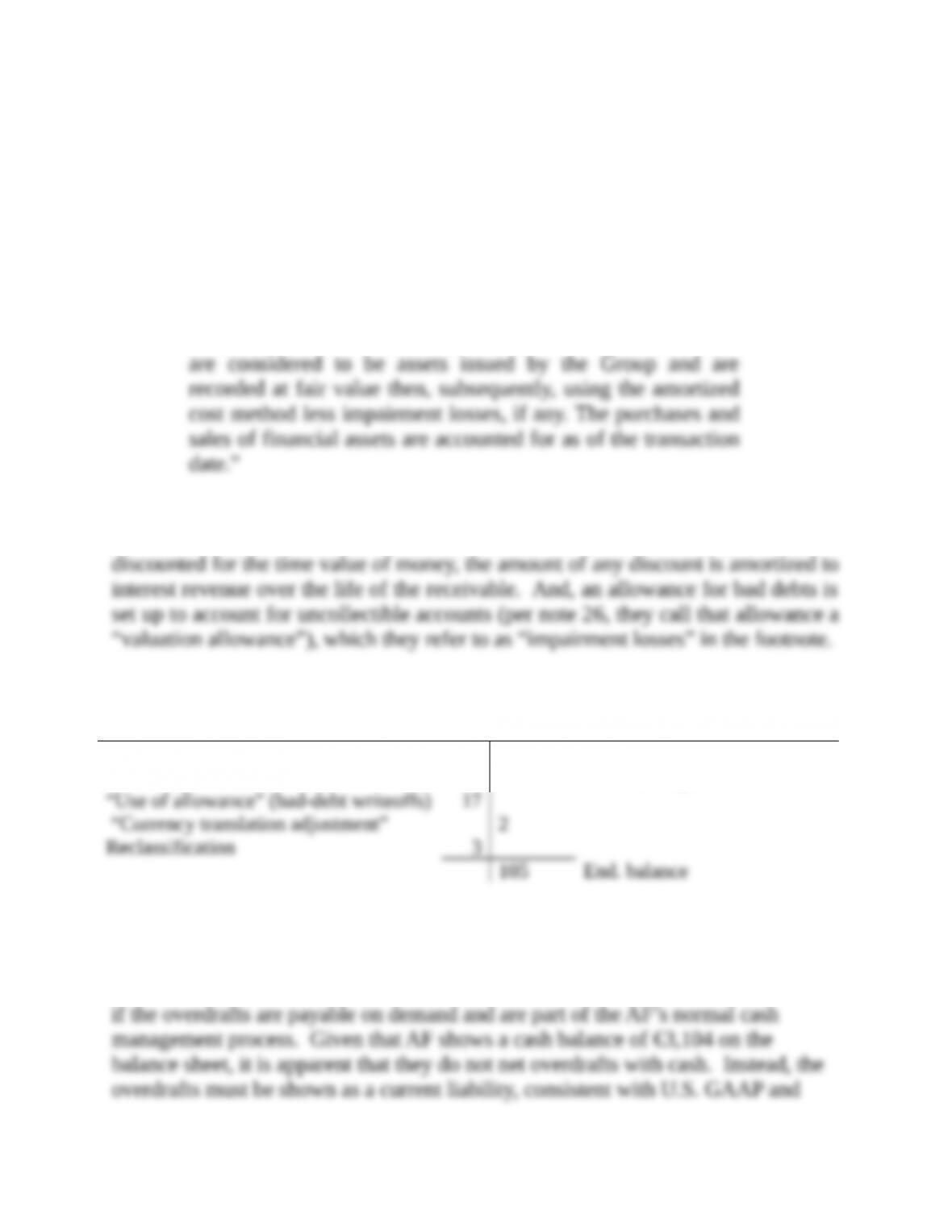
Valuation allowance for trade accounts receivable
98 Beg. balance
25 Bad debt expense
“Currency translation adjustment” 2