Question 7–1
Cash equivalents usually include negotiable instruments as well as highly
Question 7–2
Internal control procedures involving accounting functions are intended to
Question 7–3
Management must document the company’s internal controls and assess their
adequacy. The auditors must provide an opinion on management’s assessment.
Question 7–4
A compensating balance is an amount of cash a depositor (debtor) must leave
on deposit in an account at a bank (creditor) as security for a loan or a commitment
to lend. The classification and disclosure of a compensating balance depends on
Chapter 7 Cash and Receivables
Questions for Review of Key Topics
Answers to Questions (continued)
Question 7–5
Yes, IFRS and U.S. GAAP differ in how bank overdrafts are treated. Under
Question 7–6
Trade discounts are reductions below a list price and are used to establish a
final price for a transaction. The reduced price is the starting point for initial
Question 7–7
The gross method of accounting for cash discounts initially records accounts
receivable at their gross value, without reducing them for sales discounts, and then
Question 7–8
Companies estimate sales returns and reduce revenue to account for them. If
the company has received cash from the customer, the company credits a refund
Question 7–9
Each period companies estimate the amount of accounts receivable that will
be collected, and adjust an allowance for uncollectible accounts (contra to accounts
Answers to Questions (continued)
Question 7–10
The balance sheet approach to estimating future bad debts determines bad
debt expense by estimating the appropriate carrying value for accounts receivable
Question 7–11
Question 7–12
The assignment of all accounts receivable in general as collateral for debt
Question 7–13
The accounting treatment of receivables factored with recourse depends on
whether certain criteria are met. If the criteria are met, the factoring is accounted
Answers to Questions (continued)
Question 7–14
U.S. GAAP focuses on whether control of assets has shifted from the
transferor to the transferee. In contrast, IFRS focuses on whether the company has
transferred “substantially all of the risks and rewards of ownership,” as well as
whether the company has transferred control. Under IFRS:
Question 7–15
When a note is discounted, a financial institution, usually a bank, accepts the
The four-step process used to account for a discounted note receivable is as
follows:
1. Accrue any interest revenue earned since the last payment date (or date of
the note).
2. Compute the maturity value.
3. Subtract the discount the bank requires (discount rate times maturity value
4. Compute the difference between the proceeds and the book value of the
Answers to Questions (continued)
Question 7–16
A company’s investment in receivables is influenced by several related
Question 7–17
The CECL model still uses the allowance method, and it still uses the same
journal entries, but it differs from current GAAP in two important ways. First, the
“probable” threshold for identifying bad debts is removed. Therefore, even if the
Question 7–18
The items necessary to adjust the bank balance might include deposits
outstanding (including undeposited cash), outstanding checks, and any bank errors
Question 7–19
A petty cash fund is established by transferring a specified amount of cash
Answers to Questions (concluded)
Question 7–20
When a creditor’s investment in a receivable becomes impaired, due to a
troubled debt restructuring or for any other reason, the receivable is remeasured
based on the discounted present value of currently expected cash flows discounted
Question 7–21
No. Under both U.S. GAAP and IFRS, a company can recognize in net
income the recovery of impairment losses of accounts and notes receivable.
Brief Exercise 7–1
The company could improve its internal control procedure for cash receipts by
Brief Exercise 7–2
Under IFRS the cash balance would be $245,000, because they could offset
Brief Exercise 7–3
All of these items would be included as cash and cash equivalents except the
Brief Exercise 7–4
Income before tax in 2019 will be reduced by $2,500, the amount of the cash
discounts.
BRIEF EXERCISES

Brief Exercise 7–5
Income before tax in 2018 will be reduced by $2,500, the anticipated amount
of cash discounts.
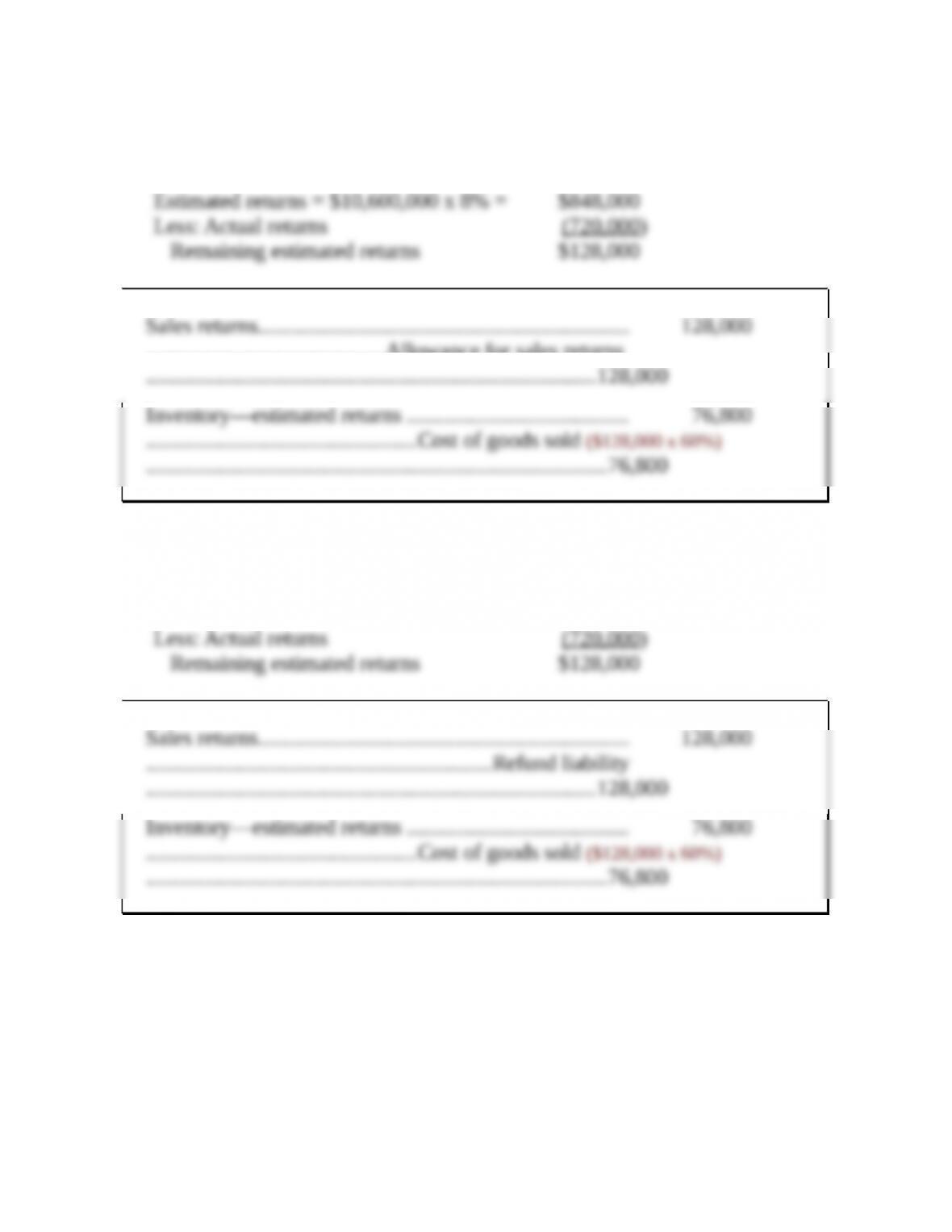
Brief Exercise 7–6
…………………………………….Allowance for sales returns
Brief Exercise 7–7
Estimated returns = $10,600,000 x 8% = $848,000
Brief Exercise 7–8
Singletary cannot combine the two types of receivables under U.S. GAAP, as the
director is a related party. Under IFRS a combined presentation would be allowed.

Brief Exercise 7–9
(1) Bad debt expense = $1,500,000 x 2% = $30,000
(2) Allowance for uncollectible accounts: