Problem 6–14
Requirement 1
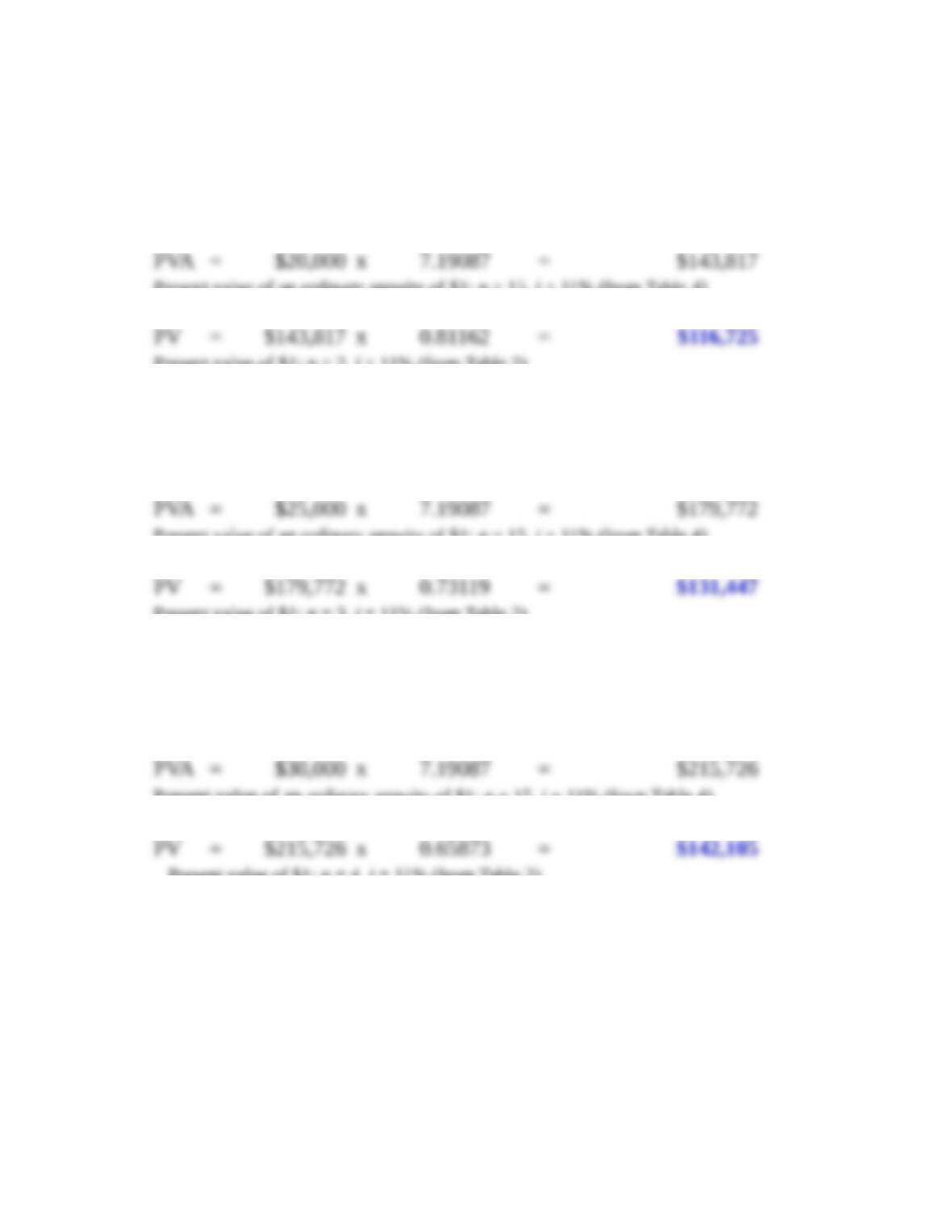
Tinkers:
Present value of an ordinary annuity of $1: n = 15, i = 11% (from Table 4)
Present value of $1: n = 2, i = 11% (from Table 2)
Note: We could use the present value of an annuity due instead of an ordinary annuity, in which
case we would use n=3 when calculating the PV at December 31, 2018.
Evers:
Present value of an ordinary annuity of $1: n = 15, i = 11% (from Table 4)
Present value of $1: n = 3, i = 11% (from Table 2)
Note: We could use the present value of an annuity due instead of an ordinary annuity, in which
case we would use n=4 when calculating the PV at December 31, 2018.
Chance:
Present value of an ordinary annuity of $1: n = 15, i = 11% (from Table 4)
Present value of $1: n = 4, i = 11% (from Table 2)
Note: We could use the present value of an annuity due instead of an ordinary annuity, in which
case we would use n=5 when calculating the PV at December 31, 2018.
Problem 6–14 (concluded)
Or, alternatively:
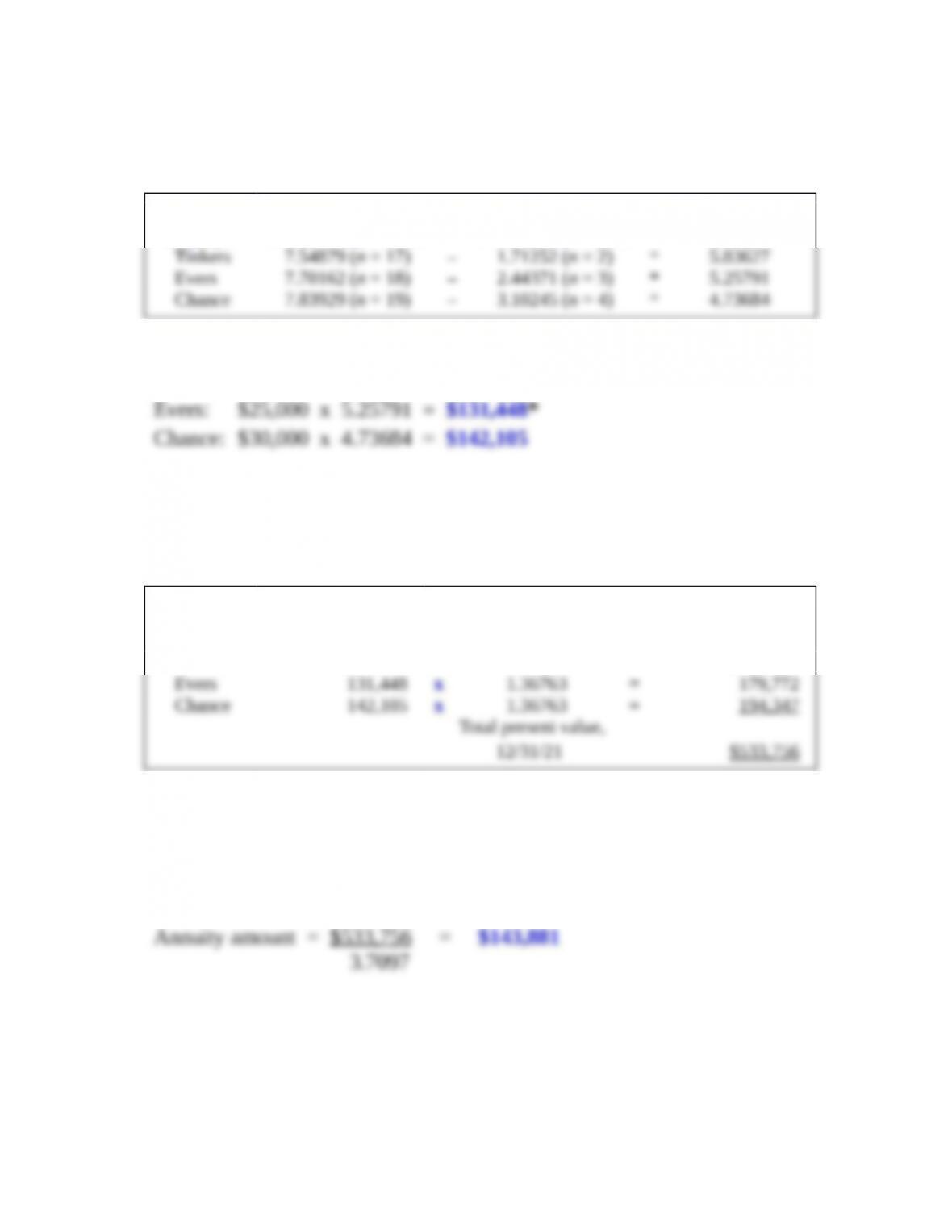
Deferred annuity
Employee PVA factor, i = 11% – PVA factor, i = 11% =factor
Present value of pension obligations at 12/31/18:
Tinkers: $20,000 x 5.83627 = $116,725
*rounding difference
Requirement 2
Present value of pension obligations as of December 31, 2021:
Employee PV as of 12/31/18 x FV of $1 factor, = FV as of 12/31/18
n = 3, i = 11%
Tinkers $116,725 x1.36763 =$159,637
Amount of annual contribution:
FVAD = Annuity amount x Annuity factor
Annuity amount =
Future value of an annuity due of $1: n = 3, i = 11% (from Table 5)
Problem 6–15
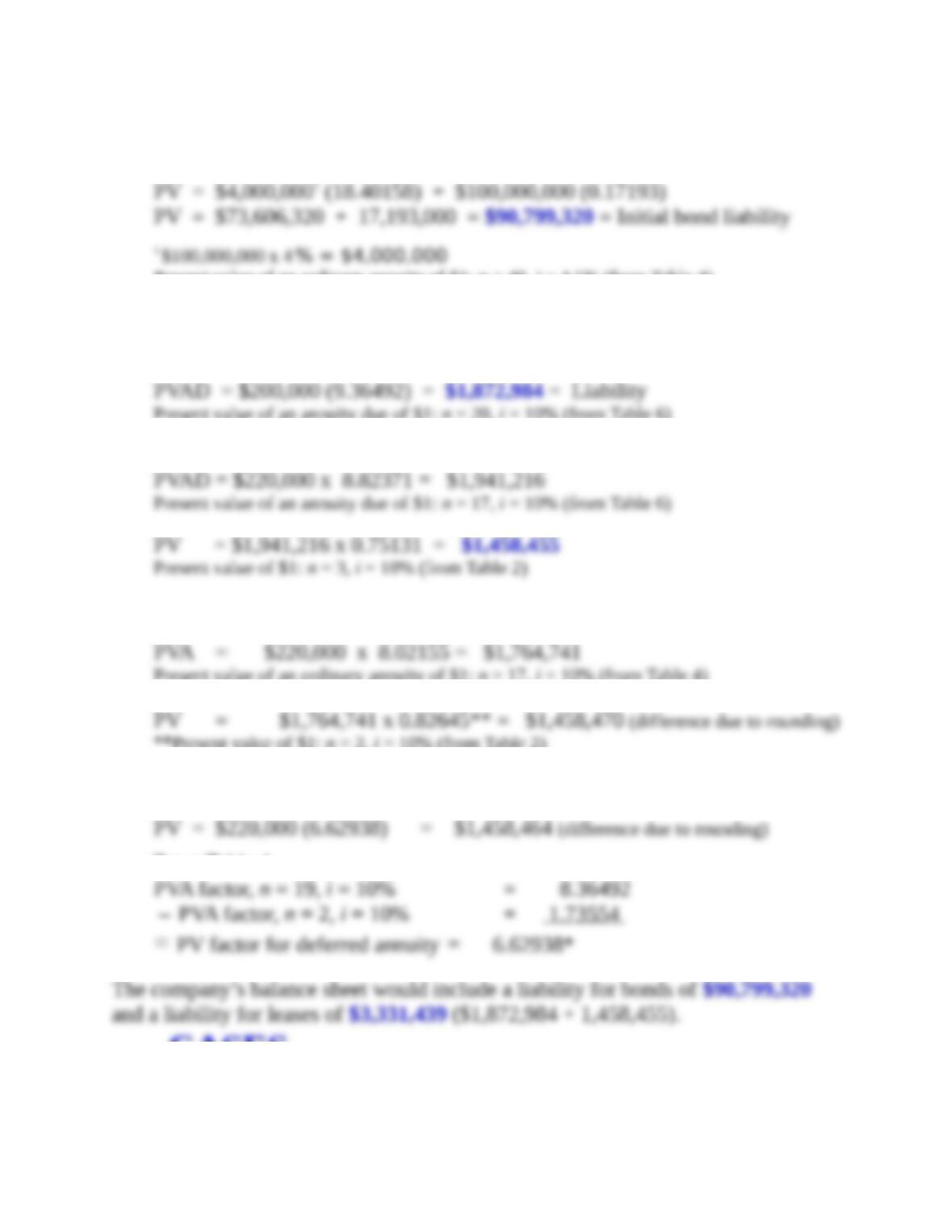
Bond liability:
Present value of an ordinary annuity of $1: n = 40, i = 4.5% (from Table 4)
Present value of $1: n = 40, i = 4.5% (from Table 2)
Lease liability:
Lease A:
Present value of an annuity due of $1: n = 20, i = 10% (from Table 6)
Lease B:
Or, alternatively for Lease B:
Present value of an ordinary annuity of $1: n = 17, i = 10% (from Table 4)
**Present value of $1: n = 2, i = 10% (from Table 2)
Or, alternatively for Lease B:
From Table 4,
Ethics Case 6–1
CASES
The ethical issue is that the 21% return implies an annual return of 21% on an
investment and misrepresents the fund’s performance to all current and future
stakeholders. Interest rates are usually assumed to represent an annual rate, unless
otherwise stated. Interested investors may assume that the return for $100 would
be $21 per year, not $21 over two years. The Damon Investment Company ad
should explain that the 21% rate represented appreciation over two years.
Analysis Case 6–2
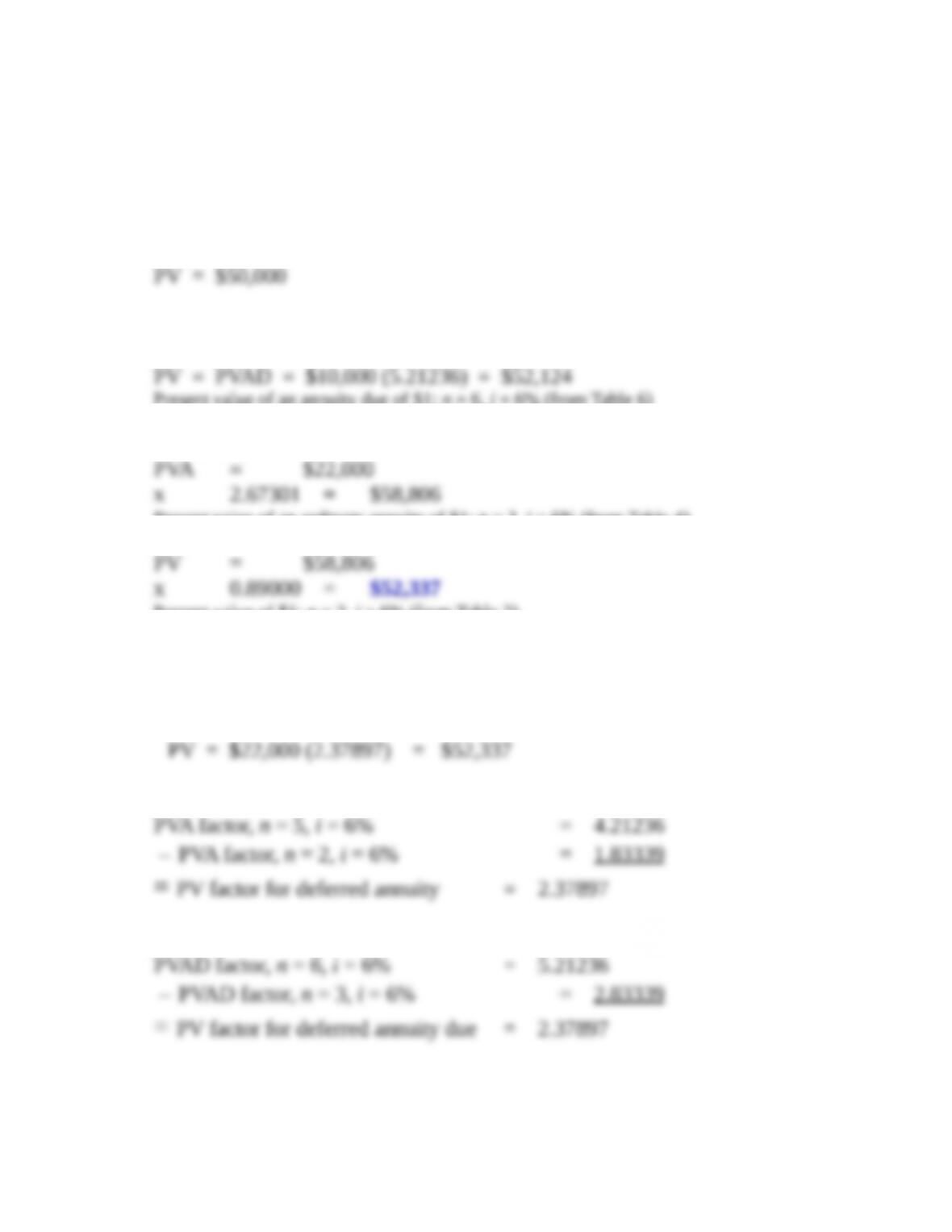
Sally should choose the alternative with the highest present value.
Alternative 1:
Alternative 2:
Present value of an annuity due of $1: n = 6, i = 6% (from Table 6)
Alternative 3:
Present value of an ordinary annuity of $1: n = 3, i = 6% (from Table 4)
Present value of $1: n = 2, i = 6% (from Table 2)
Sally should choose alternative 3.
Or, alternatively (for 3):
From Table 4,
or, from Table 6,
Communication Case 6–3
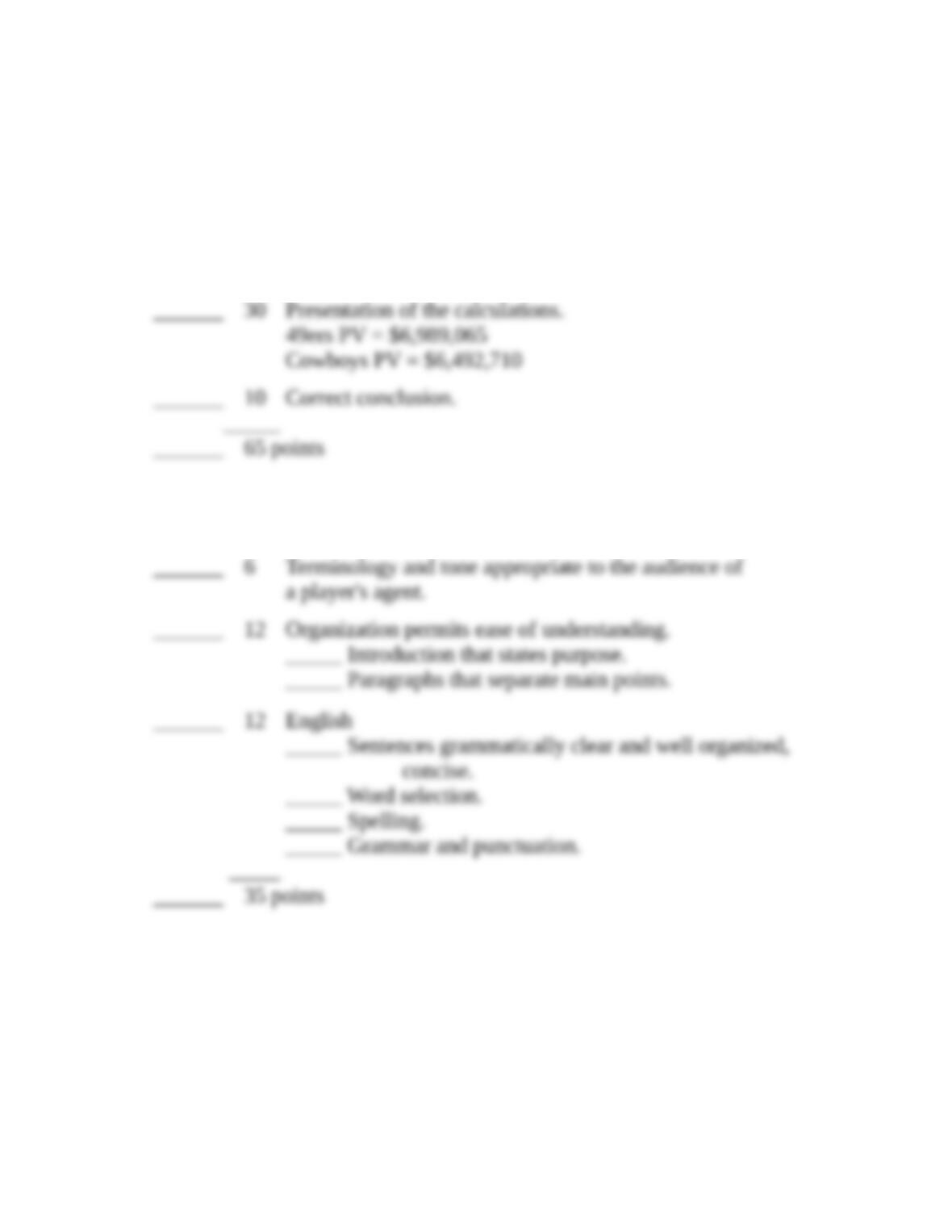
Suggested Grading Concepts and Grading Scheme:
Content (65%)
_______ 25 Explanation of the method used (present value) to
compare the two contracts.
Writing (35%)
_______ 5 Proper letter format.
Analysis Case 6–4
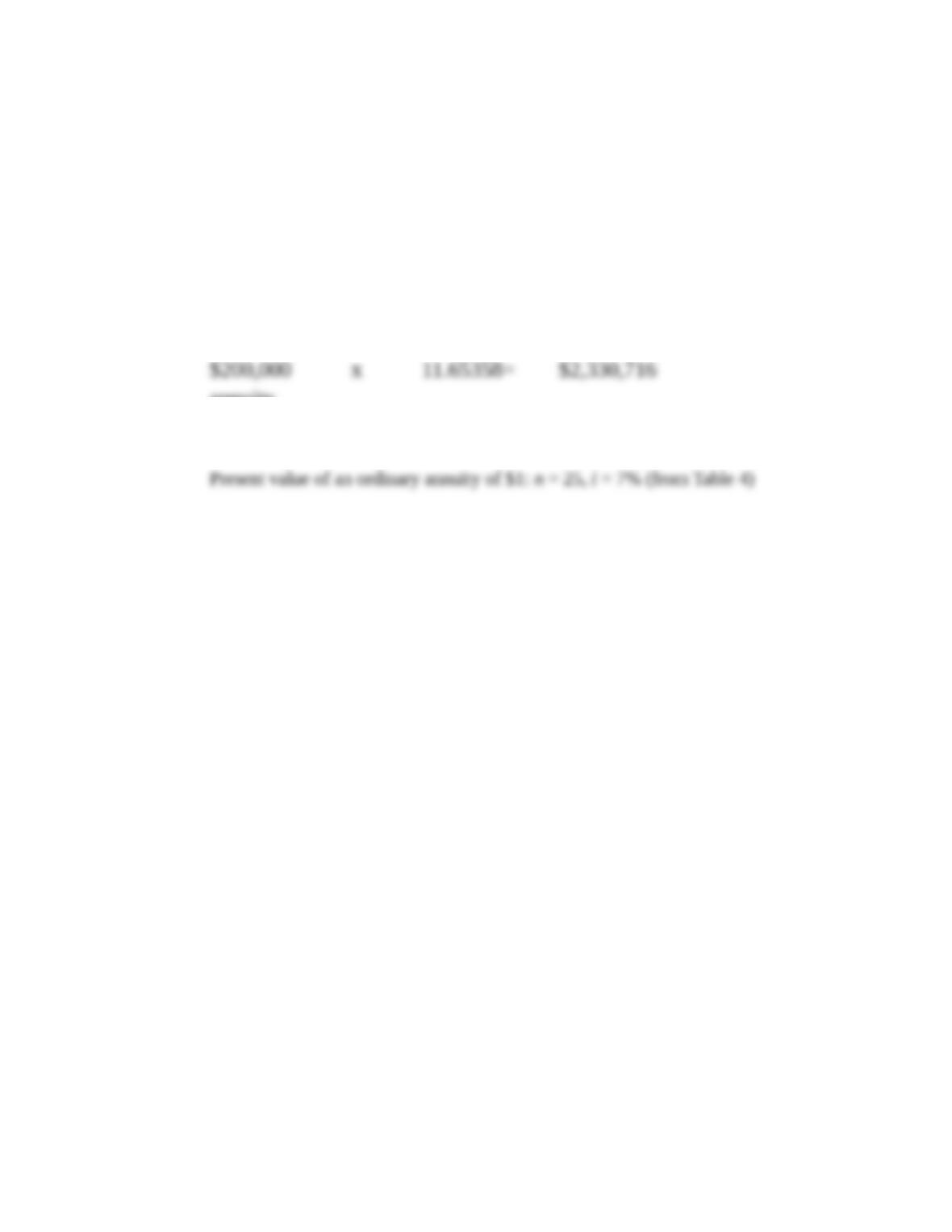
The settlement was determined by calculating the present value of lost future
income ($200,000 per year) discounted at a rate that is expected to approximate the
time value of money. In this case, the discount rate, i, apparently is 7% and the
number of periods, n, is 25 (the number of years to John’s retirement). John’s
settlement was calculated as follows:
annuity
amount
Note: In the actual case, John’s present salary was increased by 3% per year to reflect future
salary increases.
Judgment Case 6–5
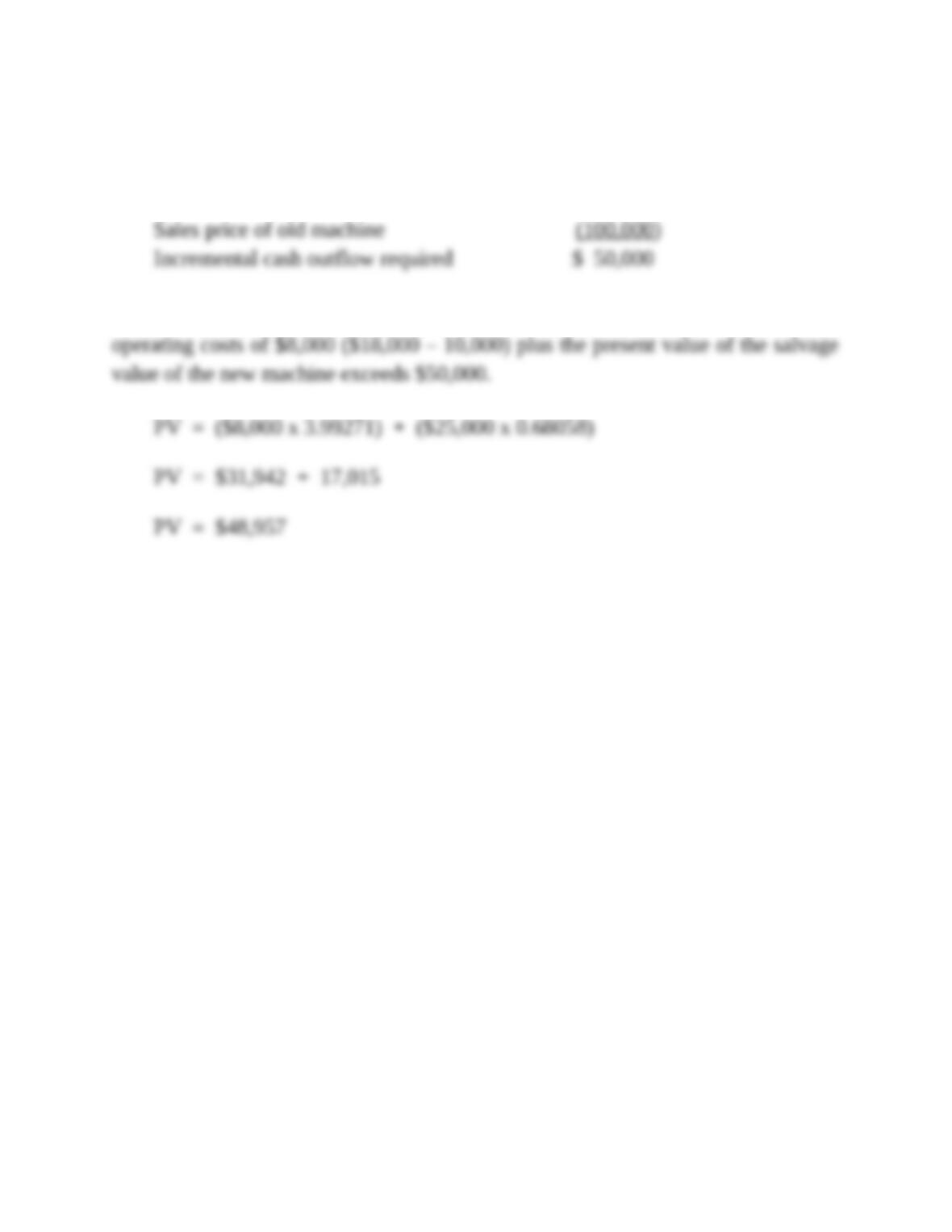
Purchase price of new machine $150,000
The new machine should be purchased if the present value of the savings in
Present value of an ordinary annuity of $1: n = 5, i = 8% (from Table 4)
Present value of $1: n = 5, i = 8% (from Table 2)
The new machine should not be purchased.