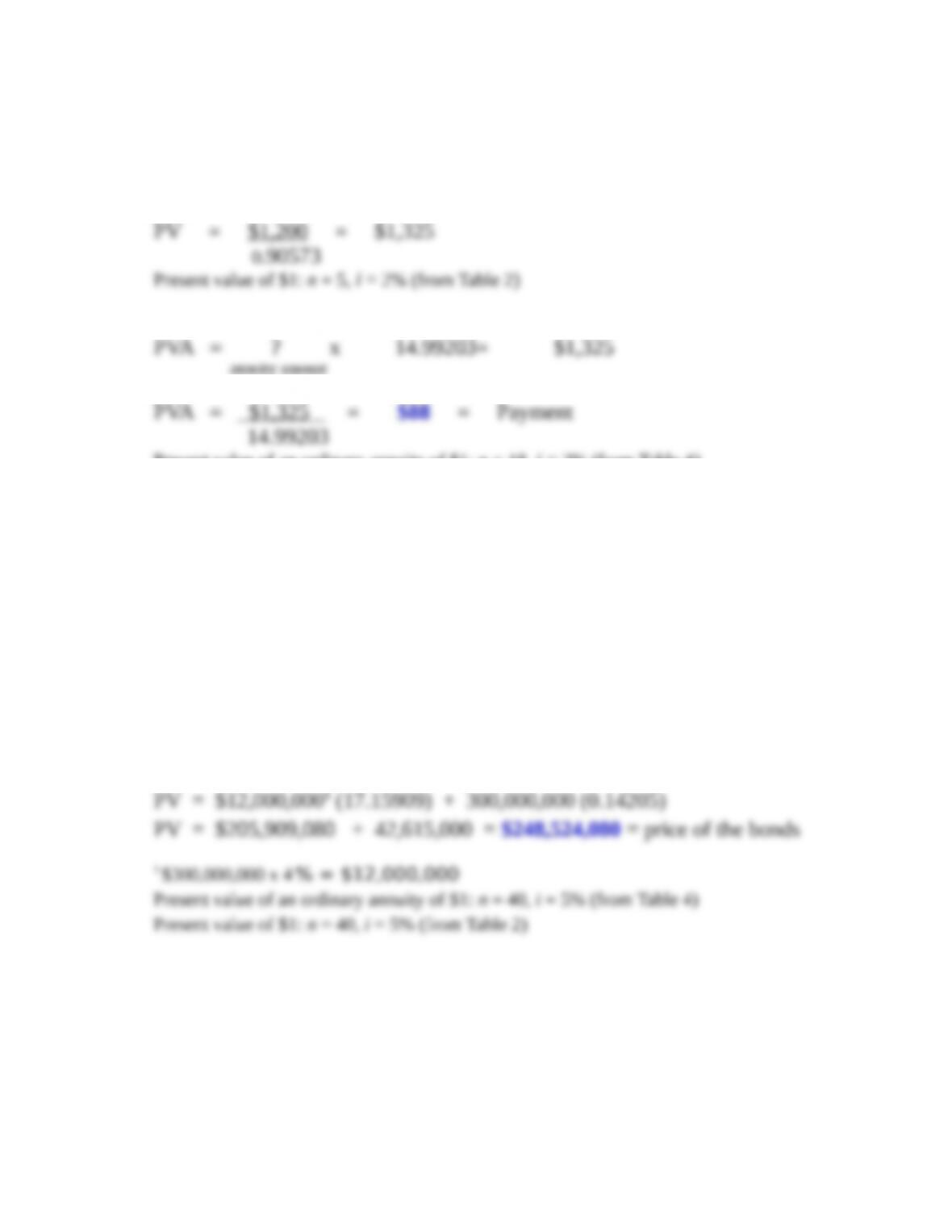
Exercise 6–16
PV = ? x 0.90573= 1,200
annuity amount
Present value of an ordinary annuity of $1: n = 18, i = 2% (from Table 4)
Exercise 6–17
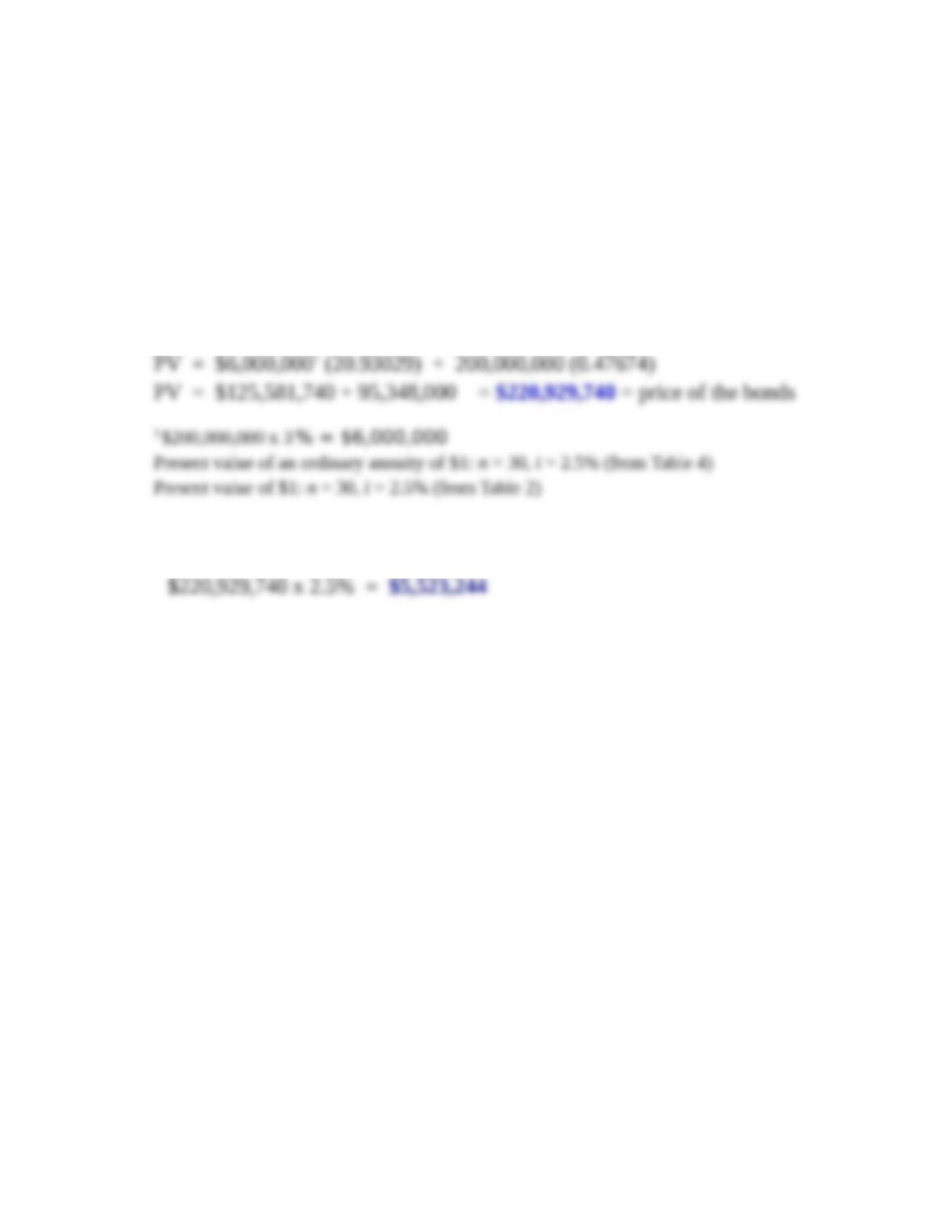
To determine the price of the bonds, we calculate the present value of the
40-period annuity (40 semiannual interest payments of $12 million) and the
lump-sum payment of $300 million paid at maturity using the semiannual market
rate of interest of 5%. In equation form,
Exercise 6–18
Requirement 1
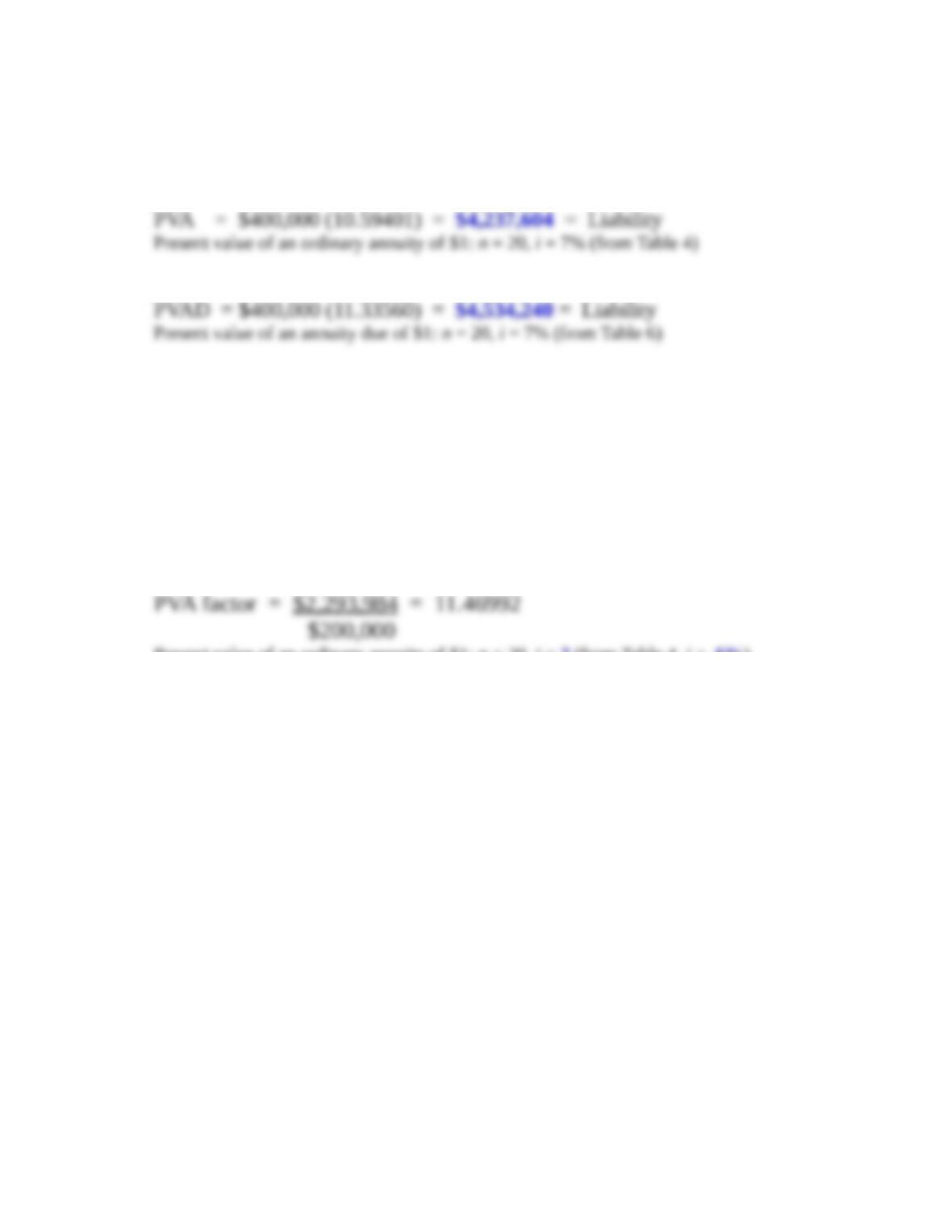
To determine the price of the bonds, we calculate the present value of the
30-period annuity (30 semiannual interest payments of $6 million) and the
lump-sum payment of $200 million paid at maturity using the semiannual market
rate of interest of 2.5%. In equation form,
Requirement 2
Because the bonds were outstanding only for six months of the year, Singleton
reports only one-half year’s interest in 2018.
Exercise 6–19
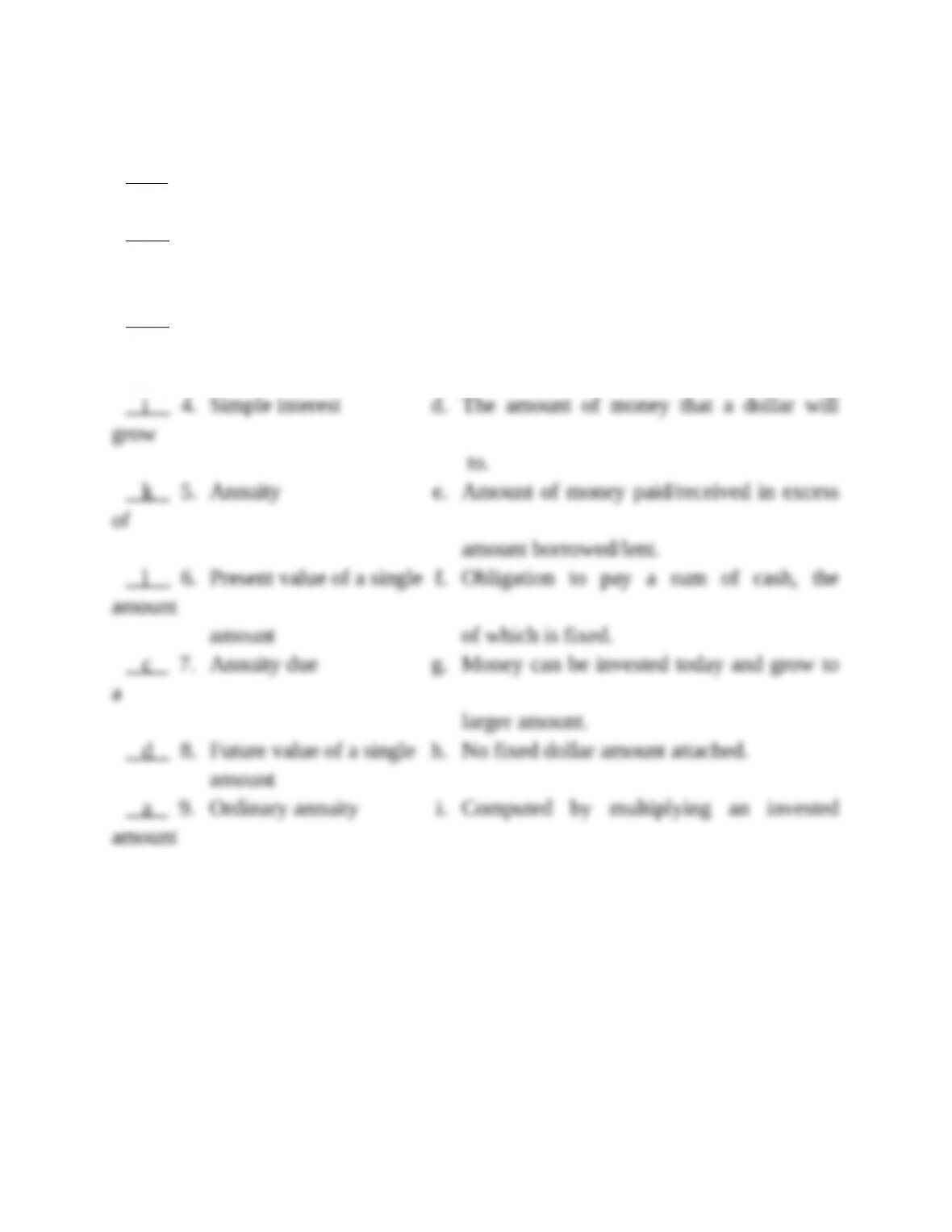
Requirement 1
Requirement 2
Exercise 6–20
Present value of an ordinary annuity of $1: n = 20, i = ? (from Table 4, i = 6%)
Exercise 6–21
List A List B
e 1. Interest a. First cash flow occurs one period after
agreement begins.
m 2. Monetary asset b. The rate at which money will actually
grow
during a year.
j 3. Compound interest c. First cash flow occurs on the first day of
the
agreement.
Problem 6–1
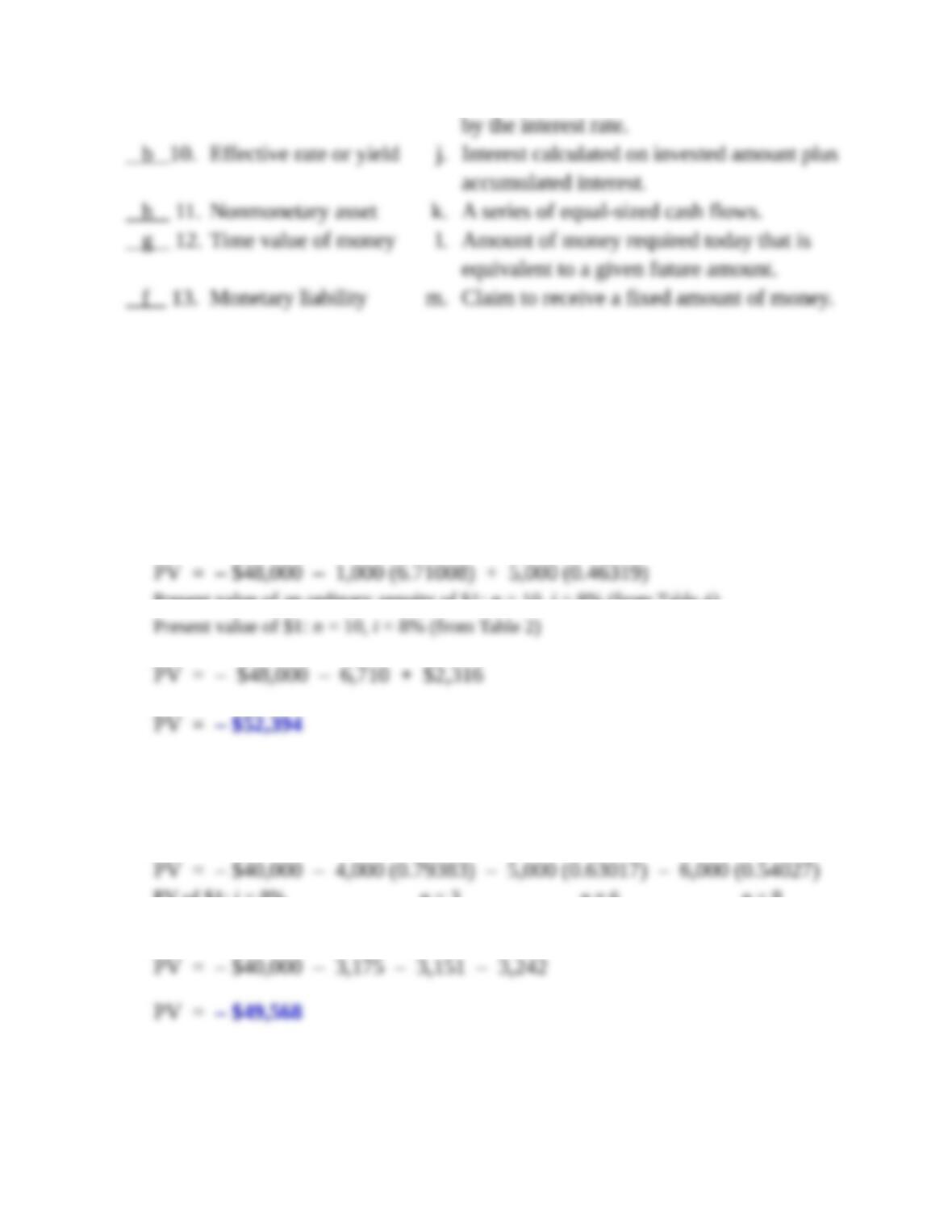
Choose the option with the lowest present value of cash outflows, net of the
present value of any cash inflows (Cash outflows are shown as negative amounts;
cash inflows as positive amounts).
Machine A:
Present value of an ordinary annuity of $1: n = 10, i = 8% (from Table 4)
Machine B:
PV of $1: i = 8% n = 3 n = 6 n = 8
(from Table 2)
Esquire should purchase machine B.
PROBLEMS
Problem 6–2
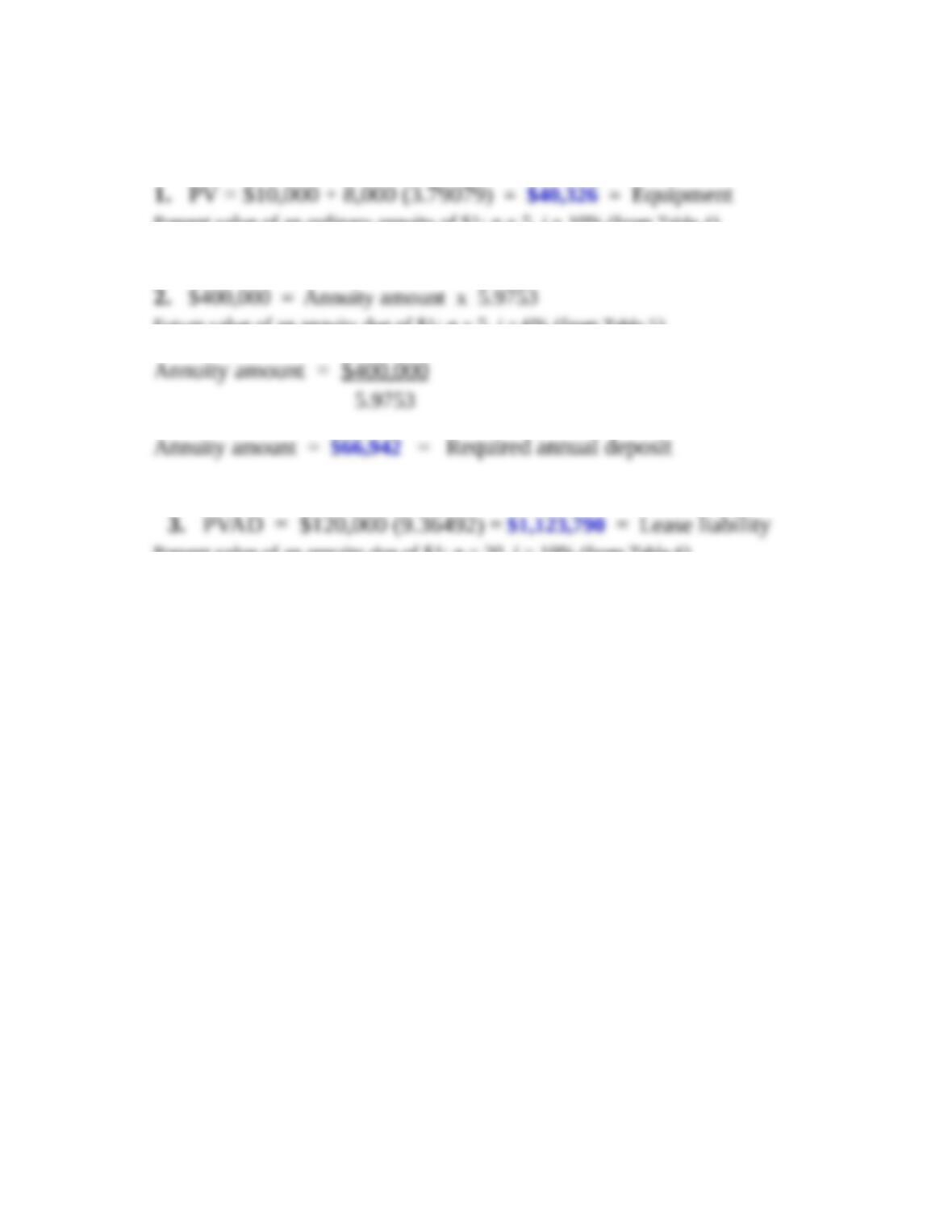
Present value of an ordinary annuity of $1: n = 5, i = 10% (from Table 4)
Future value of an annuity due of $1: n = 5, i = 6% (from Table 5)
Present value of an annuity due of $1: n = 20, i = 10% (from Table 6)
Problem 6–3
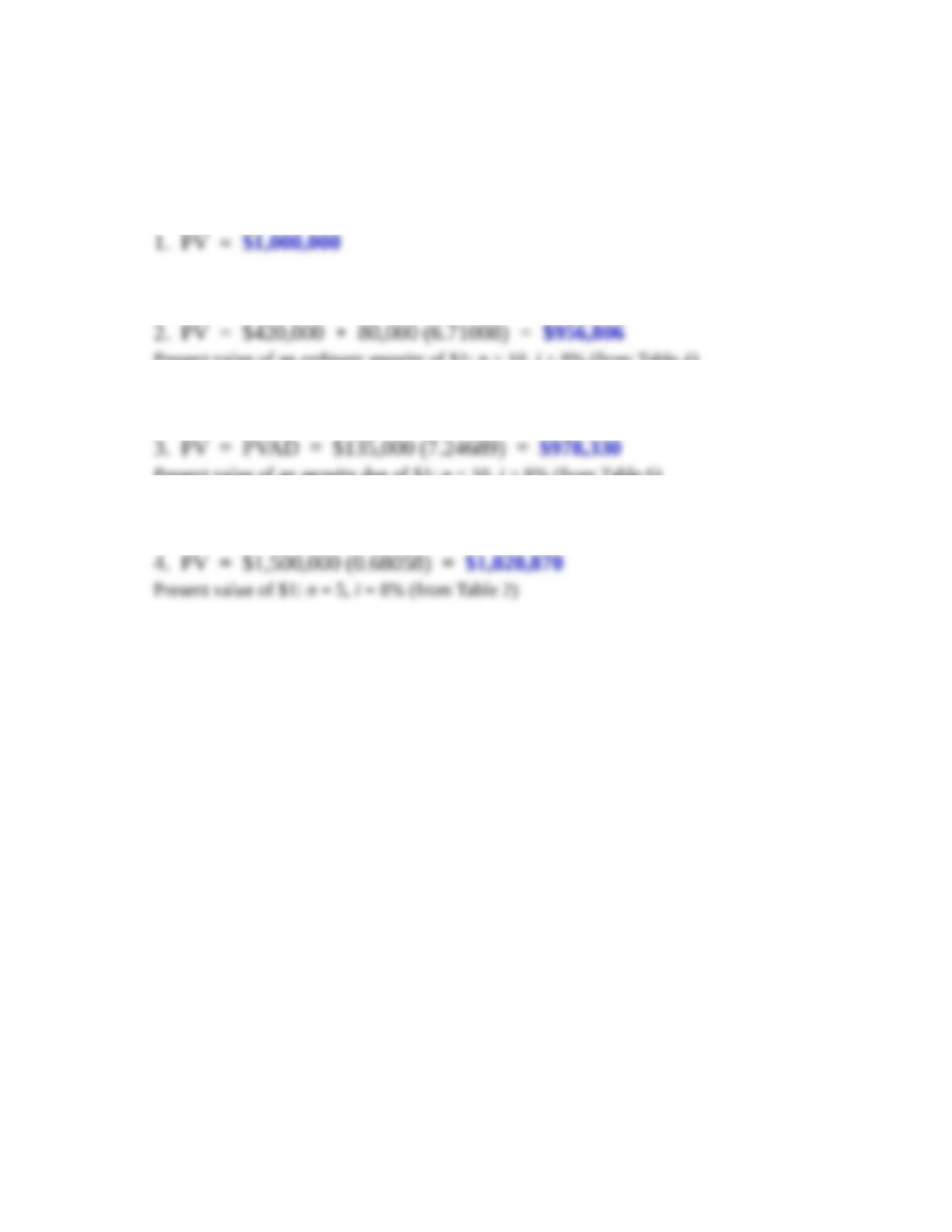
Choose the option with the lowest present value of cash payments.
Present value of an ordinary annuity of $1: n = 10, i = 8% (from Table 4)
Present value of an annuity due of $1: n = 10, i = 8% (from Table 6)
Harding should choose option 2.
Problem 6–4
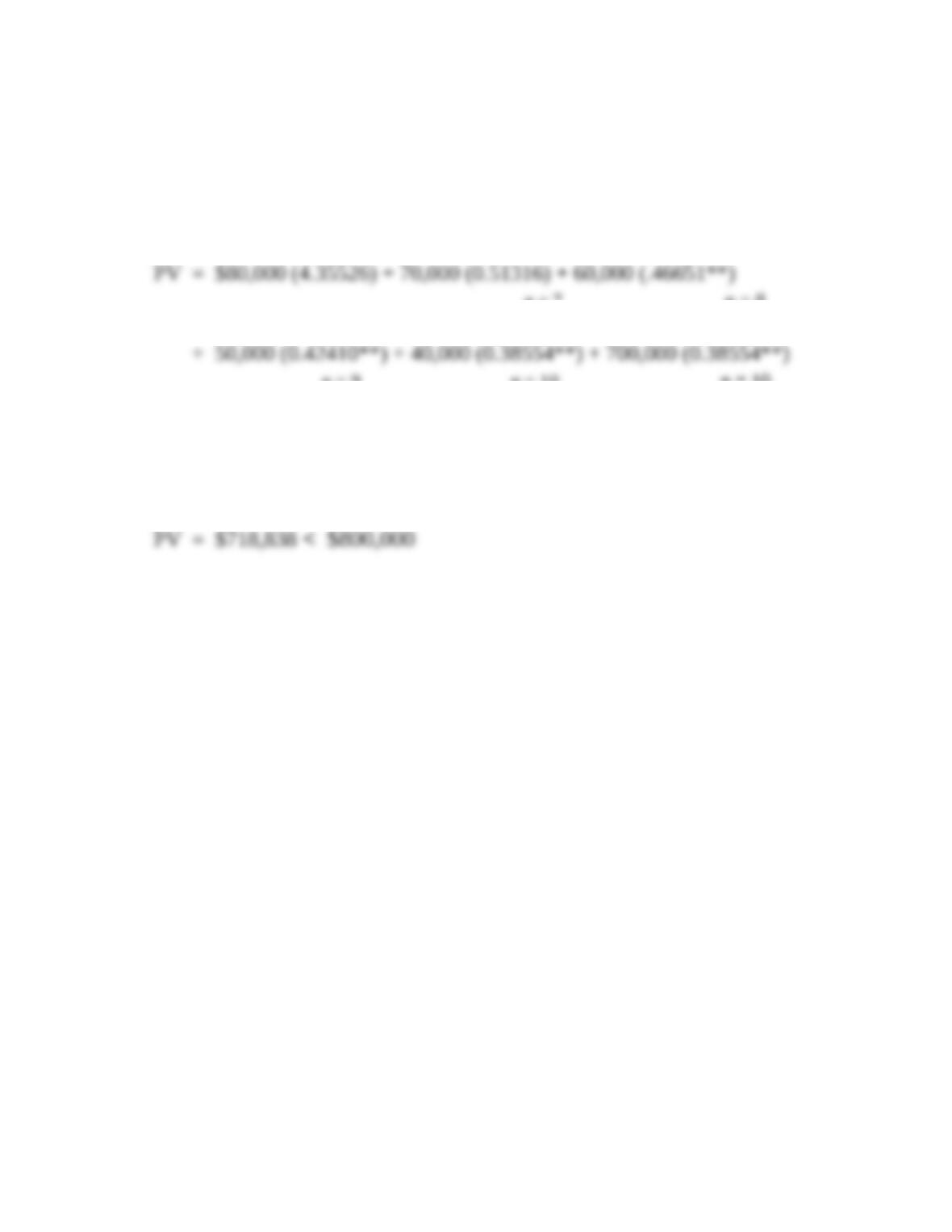
The restaurant should be purchased if the present value of the future cash
flows discounted at a 10% rate is greater than $800,000.
n = 7 n = 8
n = 9 n = 10 n = 10
Present value of an ordinary annuity of $1: n = 6, i = 10% (from Table 4)
Present value of $1: i = 10% (from Table 2)
Since the PV is less than $800,000, the restaurant should not be
purchased.
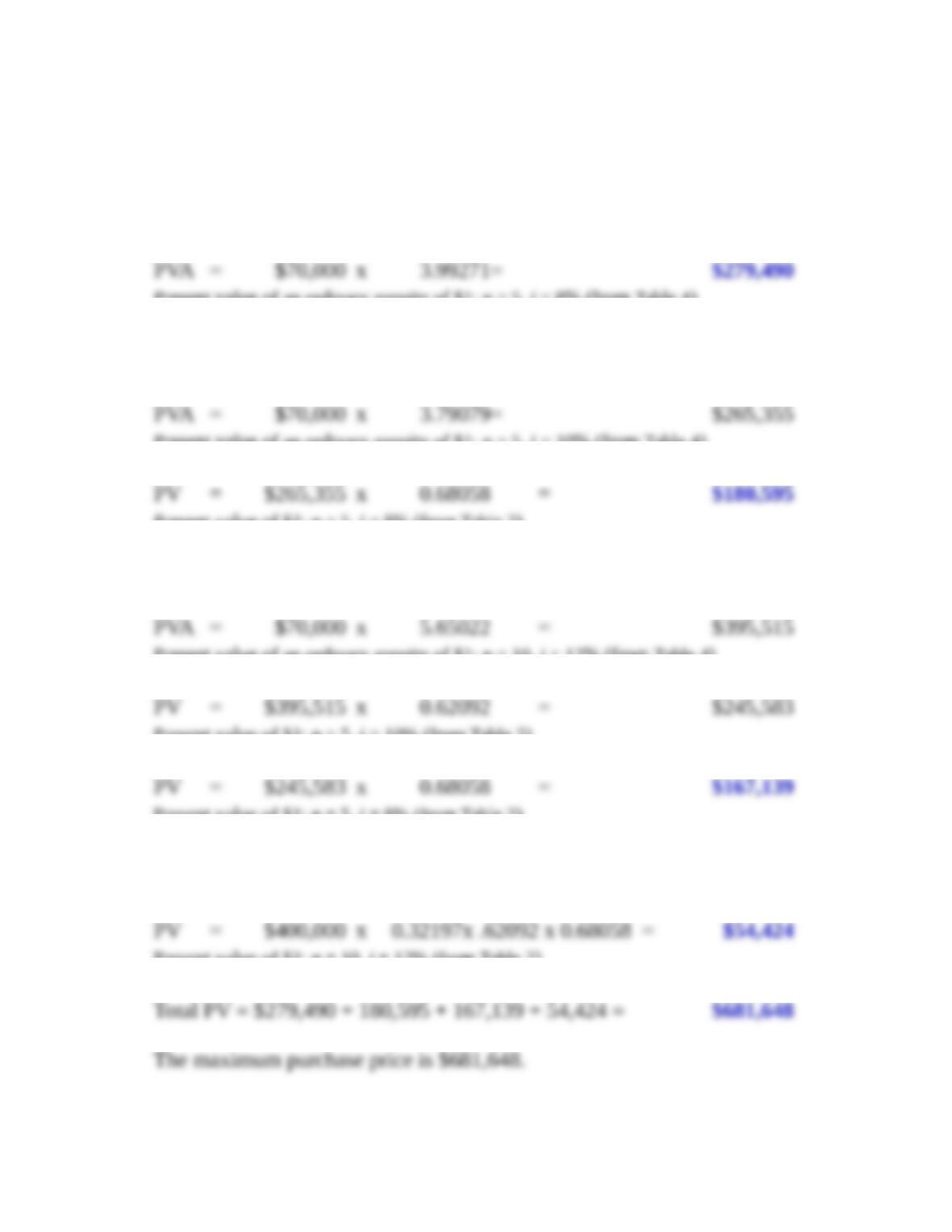
Problem 6–5
The maximum amount that should be paid for the store is the present value of
the estimated cash flows.
Years 1–5:
Present value of an ordinary annuity of $1: n = 5, i = 8% (from Table 4)
Years 6–10:
Present value of an ordinary annuity of $1: n = 5, i = 10% (from Table 4)
Present value of $1: n = 5, i = 8% (from Table 2)
Years 11–20:
Present value of an ordinary annuity of $1: n = 10, i = 12% (from Table 4)
Present value of $1: n = 5, i = 10% (from Table 2)
Present value of $1: n = 5, i = 8% (from Table 2)
End of Year 20:
Present value of $1: n = 10, i = 12% (from Table 2)