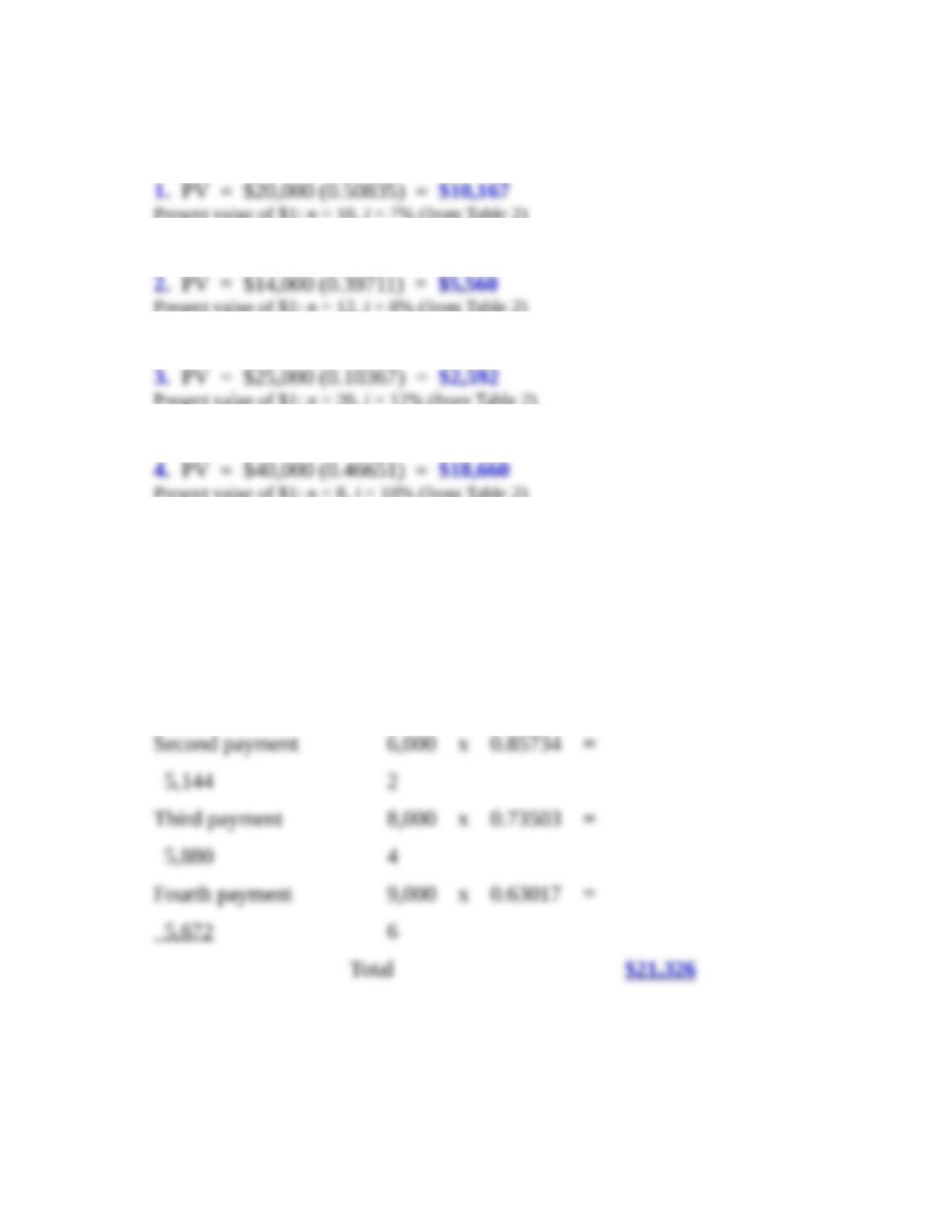
Exercise 6–3
Present value of $1: n = 10, i = 7% (from Table 2)
Present value of $1: n = 12, i = 8% (from Table 2)
Present value of $1: n = 20, i = 12% (from Table 2)
Present value of $1: n = 8, i = 10% (from Table 2)
Exercise 6–4
PV of $1
Payment i=8% PV n
First payment: $5,000 x 0.92593 = $ 4,630 1
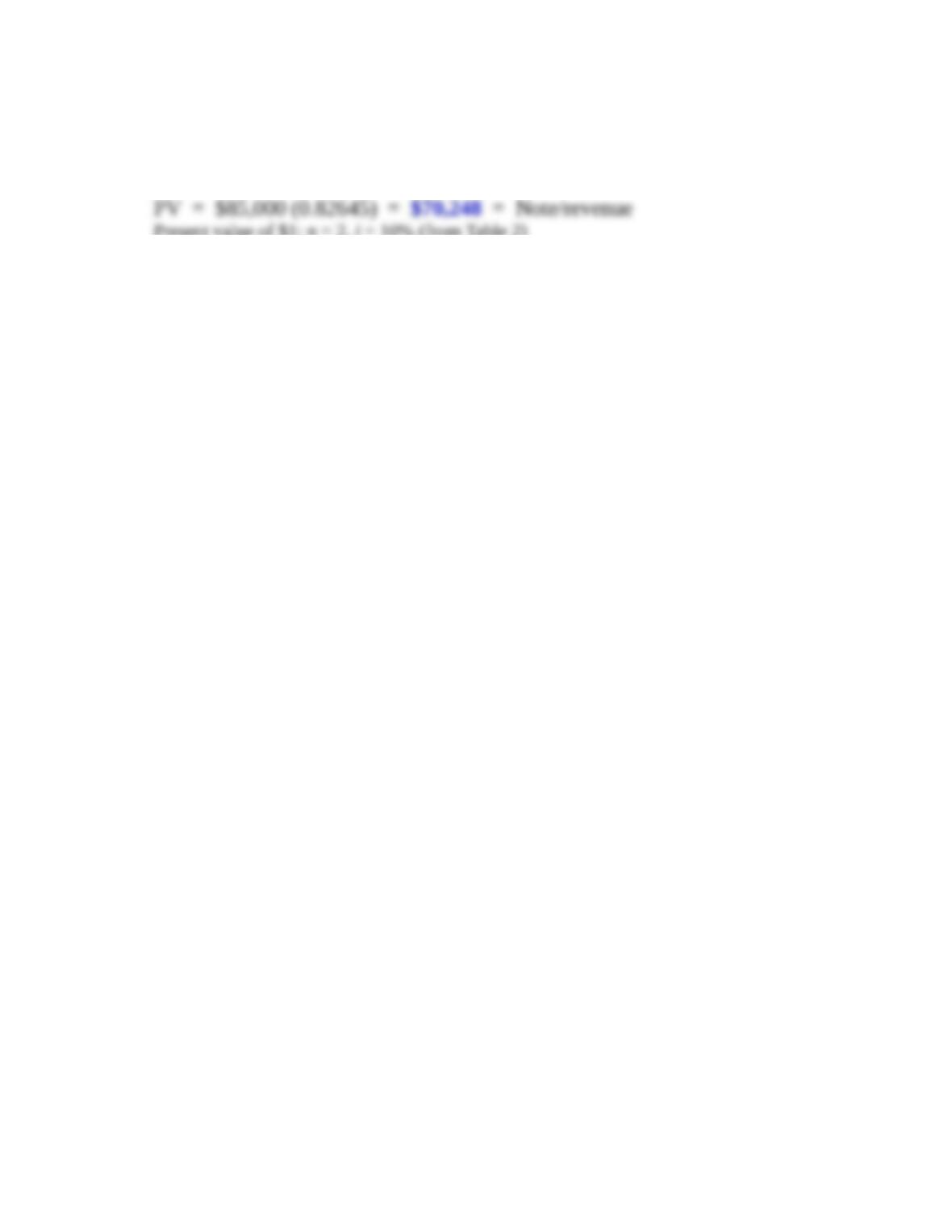
Exercise 6–5
Present value of $1: n = 2, i = 10% (from Table 2)
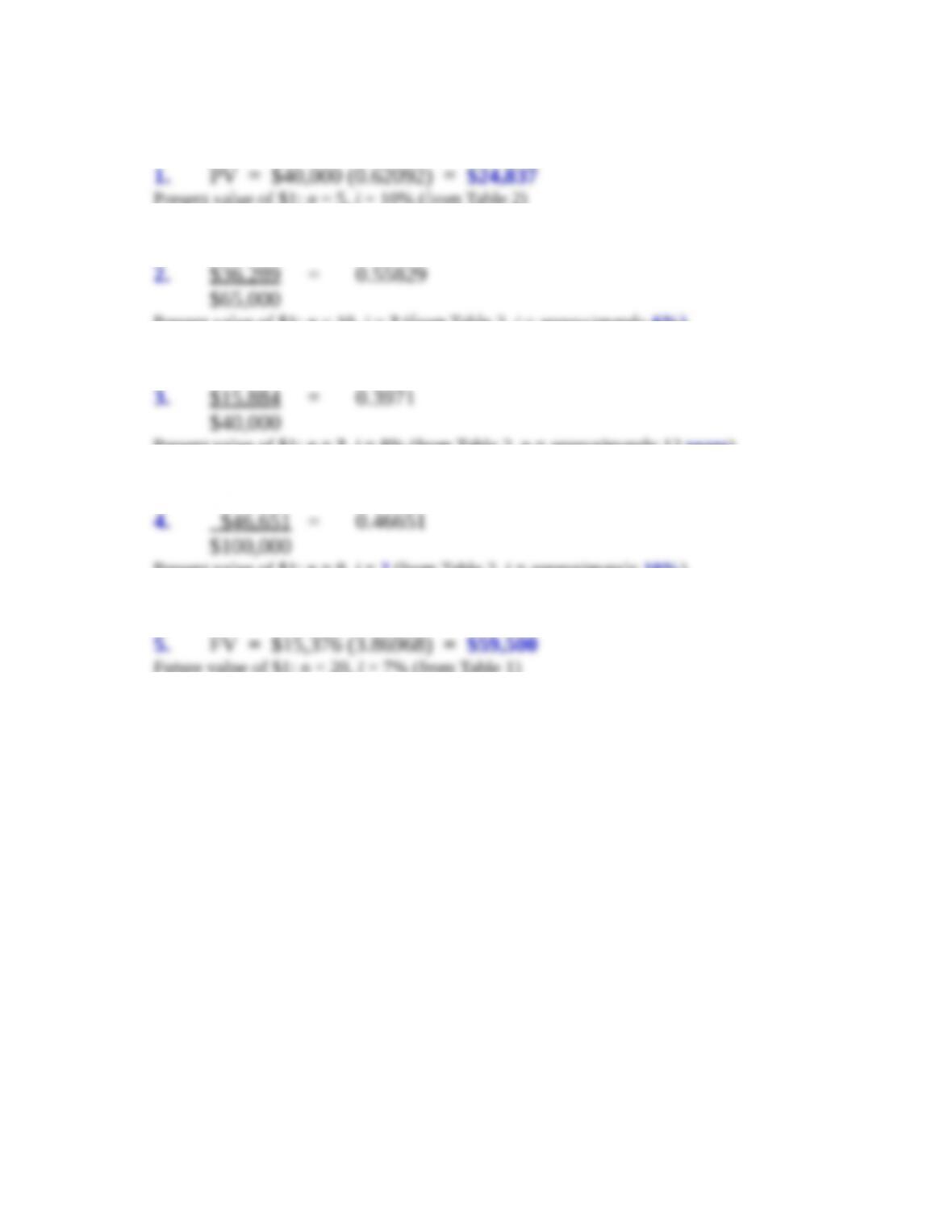
Exercise 6–6
Present value of $1: n = 5, i = 10% (from Table 2)
Present value of $1: n = 10, i = ? (from Table 2, i = approximately 6%)
Present value of $1: n = ?, i = 8% (from Table 2, n = approximately 12 years)
Present value of $1: n = 8, i = ? (from Table 2, i = approximately 10%)
Future value of $1: n = 20, i = 7% (from Table 1)
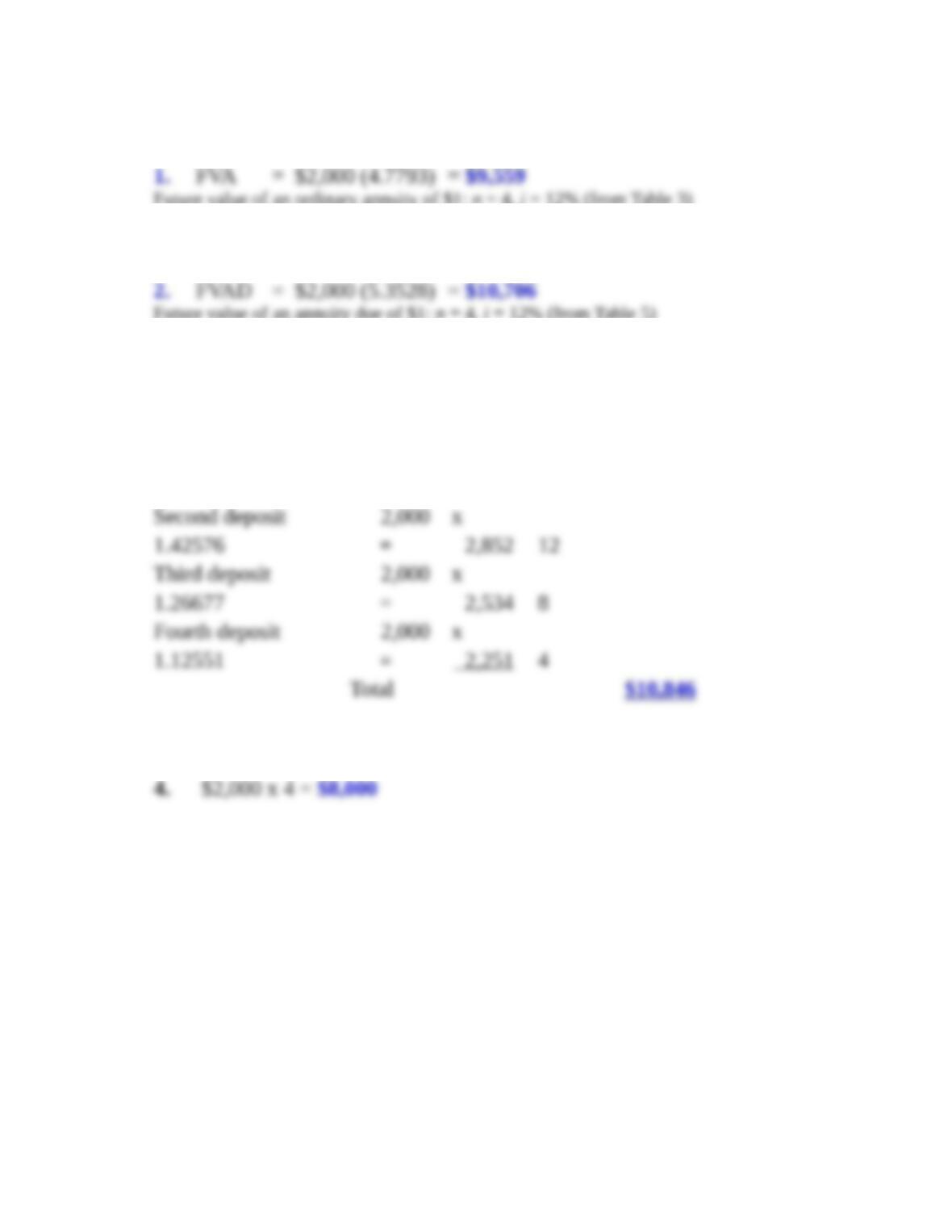
Exercise 6–7
Future value of an ordinary annuity of $1: n = 4, i = 12% (from Table 3)
Future value of an annuity due of $1: n = 4, i = 12% (from Table 5)
3. FV of $1
Deposit i=3% FV n
First deposit: $2,000 x
1.60471 = $ 3,209 16

Exercise 6–8
1. PVA = $5,000 (3.60478) = $18,024
Present value of an ordinary annuity of $1: n = 5, i = 12% (from Table 4)
2. PVAD = $5,000 (4.03735) = $20,187
Present value of an annuity due of $1: n = 5, i =12% (from Table 6)
3. PV of $1
Payment i = 3% PV n
First payment: $5,000 x
0.88849 = $ 4,442 4
Second payment 5,000 x
0.78941 = 3,947 8
Third payment 5,000 x
0.70138 = 3,507 12
Fourth payment 5,000 x
0.62317 = 3,116 16
Fifth payment 5,000 x
0.55368 = 2,768 20
Total $17 ,780

Exercise 6–9
1. PVA = $3,000 (3.99271) = $11,978
Present value of an ordinary annuity of $1: n = 5, i = 8% (from Table
4)
2. $242,980 = 3.23973
$75,000
Present value of an ordinary annuity of $1: n = 4, i = ? (from Table 4, I
= approximately 9%)
3. $161,214 = 8.0607
$20,000
Present value of an ordinary annuity of $1: n = ?, i = 9% (from Table
4, n = approximately 15 years)
4. $500,000 = 6.20979
$80,518
Present value of an ordinary annuity of $1: n = 8, i = ? (from Table 4, i
= approximately 6%)
5. $250,000 = $78,868
3.16987
Present value of an ordinary annuity of $1: n = 4, i = 10%
(from Table 4)

Exercise 6–10
Requirement 1
PV = $100,000 (0.68058) = $68,058
Present value of $1: n = 5, i = 8% (from Table 2)
Requirement 2
Annuity amount = $100,000
5.8666
Annuity amount = $17,046
Future value of an ordinary annuity of $1: n = 5, i = 8% (from Table 3)
Requirement 3
Annuity amount = $100,000
6.3359
Annuity amount = $15,783
Future value of an annuity due of $1: n = 5, i = 8% (from Table 5)
Exercise 6–11
1. Choose the option with the highest present value.
(1) PV = $64,000
(2) PV = $20,000 + 8,000 (4.91732)
Present value of an ordinary annuity of $1: n = 6, i = 6% (from Table 4)
PV = $20,000 + 39,339 = $59,339
(3) PV = $13,000 (4.91732) = $63,925
Alex should choose option (1).
2. FVA = $100,000 (13.8164) = $1,381,640
Future value of an ordinary annuity of $1: n = 10, i = 7% (from Table 3)

Exercise 6–12
PVA = $5,000 x 4.35526= $21,776
Present value of an ordinary annuity of $1: n = 6, i = 10% (from Table 4)
PV = $21,776 x 0.82645= $17,997
Present value of $1: n = 2, i = 10% (from Table 2)
Or alternatively:
From Table 4,
PVA factor, n = 8, i = 10% = 5.33493
– PVA factor, n = 2, i = 10% = 1.73554
= PV factor for deferred annuity = 3.59939
PV = $5,000 x 3.59939 = $17,997

Exercise 6–13
Annuity = $20,000 – 5,000 = $670 = Payment
22.39646
Present value of an ordinary annuity of $1: n = 30, i = 2% (from Table 4)
Exercise 6–14
PVA factor = $100,000 = 7.46938
$13,388
Present value of an ordinary annuity of $1: n = 20, i = ? (from Table 4, i =
approximately 12%)
Exercise 6–15
Annuity = $12,000 = $734 = Payment
16.35143
Present value of an ordinary annuity of $1: n = 20, i = 2% (from Table 4)
5 years x 4 quarters = 20 periods
8% ÷ 4 quarters = 2%