Question 6–1
Question 6–2
Question 6–3
Question 6–4
The three items of information necessary to compute the future value of a
Question 6–5
Question 6–6
Monetary assets and monetary liabilities represent cash or fixed
Question 6–7
Chapter 6 Time Value of Money Concepts
QUESTIONS FOR REVIEW OF KEY TOPICS
Answers to Questions (continued)
Question 6–8
Question 6–9
Table 2 lists the present value of $1 factors for various time periods and
Question 6–10
Present
Value
?
0 Year 1 Year 2 Year 3 Year 4
___________________________________________
Question 6–11
Present
Value
?
0 Year 1 Year 2 Year 3 Year 4
___________________________________________
Answers to Questions (concluded)
Question 6–12
Question 6–13
The formula for computing present value of an ordinary annuity incorporating
the ordinary annuity factors from Table 4 is:
Question 6–14
Question 6–15
Companies frequently acquire the use of assets by leasing rather than
purchasing them. Leases usually require the payment of fixed amounts at regular
Brief
Exercise 6–1
Fran should choose the second investment opportunity. More rapid
compounding has the effect of increasing the actual rate, which is called the
Brief Exercise 6–2
Bill will not have enough accumulated to take the trip. The future value of his
Brief Exercise 6–3
BRIEF EXERCISES
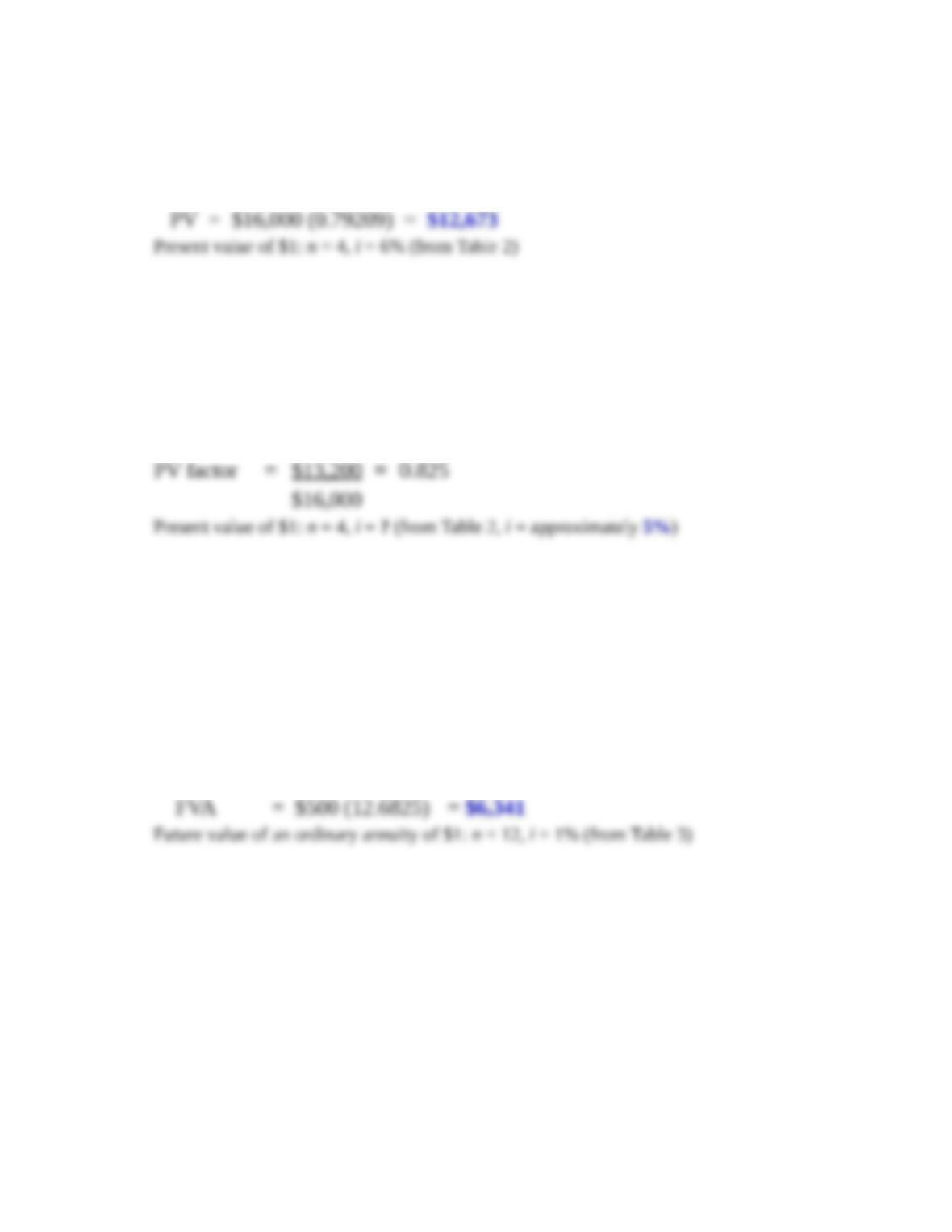
Brief Exercise 6–4
John would be willing to invest no more than $12,673 in this opportunity.
Brief Exercise 6–5
Brief Exercise 6–6
Interest is paid for 12 periods at 1% (one-quarter of the annual rate).
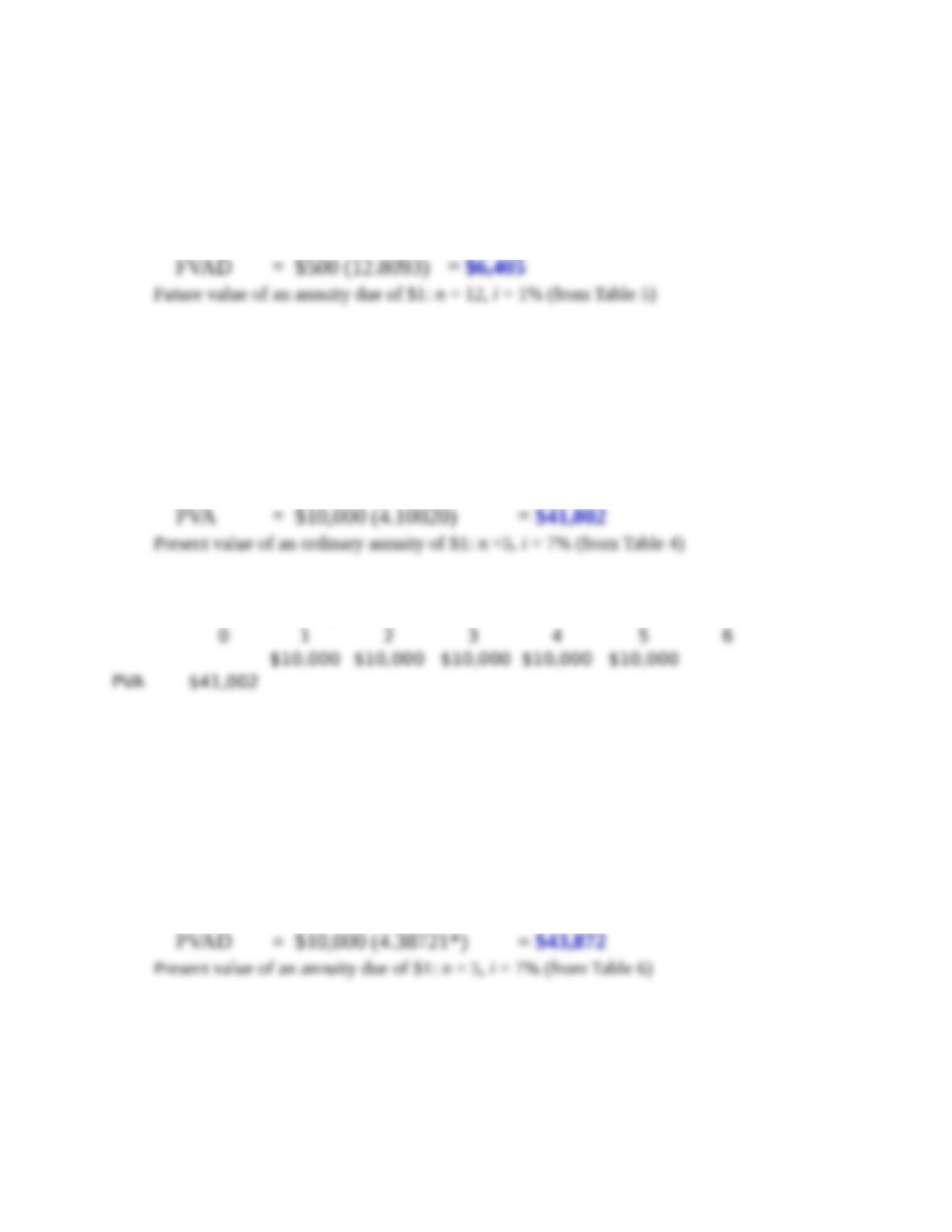
Brief Exercise 6–7
Interest is paid for 12 periods at 1% (one-quarter of the annual rate).
Brief Exercise 6–8
The following time diagram depicts this situation:
Brief Exercise 6–9
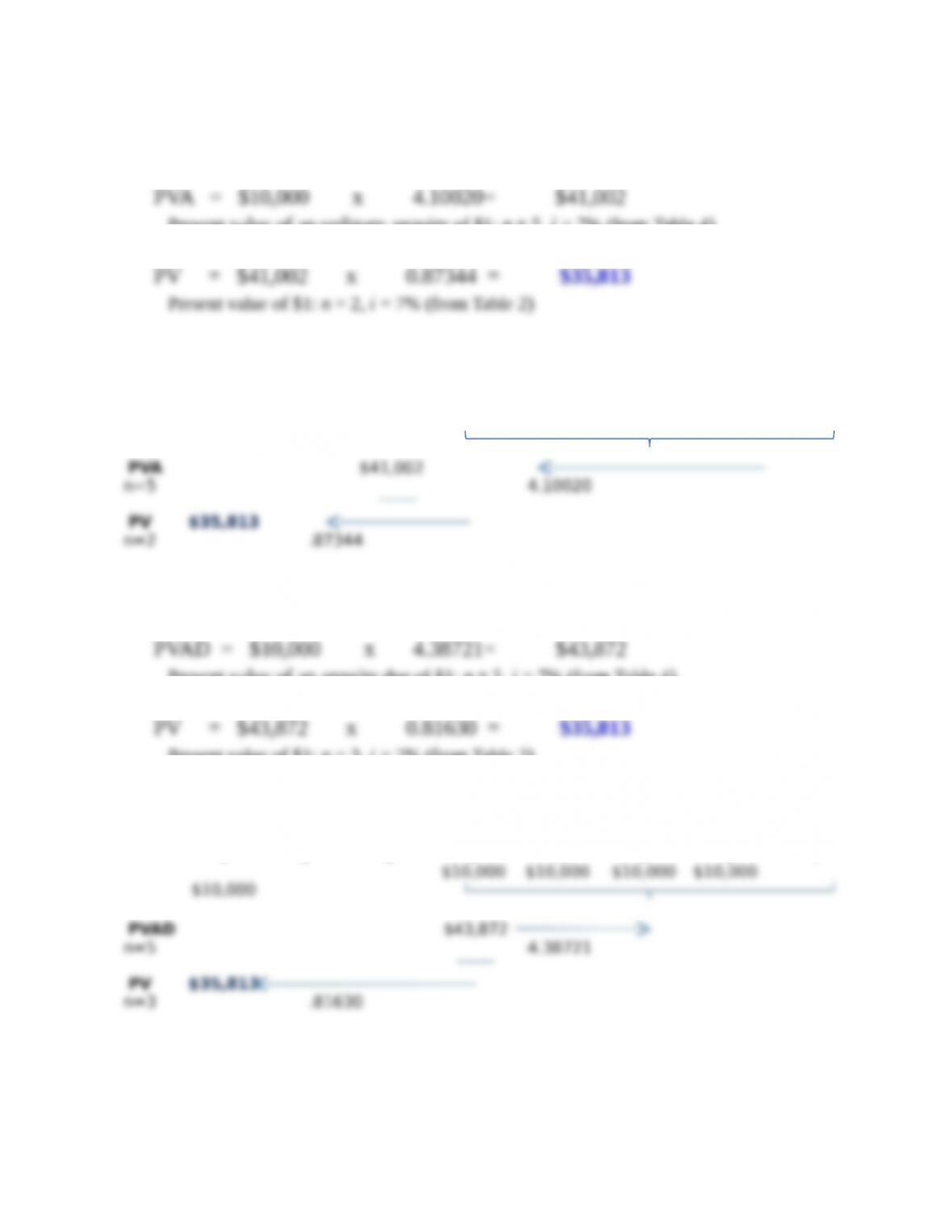
Brief Exercise 6–10
Present value of an ordinary annuity of $1: n = 5, i = 7% (from Table 4)
This time diagram helps visualize the situation:
0 1 2 3 4 5 6 7
$10,000 $10,000 $10,000 $10,000
$10,000
Or alternatively:
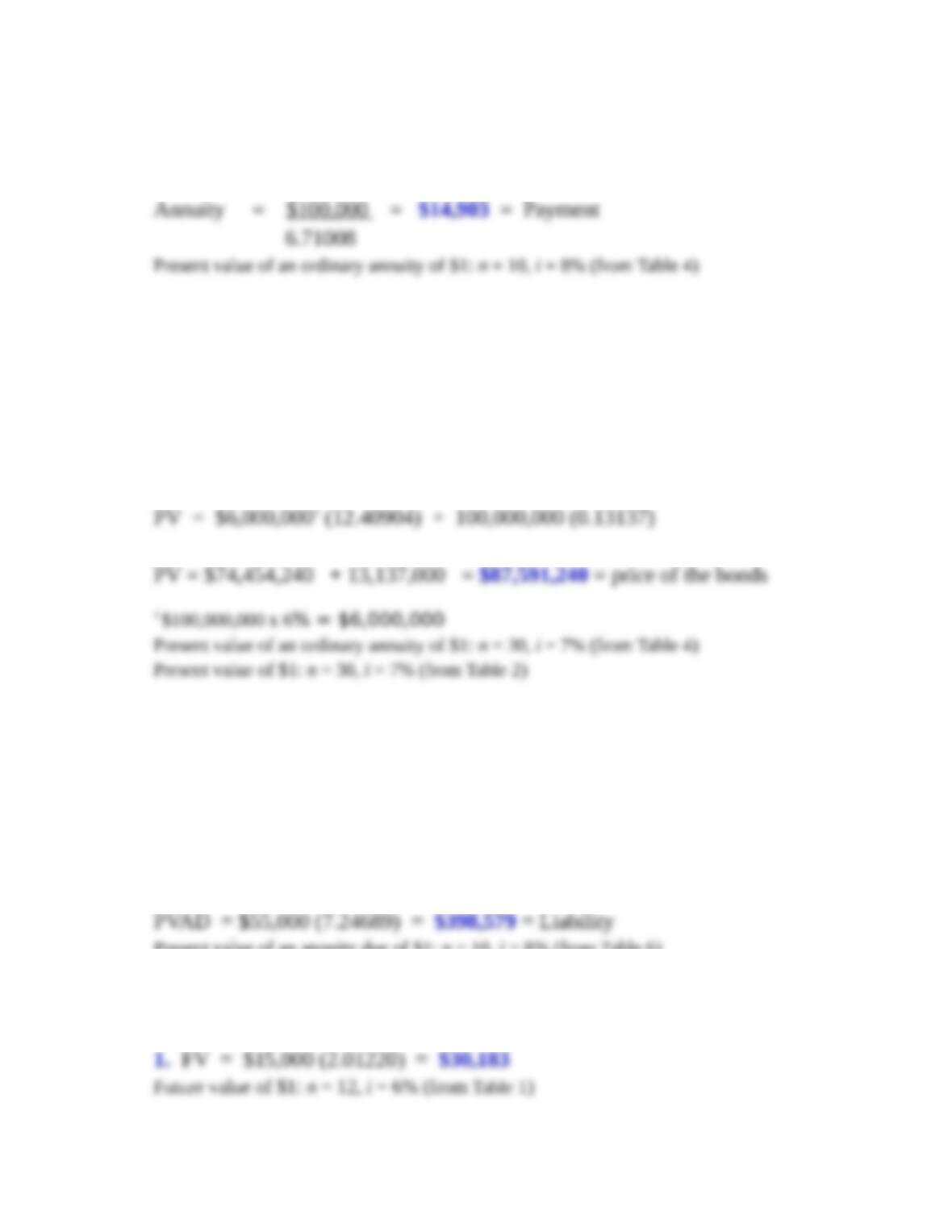
Present value of an annuity due of $1: n = 5, i = 7% (from Table 4)
Present value of $1: n = 3, i = 7% (from Table 2)
This time diagram helps visualize the situation:
0 1 2 3 4 5 6 7
Brief Exercise 6–11
Brief Exercise 6–12
Brief Exercise 6–13
Present value of an annuity due of $1: n = 10, i = 8% (from Table 6)
Exercise 6–1
EXERCISES
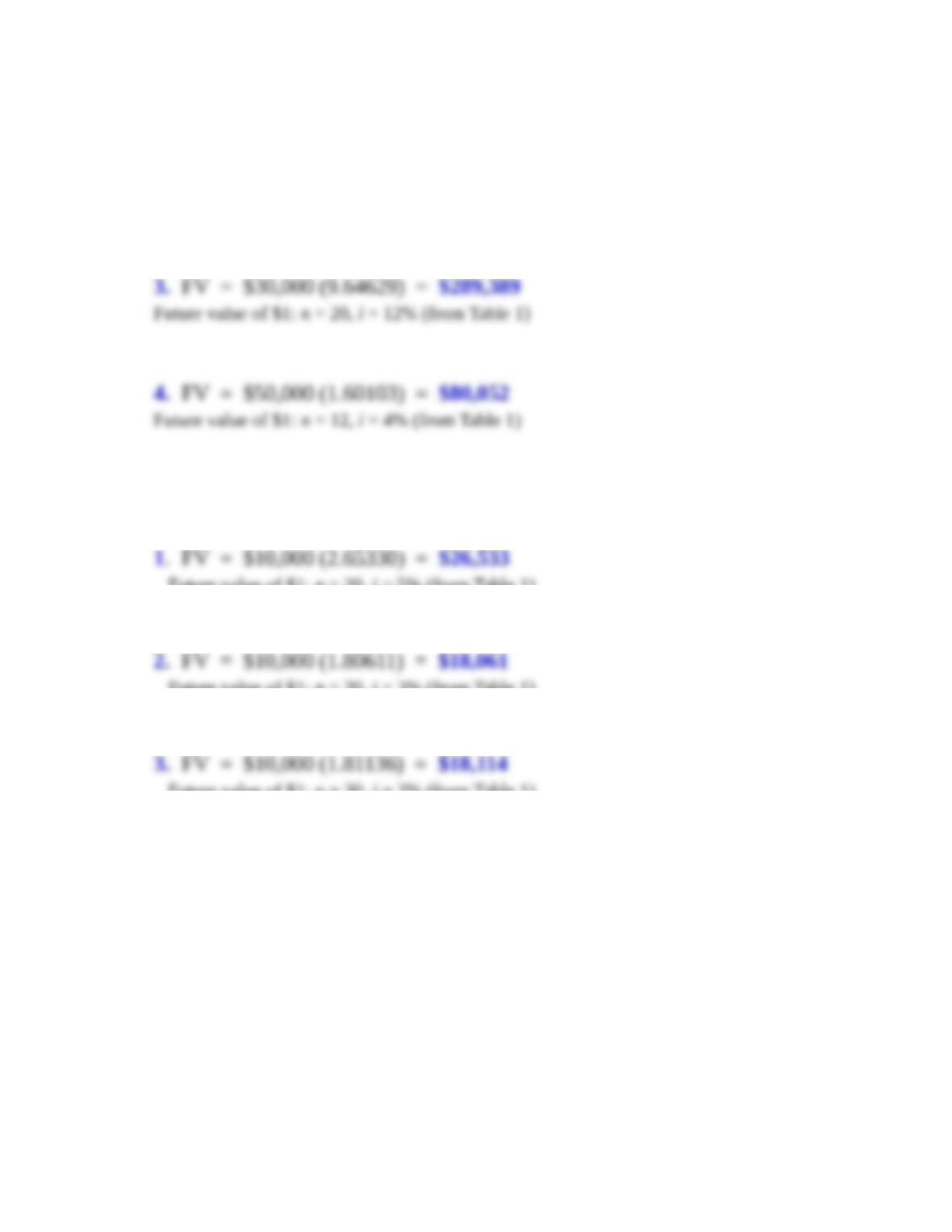
2. FV = $20,000 (2.15892) = $43,178
Future value of $1: n = 10, i = 8% (from Table 1)
Exercise 6–2
Future value of $1: n = 20, i = 5% (from Table 1)
Future value of $1: n = 20, i = 3% (from Table 1)
Future value of $1: n = 30, i = 2% (from Table 1)