Problem 5–6
Requirement 1
Cash 80,000
Deferred revenue 80,000
$80,000 is recognized as deferred revenue.
Requirement 2
Deferred revenue ($80,000 ÷ 10)
Bonus receivable ($40,000 ÷ 10)
8,000
4,000
Service revenue 12,000
will recognize 1/10 of that amount each month.
Requirement 3
Deferred revenue ($80,000 ÷ 10)
Bonus receivable [($40,000 ÷ 10) × 5]
8,000
20,000
Service revenue 28,000
Super Rise earns revenue of $8,000 in each month, including May, based on the
[($40,000 bonus receivable ÷ 10 months) × 5 months], and recognize a receivable
for that amount.
Problem 5–7
Requirement 1
Cash 80,000
Deferred revenue 80,000
$40,000 is not included in the transaction price, and only the fixed payment of
$80,000 is recognized as deferred revenue.
Requirement 2
Deferred revenue ($80,000 ÷ 10)
Bonus receivable [($40,000 ÷ 10) × 5]
8,000
20,000
Service revenue 28,000
Super Rise earns revenue of $8,000 in the month of May based on the original
$120,000 ($80,000 fixed payment + $40,000 contingent bonus). This means Super
receivable for that amount.
Problem 5-8
Requirement 1
At the contract’s inception, Velocity calculates the transaction price to be the
expected value of the two possible eventual prices:
Possible Expected
Prices Probabilities Consideration
Expected value at contract inception: $492,000
Because its consulting services are provided evenly over the eight months,
end of the contract. Therefore, Velocity’s journal entry to record the revenue each
month for the first four months is as follows:
Accounts receivable 60,000
Bonus receivable 1,500
Service revenue 61,500
Problem 5–8 (continued)
Requirement 2
By the end of the fourth month, the bonus receivable account would have a
receiving the bonus is revised so the estimated transaction price decreases:
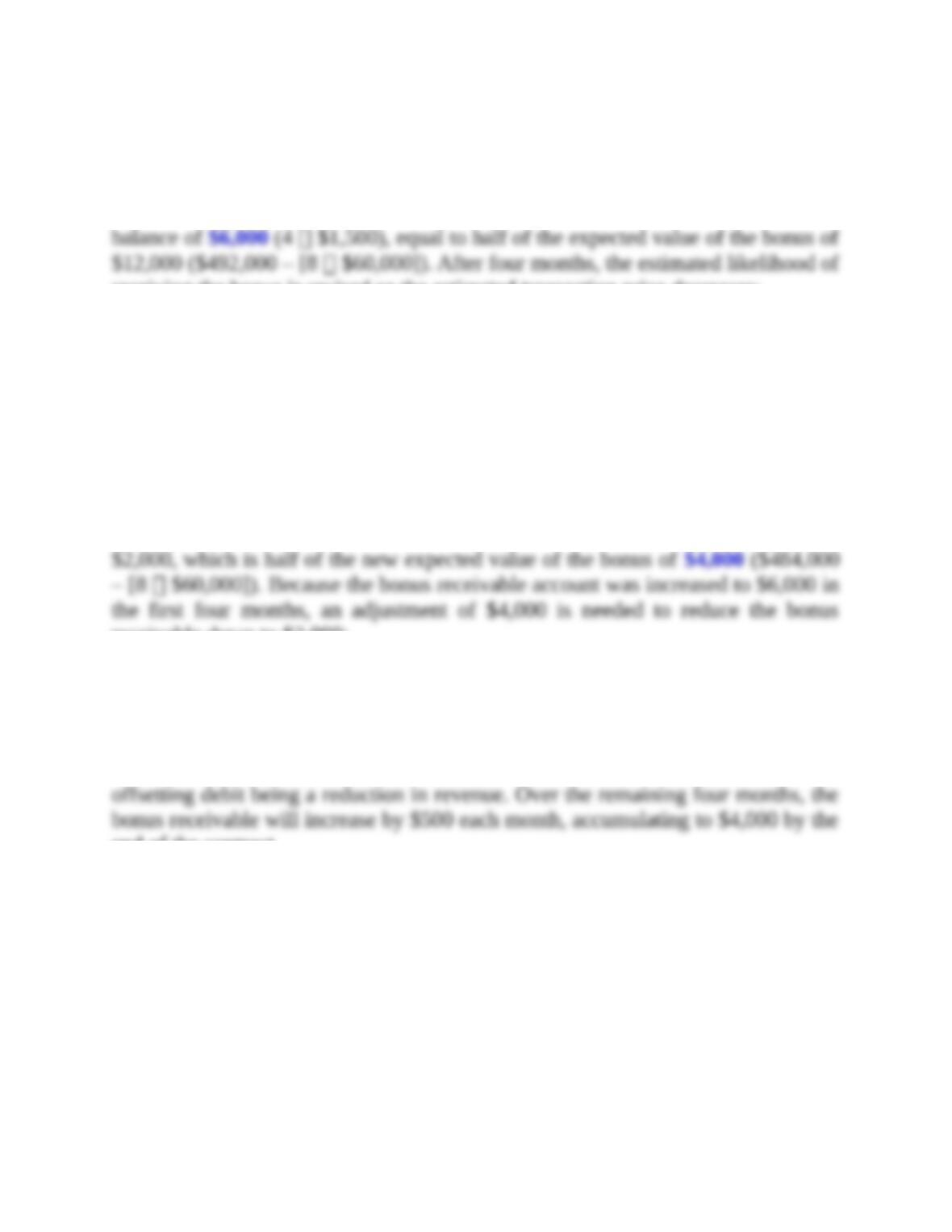
Possible
Expected
Prices
Probabilities
Consideration
$500,000 ([$60,000 8] + $20,000)
60% $300,000
$460,000 ([$60,000 8] – $20,000)
40% 184,0 0
0
Transaction price after four months: $484,000
So, after four months, the bonus receivable account should have a balance of
receivable down to $2,000:
Service revenue 4,000
Bonus receivable 4,000
This entry reduces the bonus receivable from $6,000 to $2,000, with the
end of the contract.
Problem 5–8 (concluded)
Requirement 3
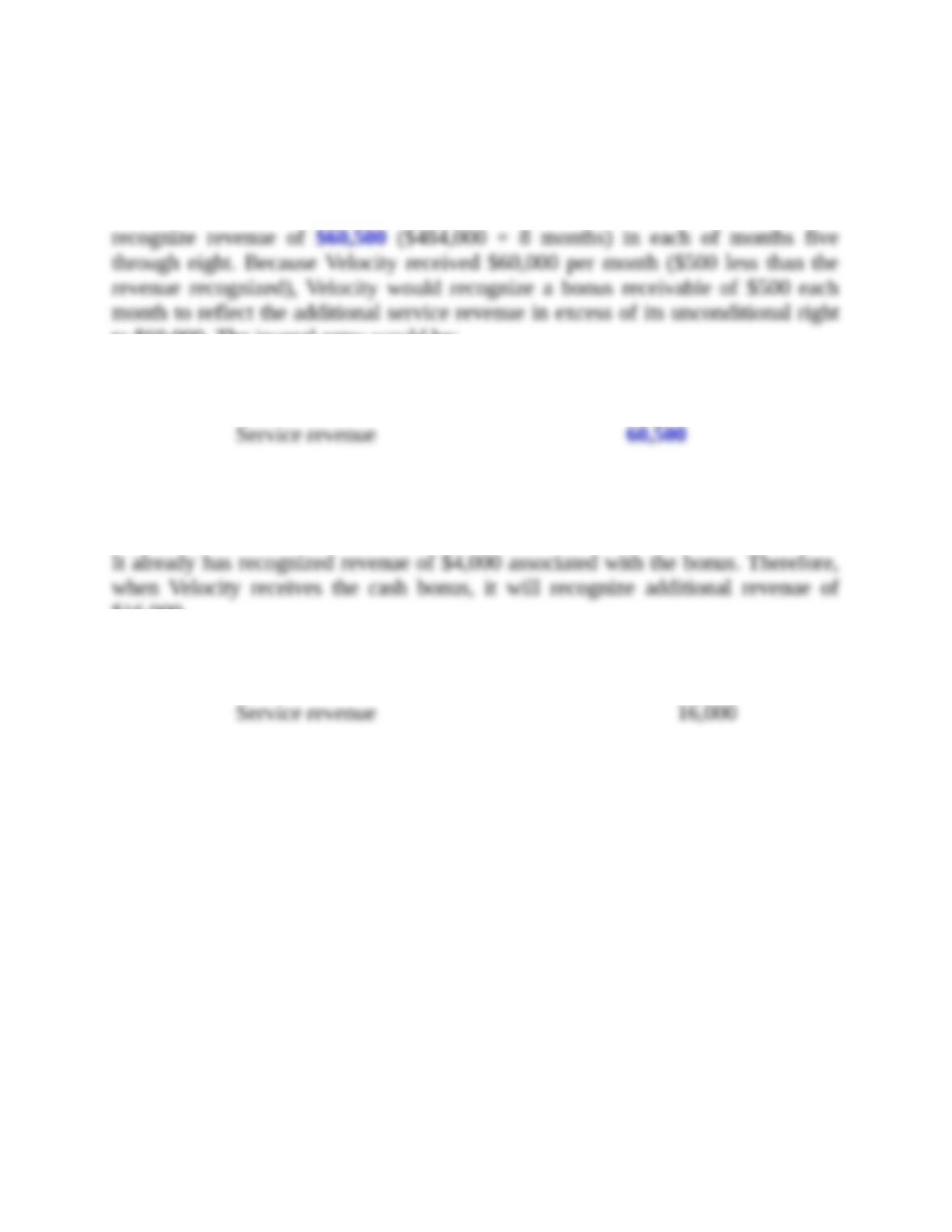
Because services are provided evenly over the eight months, Velocity would
to $60,000. The journal entry would be:
Accounts receivable 60,000
Bonus receivable 500
Requirement 4
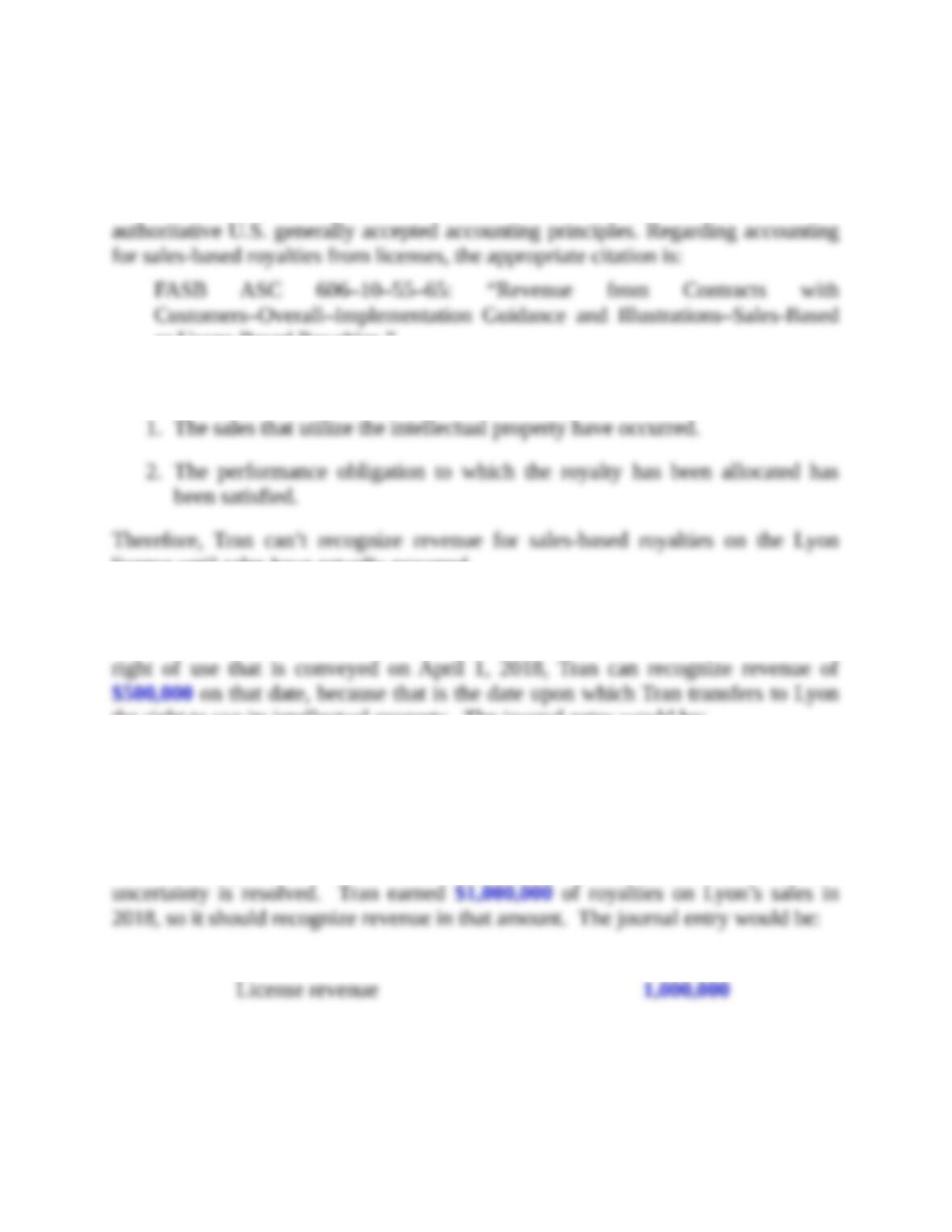
At the end of contract, Velocity learns that it will receive the bonus of $20,000.
$16,000.
Cash 20,000
Bonus receivable 4,000
Problem 5-9
Requirement 1
The FASB Accounting Standards Codification® represents the single source of
or Usage-Based Royalties.”
That citation requires that both of the following two events have occurred:
license until sales have actually occurred.
Requirement 2
If Tran accounts for the Lyon license of functional intellectual property as a
the right to use its intellectual property. The journal entry would be:
Cash 500,000
License revenue 500,000
Requirement 3
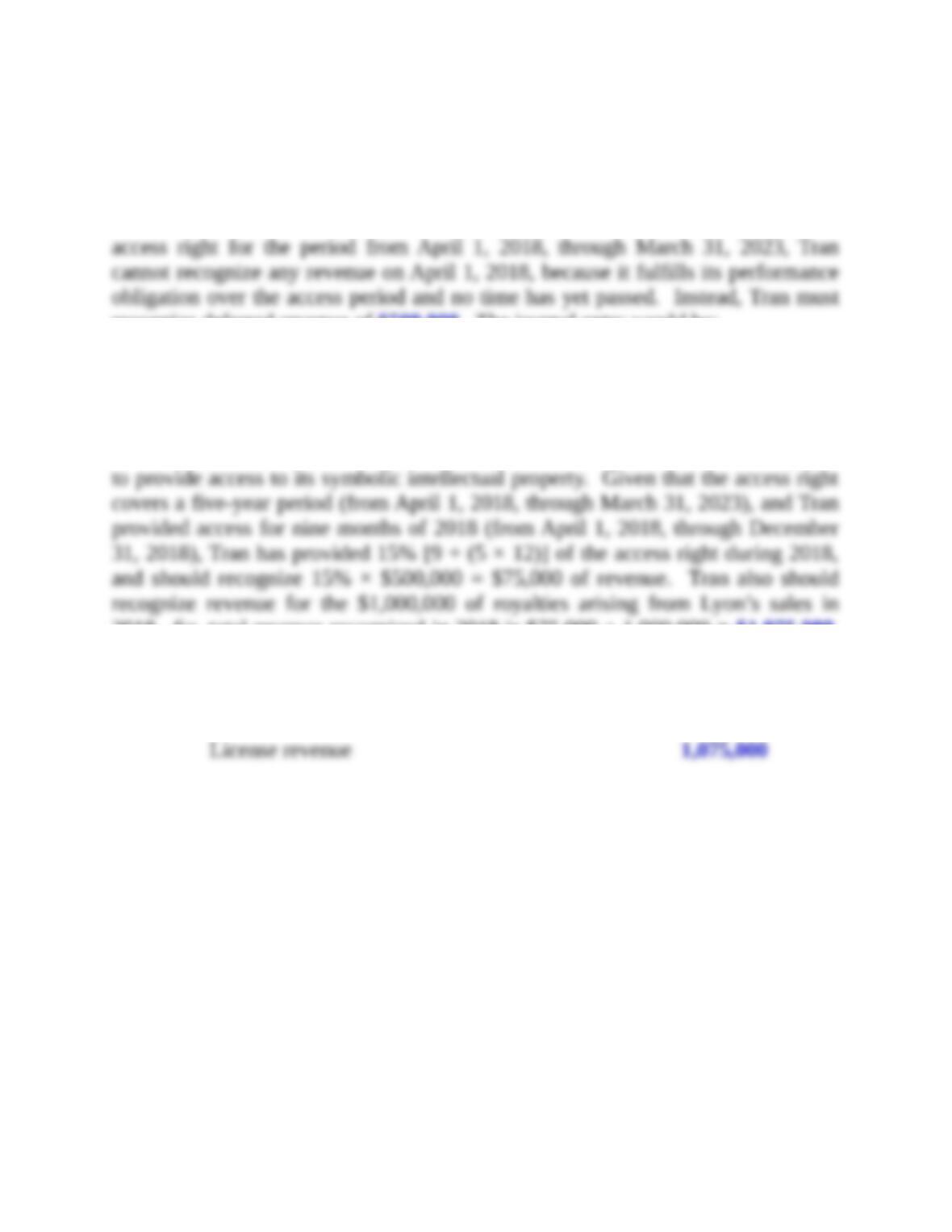
Tran recognizes revenue for sales-based royalties in the period in which
Cash 1,000,000
Problem 5–9 (concluded)
Requirement 4
If Tran accounts for the Lyon license of symbolic intellectual property as an
recognize deferred revenue of $500,000. The journal entry would be:
Cash 500,000
Deferred revenue 500,000
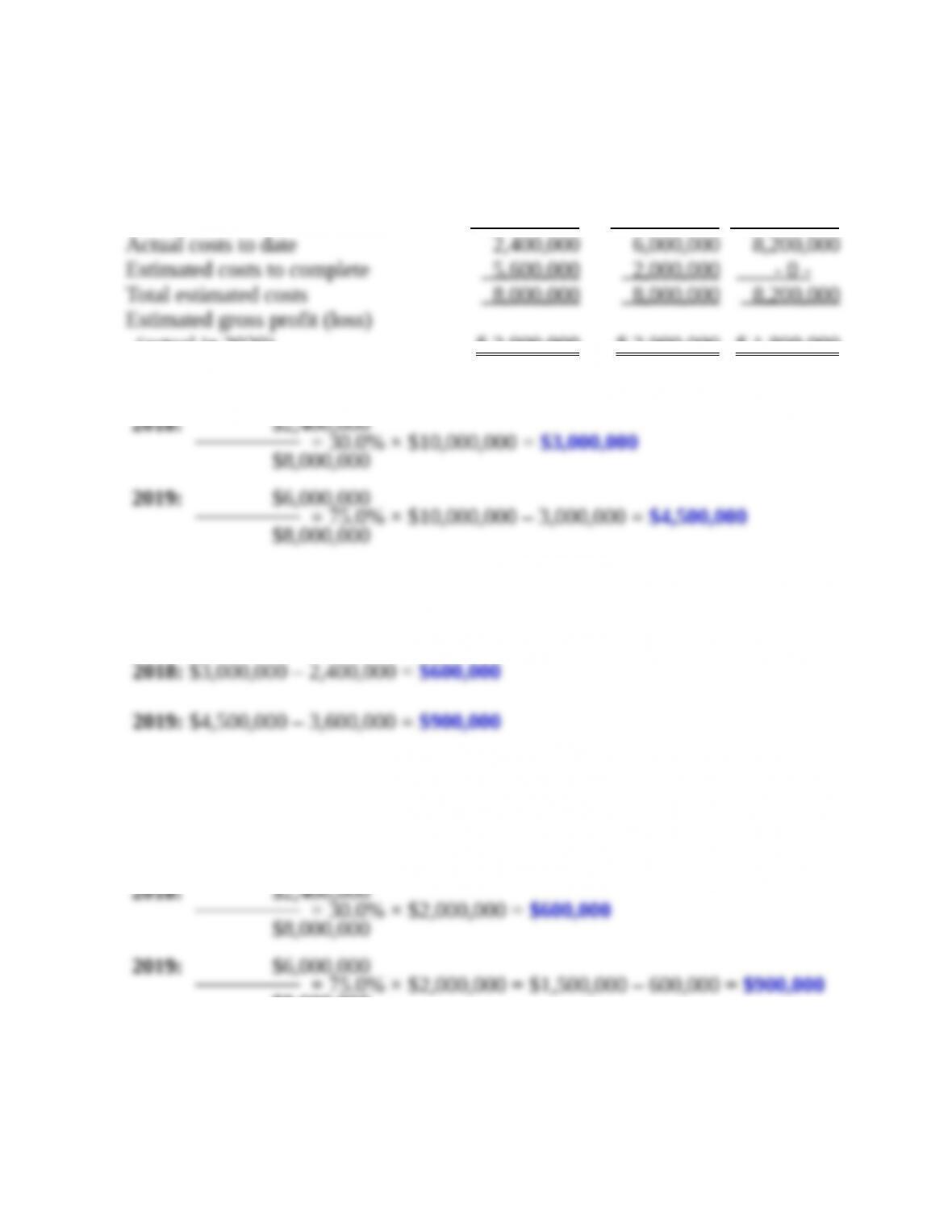
As of December 31, 2018, Tran has partially fulfilled its performance obligation
2018. So, total revenue recognized in 2018 is $75,000 + 1,000,000 = $1,075,000.
The journal entry would be:
Cash 1,000,000
Deferred revenue 75,000
Problem 5–10
Requirement 1 2018 2019 2020
Contract price $10 ,000,000 $10 ,000,000 $10 ,000,000
(actual in 2020) $ 2 ,000,000 $ 2 ,000,000 $ 1 ,800,000
Revenue recognition:
2018: $2,400,000
2020: $10,000,000 – 7,500,000 = $2,500,000
Gross profit (loss) recognition:
2020: $2,500,000 – 2,200,000 = $300,000
Note: Also can calculate gross profit directly using the percentage of completion:
2018: $2,400,000
$8,000,000
2020: $1,800,000 – 1,500,000 = $300,000
Problem 5–10 (continued)
Requirement 2
2018 2019 2020
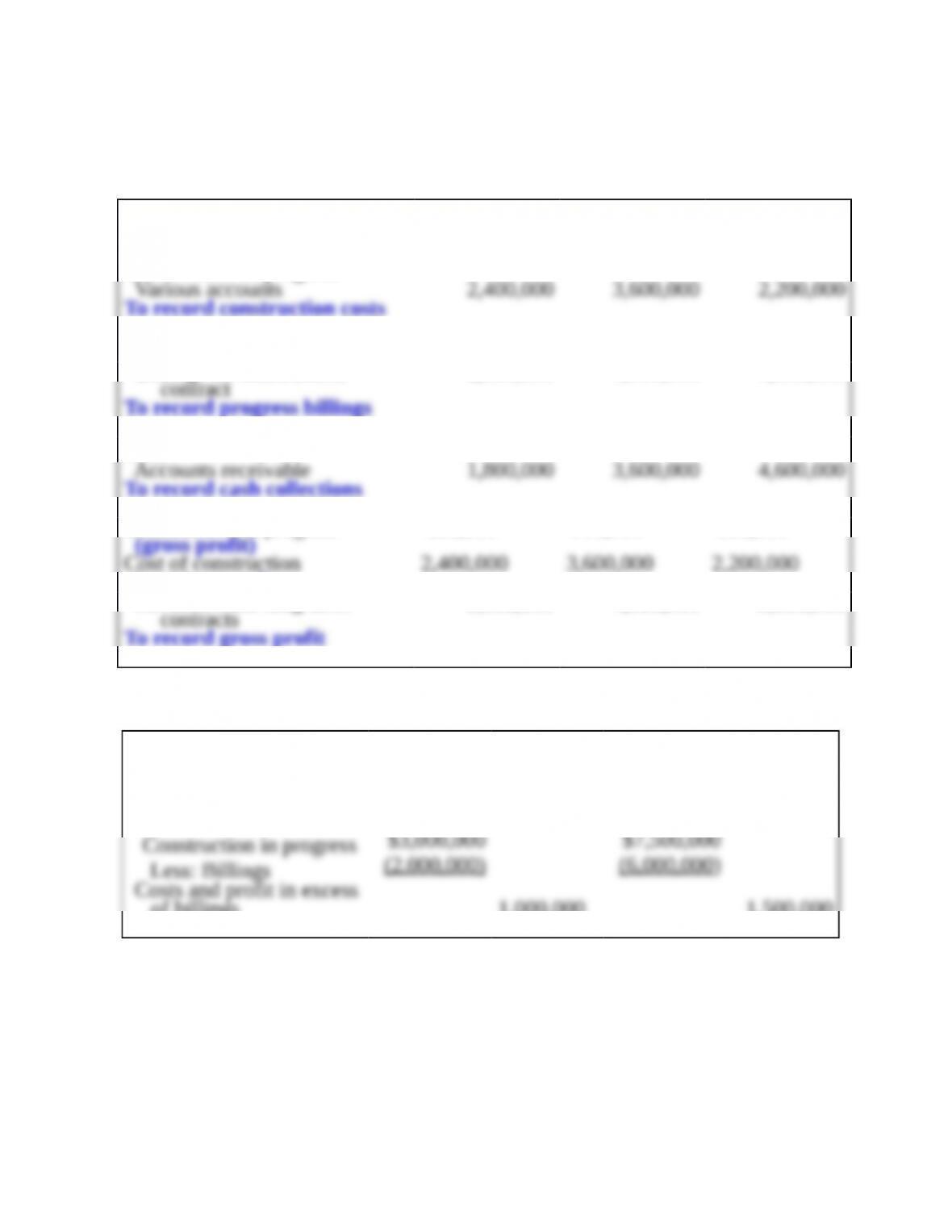
Construction in progress 2,400,000 3,600,000 2,200,000
To record construction costs
Accounts receivable 2,000,000 4,000,000 4,000,000
Billings on construction
To record progress billings
Cash 1,800,000 3,600,000 4,600,000
To record cash collections
Construction in progress
Cost of construction
(cost incurred) 2,400,000 3,600,000 2,200,000
Revenue from long-term
To record gross profit
Requirement 3
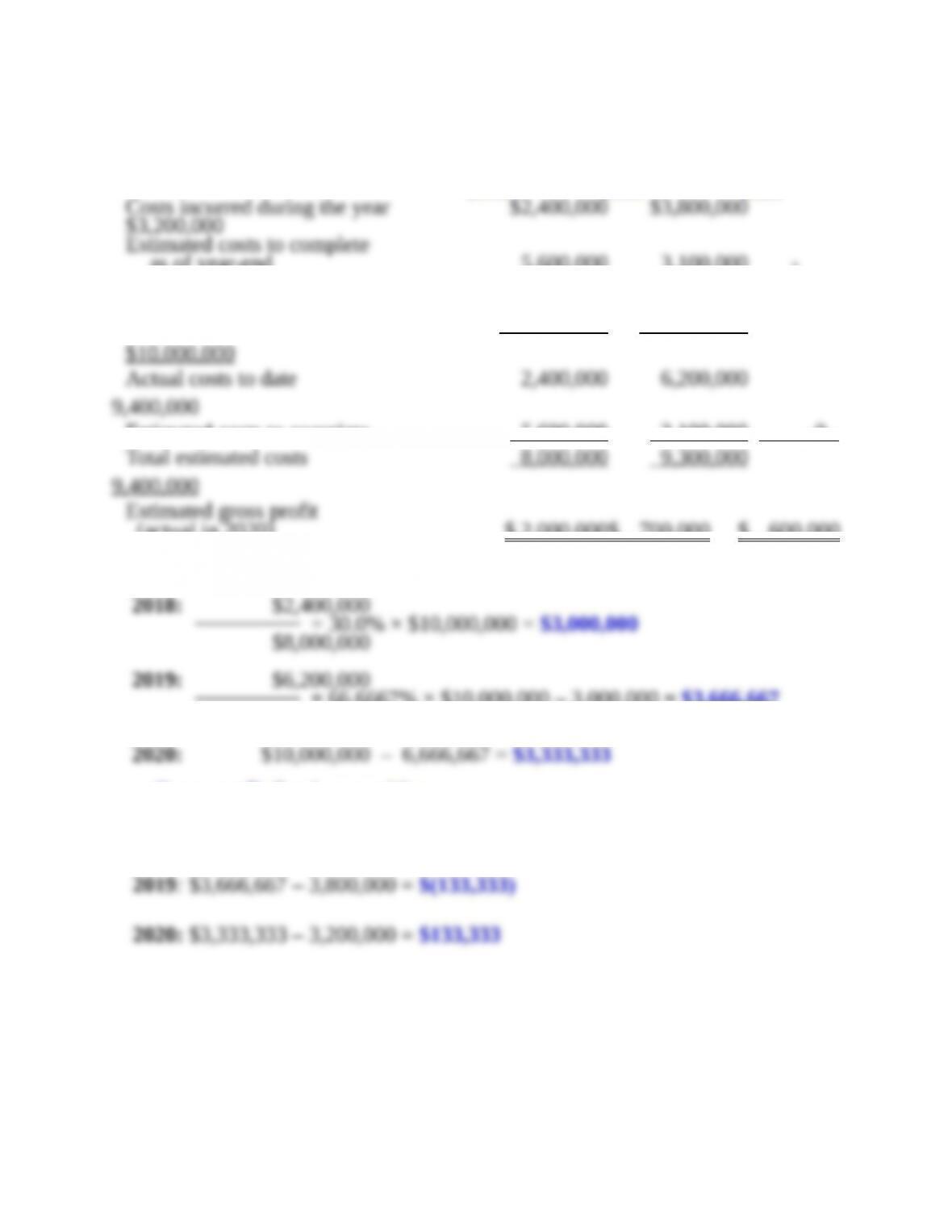
Balance Sheet 2018 2019
Current assets:
Accounts receivable $ 200,000 $600,000
of billings 1,000,000 1,500,000
Note: Construction in progress in excess of billings is a contract asset;
Billings in excess of construction in progress is a contract liability.
Problem 5–10 (continued)
Requirement 4 2018 2019 2020
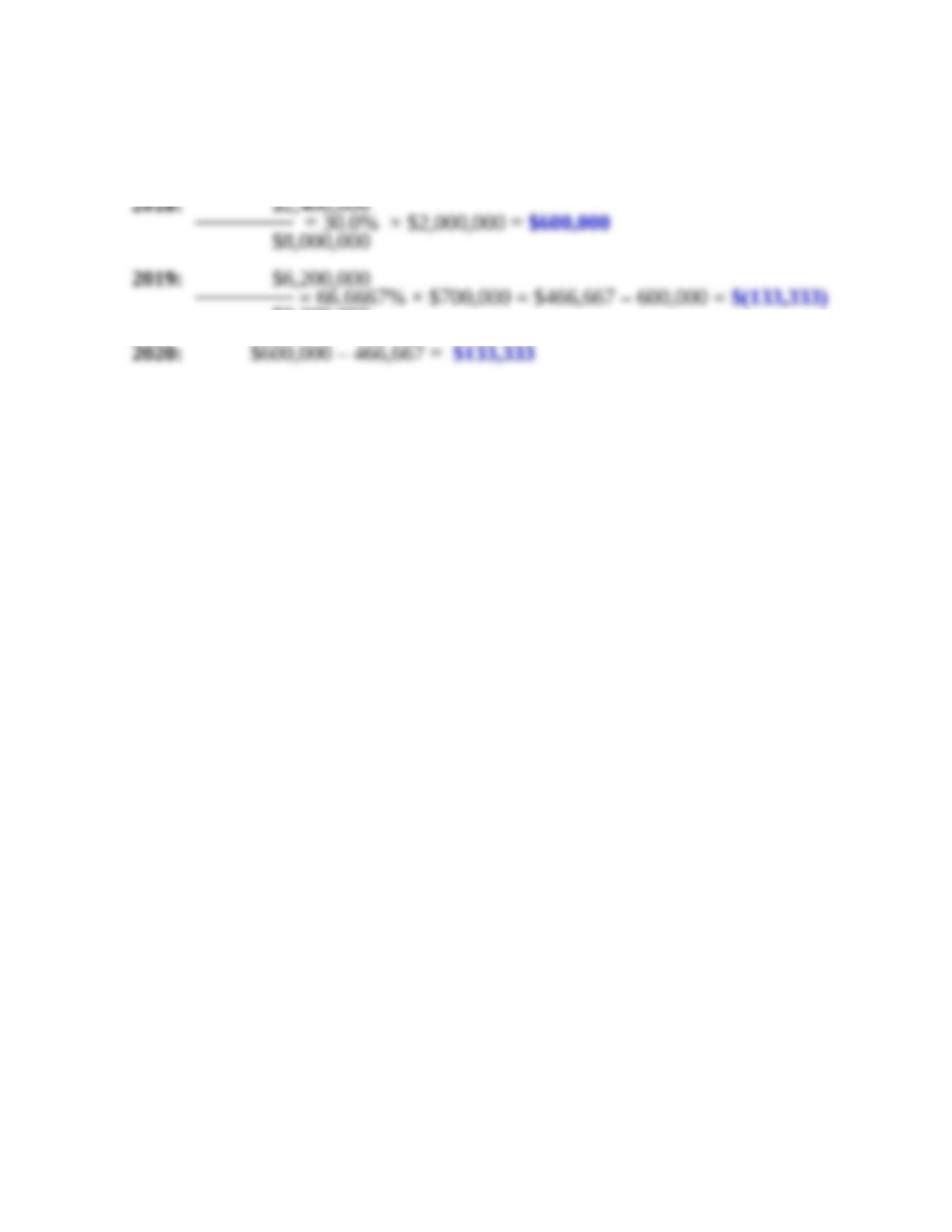
as of year-end 5,600,000 3,100,000 –
2018 2019 2020
Contract price $10 ,000,000 $10 ,000,000
Estimated costs to complete 5 ,600,000 3 ,100,000 – 0 –
(actual in 2020) $ 2 ,000,000$ 700 ,000 $ 600 ,000
Revenue recognition:
= 66.6667% × $10,000,000 – 3,000,000 = $3,666,667
$9,300,000
Gross profit (loss) recognition:
2018: $3,000,000 – 2,400,000 = $600,000
Problem 5–10 (continued)
Note: Also can calculate gross profit directly using the percentage of completion:
2018: $2,400,000
$9,300,000