
Judgment Case 4–6
Financial Statement
Presentation
Situation Treatment (a–g) (CO, BC, or RE)
1. a. CO
2. b. RE
Judgment Case 4–7
1. The loss is not unusual. It is included in income from continuing operations
2. The sale of the financing component is treated as a discontinued operation. The
3. A change in depreciation method is treated as a change in accounting estimate
4. This event usually is either included in cost of goods sold or presented as a line
5. The correction of an error is treated as a prior period adjustment. The effect of

IFRS Case 4–8
1. GSK reported “interest received” and “dividends from associates and joint
2. “Interest paid” is reported as a financing cash flow. U.S. GAAP requires
interest paid to be included with operating cash flows
Judgment Case 4–9
Requirement 1
1. a. As a component of operating income.
2. b. As a nonoperating income item.
Requirement 2
Situations 3 and 5 would be reported in the statements of income and
Judgment Case 4–10
It would be nice to think that management makes all accounting choices in the
best interest of fair and consistent financial reporting. Unfortunately, other motives
Choices made are not always those that tend to increase income. As you will
learn in Chapter 8, many companies use the LIFO inventory method because it
1Watts, R.L., and J.L. Zimmerman, “Towards a Positive Theory of the Determination of
Accounting Standards,” The Accounting Review, January 1978, and “Positive Accounting
Theory: A Ten Year Perspective,” The Accounting Review, January 1990.
2For example, see Healy, P.M., “The Effect of Bonus Schemes on Accounting Decisions,”
Journal of Accounting and Economics, April 1985, and Dhaliwal, D., G. Salamon, and E. Smith,
“The Effect of Owner Versus Management Control on the Choice of Accounting Methods,”
Journal of Accounting and Economics, July 1982.
3Bowen, R.M., E.W. Noreen, and J.M. Lacy, “Determinants of the Corporate Decision to
Capitalize Interest,” Journal of Accounting and Economics,” August 1981.
4This “political cost” motive is suggested by Watts, R.L.. and J.L. Zimmerman, “ “Positive
Accounting Theory: A Ten-Year Perspective,” The Accounting Review, January 1990, and
Zmijewski, M., and R. Hagerman, “An Income Strategy Approach to the Positive Theory of
Accounting Standard Setting/Choice,” Journal of Accounting and Economics, August 1981.
Research Case 4–11
(Note: This case requires the student to reference a journal article.]
Requirement 2
Requirement 3
Requirement 4
Requirement 5
In 2001, 136 firms reported “Restructuring Charges,” and the same number of
Requirement 6
The authors’ main conclusions are that the introduction of pro forma
regulation is associated with a substantial change in firms’ pro forma reporting.
Integrating Case 4–12
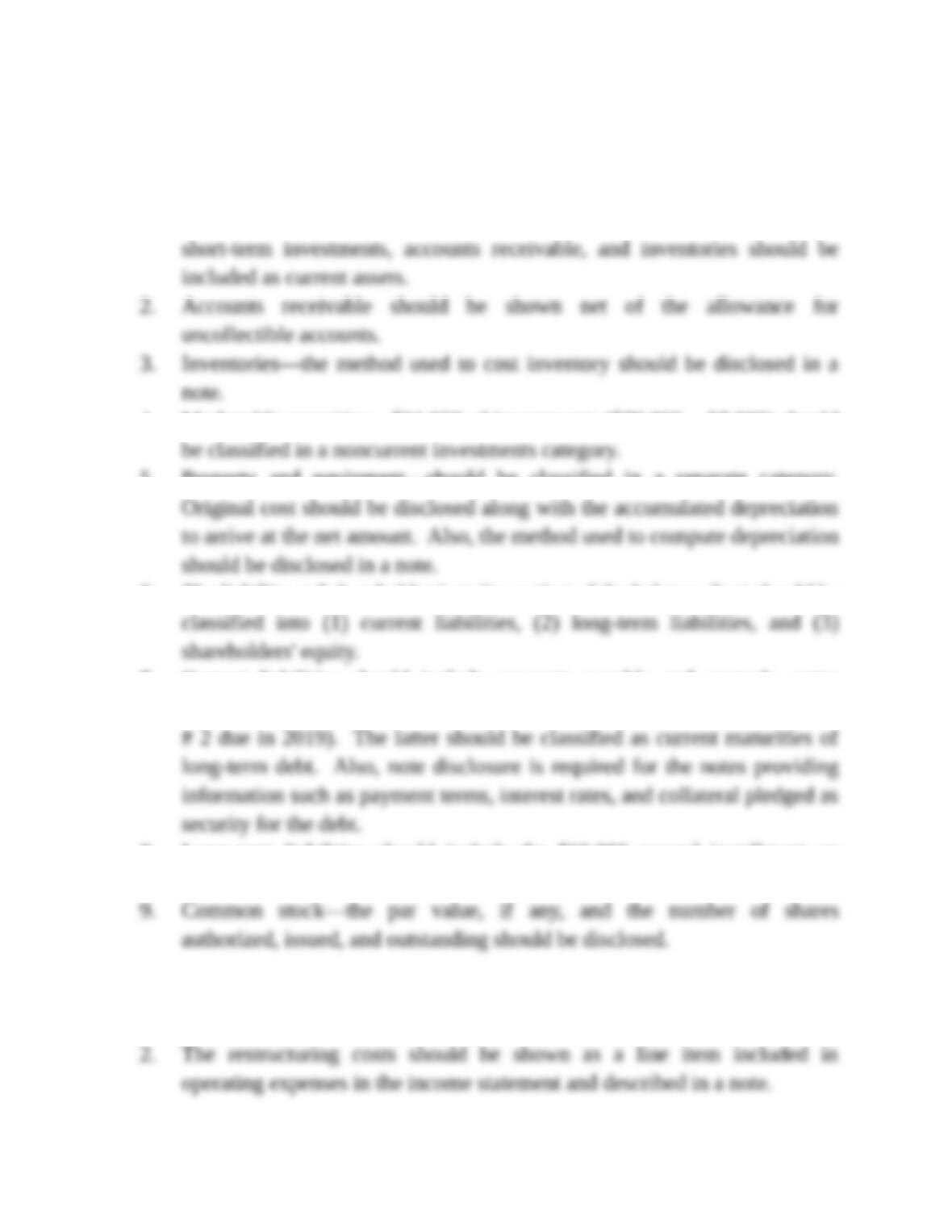
DEFICIENCIES:
Balance Sheet:
1. The asset section of the balance sheet should be classified. Cash,
4. Marketable securities—$21,000 of investments ($78,000 – 57,000) should
5. Property and equipment—should be classified in a separate category.
6. The liability and shareholders’ equity section of the balance sheet should be
7. Current liabilities should include accounts payable and accruals, notes
payable (the $80,000 note due in 2019 and the $60,000 installment on note
8. Long-term liabilities should include the $60,000 second installment on
note #2.
Income Statement:
1. Earnings per share disclosure is required.
Financial Analysis Case 4–13
Requirement 1
Multiple-step
Requirement 2
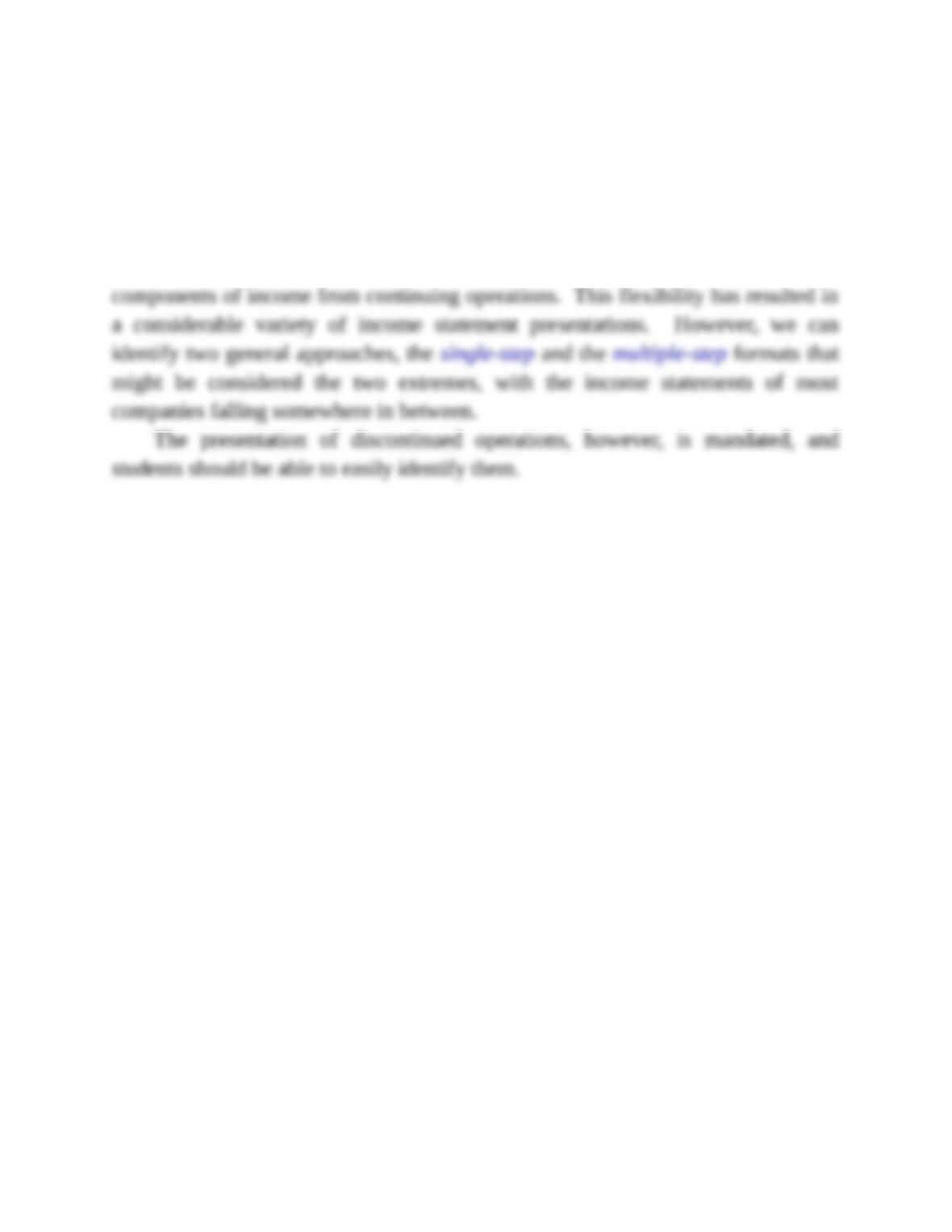
Income tax expense ÷ Income before taxes
Requirement 3
Real World Case 4–14
Answers to the questions will, of course, vary because students will research
financial statements of different companies.
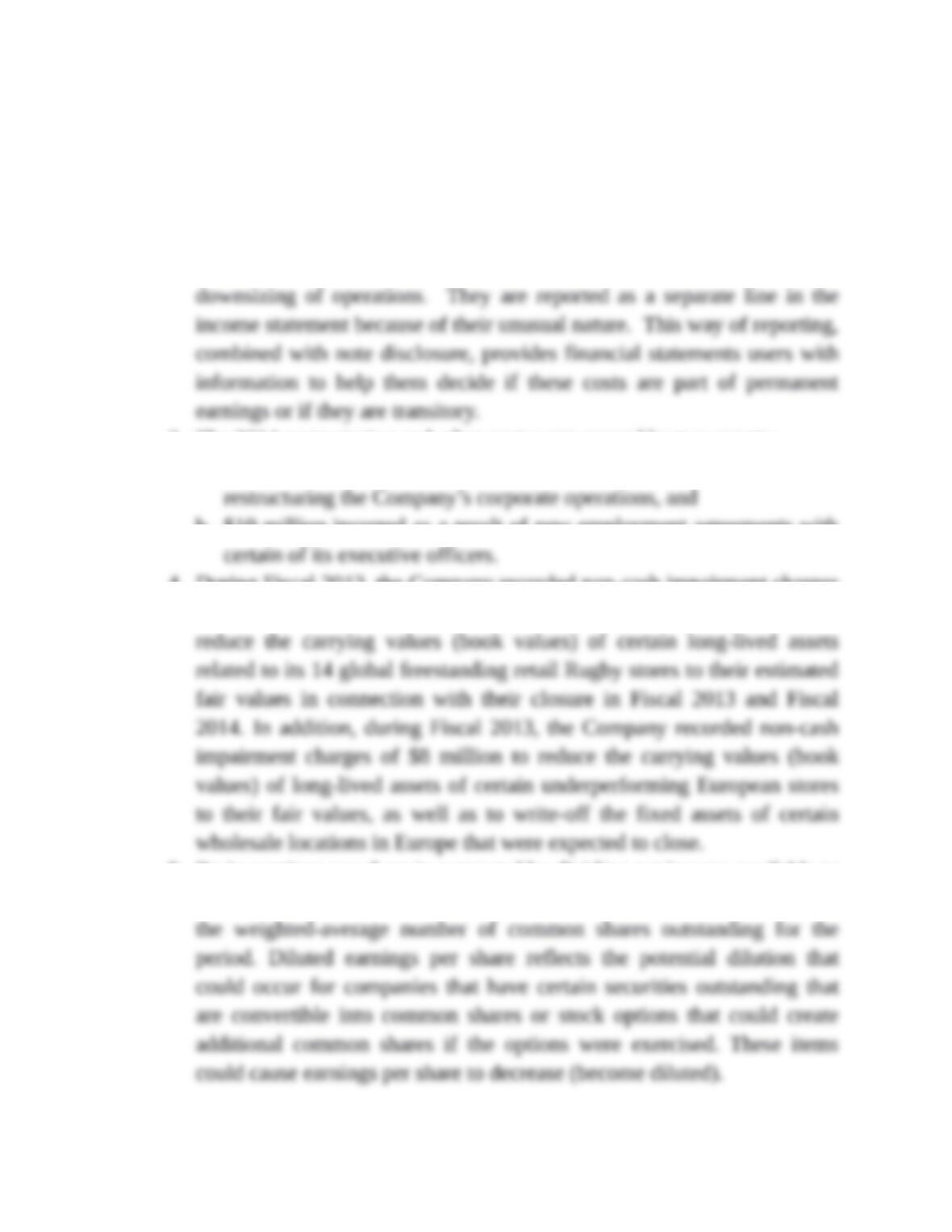
No specific standards dictate how income from continuing operations must be
displayed, so companies have considerable latitude in how they present the
Real World Case 4–15
1. The company uses the multiple-step format to present its income
statements.
2. Restructuring costs include employee severance and termination benefits
plus other costs associated with the shutdown or relocation of facilities or
3. The 2014 restructuring and other costs were caused by two events:
a. $8 million related to severance and benefit costs associated with
b. $10 million incurred as a result of new employment agreements with
4. During Fiscal 2013, the Company recorded non-cash impairment charges
of $19 million, which included $11 million of impairment charges to
5. Basic earnings per share is computed by dividing net income available to
common shareholders (net income less any preferred stock dividends) by
.