Question 3–1
The purpose of the balance sheet, also known as the statement of financial position, is to
present the financial position of the company on a particular date. Unlike the income statement,
Question 3–2
The balance sheet does not portray the market value of the entity (number of common stock
shares outstanding multiplied by price per share) for a number of reasons. Most assets are not
Question 3–3
Current assets include cash and other assets that are reasonably expected to be converted to
— Cash and cash equivalents
— Short-term investments
Question 3–4
Current liabilities are those obligations that are expected to be satisfied through the use of
current assets or the creation of other current liabilities. So, this classification will include all
— Accounts payable
— Short-term notes payable
Solutions Manual, Vol.1, Chapter 3 3–1
Copyright © 2018 McGraw-Hill Education. All rights reserved. No reproduction or distribution without the prior written consent of
McGraw-Hill Education.
Chapter 3 The Balance Sheet and Financial
Disclosures
QUESTIONS FOR REVIEW OF KEY TOPICS

Solutions Manual, Vol.1, Chapter 3 3–2
Copyright © 2018 McGraw-Hill Education. All rights reserved. No reproduction or distribution without the prior written consent of
McGraw-Hill Education.
Answers to Questions (continued)
Question 3–5
The operating cycle for a typical manufacturing company refers to the period of time required
Question 3–6
Investments in equity securities are classified as current if the company’s management (1)
Question 3–7
The common characteristics that these assets have in common are that they are tangible,
long-lived assets used in the operations of the business. They usually are the primary
Question 3–8
Property, plant, and equipment and intangible assets each represent assets that are long-lived
Question 3–9
A note payable of $100,000 due in five years would be classified as a long-term liability. A
Question 3–10
Paid-in capital consists of amounts invested by shareholders in the corporation. Retained
earnings equals net income less dividends paid to shareholders from the inception of the corporation.
Answers to Questions (continued)
Question 3–11
Disclosure notes provide additional detail concerning specific financial statement items.
Included are such data as the fair values of financial instruments and off-balance-sheet risk
Solutions Manual, Vol.1, Chapter 3 3–3
Copyright © 2018 McGraw-Hill Education. All rights reserved. No reproduction or distribution without the prior written consent of
McGraw-Hill Education.
Question 3–12
The disclosure of the company’s significant accounting policies is extremely important to
Question 3–13
A subsequent event is an event that occurs after the date of the financial statements but prior to
Question 3–14
The discussion provides management’s views on significant events, trends, and uncertainties
pertaining to the company’s (a) operations, (b) liquidity, and (c) capital resources. Certainly the
Answers to Questions (continued)
Question 3–15
A proxy statement must be reported each year to all shareholders. It is usually reported at the
same time as the annual report. The statement invites shareholders to the shareholders’ meeting to
Question 3–16
Depending on the circumstances, the auditor of a public company will issue a (an):
1. Unqualified opinion—The auditors are satisfied that the financial statements “present fairly” the
2. Qualified opinion—This contains an exception to the standard unqualified opinion, but not of
3. Adverse opinion—This is necessary when the exceptions (a) and (b) above are so serious that a
Solutions Manual, Vol.1, Chapter 3 3–4
Copyright © 2018 McGraw-Hill Education. All rights reserved. No reproduction or distribution without the prior written consent of
McGraw-Hill Education.
Question 3–17
Working capital is the difference between current assets and current liabilities. The current
Question 3–18
Debt to equity ratio = Total liabilities
Shareholders’ equity
Answers to Questions (concluded)
Question 3–19
IAS No.1, revised, “Presentation of Financial Statements,” provides authoritative guidance for
balance sheet presentation under IFRS.
Question 3–20
Differences in balance sheet presentation between U.S. GAAP and IFRS include:
1. International standards specify a minimum list of items to be presented in the balance sheet.
U.S. GAAP has no minimum requirements.
2. IAS No. 1, revised, changed the title of the balance sheet to statement of financial position,
3. Under U.S. GAAP, we present current assets and liabilities before long-term assets and
Question 3–21
An operating segment is a component of an enterprise:
1. That engages in business activities from which it may earn revenues and incur expenses
2. Whose operating results are regularly reviewed by the enterprise’s chief operating
Solutions Manual, Vol.1, Chapter 3 3–5
Copyright © 2018 McGraw-Hill Education. All rights reserved. No reproduction or distribution without the prior written consent of
McGraw-Hill Education.
Question 3–22
For areas determined to be reportable operating segments, the following disclosures are required:
1. General information about the operating segment.
2. Information about reported segment profit or loss, including certain revenues and expenses
Question 3–23
U.S. GAAP requires companies to report information about reported segment profit or loss,
Brief
Exercise 3–1
(a) Current
(b) Current
Brief Exercise 3–2
Current assets:
Current liabilities:
Brief Exercise 3–3
Assets: $ 52,000 current assets
minus
Solutions Manual, Vol.1, Chapter 3 3–6
Copyright © 2018 McGraw-Hill Education. All rights reserved. No reproduction or distribution without the prior written consent of
McGraw-Hill Education.
BRIEF EXERCISES
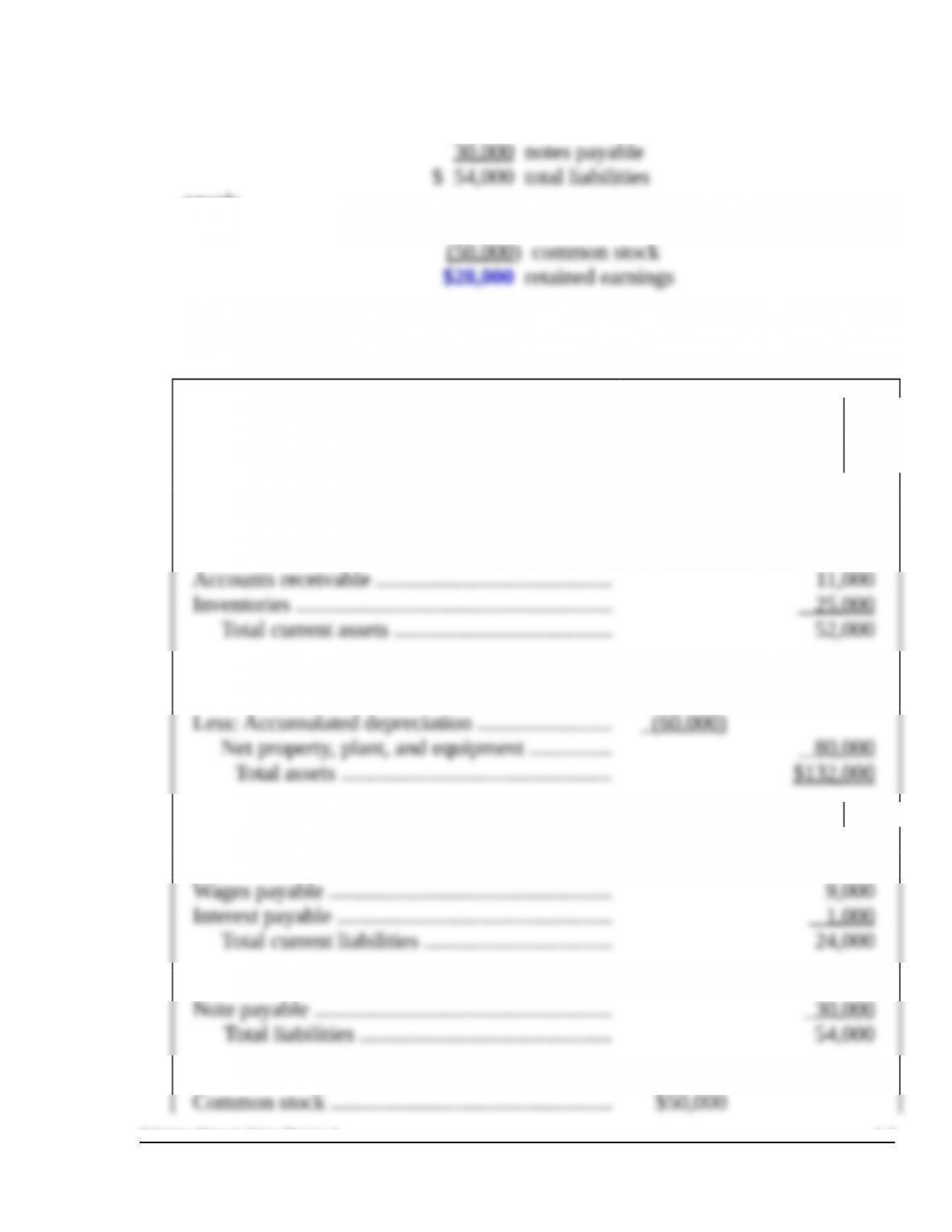
Liabilities $ 24,000 current liabilities
equals
Shareholders’ equity $78,000
Brief Exercise 3–4
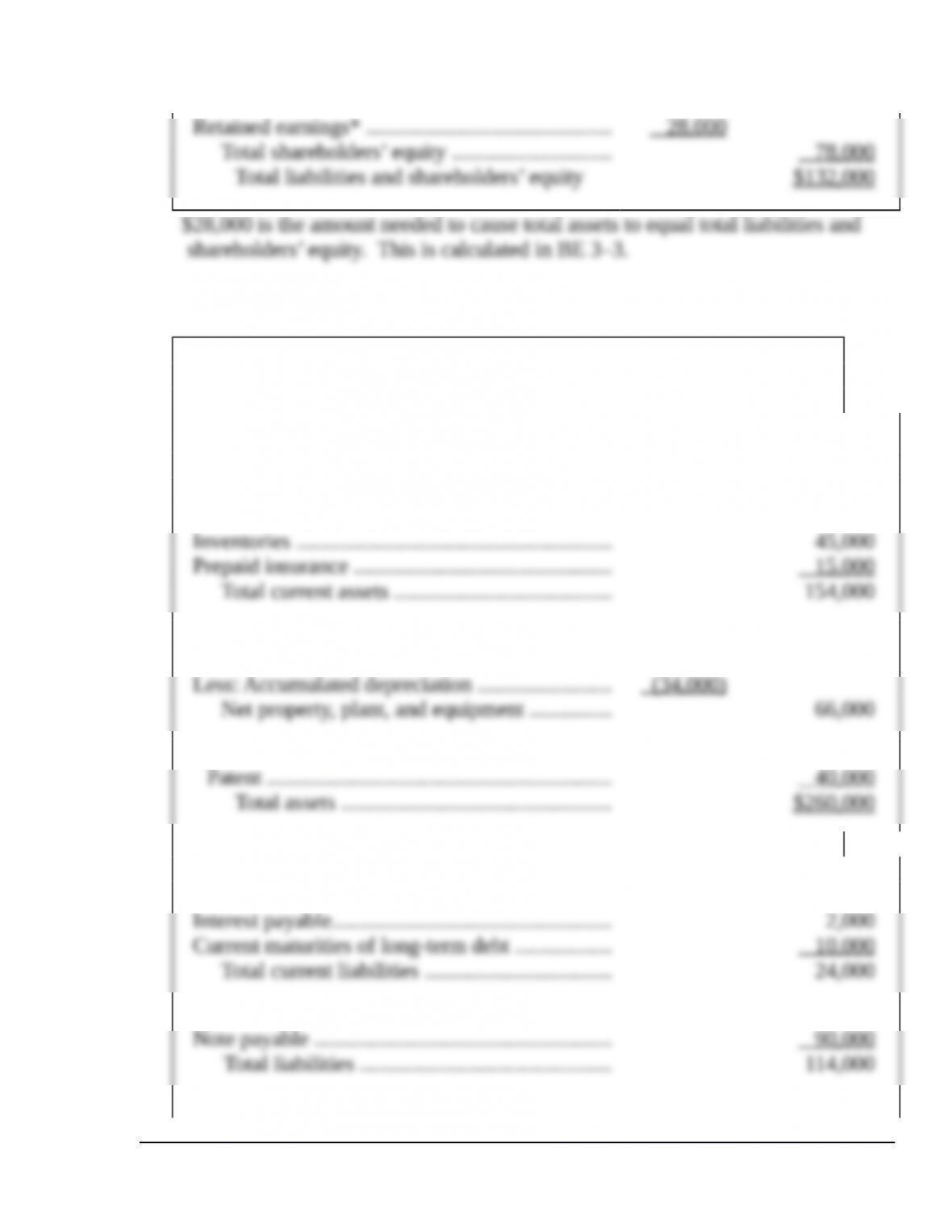
K AND J NURSERY, INC.
Balance Sheet
At December 31, 2018
Assets
Current assets:
Cash ………………………………………………………….. $ 16,000
Property, plant, and equipment:
Equipment …………………………………………………. $140,000
Liabilities and Shareholders’ Equity
Current liabilities:
Accounts payable ……………………………………….. $ 14,000
Long-term liabilities:
Shareholders’ equity:
Solutions Manual, Vol.1, Chapter 3 3–7
Copyright © 2018 McGraw-Hill Education. All rights reserved. No reproduction or distribution without the prior written consent of
McGraw-Hill Education.
Brief Exercise 3–5
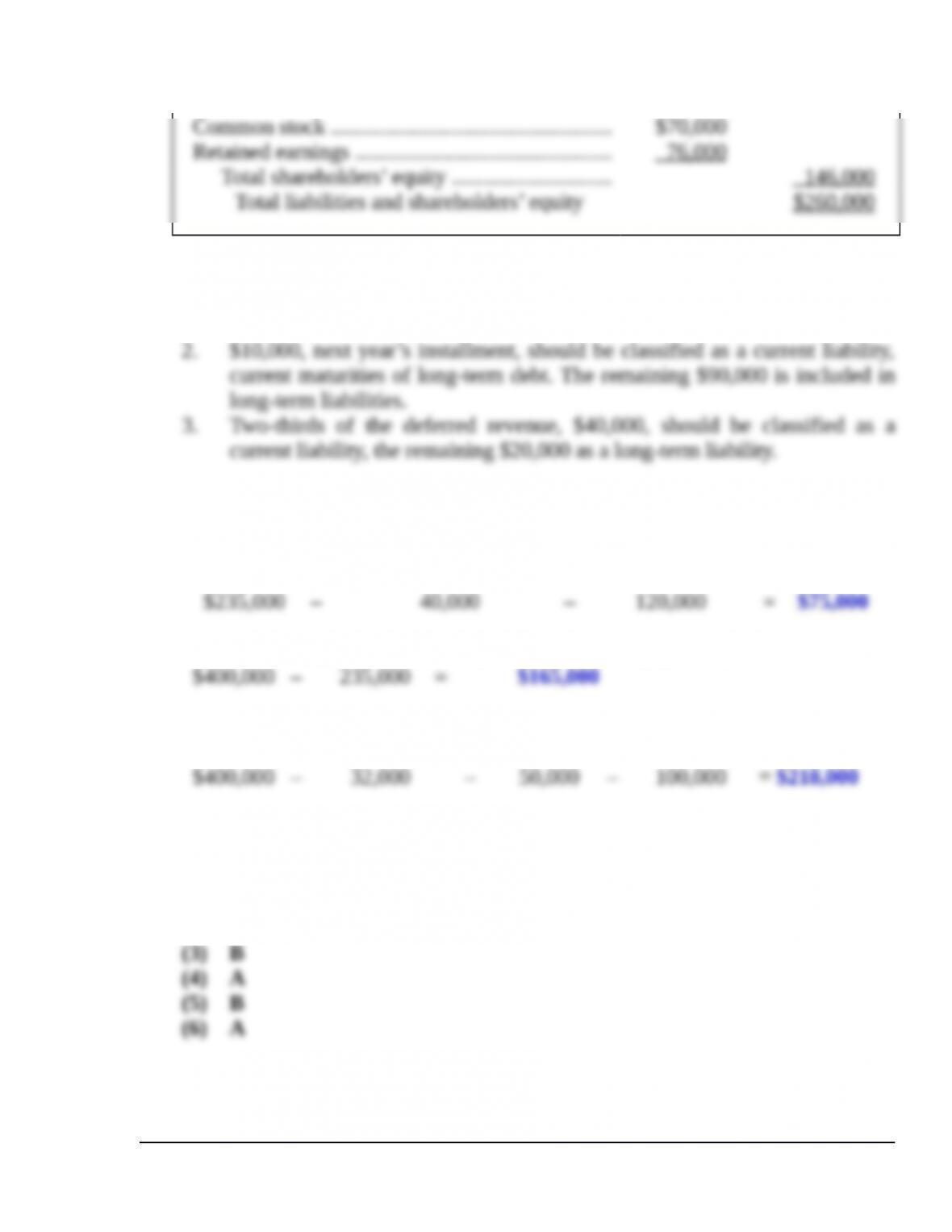
CULVER CITY LIGHTING, INC.
Balance Sheet
At December 31, 2018
Assets
Current assets:
Cash ………………………………………………………….. $ 55,000
Accounts receivable ……………………………………. 39,000
Property, plant, and equipment:
Equipment …………………………………………………. $100,000
Intangible assets:
Liabilities and Shareholders’ Equity
Current liabilities:
Accounts payable ……………………………………….. $ 12,000
Long-term liabilities:
Shareholders’ equity:
Solutions Manual, Vol.1, Chapter 3 3–8
Copyright © 2018 McGraw-Hill Education. All rights reserved. No reproduction or distribution without the prior written consent of
McGraw-Hill Education.
Brief Exercise 3–6
1. The $30,000 should be classified as a long-term asset, under the
investments classification.
Brief Exercise 3–7
Current assets – Cash and cash equivalents – Accounts receivable = Inventories
Total assets – Current assets = Property, plant, and equipment (net)
Total assets – Accounts payable – Note payable – Common stock = Retained
earnings
Brief Exercise 3–8
(1) A
(2) B
Solutions Manual, Vol.1, Chapter 3 3–9
Copyright © 2018 McGraw-Hill Education. All rights reserved. No reproduction or distribution without the prior written consent of
McGraw-Hill Education.
Brief Exercise 3–9
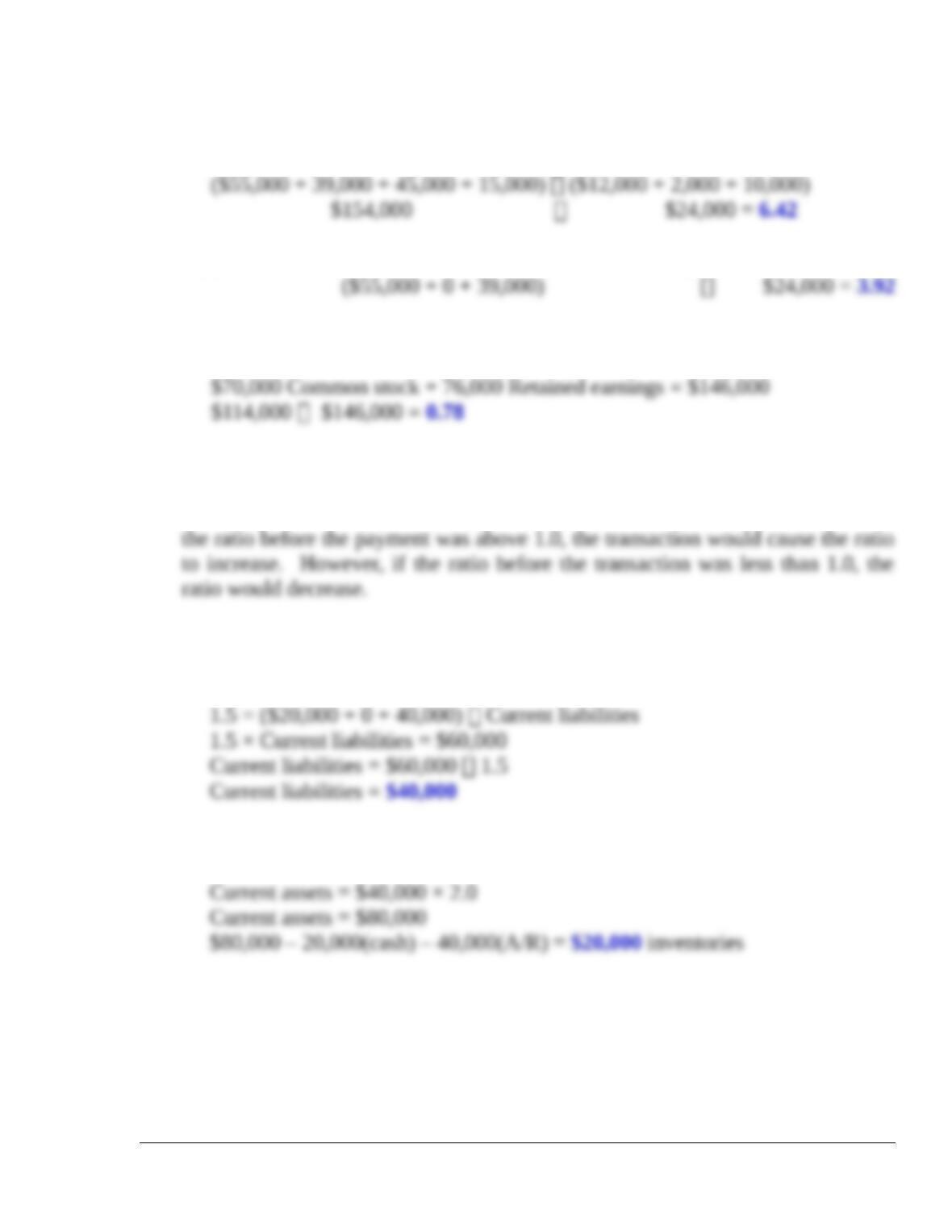
(a) Current assets Current liabilities
(b) (Cash + Short-term investments + Accounts receivable) Current liabilities
(c) Total liabilities Shareholders’ equity
$24,000 Current liabilities + 90,000 Long-term liabilities = $114,000
Brief Exercise 3–10
Paying accounts payable reduces both current assets and current liabilities. If
Brief Exercise 3–11
Acid-test ratio = (Cash + Short-term investments + A/R) Current liabilities
Current ratio = Current assets Current liabilities
2.0 = Current assets $40,000
Solutions Manual, Vol.1, Chapter 3 3–10
Copyright © 2018 McGraw-Hill Education. All rights reserved. No reproduction or distribution without the prior written consent of
McGraw-Hill Education.