Analysis Case 20-4
For changes not involving LIFO or changes from the LIFO method to another,
the event is accounted for as a normal change in accounting principle. In general,
we report voluntary changes in accounting principles retrospectively. This means
revising all previous period’s financial statements presented as if the new method
were used in those periods. In other words, for each year in the comparative
The advantage of retrospective application is to enhance comparability of the
Consistency and comparability suggest that accounting choices once made
should be consistently followed from year to year. So, any change requires that the
When a company changes to the LIFO inventory method from any other
method, it usually is impracticable to calculate the cumulative effect of the change.
Revising balances in prior years would require knowing what those balances
should be. LIFO inventory, though, consists of “layers” added in prior years at
Communication Case 20-5
Suggested Grading Concepts and Grading Scheme:
Content (80%)
20 Identifies the situation as a change in estimate.
The liability was originally (appropriately) estimated as
$750,000.
The final settlement indicates the estimate should be revised.
Writing (20%)
5 Terminology and tone appropriate to the audience of a Vice
President.
6 Organization permits ease of understanding.
Introduction that states purpose.
Paragraphs separate main points.
Analysis Case 20-6
Larry apparently is referring to the fact that because the company now
believes the useful lives of the assets are longer than before that depreciation
calculated assuming the shorter 16 year life was overstated. Now by not
Larry is right if we accept his premise that depreciation was, in fact, “too
high” before the change. That perspective enjoys the benefit of hindsight. When
the original estimate was made, 16 years was considered the appropriate useful
life. The accounting profession argues that as conditions change, estimates change,
and that resulting inconsistencies are unavoidable. Therefore, changes in estimates
Research Case 20-7
Requirement 3
The results students report will vary somewhat depending on the firms chosen.
However, disclosures of changes in actuarial assumptions for benefit plans are
quite similar.
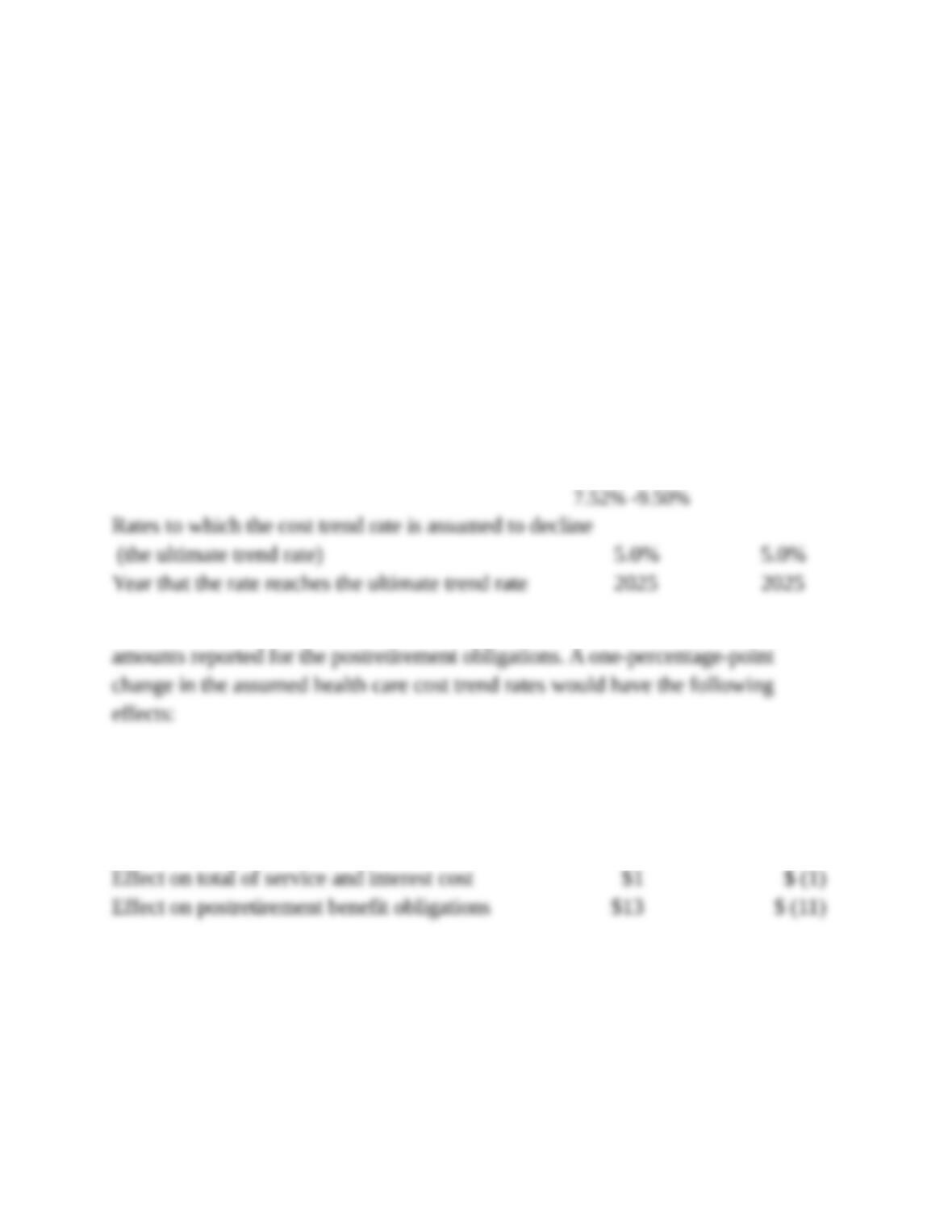
A recent disclosure for Macy’s, Inc. follows:
The following provides the assumed health care cost trend rates related to the
Company’s postretirement obligations at February 1, 2014 and February 2, 2013:
2013 2012
Health care cost trend rates assumed for next year 7.27% -9.20%
The assumed health care cost trend rates have a significant effect on the
1 Percentage 1 Percentage
Point Point
Decrease Decrease
(millions)
Case 20-7 (concluded)
Requirement 4
The specific citation that describes disclosure requirements for health care cost
trends is FASB ASC 715–20–50–1m: Compensation-Retirement Benefits–Defined
Benefit Plans-General–Disclosure.
1m. The effect of a one-percentage-point increase and the effect of a
one-percentage-point decrease in the assumed health care cost trend rates on the
aggregate of the service and interest cost components of net periodic
postretirement health care benefit costs and the accumulated postretirement benefit
Analysis Case 20-8
Requirement 1
DRS’s change in depreciation method for computers represents a change in
estimate resulting from a change in accounting principle. This is because a
change in the depreciation method is adopted to reflect a change in (a)
The change in residual value for the office building is a change in
accounting estimate. The company reports the change prospectively; previous
financial statements are not recast. Instead, the company simply employs the
DRS’s change in the specific subsidiaries constituting the group of
companies for which consolidated financial statements are presented is a
change in reporting entity. A change in reporting entity is effected and
Case 20-8 (concluded)
Requirement 2
Applying the same accounting principles from one reporting period to another
enhances the comparability of accounting information across accounting
If a change in accounting principle occurs, the nature and effect of a

Analysis Case 20-9
The change from cash basis recognition for service contract revenue to the
accrual basis is a change from an unacceptable accounting principle to one that is
The change from accelerated depreciation for all future acquisitions is a change
in accounting principle. Ray should disclose the nature and justification for the
Ray’s change from LIFO to FIFO is a change in accounting principle for which
Ray should recast prior periods’ financial statements to appear as if FIFO had