AACSB assurance of
learning standards in
accounting and
business education
require documentation of outcomes assessment. Although schools, departments, and faculty may
approach assessment and its documentation differently, one approach is to provide specific questions
on exams that become the basis for assessment. To aid faculty in this endeavor, we have labeled
each question, exercise, and problem in Intermediate Accounting, 9e, with the following AACSB
learning skills:
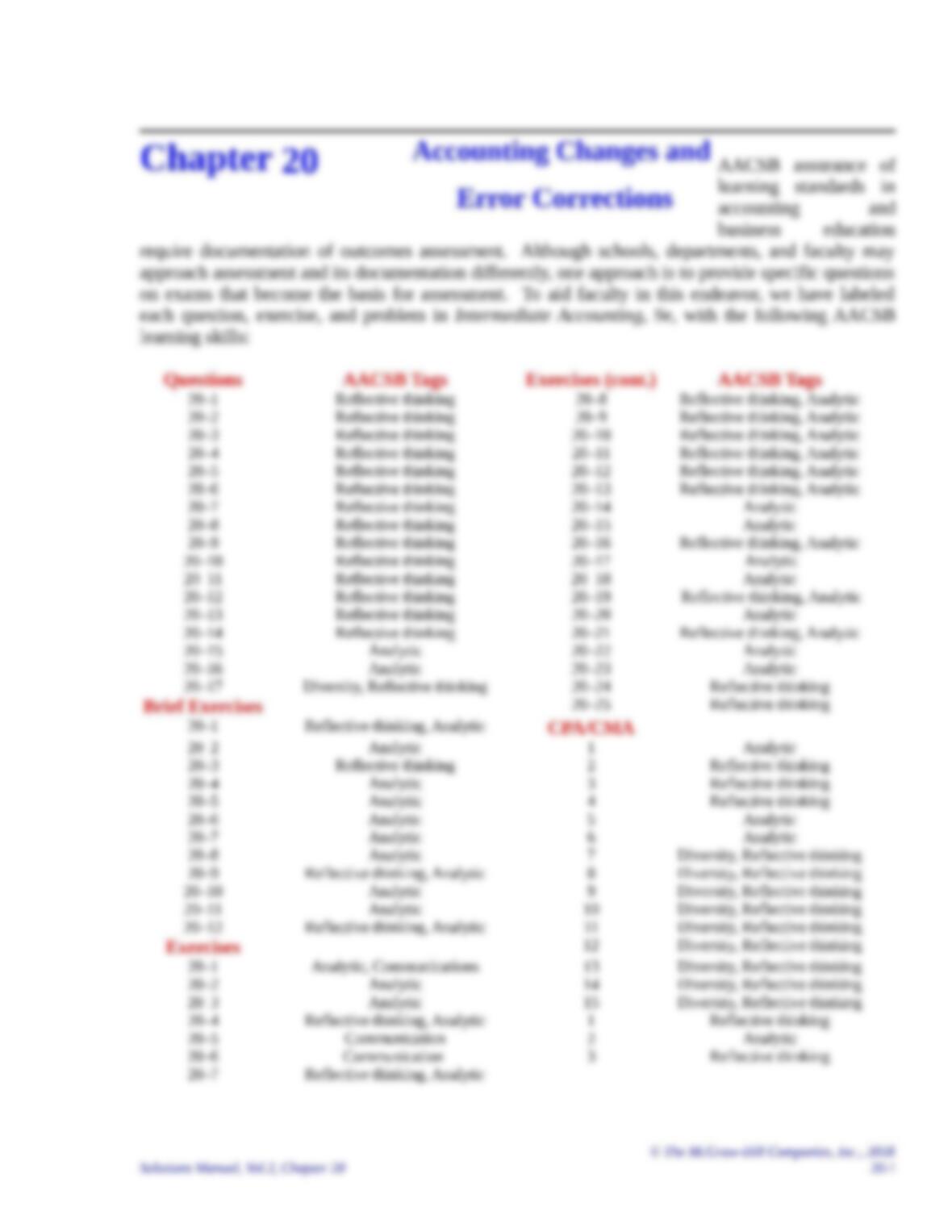
Questions AACSB Tags Exercises (cont.) AACSB Tags
20–1 Reflective thinking 20–8 Reflective thinking, Analytic
20–2 Reflective thinking 20–9 Reflective thinking, Analytic
20–3 Reflective thinking 20–10 Reflective thinking, Analytic
20–4 Reflective thinking 20–11 Reflective thinking, Analytic
20–5 Reflective thinking 20–12 Reflective thinking, Analytic
20–6 Reflective thinking 20–13 Reflective thinking, Analytic
20–7 Reflective thinking 20–14 Analytic
20–8 Reflective thinking 20–15 Analytic
20–9 Reflective thinking 20–16 Reflective thinking, Analytic
20–10 Reflective thinking 20–17 Analytic
20–11 Reflective thinking 20–18 Analytic
20–12 Reflective thinking 20–19 Reflective thinking, Analytic
20–13 Reflective thinking 20–20 Analytic
20–14 Reflective thinking 20–21 Reflective thinking, Analytic
20–15 Analytic 20–22 Analytic
20–16 Analytic 20–23 Analytic
20–17 Diversity, Reflective thinking 20–24 Reflective thinking
Brief Exercises 20–25 Reflective thinking
20–1 Reflective thinking, Analytic CPA/CMA
20–2 Analytic 1 Analytic
20–3 Reflective thinking 2 Reflective thinking
20–4 Analytic 3 Reflective thinking
20–5 Analytic 4 Reflective thinking
20–6 Analytic 5 Analytic
20–7 Analytic 6 Analytic
20–8 Analytic 7 Diversity, Reflective thinking
20–9 Reflective thinking, Analytic 8 Diversity, Reflective thinking
20–10 Analytic 9 Diversity, Reflective thinking
20–11 Analytic 10 Diversity, Reflective thinking
20–12 Reflective thinking, Analytic 11 Diversity, Reflective thinking
Exercises 12 Diversity, Reflective thinking
20–1 Analytic, Communications 13 Diversity, Reflective thinking
20–2 Analytic 14 Diversity, Reflective thinking
20–3 Analytic 15 Diversity, Reflective thinking
20–4 Reflective thinking, Analytic 1 Reflective thinking
20–5 Communication 2 Analytic
20–6 Communication 3 Reflective thinking
20–7 Reflective thinking, Analytic
© The McGraw-Hill Companies, Inc., 2018
Solutions Manual, Vol.2, Chapter 20 20-%
Chapter 20 Accounting Changes and
Error Corrections

Problems AACSB Tags
20–1 Analytic
20–2 Analytic
20–3 Reflective thinking, Analytic
20–4 Analytic
20–5 Analytic
20–6 Reflective thinking, Analytic
20–7 Analytic
20–8 Reflective thinking, Analytic
20–9 Analytic
20–10 Reflective thinking, Analytic
20–11 Analytic
20–12 Reflective thinking, Analytic
20–13 Reflective thinking, Analytic
20–14 Analytic
20–15 Analytic
20–16 Analytic
20–17 Reflective thinking, Analytic
© The McGraw-Hill Companies, Inc., 2018
Solutions Manual, Vol.2, Chapter 20 20-%
Question 20-1
Accounting changes are categorized as:
1. Changes in principle (when companies switch from one acceptable accounting
method to another)
© The McGraw-Hill Companies, Inc., 2018
Solutions Manual, Vol.2, Chapter 20 20-%
QUESTIONS FOR REVIEW OF KEY TOPICS

Question 20-2
Accounting changes can be accounted for:
1. Retrospectively (prior years revised),
© The McGraw-Hill Companies, Inc., 2018
Solutions Manual, Vol.2, Chapter 20 20-%
Question 20-3
In general, we report voluntary changes in accounting principles retrospectively.
This means revising all previous periods’ financial statements presented in
comparative statements as if the new method were used in those periods. In other
words, for each year in the comparative statements reported, we revise the balance of
© The McGraw-Hill Companies, Inc., 2018
Solutions Manual, Vol.2, Chapter 20 20-%

Answers to Questions (continued)
© The McGraw-Hill Companies, Inc., 2018
Solutions Manual, Vol.2, Chapter 20 20-%
Question 20-4
Lynch should report its change in depreciation method as a change in estimate,
rather than as a change in accounting principle. This is because a change in
depreciation method is considered a change in accounting estimate reflected by a
change in accounting principle. In other words, a change in the depreciation method is
Accordingly, Lynch reports the change prospectively; previous financial statements
are not revised. Instead, the company simply employs the straight-line method from
© The McGraw-Hill Companies, Inc., 2018
Solutions Manual, Vol.2, Chapter 20 20-%

Question 20-5
In general, we report voluntary changes in accounting principles retrospectively.
This means Sugarbaker will revise all previous period’s financial statements presented
Since the change affects income, retained earnings also changes. Sugarbaker
© The McGraw-Hill Companies, Inc., 2018
Solutions Manual, Vol.2, Chapter 20 20-%

Answers to Questions (continued)
The company also will revise deferred taxes. Income tax effect is reflected in the
deferred income tax asset because retrospectively decreasing accounting income, but
© The McGraw-Hill Companies, Inc., 2018
Solutions Manual, Vol.2, Chapter 20 20-%
Question 20-6
Voluntary changes in accounting principles usually are reported retrospectively.
Also, it’s not practicable to report some changes in principle retrospectively
because insufficient information is available. Revising balances in prior years means
knowing what those balances should be. For instance, suppose we’re switching from
Another exception is when authoritative accounting literature requires prospective
application for specific changes in accounting methods. For example, when there’s a
change from the equity method to another method of accounting for long-term
investments, GAAP requires the prospective application of the new method. From
© The McGraw-Hill Companies, Inc., 2018
Solutions Manual, Vol.2, Chapter 20 20-%

Answers to Questions (continued)
© The McGraw-Hill Companies, Inc., 2018
Solutions Manual, Vol.2, Chapter 20 20-%
Question 20-7
Accounting records of prior years usually are inadequate to determine the
cumulative income effect of the change for prior years when a company changes to
the LIFO inventory method from another inventory method. For example, it would be
necessary to make assumptions as to when specific LIFO inventory layers were
© The McGraw-Hill Companies, Inc., 2018
Solutions Manual, Vol.2, Chapter 20 20-%

Question 20-8
A change in estimate is accounted for prospectively. When a company revises an
estimate, previous financial statements are not revised. Rather, the company simply
incorporates the new estimate in any related accounting determinations from then on.
© The McGraw-Hill Companies, Inc., 2018
Solutions Manual, Vol.2, Chapter 20 20-%

Question 20-9
© The McGraw-Hill Companies, Inc., 2018
Solutions Manual, Vol.2, Chapter 20 20-%

Question 20-10
The situations deemed to constitute a change in reporting entity are (1) presenting
consolidated financial statements in place of statements of individual companies and
© The McGraw-Hill Companies, Inc., 2018
Solutions Manual, Vol.2, Chapter 20 20-%

Answers to Questions (continued)
© The McGraw-Hill Companies, Inc., 2018
Solutions Manual, Vol.2, Chapter 20 20-%

Question 20-11
Ford reported the situation as a change in reporting entity. This means that Ford
needed to recast all previous periods’ financial statements as if the new reporting
© The McGraw-Hill Companies, Inc., 2018
Solutions Manual, Vol.2, Chapter 20 20-%

Question 20-12
When an error is discovered, previous years’ financial statements that were
incorrect as a result of the error are retrospectively restated to reflect the correction.
© The McGraw-Hill Companies, Inc., 2018
Solutions Manual, Vol.2, Chapter 20 20-%

Question 20-13
If merchandise inventory is understated at the end of 2017, that year’s cost of
© The McGraw-Hill Companies, Inc., 2018
Solutions Manual, Vol.2, Chapter 20 20-%

Question 20-14
The error would have caused the previous year’s expenses to be overstated, and
therefore its net income to be understated. Therefore, retained earnings would be
© The McGraw-Hill Companies, Inc., 2018
Solutions Manual, Vol.2, Chapter 20 20-%

Answers to Questions (continued)
© The McGraw-Hill Companies, Inc., 2018
Solutions Manual, Vol.2, Chapter 20 20-%

© The McGraw-Hill Companies, Inc., 2018
Solutions Manual, Vol.2, Chapter 20 20-%

Question 20-15
During the two-year period, insurance expense would have been overstated by
$30,000, so net income during the period was understated by $30,000. This means
beginning retained earnings is currently understated by that amount. During the
two-year period, prepaid insurance would have been understated, and continues to be
© The McGraw-Hill Companies, Inc., 2018
Solutions Manual, Vol.2, Chapter 20 20-%

Question 20-16
If the error in the previous question is not discovered until the insurance coverage
has expired, no correcting entry at all would be needed. By then, the sum of the
omitted insurance expense amounts ($10,000 x 5 years) would equal the expense
© The McGraw-Hill Companies, Inc., 2018
Solutions Manual, Vol.2, Chapter 20 20-%

Question 20-17
When correcting errors in previously issued financial statements, IFRS (IAS No. 8)
© The McGraw-Hill Companies, Inc., 2018
Solutions Manual, Vol.2, Chapter 20 20-%