Question 2–1
External events involve an exchange transaction between the company and a
separate economic entity. For every external transaction, the company is receiving
Question 2–2
According to the accounting equation, there is equality between the total
economic resources of an entity, its assets, and the claims to those resources,
Question 2–3
The purpose of a journal is to capture, in chronological order, the dual effect of a
Question 2–4
Permanent accounts represent the financial position of a company—assets,
liabilities and owners’ equity—at a particular point in time. Temporary accounts
Solutions Manual, Vol.1, Chapter 2 2–1
Copyright © 2018 McGraw-Hill Education. All rights reserved. No reproduction or distribution without the prior written consent of
McGraw-Hill Education.
Chapter 2 Review of the Accounting Process
QUESTIONS FOR REVIEW OF KEY TOPICS
Answers to Questions (continued)
Question 2–5
Question 2–6
Revenues and gains are increased by credits and decreased by debits. Expenses
Question 2–7
The first step in the accounting processing cycle is to identify external
Question 2–8
Transaction analysis is the process of reviewing the source documents to
Question 2–9
Question 2–10
In Transaction 1 we record the purchase of $20,000 of inventory on account. In
Question 2–11
An unadjusted trial balance is a list of the general ledger accounts and their
Solutions Manual, Vol.1, Chapter 2 2–2
Copyright © 2018 McGraw-Hill Education. All rights reserved. No reproduction or distribution without the prior written consent of
McGraw-Hill Education.
Answers to Questions (continued)
Question 2–12
We use adjusting entries to record the effect on financial position of internal
events, those that do not involve an exchange transaction with another entity. We
record them at the end of any period when financial statements are prepared to
Question 2–13
Closing entries transfer the balances in the temporary owners’ equity accounts
(revenues, expenses, gains, losses, dividends) to a permanent owners’ equity account,
Question 2–14
Prepaid expenses represent assets recorded when a cash disbursement creates
Question 2–15
Question 2–16
Accrued liabilities are recorded when an expense has been incurred that will not
Solutions Manual, Vol.1, Chapter 2 2–3
Copyright © 2018 McGraw-Hill Education. All rights reserved. No reproduction or distribution without the prior written consent of
McGraw-Hill Education.
Answers to Questions (continued)
Question 2–17
Income statement—The purpose of the income statement is to summarize the
profit-generating activities of a company during a particular period of time. It is a
Statement of comprehensive income—The statement of comprehensive income
extends the income statement to report changes in shareholders’ equity during the
Balance sheet—The purpose of the balance sheet is to present the financial
Statement of cash flows—The purpose of the statement of cash flows is to
Statement of shareholders’ equity—The purpose of the statement of shareholders’
equity is to disclose the sources of the changes in the various shareholders’ equity
Question 2–18
A worksheet provides a way to organize the accounting information needed to
Solutions Manual, Vol.1, Chapter 2 2–4
Copyright © 2018 McGraw-Hill Education. All rights reserved. No reproduction or distribution without the prior written consent of
McGraw-Hill Education.
Answers to Questions (concluded)
Question 2–19
Reversing entries are recorded at the beginning of a reporting period. They
reverse the effects of some of the adjusting entries recorded at the end of the previous
Question 2–20
The purpose of special journals is to record, in chronological order, the dual
Special journals simplify the recording process in the following ways: (1)
journalizing the effects of a particular transaction is made more efficient through the
Question 2–21
The general ledger is a collection of control accounts representing assets,
liabilities, permanent and temporary shareholders’ equity accounts. The subsidiary
ledger contains a group of subsidiary accounts associated with a particular general
Solutions Manual, Vol.1, Chapter 2 2–5
Copyright © 2018 McGraw-Hill Education. All rights reserved. No reproduction or distribution without the prior written consent of
McGraw-Hill Education.
Brief Exercise
2–1
Assets = Liabilities + Paid-in Capital + Retained Earnings
1. + 165,000
(inventory) + 165,000 (accounts payable)
2. – 40,000
(cash) – 40,000(expense)
Brief Exercise 2–2
1. Inventory………………………………………………………… 165,000
Accounts payable…………………………………………. 165,000
Solutions Manual, Vol.1, Chapter 2 2–6
Copyright © 2018 McGraw-Hill Education. All rights reserved. No reproduction or distribution without the prior written consent of
McGraw-Hill Education.
BRIEF EXERCISES

Solutions Manual, Vol.1, Chapter 2 2–7
Copyright © 2018 McGraw-Hill Education. All rights reserved. No reproduction or distribution without the prior written consent of
McGraw-Hill Education.
Brief Exercise 2–3
BALANCE SHEET ACCOUNTS
Cash Accounts receivable
_____________________________ _____________________________
6/1 Bal. 65,000
6/1 Bal.
6/30 Bal.
Inventory Accounts payable
_____________________________ _____________________________
6/1 Bal. 0 6/1 Bal. 22,000
1. 165,000
120,000
INCOME STATEMENT ACCOUNTS
Sales revenue Cost of goods sold
_____________________________ _____________________________
Solutions Manual, Vol.1, Chapter 2 2–8
Copyright © 2018 McGraw-Hill Education. All rights reserved. No reproduction or distribution without the prior written consent of
McGraw-Hill Education.
Salaries expense
_____________________________
6/1 Bal. 0
Brief Exercise 2–4
1. Prepaid insurance…………………………………………….. 12,000
Cash …………………………………………………………… 12,000
Brief Exercise 2–5
1. Insurance expense ($12,000 x 3/12)……………………….. 3,000
Prepaid insurance ………………………………………… 3,000
Solutions Manual, Vol.1, Chapter 2 2–9
Copyright © 2018 McGraw-Hill Education. All rights reserved. No reproduction or distribution without the prior written consent of
McGraw-Hill Education.

Brief Exercise 2–6
Net income would be higher by $14,700 ($3,000 – 300 + 12,000).
Solutions Manual, Vol.1, Chapter 2 2–10
Copyright © 2018 McGraw-Hill Education. All rights reserved. No reproduction or distribution without the prior written consent of
McGraw-Hill Education.
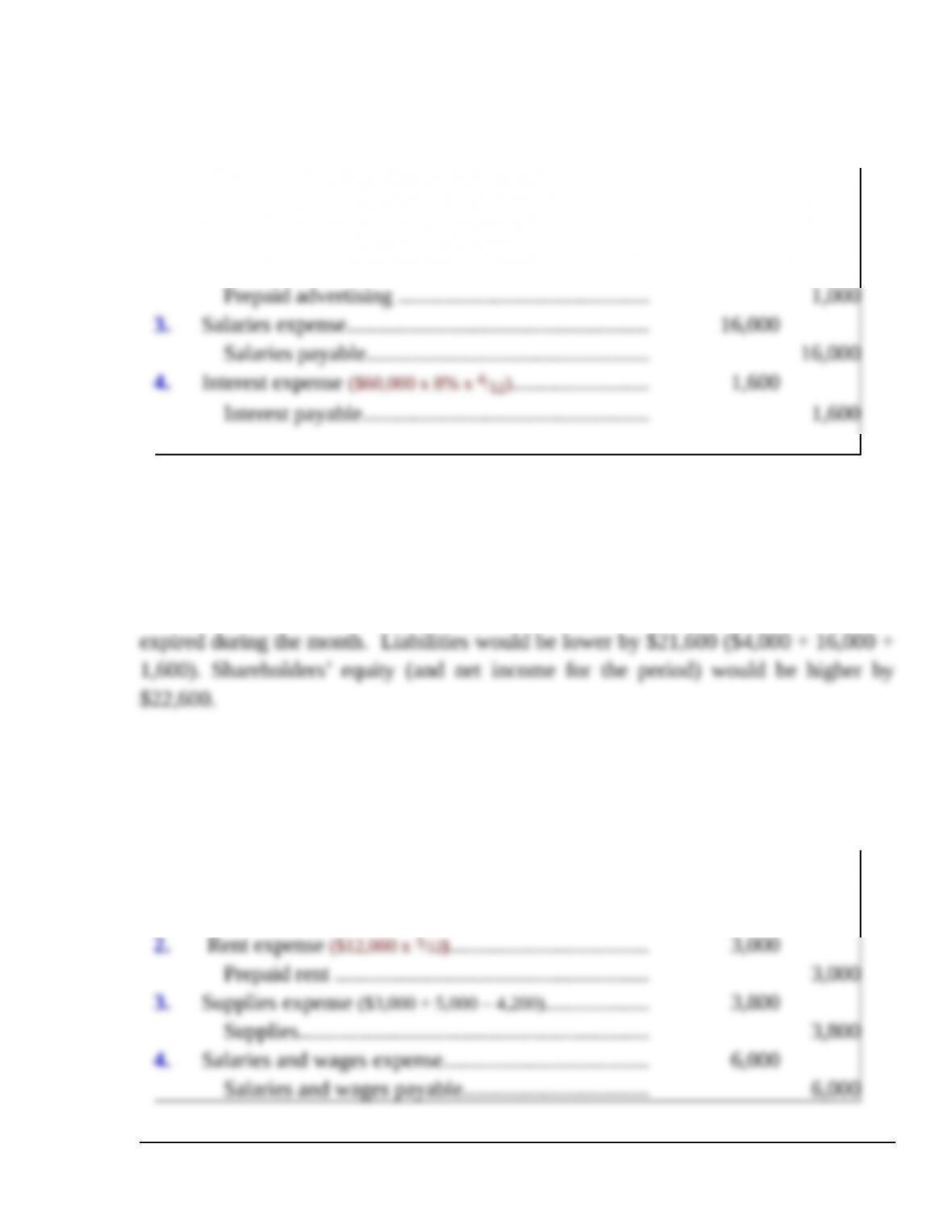
Brief Exercise 2–7
1. Service revenue ………………………………………………. 4,000
Deferred service revenue ………………………………. 4,000
2. Advertising expense ($2,000 x 1/2)……………………….. 1,000
Brief Exercise 2–8
Assets would be higher by $1,000, the amount of prepaid advertising that
Brief Exercise 2–9
1. Interest receivable …………………………………………… 2,250
Interest revenue ($50,000 x 6% x 9/12)……………….. 2,250
Solutions Manual, Vol.1, Chapter 2 2–11
Copyright © 2018 McGraw-Hill Education. All rights reserved. No reproduction or distribution without the prior written consent of
McGraw-Hill Education.
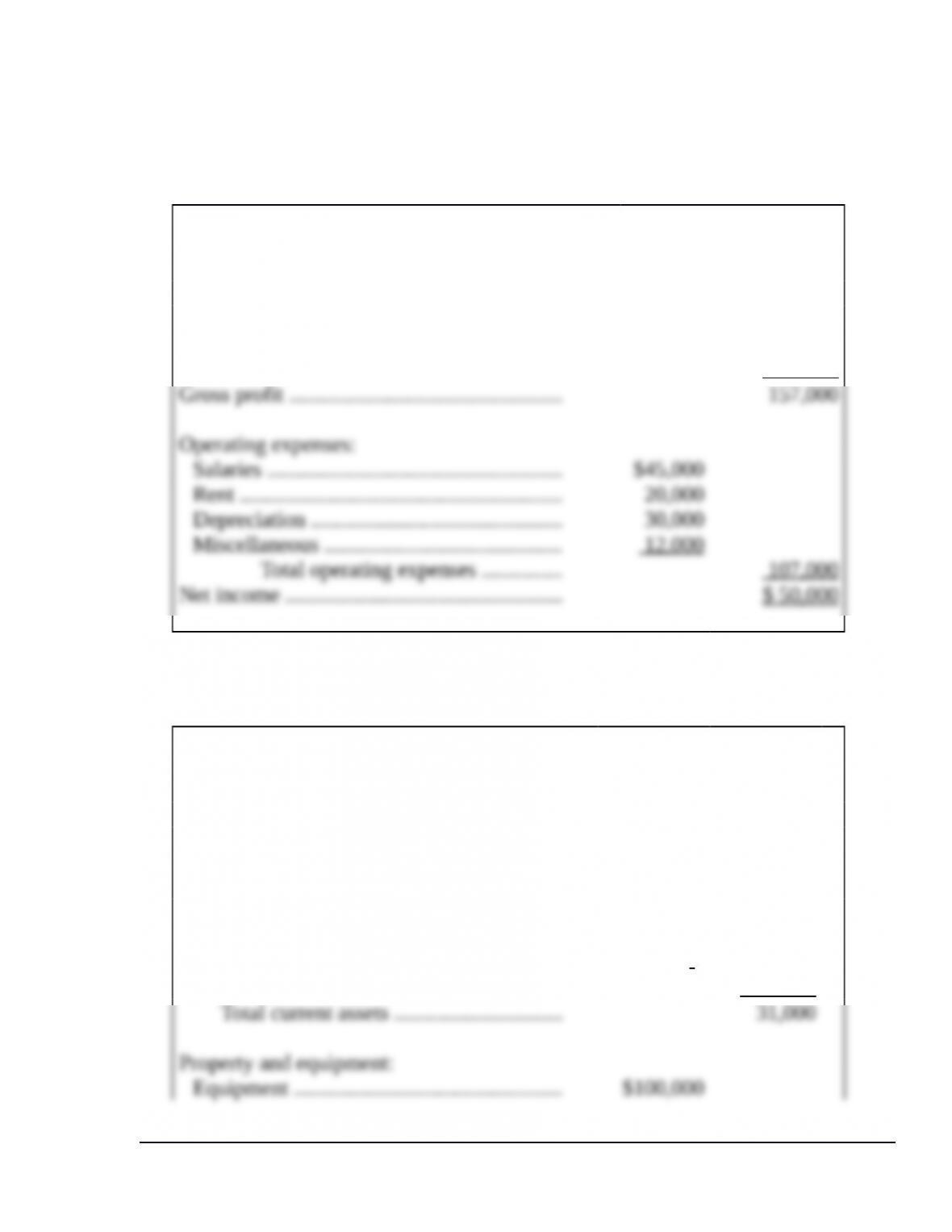
Brief Exercise 2–10
BOWLER CORPORATION
Income Statement
For the Year Ended December 31, 2018
Sales revenue ……………………………………….. $325,000
Cost of goods sold ………………………………… 168,000
Brief Exercise 2–11
BOWLER CORPORATION
Balance Sheet
At December 31, 2018
Assets
Current assets:
Cash ………………………………………………….. $ 5,000
Accounts receivable ……………………………. 10,000
Inventory …………………………………………… 16,000
Solutions Manual, Vol.1, Chapter 2 2–12
Copyright © 2018 McGraw-Hill Education. All rights reserved. No reproduction or distribution without the prior written consent of
McGraw-Hill Education.
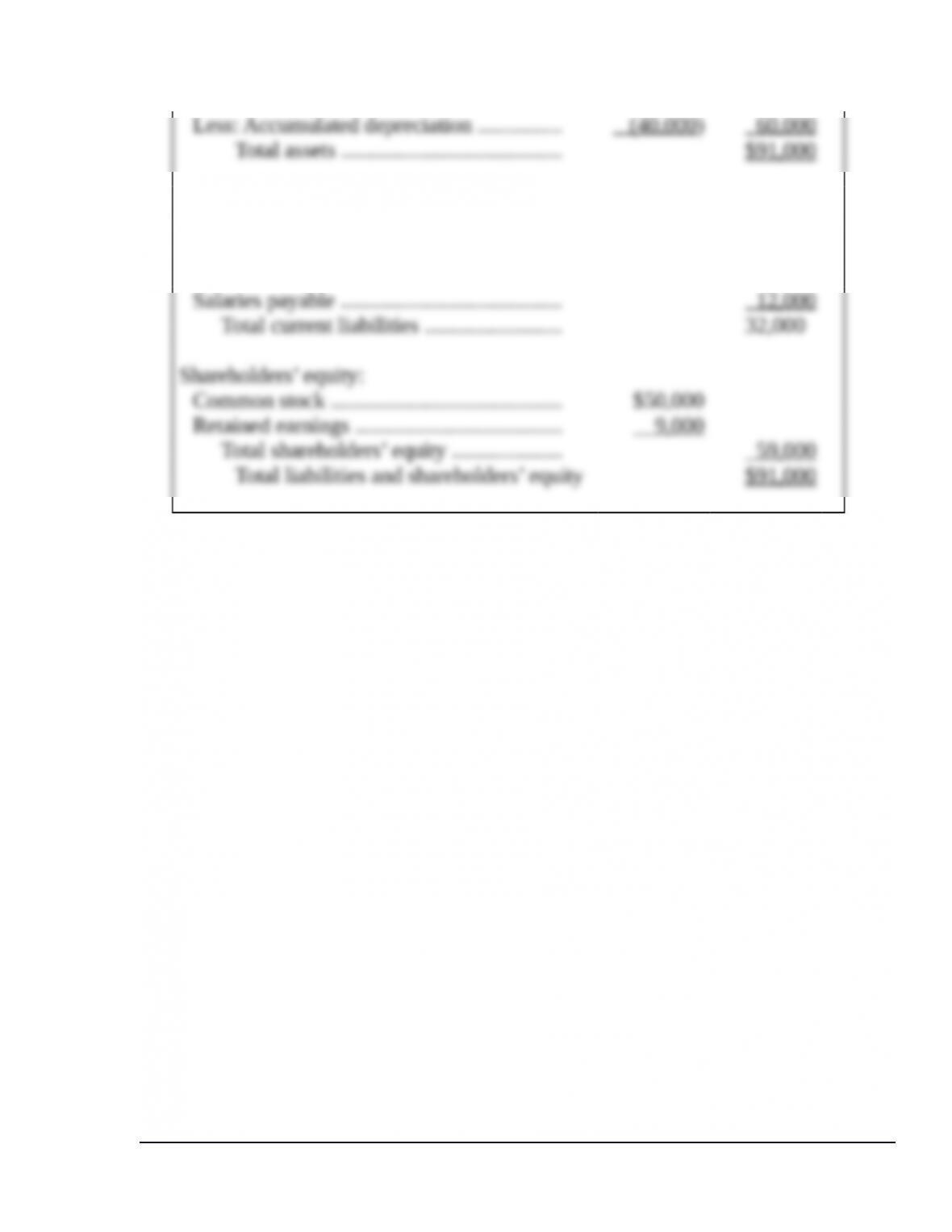
Liabilities and Shareholders’ Equity
Current liabilities:
Accounts payable ……………………………….. $ 20,000
Solutions Manual, Vol.1, Chapter 2 2–13
Copyright © 2018 McGraw-Hill Education. All rights reserved. No reproduction or distribution without the prior written consent of
McGraw-Hill Education.