Case 19–12 (concluded)
Requirement 2
Sometimes, the effect of potential common shares would be to increase, rather than
decrease, EPS. These we refer to as “antidilutive” securities. Such securities are
ignored when calculating both basic and diluted EPS. For example, when we
adjust shares for the effect of stock options being exercised, we apply what’s called
the “treasury stock” method. The number of shares assumed repurchased is fewer
Case 19–12 (concluded)
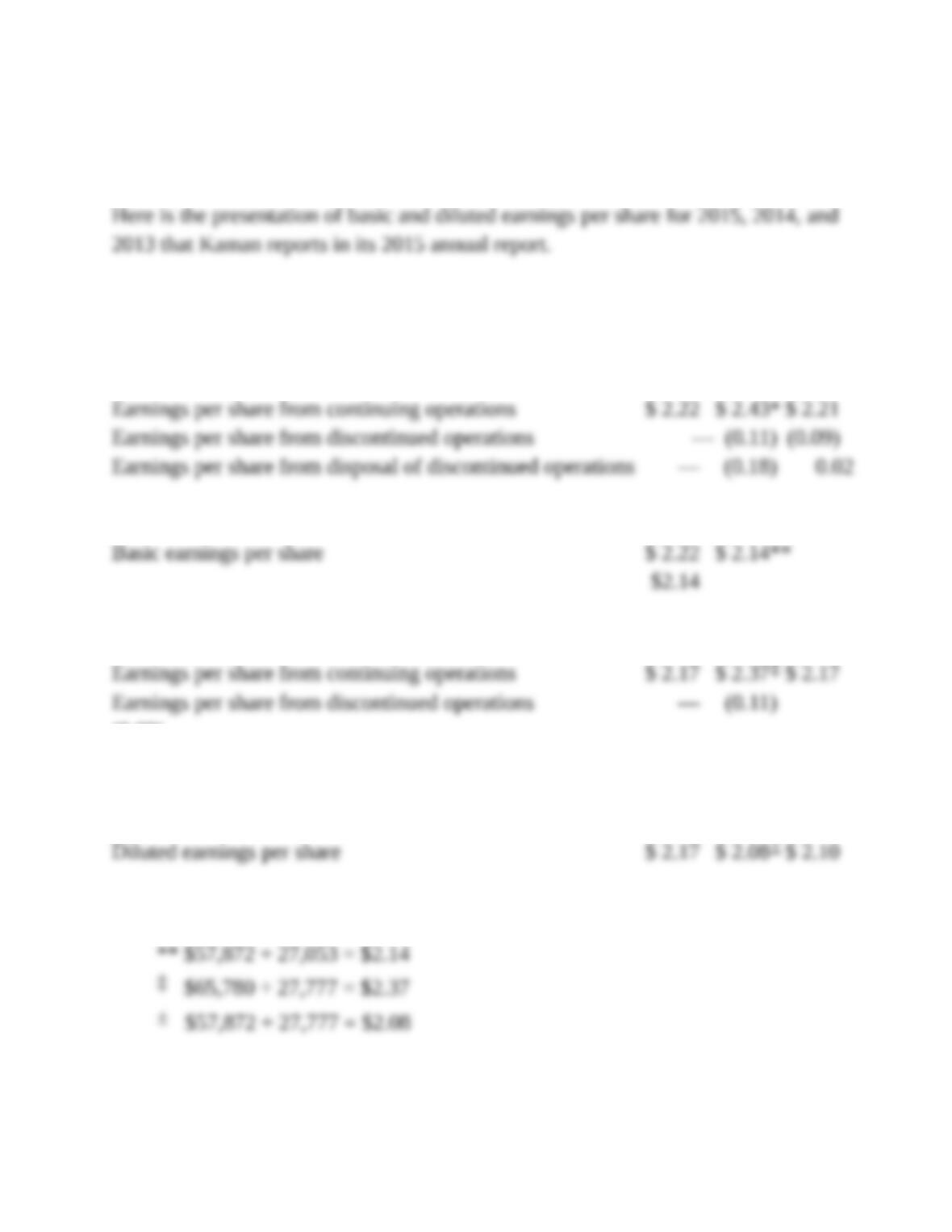
Requirement 3
2015 2014
2013
Earnings per share
Basic
_____ _____ ___
__
Diluted:
(0.09)
Earnings per share from disposal of discontinued operations — (0.18) 0.02
_____ _____ ___
__
* $65,780 ÷ 27,053 = $2.43
Analysis Case 19–13
Requirement 1
In its simplest form, earnings per share is merely a firm’s net income divided by
the number of shares outstanding throughout the year.
Earnings per share = Income available to common shareholders
Weighted-average shares outstanding
Requirement 2
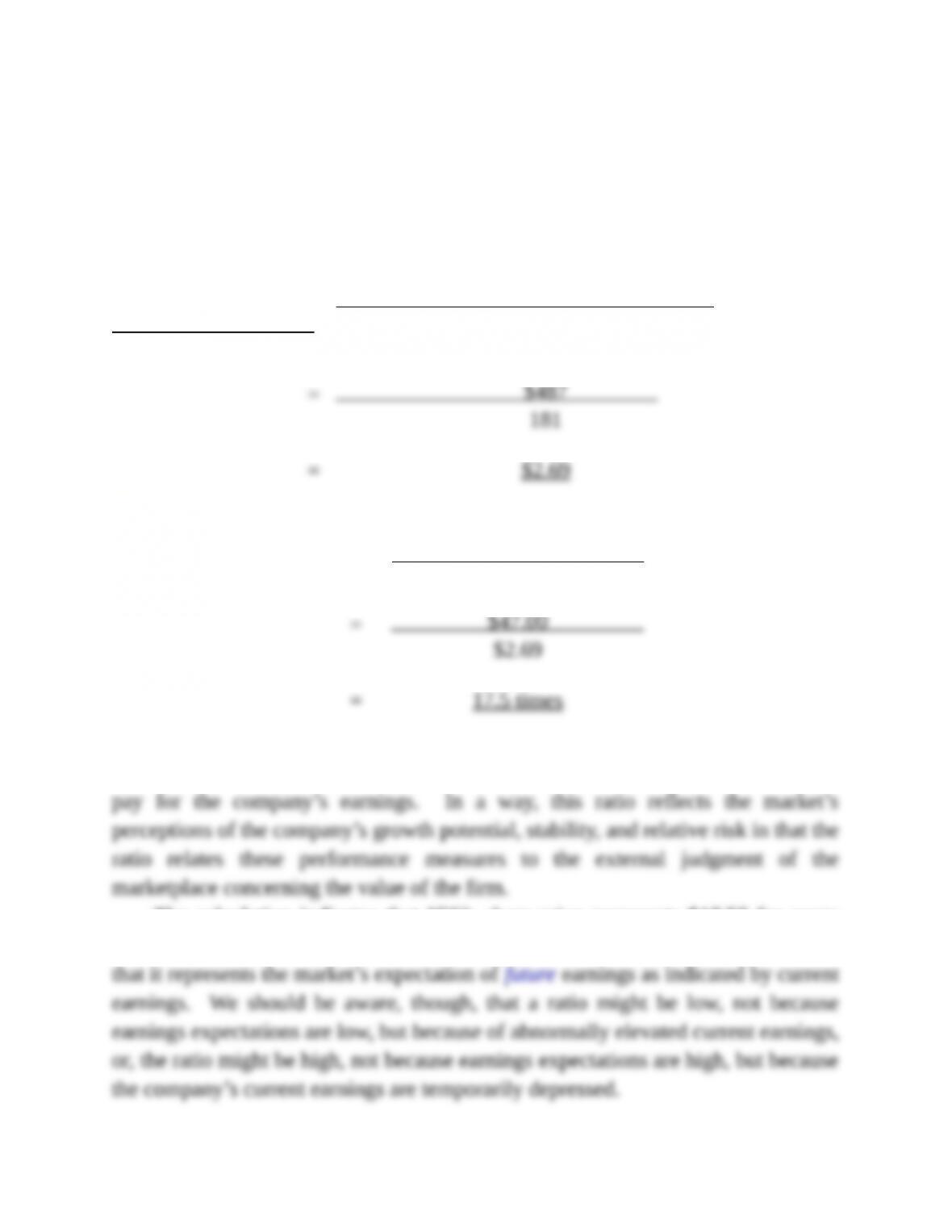
Price-earnings ratio = Market price per share
Earnings per share
The calculation indicates that IGF’s share price represents $17.50 for every
dollar of earnings. In that regard, it measures the “quality” of earnings in the sense
Case 19–13 (concluded)
Requirement 3
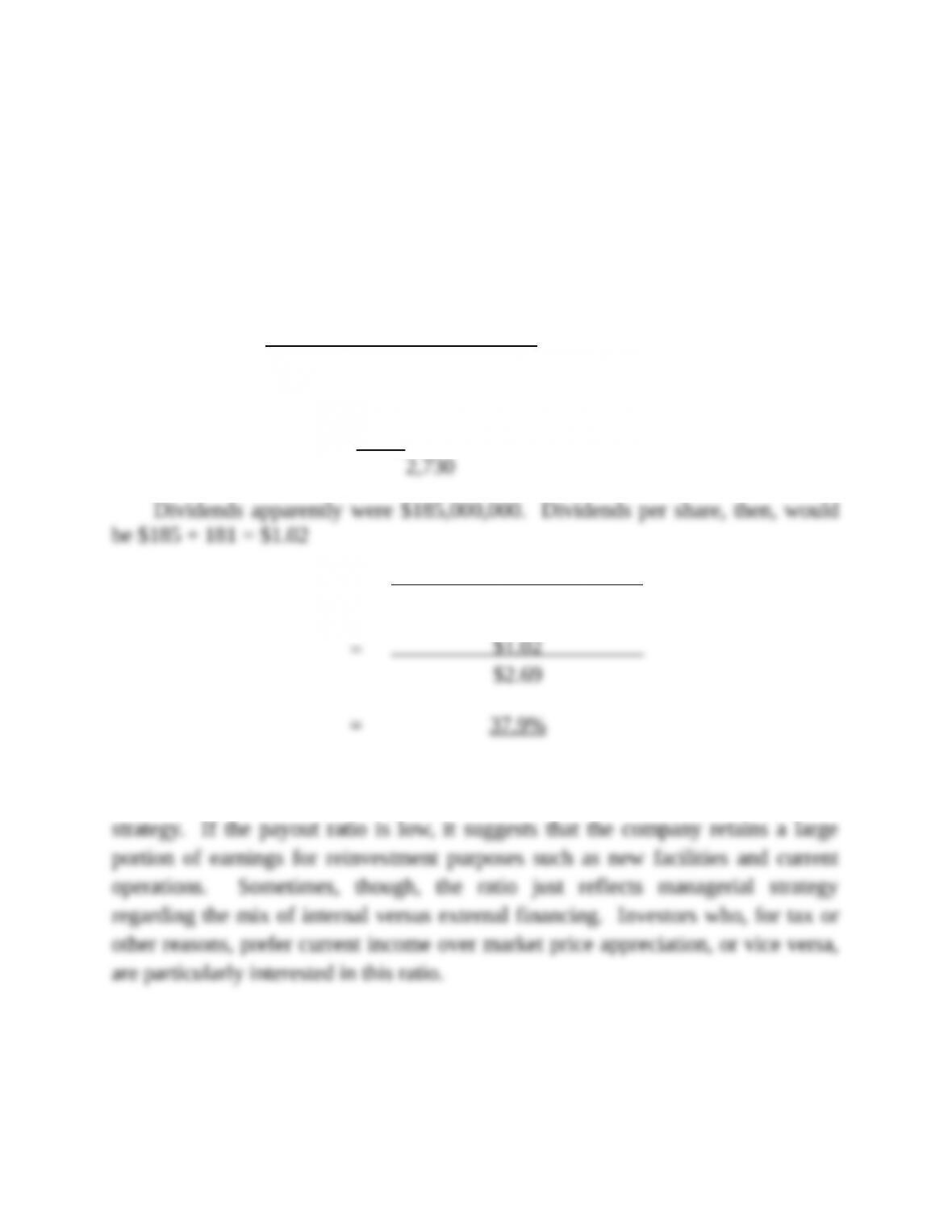
The dividend payout ratio expresses the percentage of earnings that is
distributed to shareholders as dividends. To calculate the ratio for IGF with the
information provided, we must estimate dividends from analysis of the retained
earnings account:
Retained Earnings
2,428
487Net income
Dividends ?
Dividend payout ratio = Cash dividends per share
Earnings per share
IGF paid cash dividends of $1.02 cents per share during the most recent year,
almost 38% of earnings. The ratio provides an indication of the firm’s reinvestment
Research Case 19–14
The results students report will vary somewhat depending on the dates and
The PE ratio is the market price per share divided by the earning per share. It
measures the market’s perception of the “quality” of a company’s earnings by
indicating the price multiple the capital market is willing to pay for the company’s
Analysis Case 19–15
Requirement 1
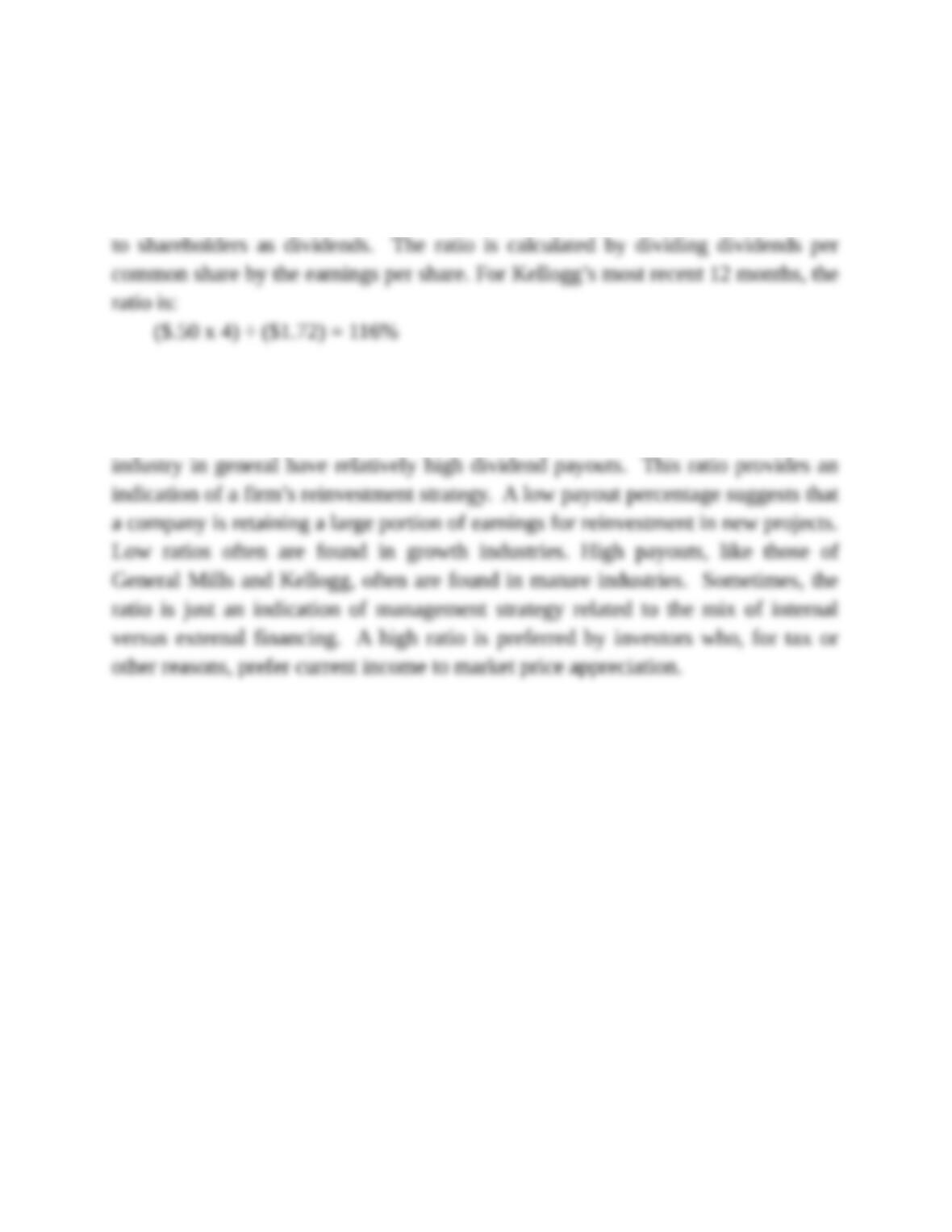
The price-earnings ratio is simply the market price per share divided by the
earnings per share. For Kellogg, the ratio is:
It purports to measure the market’s perception of the “quality” of a company’s
earnings by indicating the price multiple the securities market is willing to pay for
Care is needed when evaluating price-earnings ratios. Like other ratios, it is
best evaluated in the context of P/E ratios of earlier periods and other, similar
Case 19–15 (concluded)
Requirement 2
The dividend payout ratio expresses the percentage of earnings that is distributed
Relative to the average company, this payout percentage is quite high. It is
higher even than that of General Mills, Kellogg’s prime competitor. General Mills’
payout ratio was 75% at the same time. Historically, both companies and the
Research Case 19–16
Requirement 1
The appropriate accounting treatment for the situation is specified in FASB ASC
718–10–35: “Compensation–Stock Compensation–Overall.” Section 718–10–35–15
states:
Change in Classification Due to Change in Probable Settlement Outcome
35-15 An option or similar instrument that is classified as equity, but
subsequently becomes a liability because the contingent cash settlement event is
probable of occurring, shall be accounted for similar to a modification from an
equity to liability award. That is, on the date the contingent event becomes
probable of occurring (and therefore the award must be recognized as a liability),
the entity recognizes a share-based liability equal to the portion of the award
Requirement 2
National Paper should record a liability for the portion of the award attributed to
past service (2/5) multiplied by the award’s fair value ($8 million) on the date

Target Case
Requirement 1
Compensation expense associated with share-based awards is recognized on a
Requirement 2
Three types of awards are described in Note 26. Share-Based Compensation:
Requirement 3
Projections of future performance should be based primarily on continuing
Requirement 4
Securities, like stock options or restricted stock awards, while not being
common stock, may become common stock through their exercise or vesting. As a
Air France–KLM Case
Requirement 1
Note 30 indicates that the PPSs correspond to share-based plans with
settlement in cash. As such, they are accounted for as liabilities. AF’s PPSs options
Under IFRS, the straight-line method is not permitted. Also, there’s no
The PPS options also are performance-based, which means that under either
U.S. GAAP or IFRS the amount expensed depends on whether it’s “probable” that
the performance target will be met. Remember, though, that probable means
Requirement 2
AF reported basic earnings and diluted earnings per share of €.34 in its
income statement for 2015. If AF used U.S. GAAP, it would have reported EPS
using the same basic/diluted classification. The earnings per share requirements of