Real World Case 18–1
Requirement 1
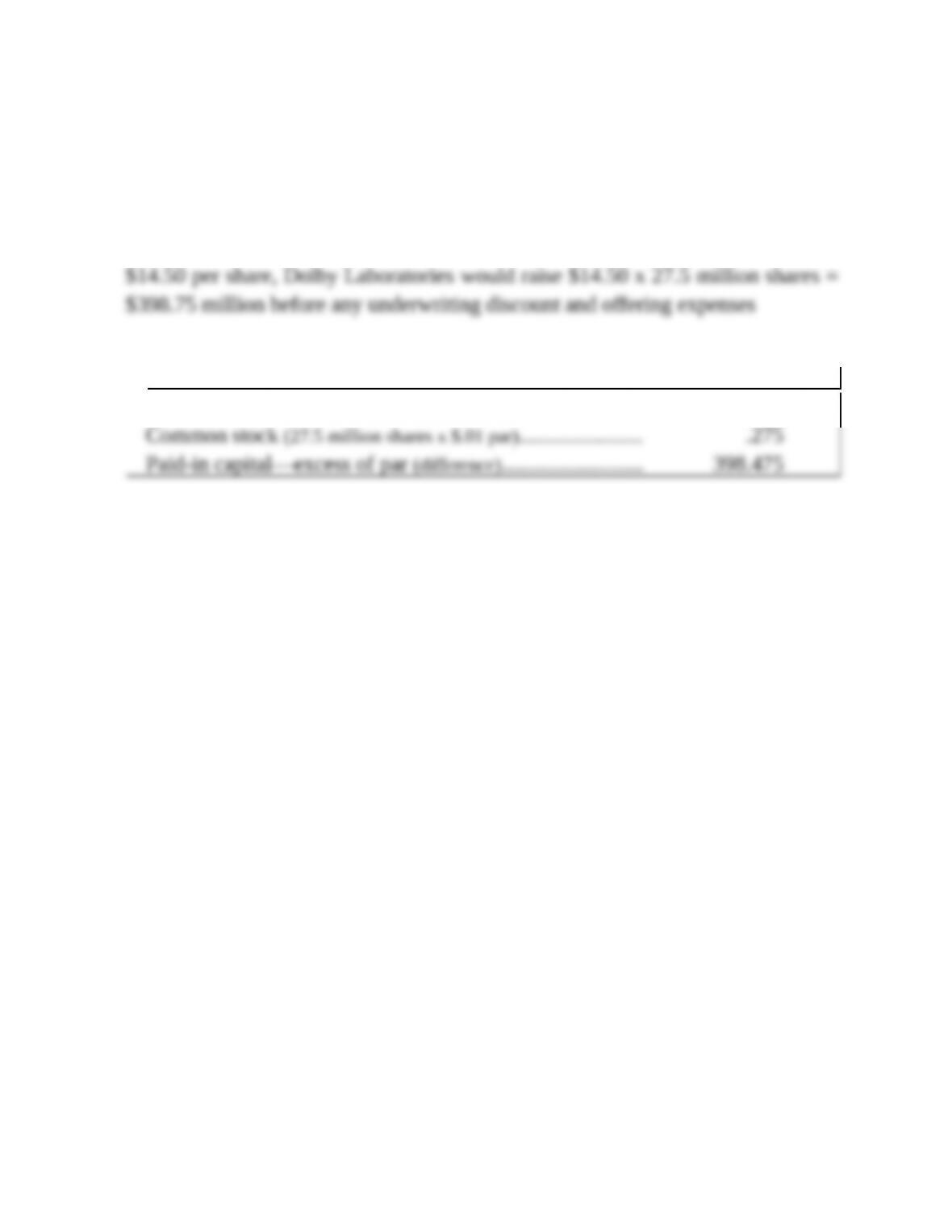
Assuming the shares are issued at the midpoint of the price range indicated,
Requirement 2
$ in millions
Cash (determined above)…………………………………………………..398.750
Cases
Analysis Case 18–2
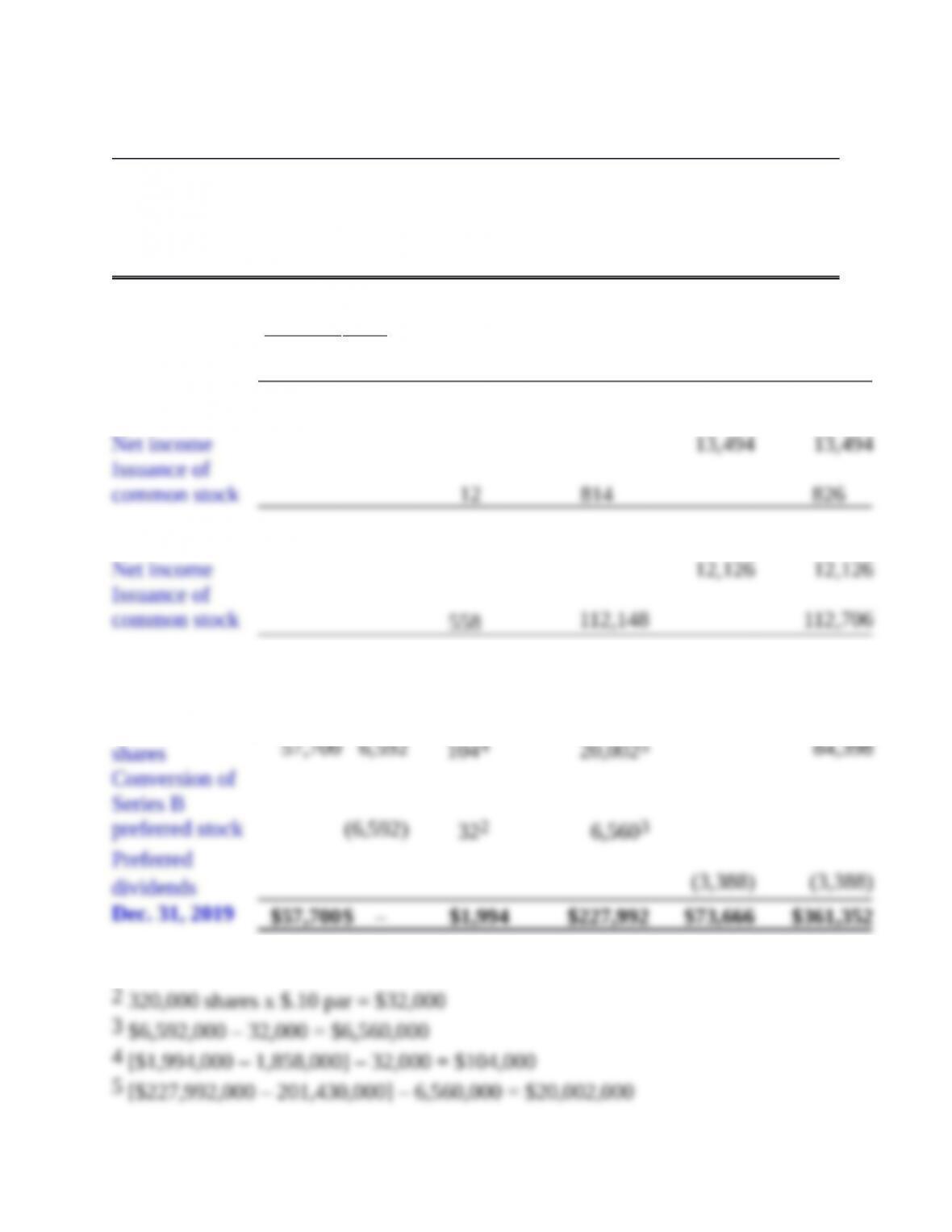
SESSEL’S DEPARTMENT STORES, INC.
Statement of Shareholders’ Equity
For the Years Ended December 31, 2019, 2018, and 2017
($ in 000s)
Preferred
Series A
Stock
Series B
Common
Stock
Additional
Paid-in
Capital
Retained
Earnings
Total
Share-
holders’
Equity
Dec. 31, 2016 $ – $ – $1,288 $ 88,468 $19,178 $108,934
Dec. 31, 2017 1,300 89,282 32,672 123,254
Dec. 31, 2018 1,858 201,430 44,798 248,086
Net income 32,256132,256
Issuance of
1 [$73,666,000 – 44,798,000] + 3,388,000 = $32,256,000
Communication Case 18–3
This case encourages students to consider the larger question of the factors
that differentiate whether financial instruments qualify for recognition as liabilities
or part of equity. It also requires them to carefully consider the profession’s
There is no right or wrong answer. Both views can and often are convincingly
defended. The process of developing and synthesizing the arguments likely will be
Arguments brought out in IAS 32 cited above include the following:
Classification as Liability or Equity
The fundamental principle of IAS 32 is that a financial instrument should be
classified as either a financial liability or an equity instrument according to the

Case 18–3 (continued)
A financial instrument is an equity instrument only if (a) the instrument includes no
contractual obligation to deliver cash or another financial asset to another entity
and (b) if the instrument will or may be settled in the issuer’s own equity
instruments, it is either:
a non-derivative that includes no contractual obligation for the issuer to
deliver a variable number of its own equity instruments; or
Illustration – preference shares
If an enterprise issues preference (preferred) shares that pay a fixed rate of
dividend and that have a mandatory redemption feature at a future date, the
substance is that they are a contractual obligation to deliver cash and, therefore,
should be recognized as a liability. In contrast, normal preference shares do not
have a fixed maturity, and the issuer does not have a contractual obligation to make
any payment. Therefore, they are equity. [IAS 32.18]
Arguments brought out in FASB documents cited above include the following:
Basic Ownership Approach—The Board’s Preliminary View
The underlying principle of the basic ownership approach is that claims against the
entity’s assets are liabilities (or assets) if they reduce (or enhance) the net assets
available to the owners of the entity. Under the approach, an instrument would be
classified as equity if it is a basic ownership instrument. A basic ownership
instrument (1) is the most subordinated interest in an entity and (2) entitles the
holder to a share of the entity’s net assets after all higher priority claims have been
satisfied. All other instruments, for example, all forward contracts, options, and
convertible debt, would be classified as liabilities or assets. Instruments classified
as liabilities or assets that have varying or uncertain settlement amounts would be
measured at fair value with changes reported in income unless other generally
accepted accounting principles apply. As a result, changes in an issuer’s share price
would affect income. Instruments or components with fixed payoffs at the
settlement date would be accreted or amortized.

Case 18–3 (concluded)
Ownership-Settlement Approach
Under the ownership-settlement approach, an entity would classify instruments
based on the nature of their return and their settlement requirements (or lack
thereof). The following three types of instruments would be classified as equity:
1. Basic ownership instruments
2. Other perpetual instruments (for example, preferred shares)
3. Indirect ownership instruments settled by issuing related basic ownership
instruments.
An indirect ownership instrument has the following characteristics:
1. It is not perpetual
2. Its terms link its value to the price of a basic ownership instrument and cause
3. It does not include a contingent exercise provision based on either of the
following factors:
(b) A price index other than an index calculated or measured solely by
If an instrument has one or more equity outcomes and one or more nonequity
outcomes, it would be separated into an equity component and a nonequity

Research Case 18–4
Requirement 1
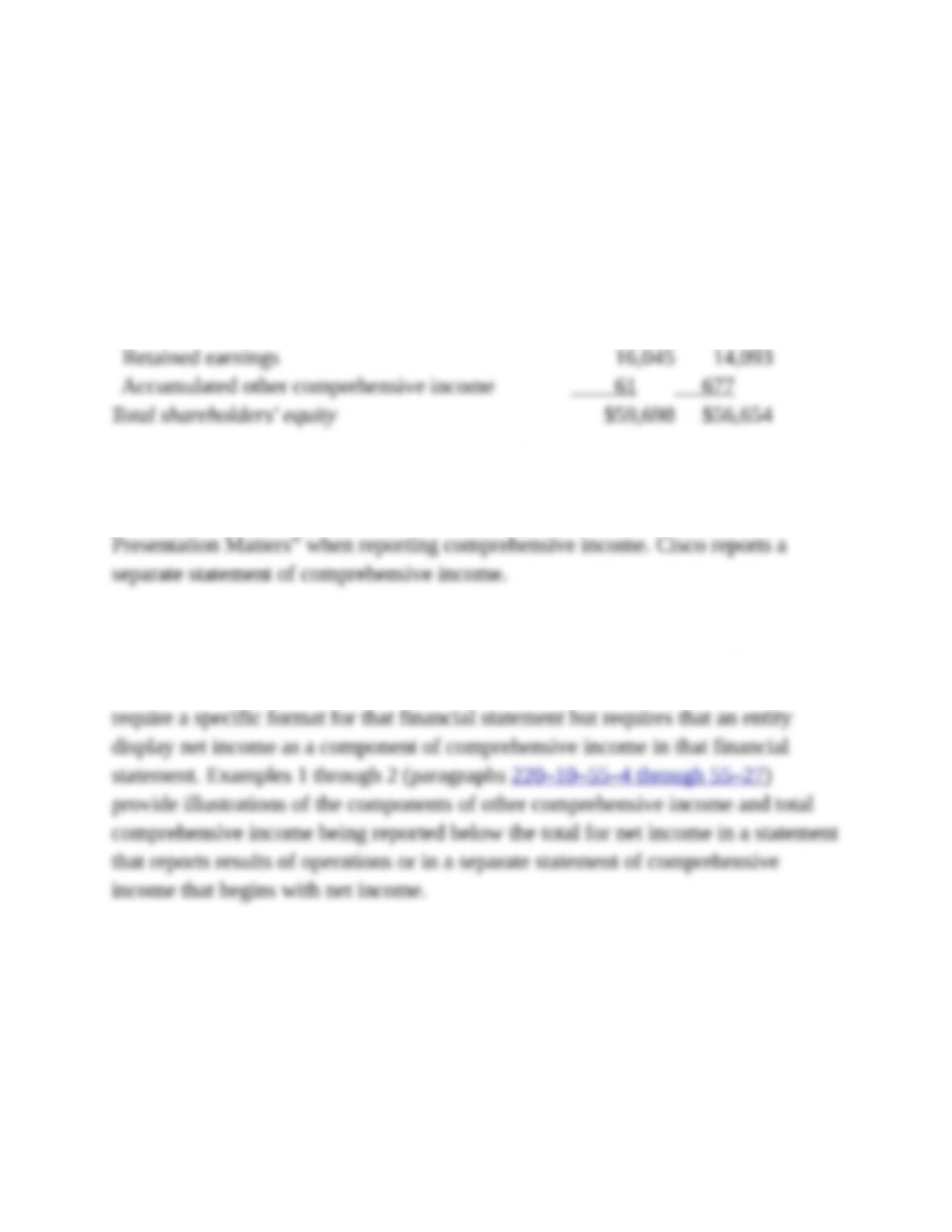
Cisco reports accumulated other comprehensive income in its balance sheet as a
component of shareholders’ equity as follows:
($ in millions)
Shareholders’ equity: 2015 2014
Preferred stock
Common stock and additional paid-in capital $43,592 $41,884
Requirement 2
Cisco relies on FASB ASC 220–10–45–8: “Comprehensive Income–Overall–Other
45–8 An entity shall display comprehensive income and its components in a
financial statement that is displayed with the same prominence as other financial
statements that constitute a full set of financial statements. This Subtopic does not
Case 18–4 (continued)
Requirement 3
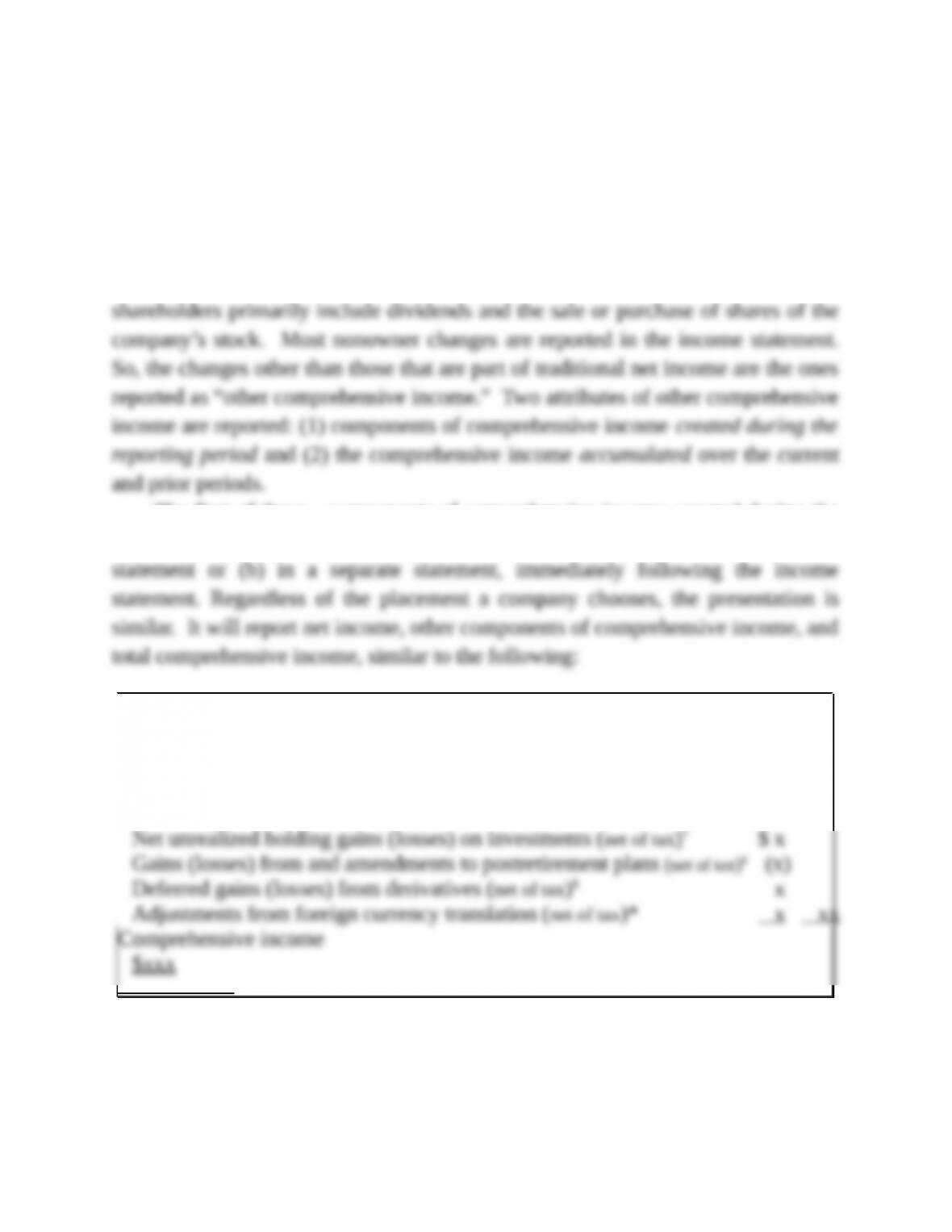
Comprehensive income is a more expansive view of the change in
shareholders’ equity than traditional net income. It is the total nonowner change in
equity for a reporting period. In fact, it encompasses all changes in equity other
than from transactions with owners. Transactions between the corporation and its
The first of these—components of comprehensive income created during the
reporting period—can be reported either (a) as an extension of the income
($ in
millions)
Net income
$xxx
Other comprehensive income:
†Changes in the fair value of available-for-sale debt securities.
‡Gains and losses due to revising assumptions or market returns differing from
expectations, and prior service cost from amending the plan (described in Chapter 17).

§When a derivative designated as a cash flow hedge is adjusted to fair value, the gain or
loss is deferred as a component of comprehensive income and included in earnings later, at

Case 18–4 (continued)
This is the measure of comprehensive income Cisco reported in the disclosure
The second measure—the comprehensive income accumulated over the
current and prior periods—is reported as a separate component of shareholders’