Exercise 18–2
Requirement 1
The specific citation that describes the guidelines for presenting accumulated other
comprehensive income on the statement of shareholders’ equity is FASB ASC
Requirement 2
45-14 The total of other comprehensive income for a period shall be transferred
to a component of equity that is displayed separately from retained earnings and
additional paid-in capital in a statement of financial position at the end of an
Exercise 18–3
Indicate by letter whether each of the items listed below most likely is reported in
the income statement as Net Income (NI) or in the statement of comprehensive in-
come as Other Comprehensive Income (OCI).
Items
OCI 1. Increase in the fair value of available-for-sale debt securities
NI 2. Gain on sale of land
OCI 3. Loss on pension plan assets (actual return less than expected)
Exercise 18–4
Cash (3 million shares x $17.15 per share)………………………… 51,450,000
Exercise 18–5
February 12
Cash (2 million shares x $9 per share)………………………….. 18,000,000
February 13
Legal expenses (40,000 shares x $9 per share)………………. 360,000
February 13
Cash…………………………………………………………………… 945,000
Common stock (80,000 shares x $1 par) …………………. 80,000
* 80,000 shares x [$9 market value – $1 par]
** Since the value of the common shares is known ($720,000), the market value of the
preferred ($225,000) is assumed from the total selling price ($945,000).
November 15
Property, plant, and equipment (cash value)………………. 3,688,000
Exercise 18–6
Williams Industries must report the 20 million Class B shares among its
long-term liabilities in its balance sheet, not as part of shareholders’ equity. The
“triggering event,” the death of J.P Williams, is certain to occur even though its
Because Williams has the right but not the obligation to repurchase the Class
Exercise 18–7
Requirement 1 ($ in millions)
Cash ($424 million – 2 million)…………………………………………… 422
Common stock (15 million shares at $1 par per share)…………… 15
Paid-in capital—excess of par (difference)……………………… 407
Requirement 2
In recording the sale of shares above, the cost of services related to the sale
reduced the net proceeds from selling the shares. Paid-in capital—excess of par is
While debt issue costs are similarly treated in that they reduce the proceeds
The difference in accounting treatment often is justified by the presumption
that share issue costs and debt issue costs are fundamentally different because a
Exercise 18–8
Requirement 1
The base amount of the preferred shares is $2,500,000 ÷ 100,000 shares = $25.
Requirement 2
If dividends are not paid in 2019 and 2020, but are paid in 2021, the shareholder
will receive $169.625 x 3 = $508.875. The prior years’ unpaid dividends are paid
Requirement 3
If the investor chooses to convert the shares in 2019, the investor will receive $25
Requirement 4
The redemption price is $27.50 ($25 x 110%), original 112% reduced by 2%
Exercise 18–9
AMTC
Cash (7.5 million shares x $13.546)………………… 101,595,000
PSI
Cash (9 million shares x $15.20)…………………….. 136,800,000
Exercise 18–10
1. January 7, 2018
($ in millions)
Common stock (2 million shares x $1 par)……………………………. 2
* Paid-in capital—excess of par: $300 ÷ 100 million shares
2. August 23, 2018
Common stock (4 million shares x $1 par)……………………………. 4
3. July 25, 2019
Cash (3 million shares x $6 per share)……………………………………. 18
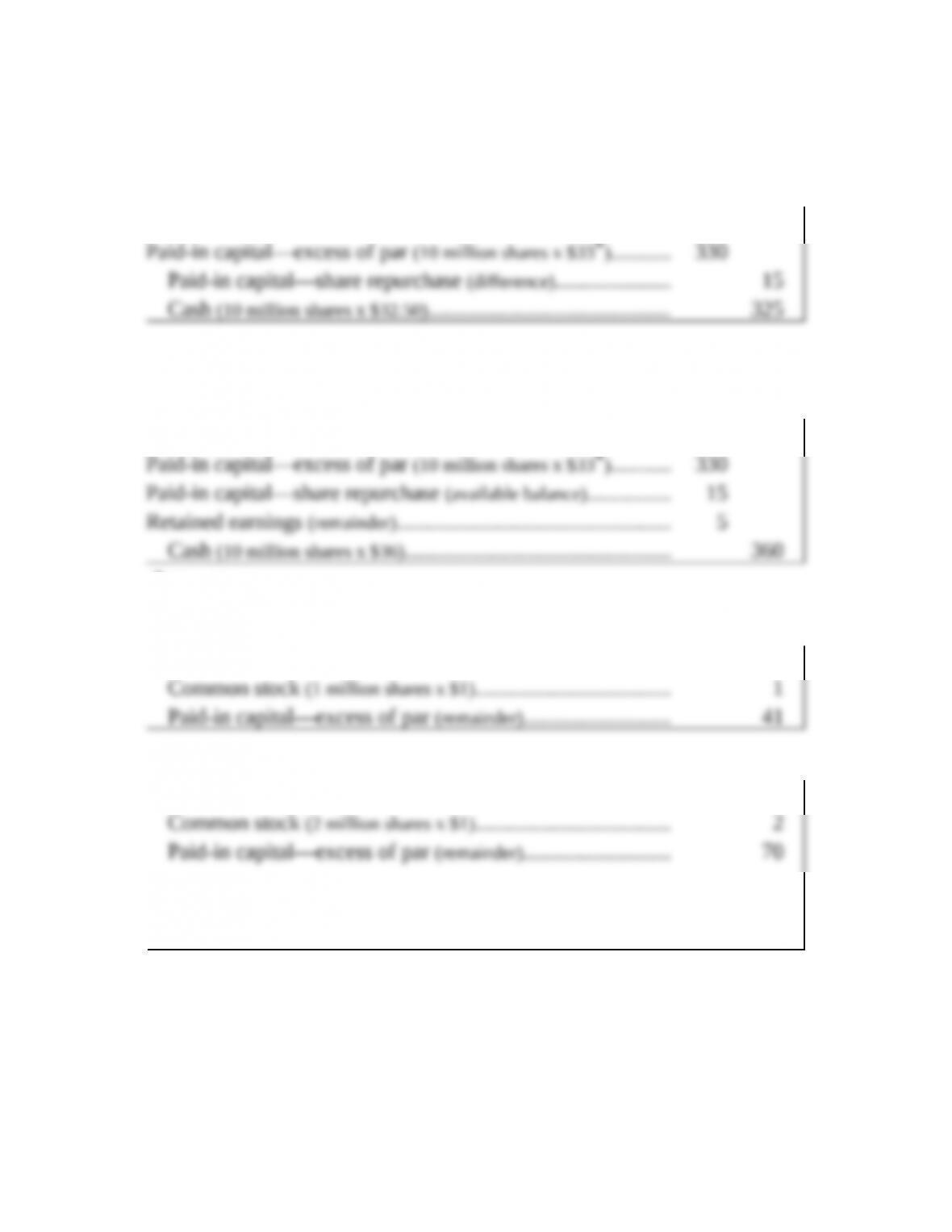
Exercise 18–11
1. January 2, 2018 ($ in millions)
Common stock (10 million shares x $1 par)…………………………… 10
* $34 – $1 par
2. March 3, 2018
Common stock (10 million shares x $1)……………………………….. 10
* $34 – $1 par
3. August 13, 2018
Cash (1 million shares x $42)……………………………………………… 42
4. December 15, 2018
Cash (2 million shares x $36)……………………………………………… 72