Research Case 18–9
The results students report will vary depending on the companies chosen. It
Typical items that affect retained earnings are dividends (cash, property, or
Typical transactions that affect common stock are new stock issues, treasury
Communication Case 18–10
You may wish to suggest to your students that they consult the FASB 1990
Discussion Memorandum, “Distinguishing between Liability and Equity
Instruments and Accounting for Instruments with Characteristics of Both,” which
sets forth the most common arguments on the issues in this case. Or, you may
prefer that they think for themselves and approach the issue from scratch.
There is no right or wrong answer. Both views can and often are convincingly
defended. The process of developing and synthesizing the arguments likely will be
more beneficial than any single solution. Each student should benefit from
participating in the process, interacting first with his or her partner, then with the
class as a whole. It is important that each student actively participate in the
process. Domination by one or two individuals should be discouraged.
A significant benefit of this case is that it forces students’ consideration and
acceptance of the fact that both liabilities and equities are claims to an enterprise’s
assets. It also requires them to carefully consider the profession’s definitions of
those elements. Arguments brought out in the FASB DM include the following:
Arguments Supporting View 1:
Some students likely will argue that convertible bonds and other similar
instruments can be appropriately classified in the two existing categories on the
basis of existing distinctions and definitions. For instance, they might focus on
the characteristic of a liability that requires that the enterprise issuing it have
little or no discretion to avoid the future sacrifice of economic benefits.
Concepts Statement 6 defines liabilities as:
. . . probable future sacrifices of economic benefits arising from present
obligations of a particular entity to transfer assets or provide services to other
entities in the future as a result of past transactions or events. [paragraph 35]
Three essential characteristics of a liability are:
a. It embodies a present duty or responsibility to one or more other entities for
b. The duty or responsibility obligates a particular entity, leaving it little or no
c. The transaction or other event obligating the entity has already happened.
Case 18–10 (continued)
Equity of a business enterprise is defined simply as the residual interest: the
difference between an enterprise’s assets and its liabilities. The essential
A company may have two or more classes of equity, such as preferred stock and
common stock; no class has an unconditional right to receive distributions of
The distinction between liabilities and equity is important to reported financial
position. So, whether an issue of convertible bonds is classified as a liability or
as equity affects both reported amounts of total liabilities and equity and
Reported income also is affected. Convertible bonds have features of both debt
(fixed interest and principal payments) and equity (ability to participate in the
Case 18–10 (continued)
Arguments Supporting View 2:
Arguments here center on the “entity theory” of accounting first proposed by W.
A. Paton in 1922, which views the accounting equation as:
Assets = Equities
with equities including both what are termed liabilities and equity in the current
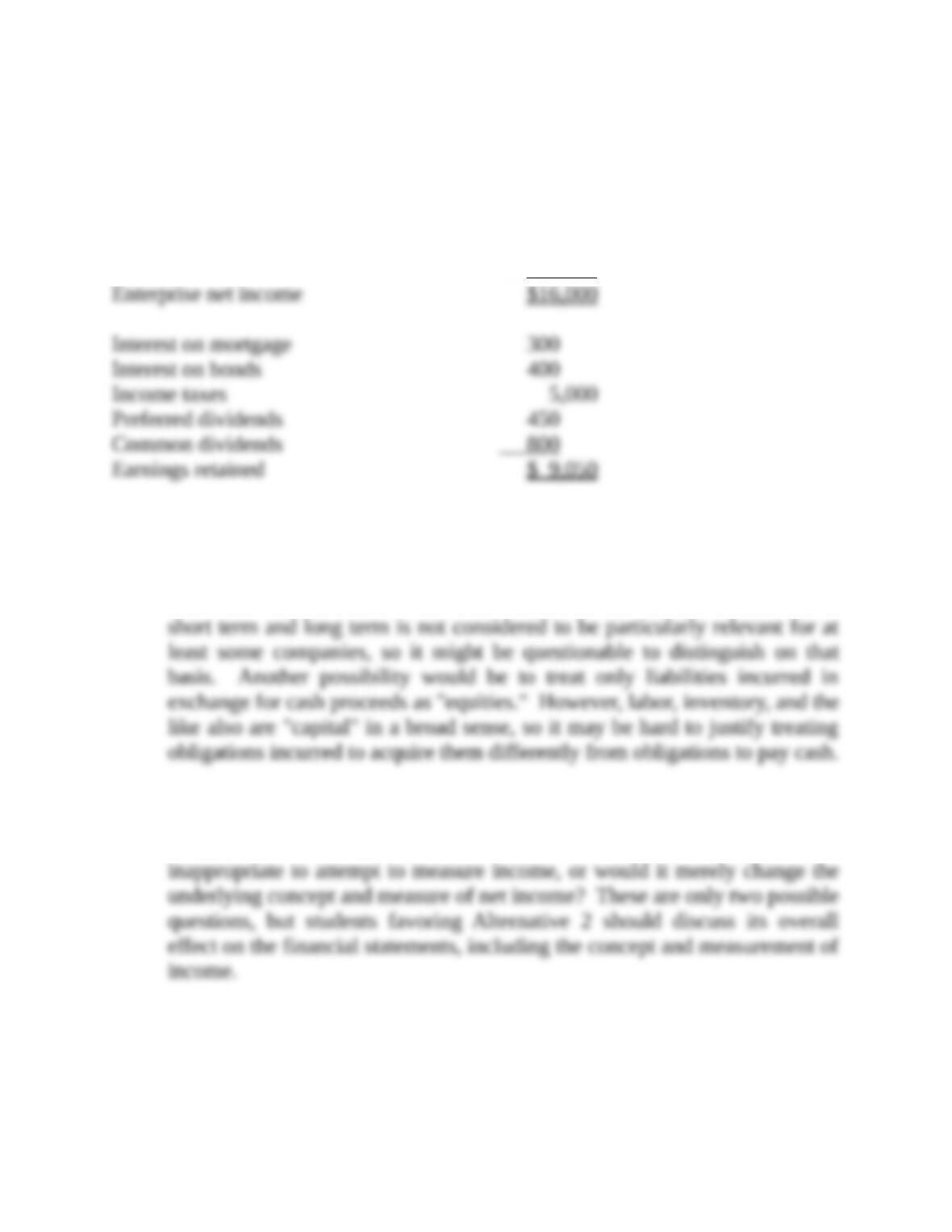
conceptual framework. A central feature of this theory is that profits are
Balance Sheet
Cash $ 2,050 Accounts payable $ 1,200
Investments 5,000 Mortgage 4,000
Income Statement
Sales $30,000
Cost of goods sold 10,000

Case 18–10 (concluded)
or, alternatively:
Sales $30,000
Cost of goods sold 10,000
Selling and other expenses 4 ,000
Many issues would have to be resolved if this approach were to be seriously
pursued. For instance, would all present liabilities be treated as “equities”?
If not, which would be treated differently? Today the distinction between
The concept of income under this approach is another question. Would an
attempt to eliminate the line between liabilities and equity make it
Target Case
Requirement 1
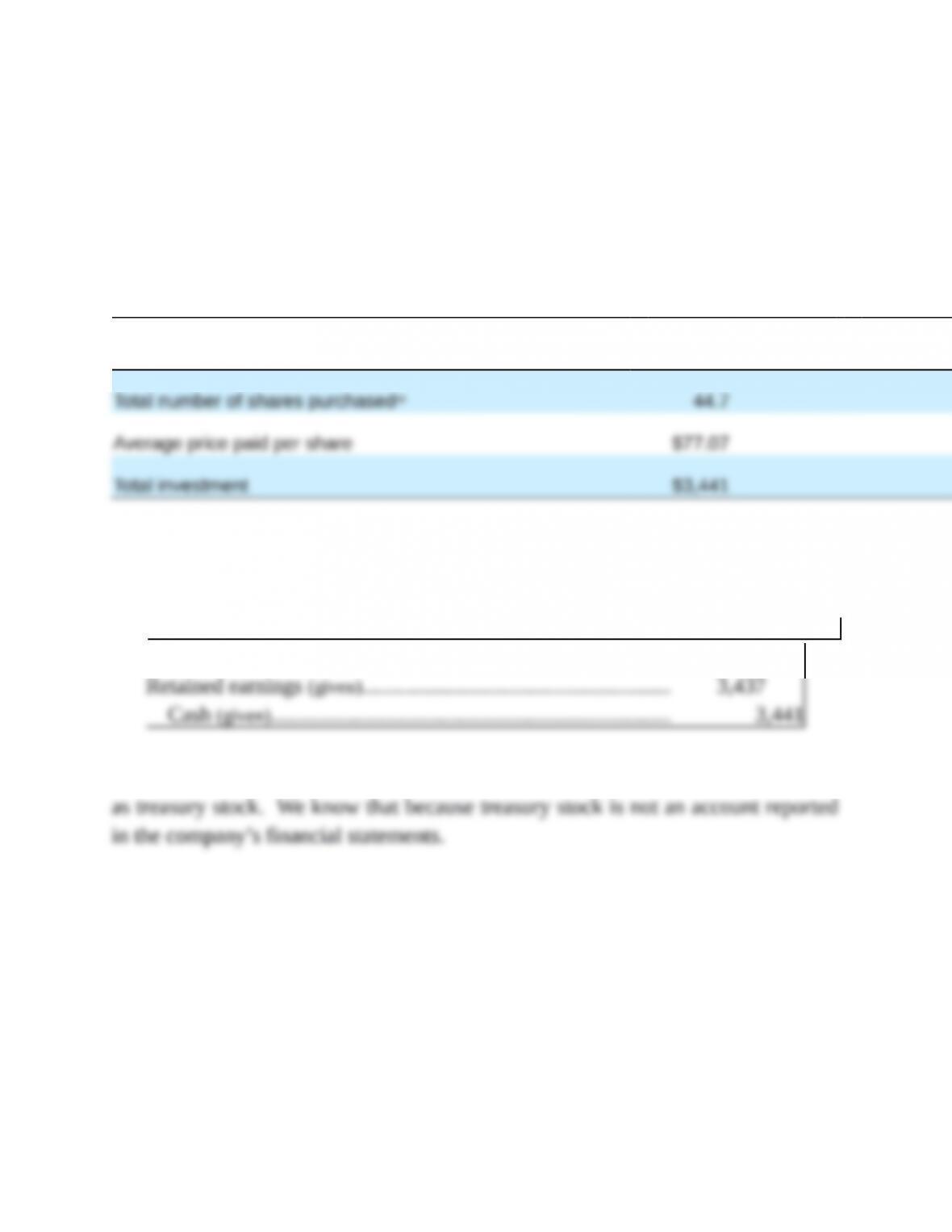
Target’s Consolidated Statements of Shareholders’ Investment reports the changes
that occurred in each of Target’s shareholders’ equity accounts for the most recent
three years:
(millions, except
footnotes)
Common
Stock
Shares
Stock
Par
Value
Additional
Paid-in
Capital
Retained
Earnings
Accumulated
Other
Comprehensive
Income/(Loss) Total
February 2, 2013 645.3 $54 $3,925 $13,155 $(576) ) $16,558
Net earnings — — — 1,971 — 1,971
Other comprehensive
income — — — — (315) ) (315)
In each of the three years five types of events and transactions affected one or more
of those accounts: earnings, other comprehensive income, dividends, share repur-
chases, and stock options and awards.
Target Case (continued)
Requirement 2
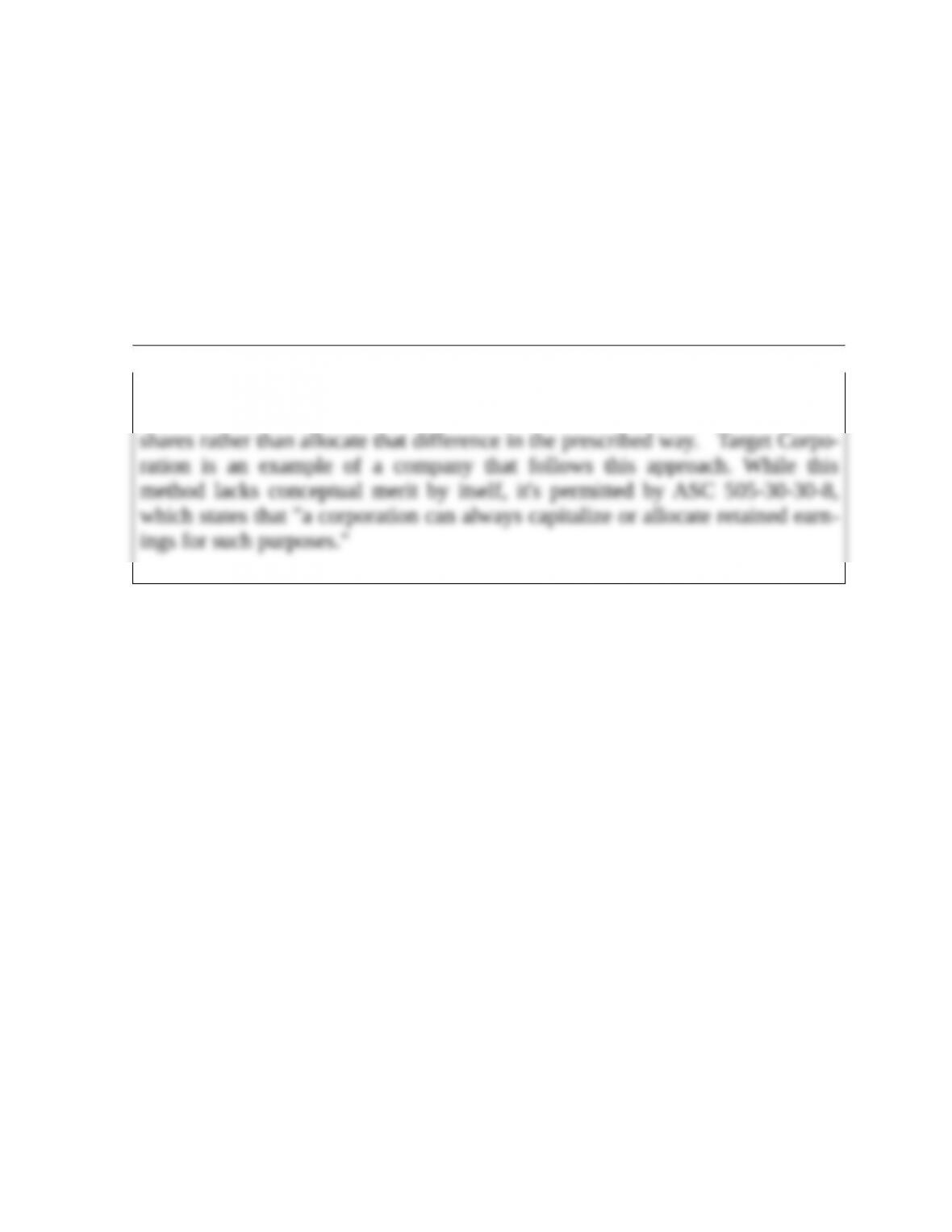
Target’s share repurchases are described in Note 25 “Share Repurchase”. In 2015,
these repurchases were reported:
Share Repurchases
(millions) 2015
This information combined with that in the Statements of Shareholders’ Invest-
ment allow us to reconstruct the (summary) journal entry for these repurchases:
($ in millions)
Common stock (44.7 million shares x $.0833 par)…………………… 4
Target retires the shares it repurchases rather than labeling the repurchased shares
Target Case (concluded)
We also see that Target does not follow the traditional approach to recording retired
stock as described in the chapter. Instead, Target debits the entire difference be-
tween the cash paid and the shares’ par to retained earnings. This approach is not
common, but permissible as indicated in the following Additional Consideration
from the chapter:
Additional Consideration
Some companies choose to debit retained earnings for the entire debit differ-
ence between the cash paid to repurchase shares and the par amount of those
Air France–KLM Case
Requirement 1
Air France–KLM lists four items in the shareholders’ equity (shareholders’
investment) section of the balance sheet. If AF used U.S. GAAP, Issued share
capital would be Common stock, Reserves and retained earnings would be
Requirement 2
Note 29.5 indicates that the items that comprise “Reserves and retained
earnings” as reported in the balance sheet are Legal reserve, Distributable
reserves, Pension defined benefit reserves, Derivatives reserves, Available for
sale securities reserves, Other reserves, Net income (loss)—group share. If AF
Requirement 3
The order of presentation of the components of the balance sheet usually is