Case 18–4 (concluded)
Requirement 4
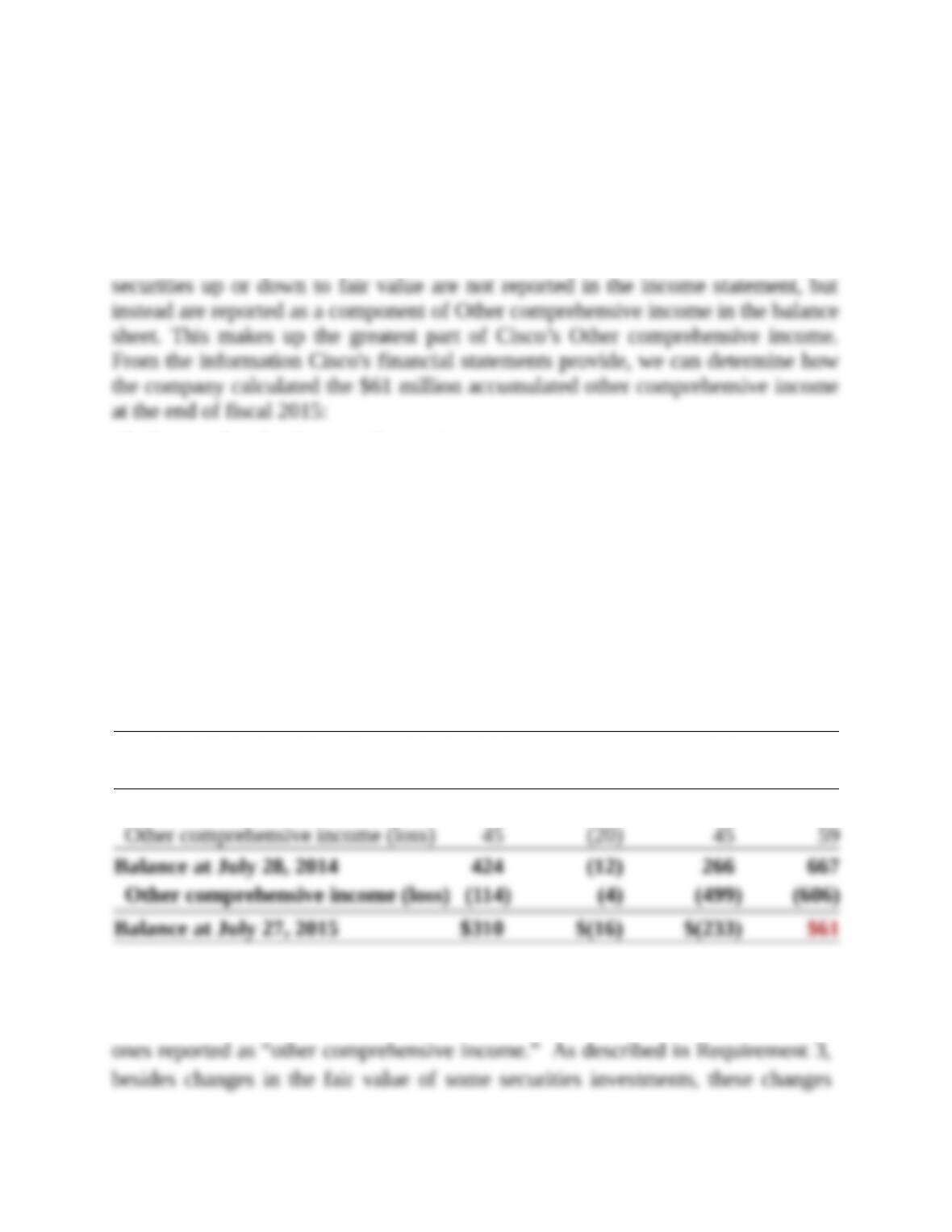
One component of Other comprehensive income for Cisco is “unrealized gains on
investments.” For reporting purposes, some investments in securities are reported
at their fair values. The holding gains and losses from writing “available-for-sale”
15. Comprehensive Income (in part)
The components of AOCI, net of tax, and other comprehensive income (loss) are
summarized as follows (in millions):
Net Unrealized Net Unrealized Cumulative
Accumulated
Gains on Gains (Losses) Translation Other
Investments Cash Flow Adjustment
Comprehensive
Hedging and Other Income
Instruments
Balance at July 31, 2012 $409 $(53) $305 $661
Other comprehensive income (loss) (30) 61 (84) (53)
Balance at July 30, 2013 379 8 221 608
Requirement 5
Nonowner changes other than those that are part of traditional net income are the

Judgment Case 18–5
Requirement 1
Alcoa has two choices of how to account for the buyback:
1. The shares can be formally retired.
Regardless of the choice, total
shareholders’ equity will be the same. Cash is paid to repurchase stock so the
Formally retiring shares restores the balances in both the Common stock
account and Paid-in capital—excess of par to what those balances would have
In contrast, when a share repurchase is viewed as treasury stock, the cost of the
treasury stock is simply reported as a reduction in total shareholders’ equity.
Alcoa would account for the purchase of the treasury stock by debiting treasury
If later resold for an amount greater than cost, Alcoa should account for the sale
of the treasury stock by debiting cash for the selling price, crediting treasury
2. The shares can be called “treasury stock”
Case 18–5 (concluded)
Requirement 2
Alcoa can choose not to make any journal entry for the stock split.
Alternatively, Alcoa can choose to effect the split “in the form of a stock
Requirement 3
Alcoa should account for the cash dividend on the declaration date by debiting
retained earnings and crediting cash dividends payable for $.25 per share
Communication Case 18–6
sample memo:
Memorandum
To: Les Kramer
Supervisor
From: {your name}
Re: Share issue costs
Date: {current date}
This memo is in response to your request for information about how IBR
accounted for share issue costs in its recent equity offering. When a company
sells shares, it obtains the legal, promotional, and accounting services necessary
to effect the sale. The cost of these services reduces the net proceeds from
selling the shares. Paid-in capital—excess of par is credited for the excess of the
proceeds over the par value of the shares sold. Thus, the effect of share issue
costs is to reduce the amount credited to that account.
This treatment differs from how debt issue costs are recorded. The costs
associated with a debt issue are deducted from the proceeds of the debt thereby
increasing the effective interest rate on the debt. These costs are amortized over
the life of the debt.
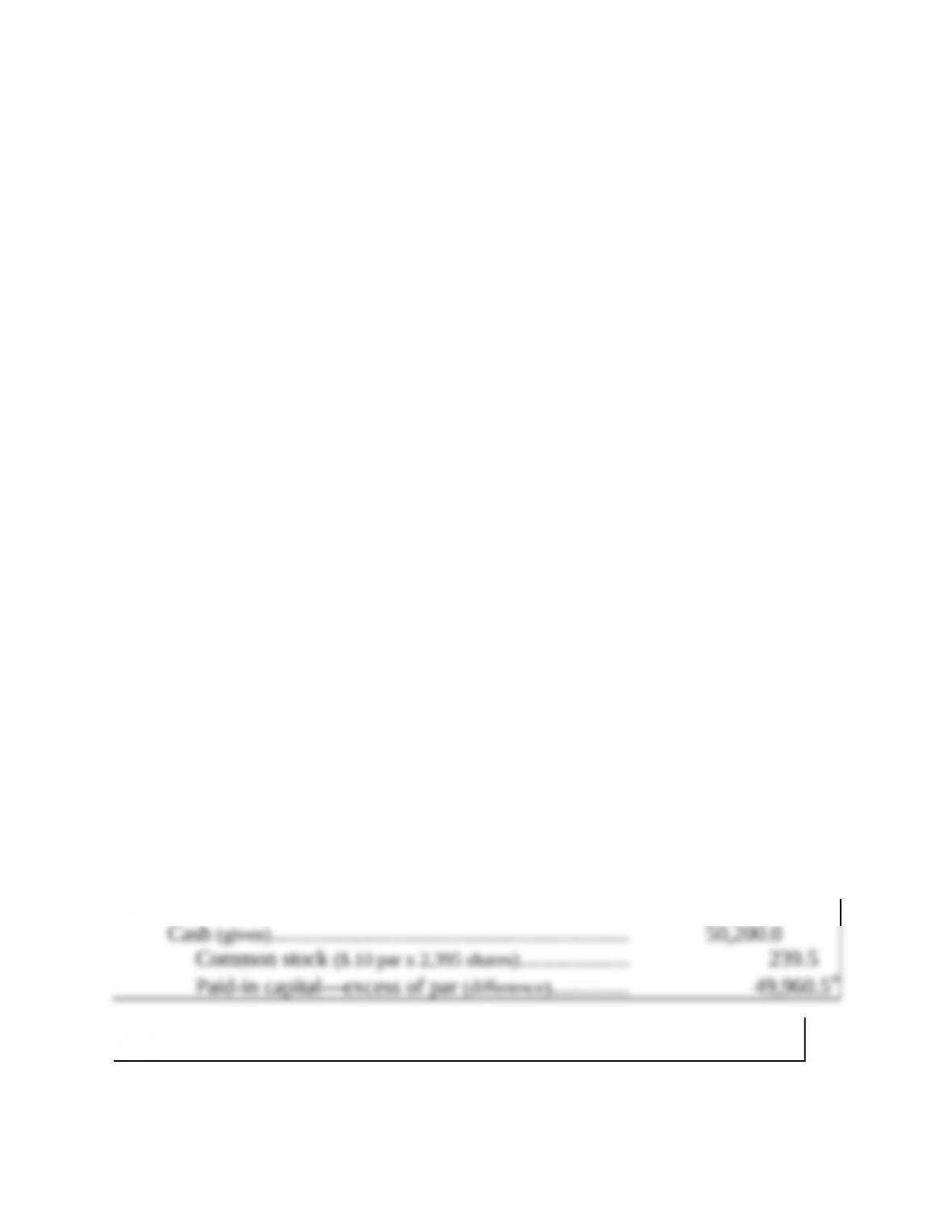
In IBR’s case, the shares sold for a total of $53.289 million (2,395,000 shares
times $22.25 per share). Since paid-in capital—excess of par is credited for the
excess of the $50.2 million net proceeds over the par amount of the shares sold,
the effect of share issue costs (underwriting discount and offering expenses) is to
reduce the amount credited to that account. In particular, IBR would have
recorded the following journal entry upon the issue of the shares.
($ in 000s)
* This amount reflects the reduction for share issue costs (underwriting
discount and offering expenses).
Please let me know if I can provide you additional information.
Case 18–6 (concluded)
Suggested Grading Concepts And Grading Scheme:
Content (80% )
30 Accounting for share issue costs.
Nature of costs.
Reduces the net proceeds from selling the shares.
Effect of share issue costs is to reduce the amount credited to
paid-in capital.
Writing (20%)
5 Terminology and tone appropriate to the audience of supervisor.
6 Organization permits ease of understanding.
Introduction that states purpose.
Paragraphs separate main points.
Analysis Case 18–7
Requirement 1
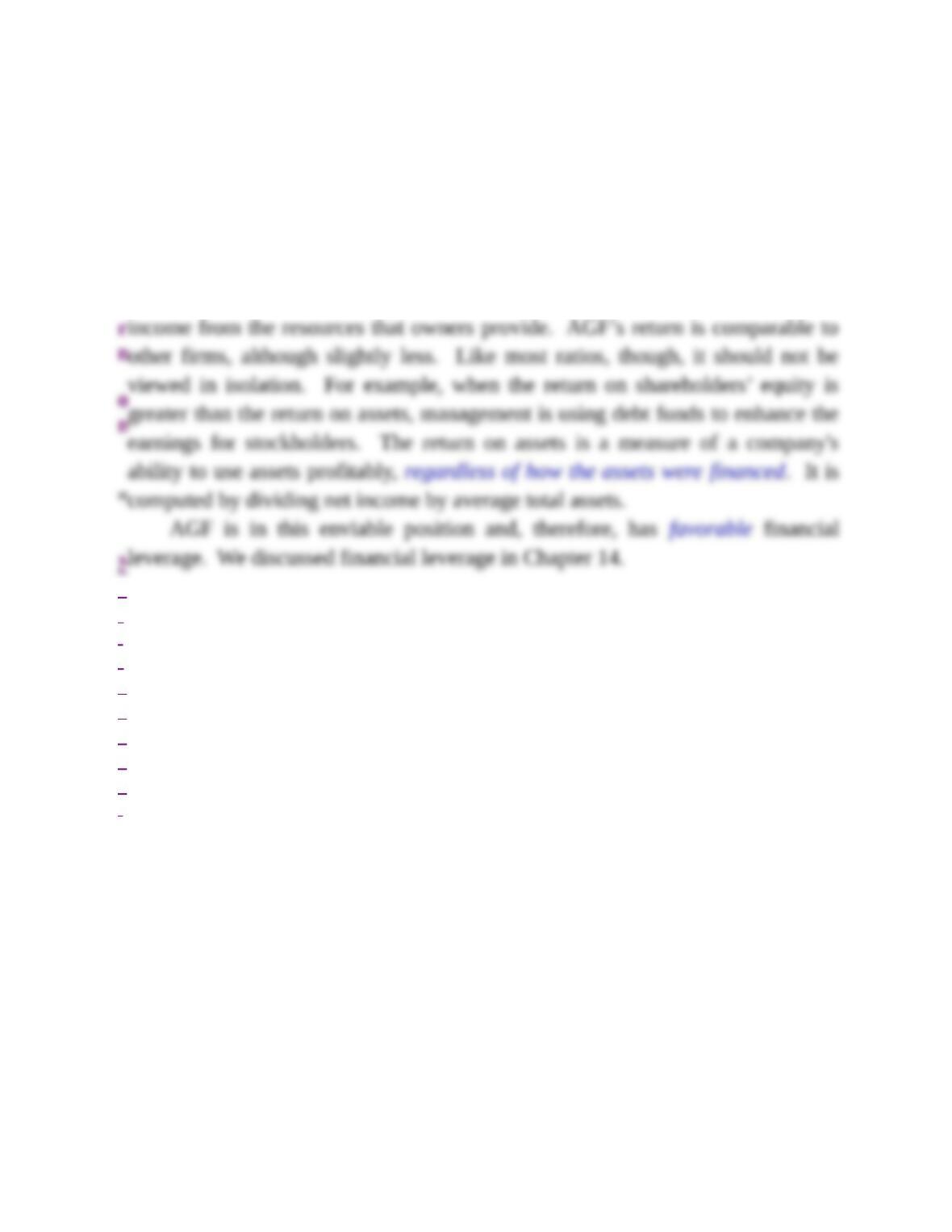
The ratio is computed by dividing net income by average shareholders’ equity.
Rate of return on = Net income
shareholders’ equity Average shareholders’ equity
Analysis Case 18–7
Requirement 1
The ratio is computed by dividing net income by average shareholders’
equity.
The return on shareholders’ equity is an important ratio for the owners of a
company. It measures the ability of company management to generate net
R
a
t
e
o
f
r
e
t
u
N
e
t
i
n
c
o
m
e
s
h
a
r
e
h
o
l
d
e
r
s
’
e
q
R
a
t
e
o
f
r
e
t
u
N
e
t
i
n
c
o
m
e
a
s
s
e
t
s
A
v
e
r
a
g
e
Case 18–7 (concluded)
Requirement 2
Earnings per share, in its simplest form, is simply a firm’s net income
To complement the return on shareholders’ equity ratio, analysts sometimes
The earnings-price ratio measures the return on the market value of common
stock. Remember, shareholders’ equity is a measure of the book value of equity.
The market value of a share of stock (or of total shareholders’ equity) usually is
Ethics Case 18–8
Discussion should include these elements.
Return on assets:
Rate of return on assets is net income divided by assets. The lower the asset
base, the higher the percentage return.
A noncash transaction should be recorded at fair value. This should be the fair
Ethical Dilemma:
E
a
r
n
i
n
g
p
e
s
h
a
r
I
n
c
o
m
e
a
v
a
b
l
e
t
o
c
o
E
a
r
n
i
n
g
p
r
c
e
r
a
=
E
a
r
n
i
n
g
e
r
s
h
a
r
e
Is the desire to boost return justification for questionable accounting treatment
of the transaction?
Who is affected?
Benson
Sharp
Other managers?
The company’s auditor, if any. This is a private company.
Shareholders (probably few)
The employees
The creditors