Case 17–1 (continued)
Requirement 2
The value of your plan assets as of the anticipated retirement date is $1,872,981:
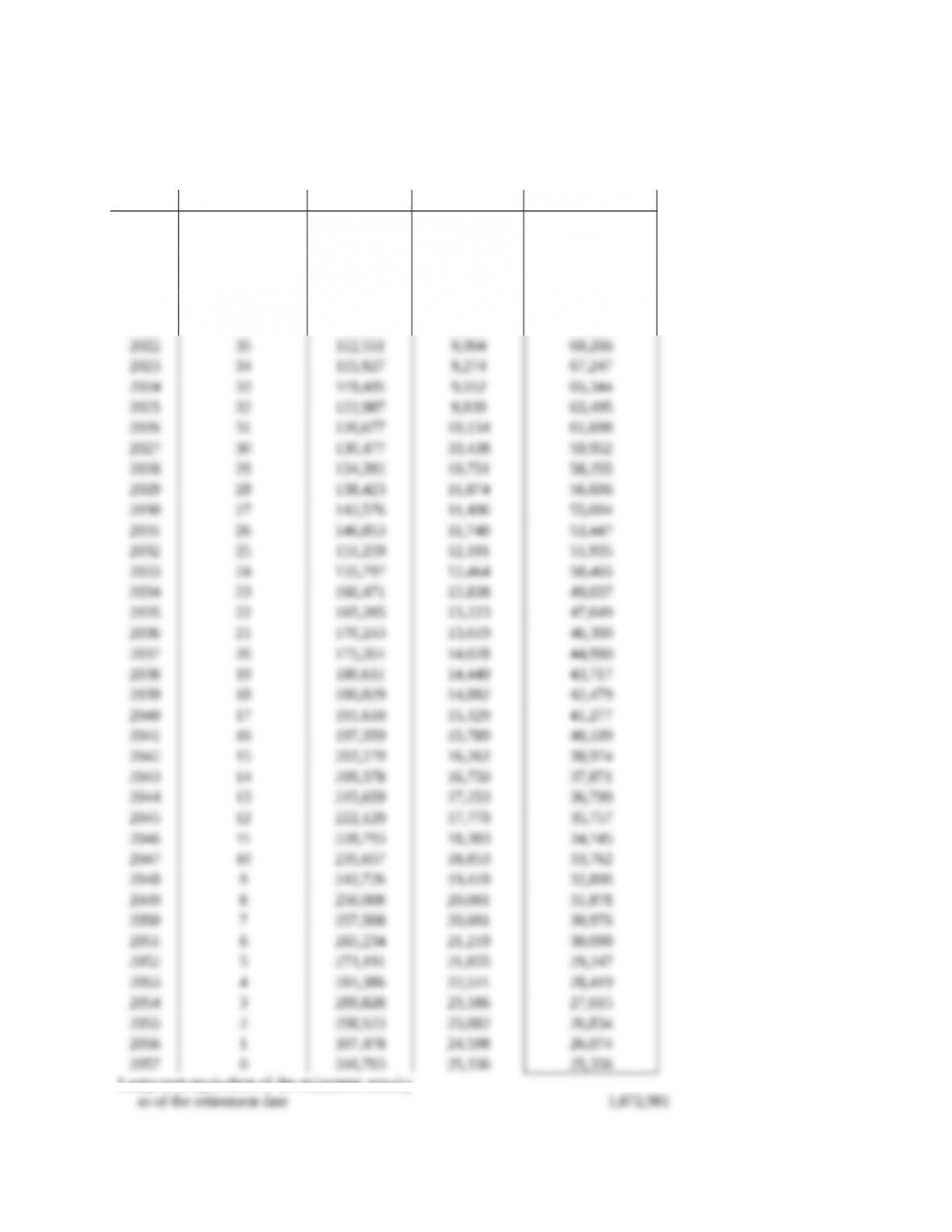
A B C D E
End of Years to Future Value
Year: Retirement Salary Contribution at Retirement
2018 39 100,000 8,000 77,628
2019 38 103,000 8,240 75,431
2020 37 106,090 8,487 73,296
2021 36 109,273 8,742 71,222
Lump-sum equivalent of the retirement annuity
Case 17–1 (concluded)
Your annual retirement pay assuming continuing investment of assets at 6% will
be:
Requirement 3
Based on the calculations alone, the state’s defined benefit plan offers the
larger retirement annuity and, therefore, lump-sum equivalent of the retirement
Also, greater uncertainty is associated with defined contribution plans, in
general. The employee bears the risk of uncertain investment returns and,
Relatedly, uncertainty regarding mortality significantly affects the equation.
Defined benefit plans pay benefits from retirement to death. Assets accumulated
Communication Case 17–2
Suggested Grading Concepts and Grading Scheme:
Content (80%)
25 The net periodic pension expense measures this compensation and
consists of the following five elements which can vary differently
from changes in employment. (5 each; maximum of 25 for this
part)
The interest cost component is the increase in the projected
benefit obligation due to the passage of time.
The return on plan assets reduces the pension expense. The
actual return on plan assets component is the difference between
Prior service cost is created when a pension plan is amended and
credit is given for employee service rendered in prior years. This
Gains and losses arise from changes in estimates concerning the
amount of the projected benefit obligation or the return on the
20 Gains and losses occur when the PBO or the return on plan assets
Gains and losses are reported as they occur in the statement of
A net gain or a net loss affects pension expense only if it exceeds
Case 17–2 (concluded)
When the corridor is exceeded, the excess is not charged to
pension expense all at once. Instead, the amount that should be
20 PBO and ABO compared (10 each; maximum of 20 for this part)
Both the accumulated benefit obligation and the projected benefit
The accumulated benefit obligation is based on present salary
15 The projected benefit obligation in excess of plan assets:
9 English
Word selection.
20 points
Judgment Case 17–3
Requirement 1
Yes, it’s true that the pension expense is calculated as if the balance sheet
contained certain amounts it doesn’t individually report, specifically the projected
Actually, even the pension expense falls short of reflecting all changes in the
Requirement 2
A small liability, $30,000, was reported in 2017 because the plan was
Requirement 3
A net pension asset, $405,000, was reported in 2018 because the plan was
Requirement 5
Gains and losses occur when either the PBO or the return on plan assets turns
out to be different than expected. LGD’s net gain indicates that cumulative
previous gains of either type have exceeded cumulative previous losses of either
A net gain or a net loss affects pension expense only if it exceeds an amount
Requirement 6
As mentioned in the previous part, losses and gains are reported in the
Communication Case 17–4
First, this case has no right or wrong answer. The process of developing the
Solutions should take into account the facts brought out in the solution to the
1. The FASB “funded status” approach as described in the text.
2. Individual recognition of the projected benefit obligation and the plan
assets.
It is important that each student actively participate in the process.
Domination by one or two individuals should be discouraged. Students should be
Real World Case 17–5
Requirement 1
Microsoft’s pension plan is a defined contribution plan in the form of a 401(k)
plan. It is described in disclosure note 21:
NOTE 21 — EMPLOYEE STOCK AND SAVINGS PLANS (in part)
We have a savings plan in the U.S. that qualifies under Section 401(k) of the
Internal Revenue Code, and a number of savings plans in international locations.
Participating U.S. employees may contribute up to 75% of their salary, but not
Requirement 2
Defined contribution plans promise defined periodic contributions to a pension
fund, without further commitment regarding benefit amounts at retirement.
Case 17–5 (concluded)
Requirement 3
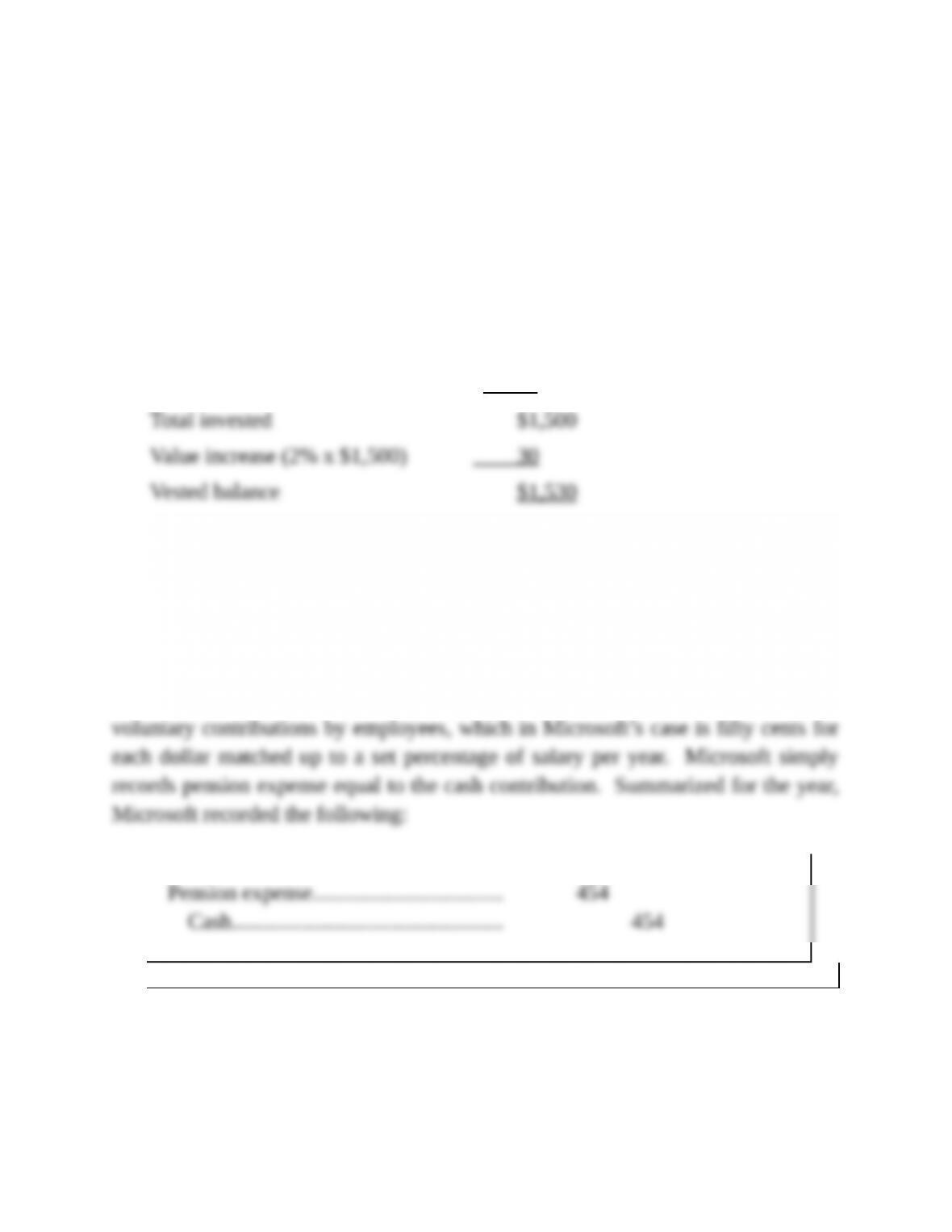
Microsoft matches contributions fifty cents for each dollar contributed. Also, both
employee and employer contributions vest immediately. So, she is entitled to roll
over $1,540:
Employee contribution $1,000
Microsoft match 500
Requirement 4
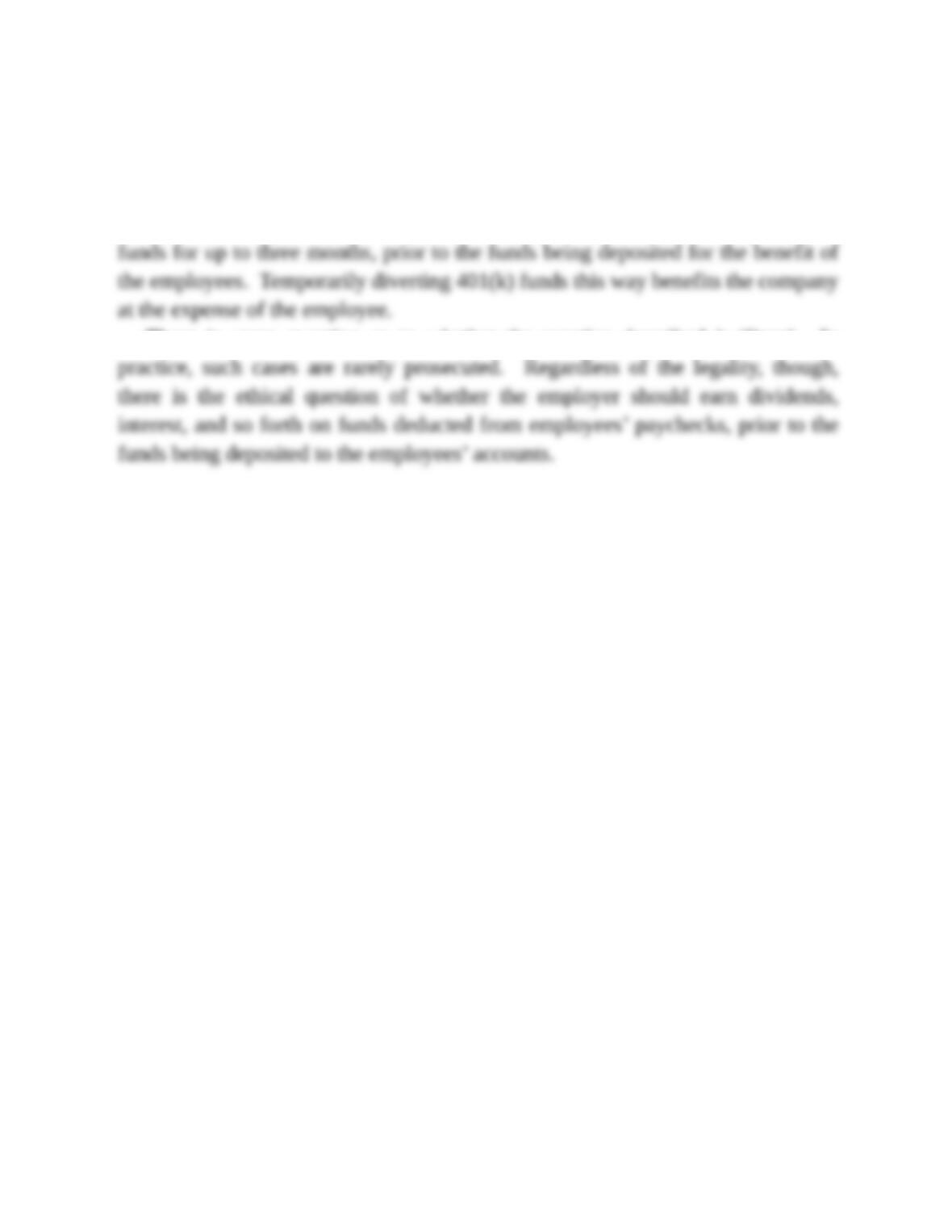
Microsoft’s plan is a 401(k) plan—named after the Tax Code section that specifies
the conditions for the favorable tax treatment of these plans. 401(k) plans allow
($ in millions)
Ethics Case 17–6
Mr. Maxwell’s apparent motivation for the change in the way contributions are
handled is to have the company benefit from the earning power of the contributed
There is some question as to whether the practice described is illegal. In