_____________________________________________________________________________
Question 16–1
Income tax expense is comprised of both the current and the deferred tax
consequences of events and transactions already recognized. Specifically, the $12.3
Question 16–2
Temporary differences between the reported amount of an asset or liability in the
financial statements and its tax basis are primarily caused by revenues, expenses,
gains, and losses being included in taxable income in a year earlier or later than the
year in which they are recognized for financial reporting purpose, although there are
other, less common, events that can cause these temporary differences. Some
temporary differences create deferred tax liabilities because they result in taxable
© The McGraw-Hill Companies, Inc., 2018
Solutions Manual, Vol.2, Chapter 16 16–)
Chapter 16 Accounting for Income Taxes
Questions for Review of Key Topics
Answers to Questions (continued)
Question 16–3
Future deductible amounts mean that taxable income will be decreased relative to
pretax accounting income in one or more future years. Two examples are (a)
Question 16–4
Deferred tax assets are recognized for all deductible temporary differences and
operating loss carryforwards. However, a deferred tax asset is then reduced by a
Question 16–5
Nontemporary or “permanent” differences are caused by transactions and events
that under existing tax law will be removed from accounting income when calculating
© The McGraw-Hill Companies, Inc., 2018
Solutions Manual, Vol.2, Chapter 16 16–)
Answers to Questions (continued)
Question 16–6
Examples of nontemporary or “permanent” differences are:
•Interest received from investments in bonds issued by state and municipal
governments (not taxable)
•Investment expenses incurred to obtain tax-exempt income (not tax
deductible)
Question 16–7
A deferred tax liability (or asset) is based on enacted tax rates and laws. Hudson
© The McGraw-Hill Companies, Inc., 2018
Solutions Manual, Vol.2, Chapter 16 16–)
Answers to Questions (continued)
Question 16–8
When a change in a tax law or rate occurs, a deferred tax liability or asset must be
adjusted to reflect the amount to be paid or recovered in the future. If a deferred tax
liability was established with the expectation that the future taxable amount would be
Question 16–9
The income tax benefit of either a net operating loss carryback or a net operating
A net operating loss carryforward creates future deductible amounts, so a
Question 16–10
Deferred tax assets and deferred tax liabilities are classified as noncurrent. So
long as they are associated with the same taxable component of a company and the
© The McGraw-Hill Companies, Inc., 2018
Solutions Manual, Vol.2, Chapter 16 16–)
Answers to Questions (continued)
Question 16–11
Regarding deferred tax amounts reported in the balance sheet, disclosure notes
Question 16–12
Pertaining to the income tax expense reported in the income statement, disclosure
notes should indicate (a) the current portion of the tax expense (or tax benefit), (b) the
Question 16–13
Step 1: For an uncertain tax benefit to be recognized in a company’s financial
statements, the identified tax position must have a “more-likely-than-not” likelihood—
Step 2: Once a company concludes that a particular tax position has a “more likely
© The McGraw-Hill Companies, Inc., 2018
Solutions Manual, Vol.2, Chapter 16 16–)
Answers to Questions (concluded)
Question 16–14
Intraperiod tax allocation means the total income tax obligation for a reporting
period is allocated among the income statement items that gave rise to the income tax.
The following items should be reported net of their respective income tax effects:
Question 16–15
Despite the similar approaches for accounting for taxation under IAS No. 12, “In-
come Tax,” and U.S. GAAP, differences in reported amounts for deferred taxes are
Brief Exercise 16–1
Since taxable income is less than pretax accounting income, a future taxable
($ in millions)
Income tax expense (to balance) 4.0
Brief Exercise 16–2
Since tax depreciation to date has been $100,000 more than depreciation for
financial reporting purposes, a future taxable amount will occur when the temporary
difference reverses. This means a deferred tax liability should be reported to reflect
© The McGraw-Hill Companies, Inc., 2018
Solutions Manual, Vol.2, Chapter 16 16–)
BRIEF Exercises
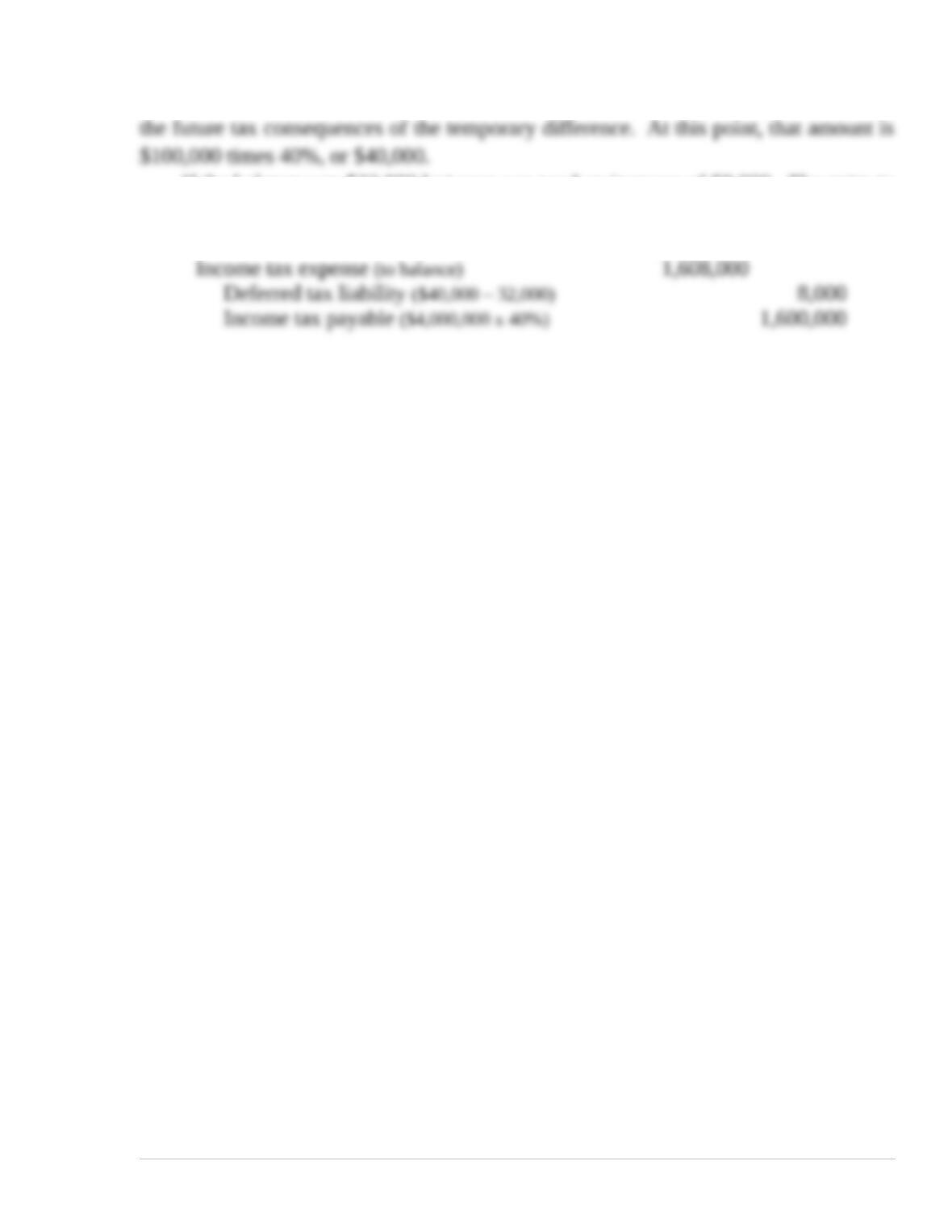
If the balance was $32,000 last year, we need an increase of $8,000. The entry to
record income taxes is:
© The McGraw-Hill Companies, Inc., 2018
Solutions Manual, Vol.2, Chapter 16 16–)
Brief Exercise 16–3
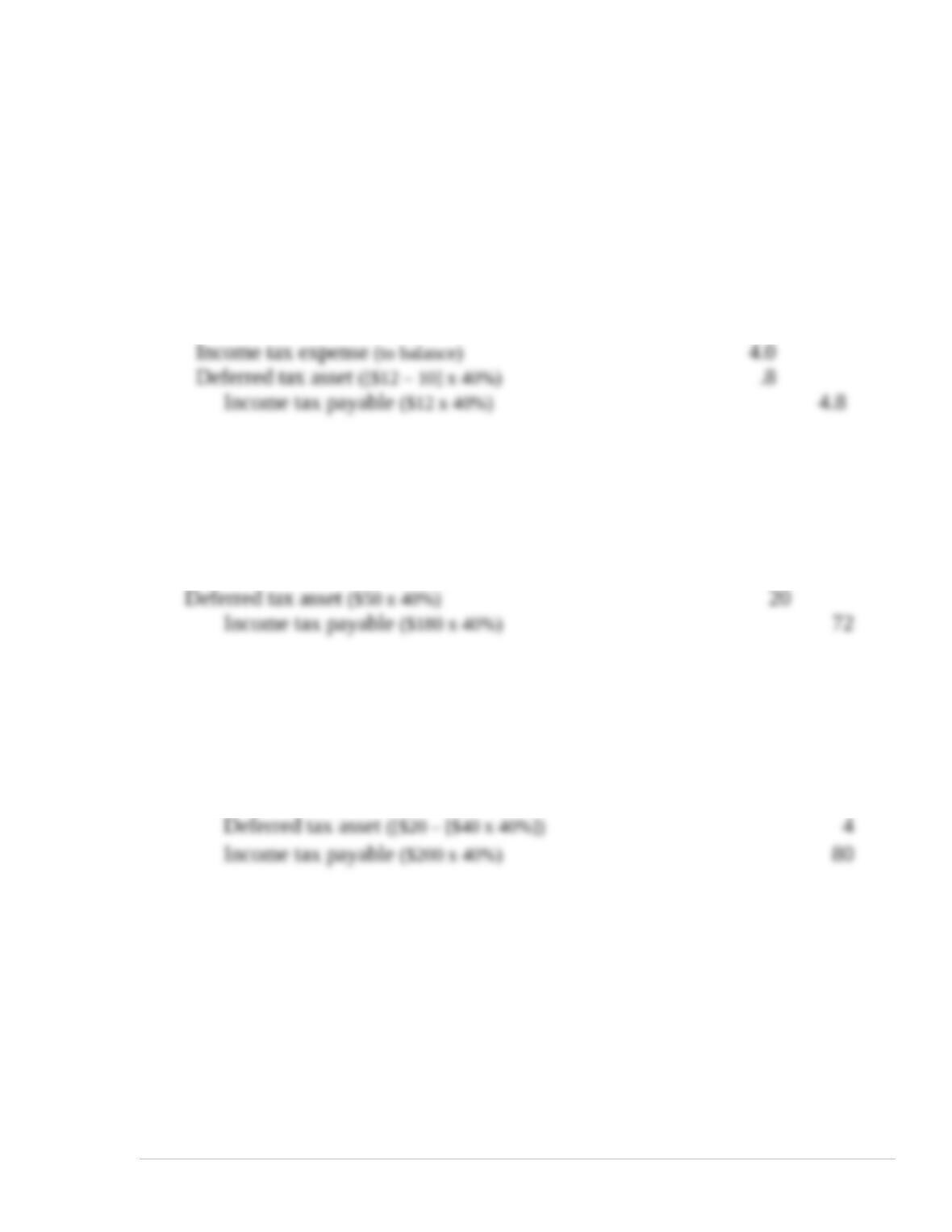
Since taxable income is more than pretax accounting income, a future deductible
amount will occur when the temporary difference reverses. This means a deferred tax
asset should be recorded to reflect the future tax savings from the temporary
difference:
($ in millions)
Brief Exercise 16–4
($ in millions)
Income tax expense (to balance) 52
Brief Exercise 16–5
($ in millions)
Income tax expense (to balance) 84
© The McGraw-Hill Companies, Inc., 2018
Solutions Manual, Vol.2, Chapter 16 16–)
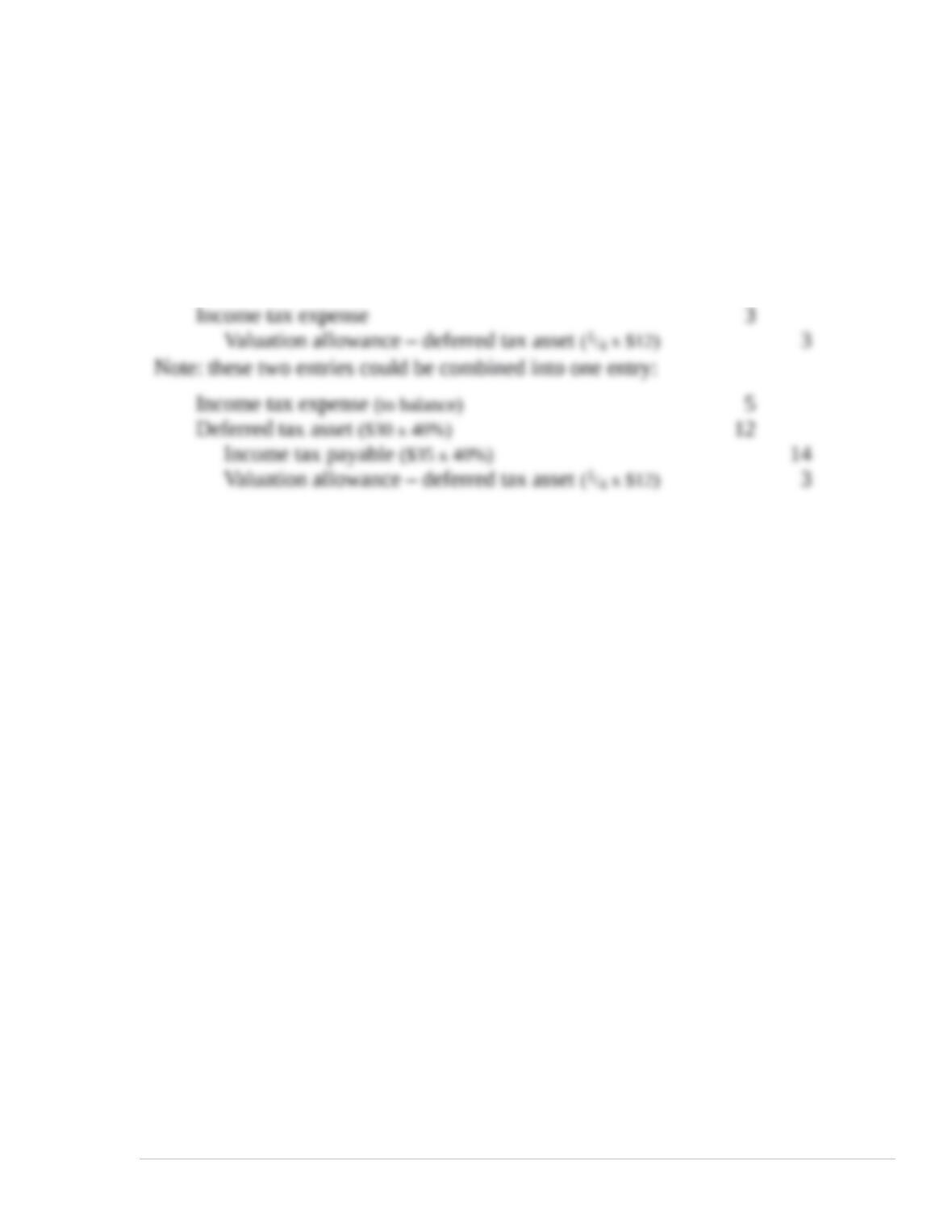
Brief Exercise 16–6
($ in millions)
Income tax expense (to balance) 2
Deferred tax asset ($30 x 40%) 12
Income tax payable ($35 x 40%) 14
© The McGraw-Hill Companies, Inc., 2018
Solutions Manual, Vol.2, Chapter 16 16–)
Brief Exercise 16–7
Deferred tax assets are recognized for all deductible temporary differences and
net operating loss carryforwards. Deferred tax assets are then reduced by a valuation
VeriFone Systems reported large operating losses in 2013 and 2014. This led
management to believe that future taxable income would not be sufficient to realize
the benefits from the tax savings provided by its deferred tax assets. In its
© The McGraw-Hill Companies, Inc., 2018
Solutions Manual, Vol.2, Chapter 16 16–)
Brief Exercise 16–8
Since taxable income to date has been $40 million less than pretax accounting
income because of the temporary difference, a future taxable amount of $40 million
© The McGraw-Hill Companies, Inc., 2018
Solutions Manual, Vol.2, Chapter 16 16–)