Case 14–3 (continued)
Arguments Supporting View 1:
1. Those who favor accounting for convertible debt as entirely a liability until it
is either converted or repaid argue that a convertible bond offers the holder
two mutually exclusive choices. The holder cannot both redeem the bond for
cash at maturity and convert it into common stock. They contend that the
2. Supporters of the first alternative generally also are concerned about the
ability to measure reliably the components of convertible debt because neither
is separately traded. They conclude that because the market does not
Case 14–3 (continued)
3. Supporters of that view argue that factors other than the conversion feature
typically affect the pricing of convertible debt and therefore may complicate
an attempt to allocate the proceeds from issuance between the straight debt
and the conversion feature. For example, convertible bonds generally have
4. Moreover, no cash payment from holder to issuer is required when a
convertible bond is converted; the bond itself represents the consideration
received by the issuing enterprise for the stock into which the bond is
Arguments Supporting View 2:
1. Those who favor separate recognition of the liability and equity components
of convertible debt argue that to ignore the existence of the conversion feature
Case 14–3 (continued)
2. The higher interest expense recognized if the components are separately
recognized than if all of the proceeds of issuance are recorded as a liability
reflects the fact that an enterprise that issues debt at less than its face amount
pays an effective interest rate that is higher than the coupon rate. The lower
3. Supporters of separate accounting contend that accounting for convertible
debt as entirely a liability impairs comparability between enterprises. If
4. Those who support separate recognition of the liability and equity components
of convertible debt point to the different values assigned by the market to
convertible and nonconvertible debt with like terms as evidence of the

Case 14–3 (concluded)
5. In the 21 years since the original pronouncement, Opinion 14, was issued (to
the date of this literature), the idea that many financial instruments may be
broken down into more fundamental components, which then may be traded
separately, has been embraced by the Wall Street community. The cash flows
Analysis Case 14–4
Requirement 1
The notice is being placed by the four underwriters listed at the bottom of the
notice. The purpose is to announce the sale of the bonds described. Actually, the
Requirement 2
In practice, debt securities rarely are priced at a premium in their initial
offering. The reason is primarily a marketing consideration. It’s psychologically
Requirement 3
The accounting considerations for Craft Foods are to recognize the liability
and related debt issue costs, as well as to record interest expense semiannually over
the 10-year term to maturity at the effective rate of interest. The bonds were
recorded at their selling price: $750,000,000 x 99.57 = $746,775,000 (Bonds
payable at face, discount of $3,225,000). Craft Foods also recorded the debt issue

Judgment Case 14–5
Obviously, no rational lender will lend money without interest. The
zero-interest loan described actually does implicitly bear interest. The amount and
If we knew, for instance, that the market rate of interest at the time for this
Both the asset acquired and the liability used to purchase it should be recorded
In row 12 of Table 4, the value 10.90751 is in the 1.5% column. Since
In any case, Mr. Wilde will not avoid interest charges with this offer. Interest

Judgment Case 14–6
Although not specifically discussed in the chapter, concepts studied in this and
other chapters provide the logic for addressing the situation described. The
The journal entry to record the initial transaction is as follows:
Interest revenue is recognized over the four-year life of the note using the
Prepaid inventory is credited and inventory is debited as inventory is

Communication Case 14–7
The critical question that student groups should address is the valuation of the
note receivable. In this case, there is a correct answer. The note should be valued
It is important that each student actively participate in the process of arriving
at a solution. Domination by one or two individuals should be discouraged.
Ethics Case 14–8
Discussion should include these elements.
Facts:
Inducing a bond conversion is a common method of indirectly issuing stock,
though typically not for the purpose of enhancing profits.
Reported performance will increase.
Company managers stand to benefit from the change.
Ethical Dilemma:
Should Hunt Manufacturing enter into these transactions primarily for
“window dressing” rather than for economic reasons?
Who is affected?
Meyer
Barr
Other managers
Bondholders
Hunt’s auditors
Shareholders
Potential shareholders
The employees
Other creditors
Judgment Case 14–9
Requirement 1
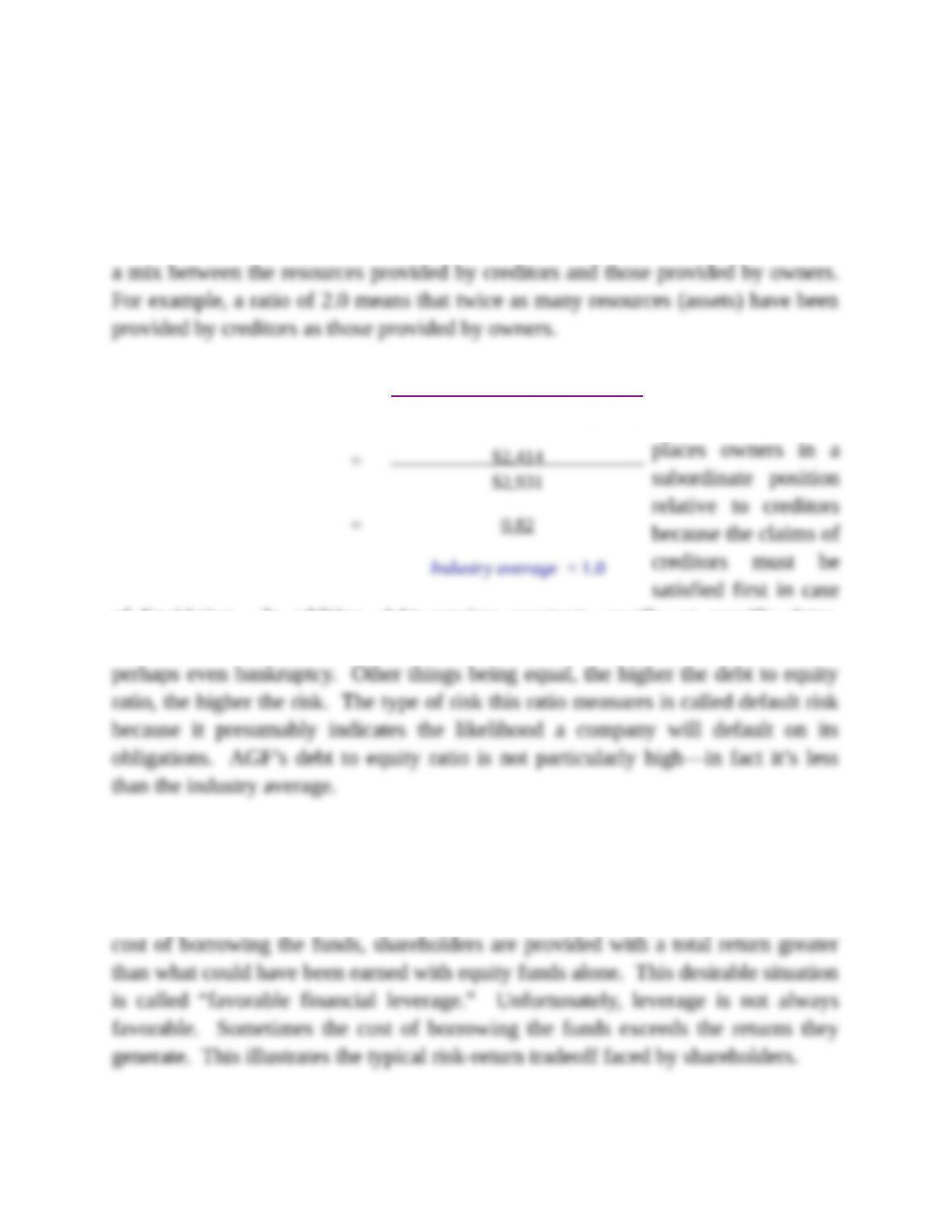
The debt to equity ratio is computed by dividing total liabilities by total
shareholders’ equity. The ratio summarizes the capital structure of the company as
In general, debt
increases risk. Debt
of liquidation. In addition, debt requires payment, usually on specific dates.
Failure to pay debt interest and principal on a timely basis may result in default and
Requirement 2
Debt also can be used to enhance the return to shareholders. This concept is
known as leverage. If a company earns a return on borrowed funds in excess of the
Debt to equity ratio = Total liabilities
Shareholders’ equity