Problem 14–19
Requirement 1
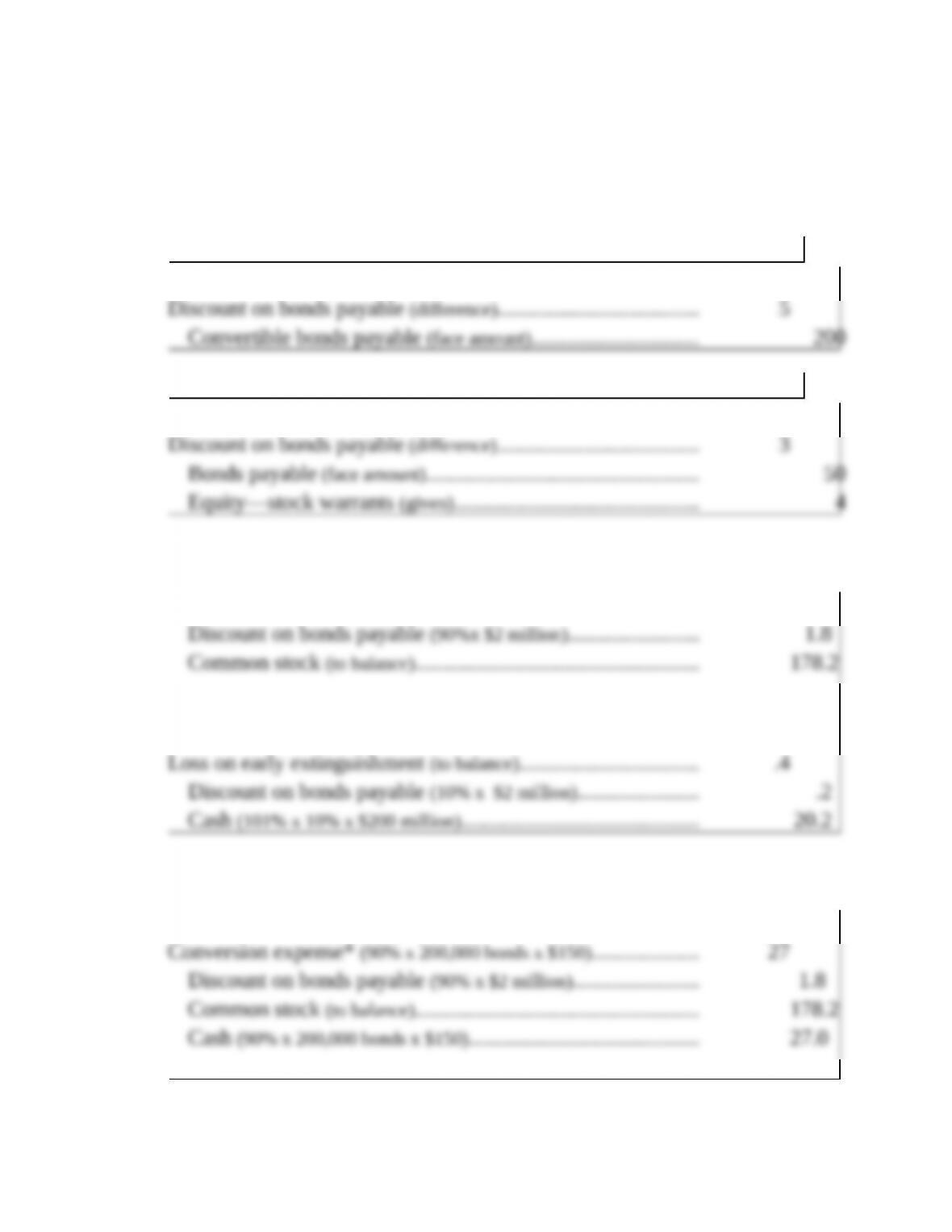
Convertible Bonds—2005 issue
Cash (97.5% x $200 million)……………………………………………….. 195
Bonds with Warrants—2009 issue
Cash (102% x $50 million)………………………………………………….. 51
Requirement 2
($ in millions)
Convertible bonds payable (90% x $200 million)………………….. 180
Convertible bonds payable (10% x $200 million)…………………… 20.0
Requirement 3
($ in millions)
Convertible bonds payable (90% x $200 million)…………………… 180

* When additional consideration is provided to induce conversion, the fair value of that consideration
is considered an expense incurred to bring about the conversion.
Problem 14–19 (concluded)
Requirement 4
($ in millions)
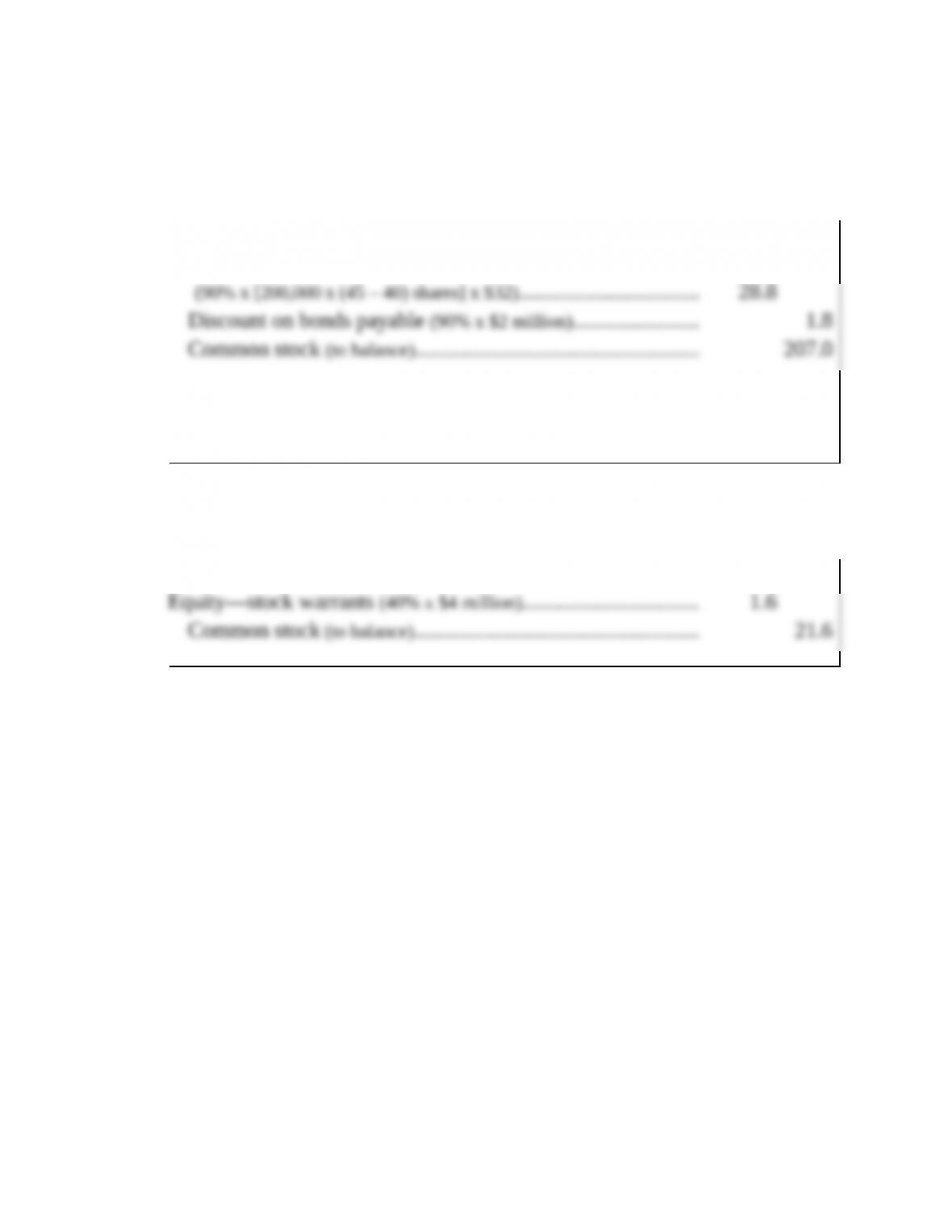
Convertible bonds payable (90% x $200 million)…………………… 180.0
Conversion expense*
* When additional consideration is provided to induce conversion, the fair value of that consideration
is considered an expense incurred to bring about the conversion.
Requirement 5
($ in millions)
Cash (40% x 50,000 x 40 warrants x $25)………………………………… 20.0
Problem 14–20
Requirement 1
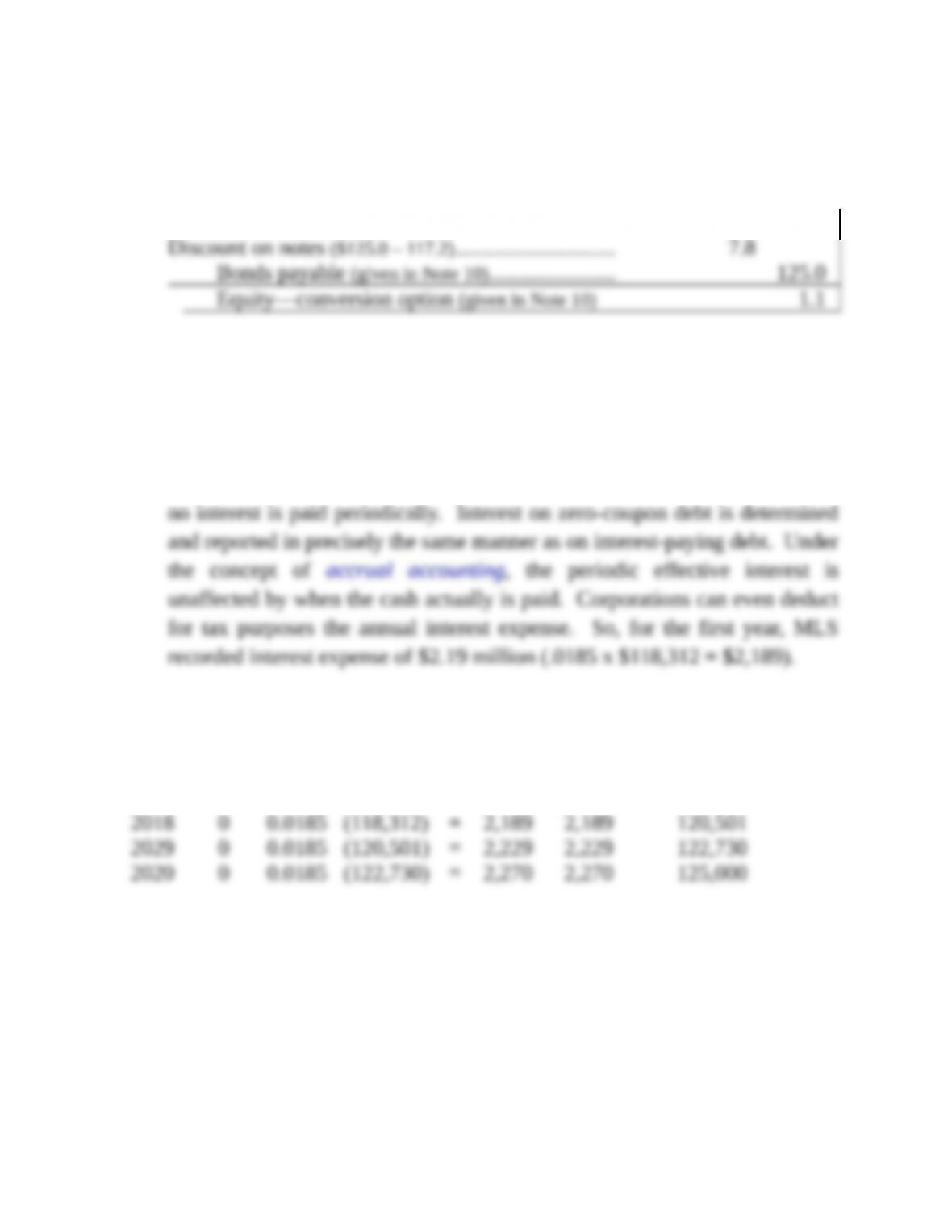
($ in 000s)
Cash (proceeds given in Note 10)…………………………….. 118.3
Requirement 2
In a strict sense, zero-coupon debt pays no interest. “Zeros” offer a
return in the form of a “deep discount” from the face amount. In fact,
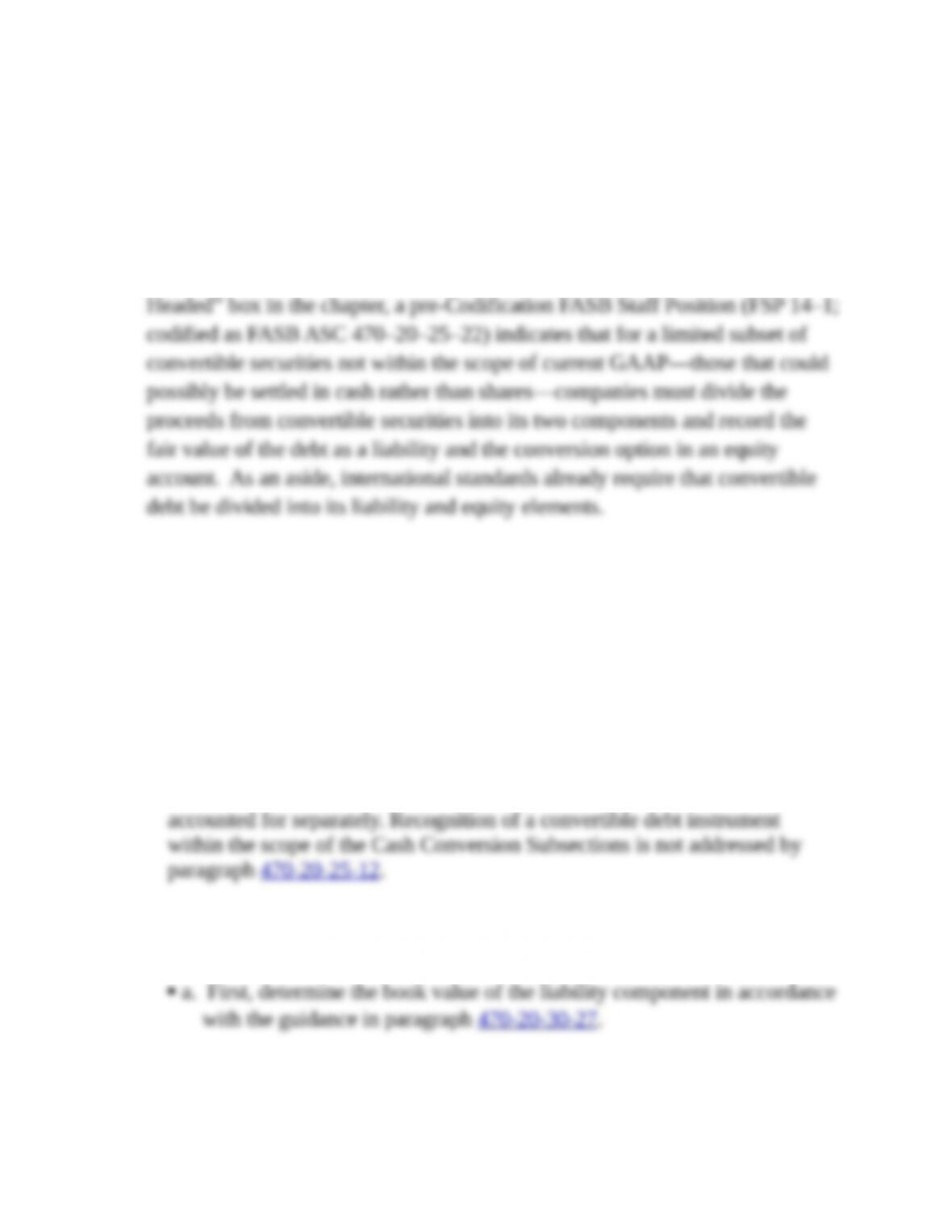
though, interest accrues at the effective rate (1.85% in this case) times the
outstanding balance ($1,183,115 million during the first year), even though
Amortization schedule (not required):
Increase Outstanding
June Cash Interest Expense in Balance Balance
2017 118,312
Problem 14–20 (concluded)
Requirement 3
MLS’s note states that “Because the convertible debt may be wholly or
partially settled in cash, we are required to separately account for the liability
and equity components of the notes.” As indicated in the “Where We’re
Requirement 4
FASB ASC 470–20–25–22: “Debt–Debt with Conversion and Other
Options–Recognition–Liability and Equity Components.”
This is the codification of FASB Staff Position (FSP 14–1):
Liability and Equity Components
25-22 The liability and equity components of a convertible debt
instrument within the scope of the Cash Conversion Subsections shall be
25-23 The issuer of a convertible debt instrument within the scope of the
Cash Conversion Subsections shall do both of the following:

b. Second, determine the book value of the equity component represented
Problem 14–21
List A List B
j_ 1. Effective rate times balance a. Straight-line method
h_ 2. Promises made to bondholders b. Discount
o_ 3. Present value of interest plus c. Liquidation payments after
other
present value of principal claims satisfied
m_4. Call feature d. Name of owner not registered
Problem 14–22
Requirement 1
January 1
Requirement 2
June 30
Requirement 3
December 31
Requirement 4
increase the book value to $668,000, NFB needed the following entry:
Problem 14–23
Requirement 1
At January 1, the book value of the bonds was the initial issue price, $331,364.
The liability, though, was increased by three months’ interest that has accrued for
the quarter but has not been paid. This is recorded in an adjusting entry in
preparation for the quarterly financials:
Interest expense (5% x $331,364 x 3/6)8,284
Reducing the discount increases the book value of the bonds:
*Interest payable is considered part of the book value of the bonds.
Comparing the amortized initial amount at March 31, 2018, with the fair value on
that date provides the fair value adjustment balance needed:
Appling assumes the change in fair value is due to a change in the credit risk
Note: An increase in the value of an asset is a gain; an increase in the value of a liability is a loss.
Appling’s first quarter comprehensive income will be decreased by:
Note: Remember that comprehensive income includes net income and other comprehensive income.
Problem 14–23 (continued)
Requirement 2
If the fair value on March 31 is $350,000, Appling needs to compare that
amount with the amortized initial measurement on that date. That amount was
increased when Appling recorded interest on June 30:
Interest expense (5% x $331,364* x 3/6)8,284
* Because interest is compounded semiannually on bonds, this amount is not increased by
the discount amortization until June 30.
*Interest payable is considered part of the book value of the bonds.
Comparing the amortized initial amount at June 30 with the fair value on that date
provides the fair value adjustment balance needed:
June 30 book value (amortized initial amount) $331,932
statement of comprehensive income:
Appling’s second quarter comprehensive income will be decreased by:
Note: Remember that comprehensive income includes net income and other comprehensive income.
Problem 14–23 (continued)
Requirement 3
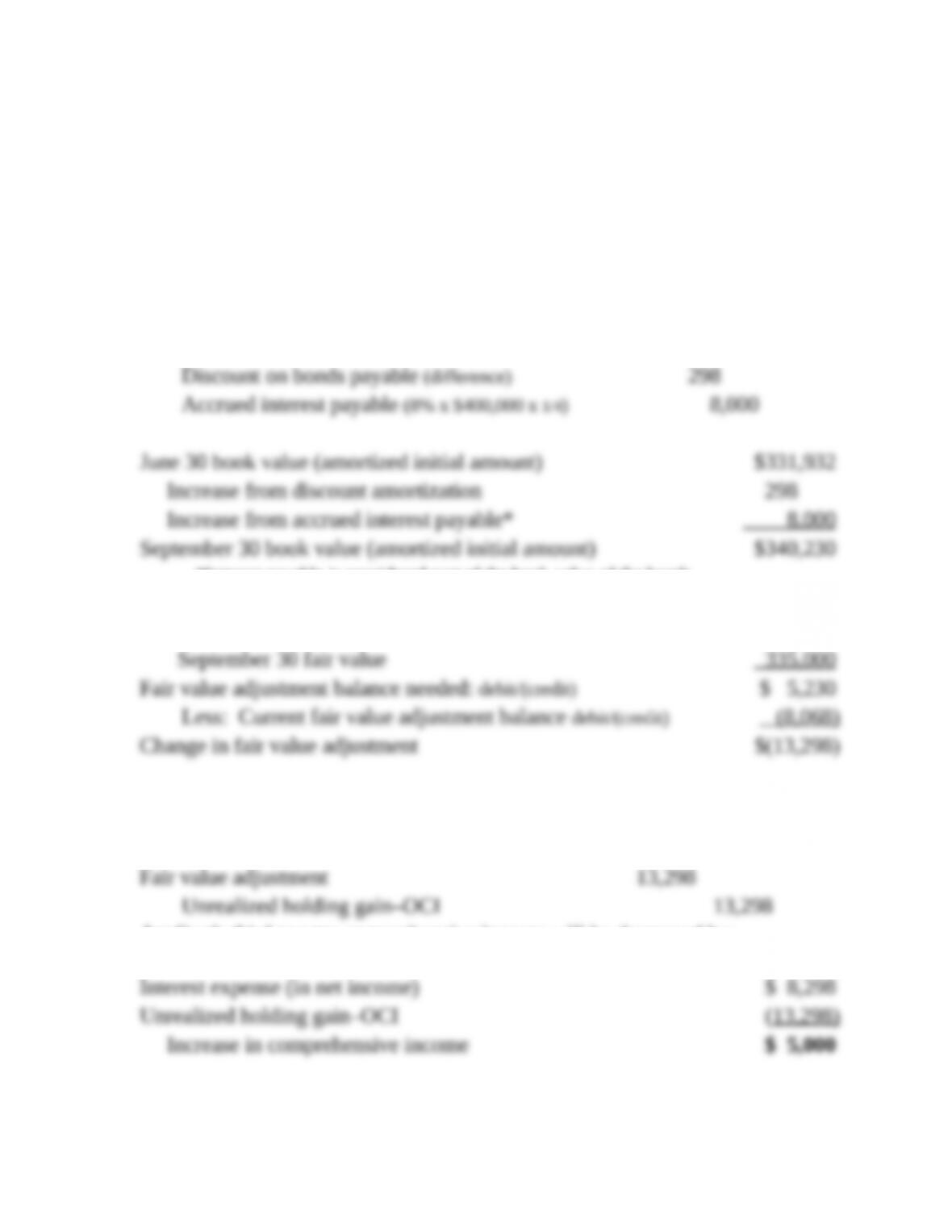
If the fair value on June 30 is $340,000, Appling needs to compare that amount
with the amortized initial measurement on that date. That amount, though, has
increased by three months’ interest that has accrued for the quarter but has not been
paid. This is recorded in an adjusting entry in preparation for the quarterly
financials:
Interest expense (5% x [$331,364 + 284 + 284] x 3/6)8,298
*Interest payable is considered part of the book value of the bonds.
September 30 book value (amortized initial amount) $340,230
Appling would record the $13,298 gain as OCI in the 2018 third quarter
statement of comprehensive income:
Appling’s third quarter comprehensive income will be decreased by:
We are ignoring income tax in this problem, but note that gains–OCI and
losses–OCI are reported in the statement of comprehensive income net of tax.