IFRS Case 13–15
Under IFRS, the $70 million environmental contingency would be accrued
and included in Fizer’s liabilities. The associated loss would be reported in the
income statement. Accounting for contingencies is covered under IAS No. 37,
“Provisions, Contingent Liabilities, and Contingent Assets.” U.S. GAAP’s specific
guidance on contingencies can be found in the FASB’s Codification Research
Under IFRS, Fizer’s bonds would have been reported as a current liability in
Fizer’s balance sheet rather than as long-term debt. Under U.S. GAAP, liabilities
Fizer would have reported the long-term contingency in its 2018 financial
statements at its present value rather than the face amount. The reason the cash
Analysis Case 13–16
Requirement 1
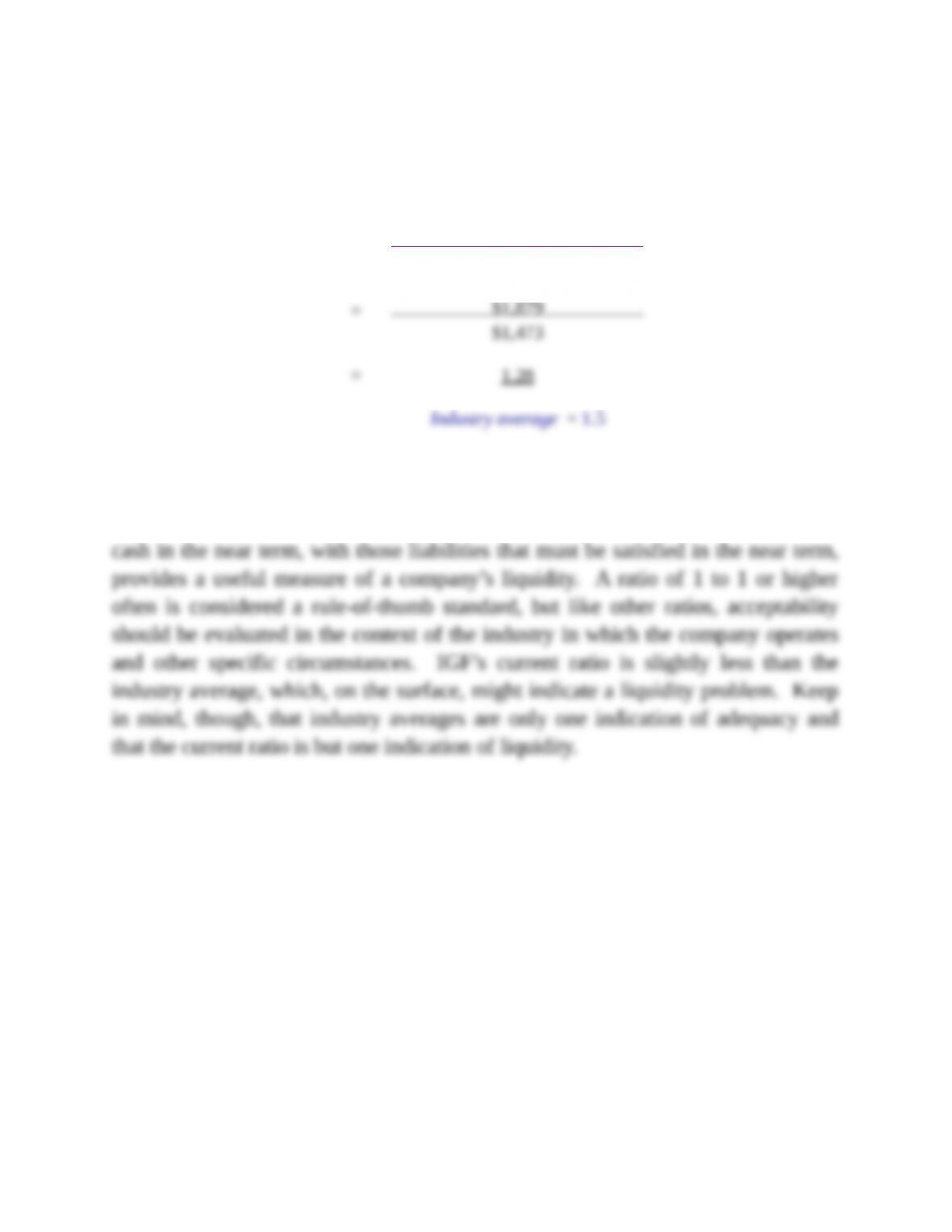
Current ratio = Current assets
Current liabilities
The current ratio is one of the most widely used ratios. It is intended as a
measure of short-term solvency and is determined by dividing current assets by
current liabilities. Comparing assets that either are cash or will be converted to
Case 13–16 (concluded)
Requirement 2
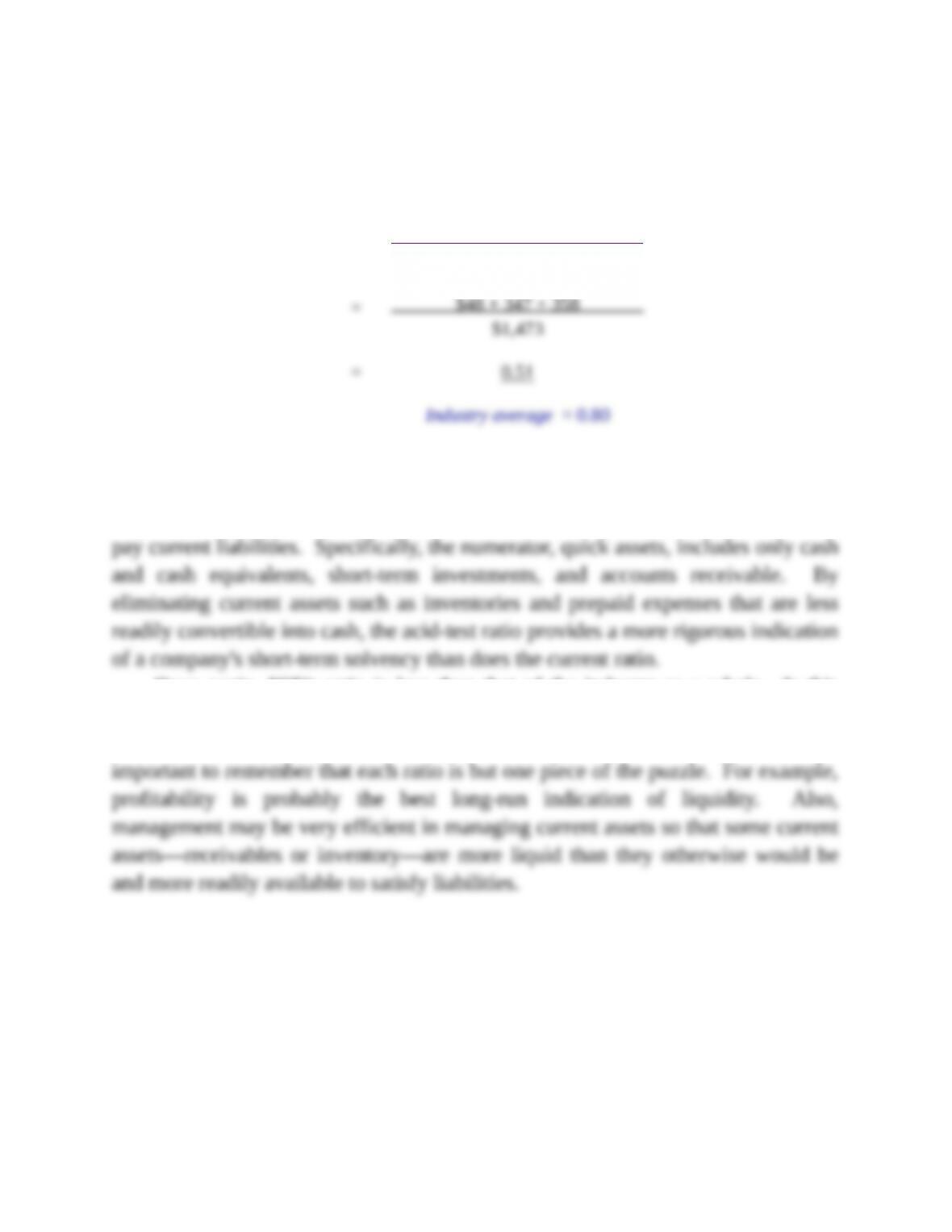
Acid-test ratio = Quick assets
(or quick ratio) Current liabilities
The acid-test or quick ratio attempts to adjust for the implicit assumption of
the current ratio that all current assets are equally liquid. This ratio is similar to the
current ratio, but is based on a more conservative measure of assets available to
Once again, IGF’s ratio is less than that of the industry as a whole. Is this
confirmation that liquidity is an issue for IGF? Perhaps; perhaps not. It does,
though, raise a red flag that suggests caution when assessing other areas. It’s
Trueblood Accounting Case 13–17
[Note: This case encourages the student to reference authoritative pronouncements.]
A solution and extensive discussion materials accompany each case in the Deloitte
& Touche Trueblood Case Study Series. These are available to instructors at:
www.deloitte.com/us/truebloodcases. Relevant discussion in the FASB
codification can be found at FASB ASC 450: “Contingencies.”
Real World Case 13–18
Requirement 1
A liability is accrued if it is both probable that a loss will occur and the amount
can be at least reasonably estimated. Most consumer products are accompanied by
If Microsoft had known or believed the obligation was this large when the
Requirement 2
When the announcement was made, analyst Richard Doherty stated that either a
high number of Xbox 360s will fail or the company is being overly conservative in
Real World Case 13–19
Requirement 1
Per AU Optronics’ (Form 20-F, filed 3/21/2016): Where there is a continuous
range of possible outcomes, with each point in the range as likely as any other,
what amount is accrued as the estimate of the obligation?
“Where there is a continuous range of possible outcomes, and each point
Requirement 2
B Communications LTD (Form 20-F, filed 4/19/2016): With respect to legal
claims, at what probability level would B Communications accrue a liability for a
possible litigation loss?
Legal claims
Contingent liabilities are accounted for according to IAS 37 and its
related provisions. Accordingly, the claims are classified by
likelihood of realization of the exposure to risk, as follows:
Real World Case 13–20
Requirement 1
The acquisition is a subsequent event, given that J. Crew’s fiscal year ends on
Requirement 2
a. Yes, J. Crew has recorded a $10 million reserve. It would record a journal
entry like the following:
b. For J. Crew to recognize a $10 million reserve, management must believe
a $10 million loss to be probable and reasonably estimable. Management
may believe that higher amounts are probable but not reasonably
Trueblood Accounting Case 13–21
[Note: This case encourages the student to reference authoritative pronouncements.]
A solution and extensive discussion materials accompany each case in the Deloitte
& Touche Trueblood Case Study Series. These are available to instructors at:
www.deloitte.com/us/truebloodcases. Relevant discussion in the FASB
codification can be found at FASB ASC 855: “Subsequent Events.”