Communication Case 13–7
Assumptions students make will determine the correct answer to some
classifications. Depending on the assumptions made, different views can be
convincingly defended. The process of developing and synthesizing the arguments
will likely be more beneficial than any single solution. Each student should benefit
from participating in the process, interacting first with his or her partner, then with
the class as a whole. It is important that each student actively participate in the
process. Domination by one or two individuals should be discouraged.
A significant benefit of this case is forcing students’ consideration of why
liabilities currently due are sometimes classified as long term. It also requires
them to carefully consider the profession’s definition of current liabilities.
Arguments likely will include the following:
a. Commercial paper
If it’s assumed that early April is prior to the actual issuance of the financial
statements, then $12 million can be reported as long term, but $3 million must be
reported as a current liability. Short-term obligations that are expected to be
refinanced with long-term obligations can be reported as noncurrent liabilities only
If it’s assumed that early April is after the actual issuance of the financial
b. 11% notes
The debt should be reported as a current liability because it is payable in the
Case 13–7 (concluded)
c. 10% notes
Short-term obligations that are expected to be refinanced with long-term
obligations can be reported as noncurrent liabilities only if the firm (a) intends to
refinance on a long-term basis and (b) actually has demonstrated the ability to do
d. Bonds
If it’s assumed that March 15 is prior to the actual issuance of the financial
statements, the bonds can be reported as noncurrent liabilities. The firm (a)
Communication Case 13–8
Memorandum:
To: Mitch Riley
From: Your Name
Re: Accounting for contingencies
Below is a brief overview of my initial thoughts on how Western should account
for the four contingencies in question.
1. The labor disputes constitute a loss contingency. Though a loss is probable,
the amount of loss is not reasonably estimable. A disclosure note is
appropriate:
_______________________________
Note X: Contingency
2. The A. J. Conner matter is a gain contingency. Gain contingencies are not
accrued even if the gain is probable and reasonably estimable. The gain
should be recognized only when realized.
_______________________________
Note X: Contingency
In accordance with a 2016 contractual agreement with A.J. Conner
Company, the Company is entitled to $37 million for certain fees and
Case 13–8 (concluded)
3. The contingency for warranties should be accrued. During the period
Western would make the following journal entries:
4. The Crump Holdings lawsuit is a loss contingency. Even though the lawsuit
occurred in 2019, the cause for the action occurred in 2018. Only a
disclosure note is needed because an unfavorable outcome is reasonably
possible, but not probable. Also, the amount is not reasonably estimable.
_______________________________
Note X: Contingency
Crump Holdings filed suit in January 2019 against the Company seeking
We can discuss these further in our meeting later today.
Judgment Case 13–9
This is a loss contingency. Valleck can use the information from the February
negotiations (occurring after the end of the year) in determining appropriate
The disclosure note should also indicate that accrual was made. This can be
accomplished by adding the following sentence to the end of the note:
Communication Case 13–10
Suggested Grading Concepts and Grading Scheme:
Content (80% )
20 Identifies the situation as a change in estimate.
The liability was originally (appropriately) estimated as
$750,000.
The final settlement indicates the estimate should be revised.
Bonus (4) Provides detail regarding the disclosure note.
A disclosure note should describe the effect of a
change in estimate on key items.
Writing (20%)
5 Terminology and tone appropriate to the audience of a vice
president.
Research Case 13–11
A liability is accrued if it is both probable that a loss will occur and the
amount can be at least reasonably estimated. If one or both of these criteria is not
Often such disclosure notes provide only a very general description of
The relevant GAAP can be accessed in the FASB’s Codification Research
Communication Case 13–12
Suggested Grading Concepts and Grading Scheme:
Content (80% )
30 Warranty for awnings (5 each; maximum of 30 for this part)
Change in estimate.
Change is effected prospectively only.
30 Clean air lawsuit (5 each; maximum of 30 for this part)
Change in estimate.
Change is effected prospectively only.
Bonus (4) Provides detail regarding the disclosure note.
A disclosure note should describe the effect of a
Writing (20%)
5 Terminology and tone appropriate to the audience of
division managers.
Real World Case 13–13
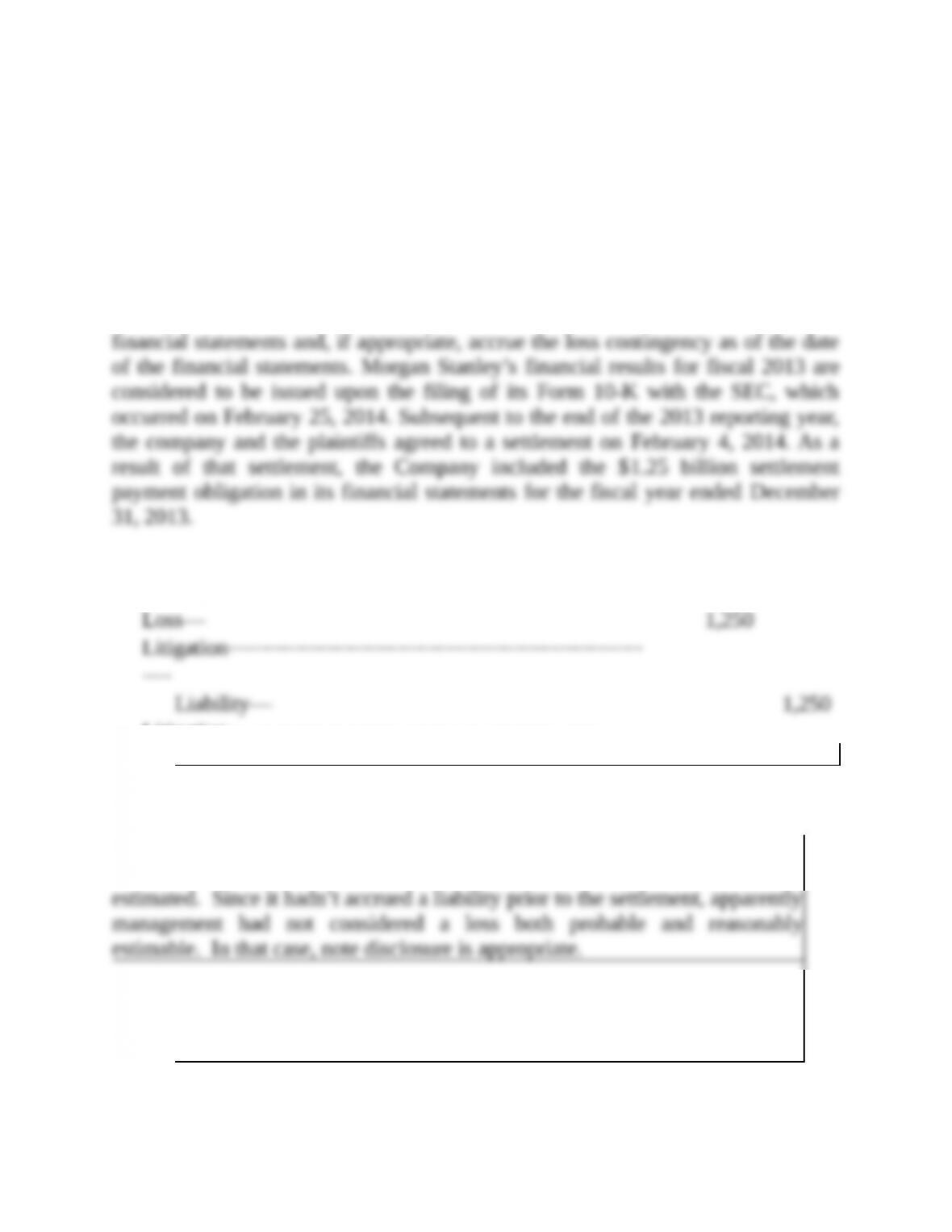
Requirement 1
In accordance with GAAP, when a contingency exists as of the end of a
fiscal year, in assessing whether a loss is probable and measurable and therefore
should be recorded in its financial statements, Morgan Stanley is required to take
into consideration all information up to and including the date of issuance of its
Requirement 2
($ in millions)
Litigation······························································
Requirement 3
If the settlement had occurred after the February 25 financial statement
date, the company still should accrue a liability if a loss is probable and can be
Ethics Case 13–14
Discussion should include these elements.
Warranty estimate
The cost of product warranties (or product guarantees) cannot be predicted with
certainty. However, to match expenses and revenues, we estimate the cost. The
Ethical Dilemma:
Is Craig’s obligation to challenge the questionable change in estimates greater
than the obligation to the financial interests of his employer and bosses?
Who is affected?
Craig
President, controller, and other managers