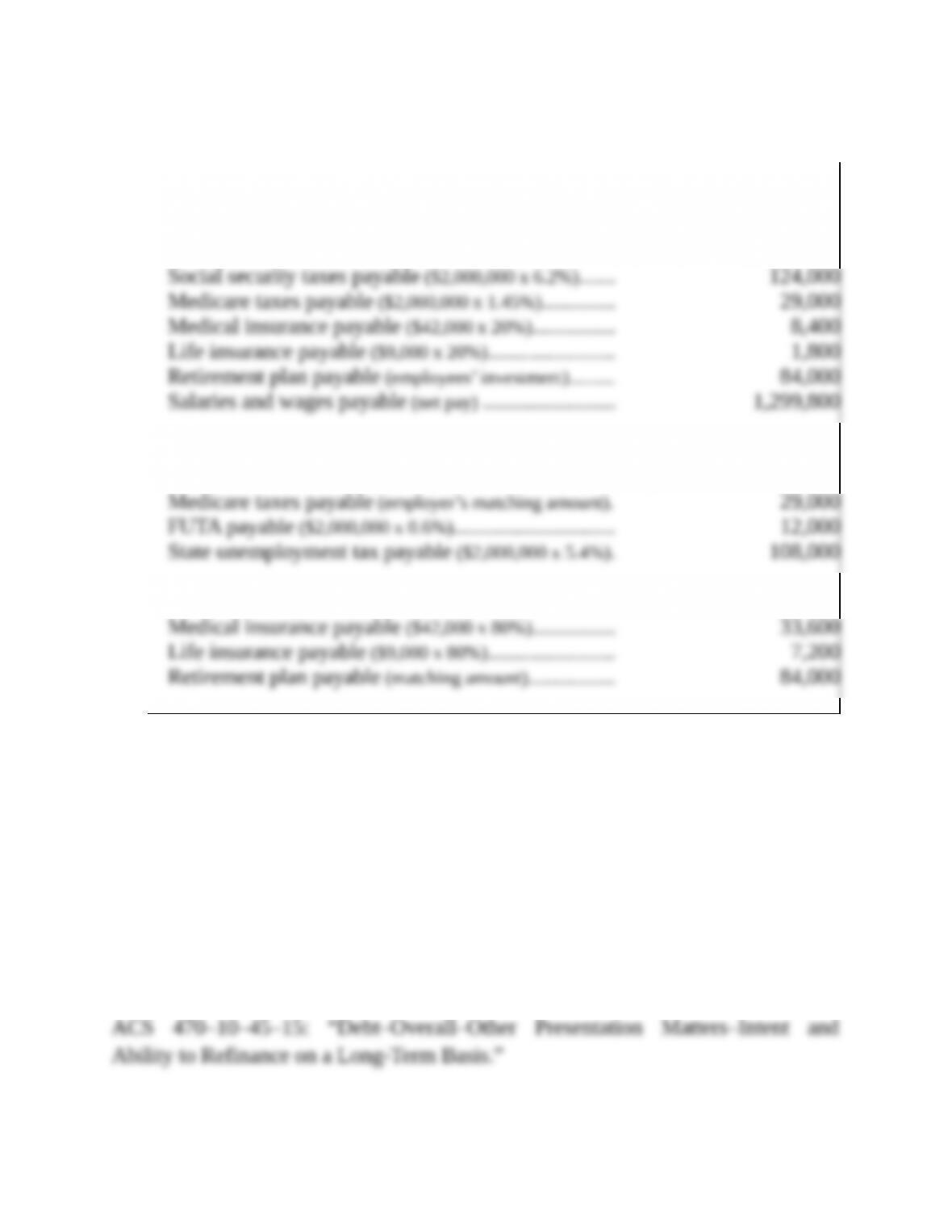
Problem 13–13
Salaries and wages expense (total amount earned)……….. 2,000,000
Withholding taxes payable (federal income tax)………. 400,000
Withholding taxes payable (local income tax)…………. 53,000
Payroll tax expense (total)……………………………………. 273,000
Social security taxes payable (employer’s matching amount) 124,000
Salaries and wages expense (fringe benefits)……………. 124,800
Research Case 13–1
[Note: This case encourages the student to reference authoritative pronouncements.]
The $2,000,000 of commercial paper liquidated in November 2018 would be
classified as a current liability in Cheshire’s balance sheet at September 30, 2018.
The essence of a current liability is that its payment requires the use of current
assets or the creation of other current liabilities. If a liability is liquidated after the
year-end with current assets, it is reported as a current liability as of the end of the
reporting period—even if the current assets are later replenished by proceeds of a
long-term obligation before the issuance of the financial statements.
The relevant authoritative literature can be found in the FASB’s codification at
CASES
The relevant authoritative literature can be found in the FASB’s codification at
Real World Case 13–2
Collecting cash from a customer as a refundable deposit normally creates a
liability to return the deposit if the deposit is expected to be refunded. In this case,
the deposit is not returnable to the customer, but payment still will be made—to the
zoo—if the pails are returned. The possible future payment represents a loss
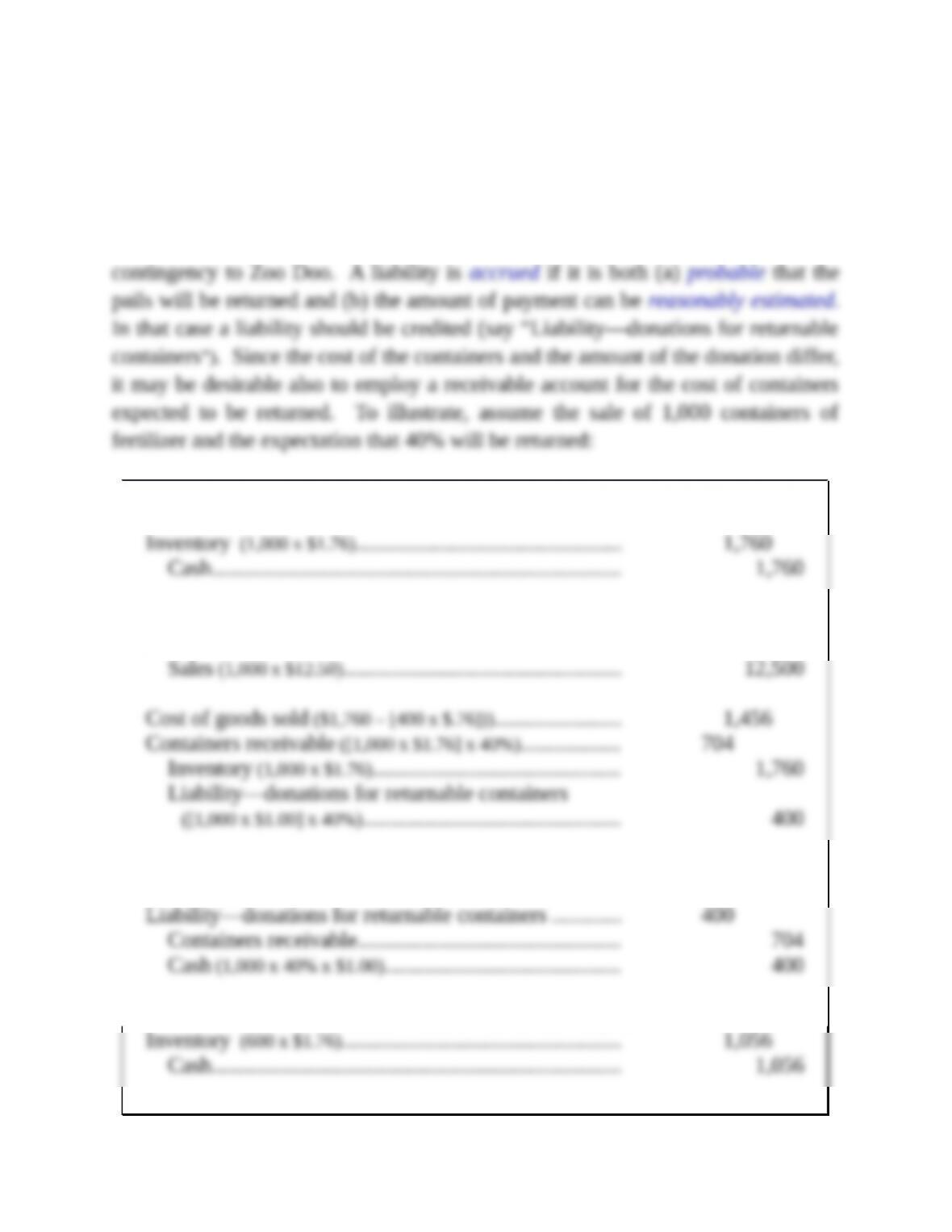
When Containers Purchased
When Product Sold
Cash……………………………………………………………………. 12,500
When Containers Returned
Inventory (1,000 x 40% x $1.76)…………………………………. 704
When Unreturned Containers Replaced
Case 13–2 (concluded)
It is probable that at least some pails will be returned. But this is a start-up
If one or both of the accrual criteria is not met, but there is at least a
Research Case 13–3
[Note: This case encourages the student to reference authoritative pronouncements.]
Paragraph 54 of SFAC No. 6 explains:
“Assets are probable future economic benefits owned or controlled by the
entity. Its liabilities are claims to the entity’s assets by other entities and, once
Briefly stated, creditors and owners have claims to a single set of probable
future economic benefits owned or controlled by the company.
Judgment Case 13–4
Requirement 1
The conditions, all of which must be met for accrual, are:
1. The obligation is attributable to employees’ services already performed.
Requirement 2
a. Military leave, maternity leave, and jury time
Custom and practice also influence whether unused rights to paid
absences expire or can be carried forward. Obviously, if rights vest
(payable even if employment is terminated) they haven’t expired. But
typically, absence periods for these types of potential absences do not
b. Paid sabbatical leave
An expense and related liability should not be accrued if the
sabbatical leave is granted for the benefit of the employer, say for the
Case 13–4 (concluded)
c. Sick days
If payment of sick pay benefits depends on future illness, an employer
does not have to accrue a liability for benefits, even if the four accrual
Ethics Case 13–5
Discussion should include these elements.
Liabilities had been recorded previously.
When a high degree of uncertainty exists concerning the collection of
receivables, revenue should not be recorded at the time of sale. Instead,
Who is affected?
Rice
Sun
Trueblood Accounting Case 13–6
[Note: This case encourages the student to reference authoritative pronouncements.]
A solution and extensive discussion materials accompany each case in the Deloitte
& Touche Trueblood Case Study Series. These are available to instructors at:
www.deloitte.com/us/truebloodcases. Relevant discussion in the FASB
codification can be found at FASB ASC 450: “Contingencies.”