Problem 13–7
Requirement 1
Item (a): Because the loss is probable and can be reasonably estimated,
HW would be required to accrue a liability under both U.S. GAAP and
Item (b): Under IFRS, present values would be used, so the relevant
midpoint of the range that would be accrued as a liability would be
Item (c): This item is only probable according to IFRS’s use of the term,
Item (d): This item would be classified as long-term under U.S. GAAP,
Requirement 2
In this case, U.S. GAAP provides the lower total liabilities.
Problem 13–8
Requirement 1
By the traditional approach, Heinrich would accrue the more-likely-than-not
(more than 50%) amount, $30 million:
Requirement 2
Heinrich would record a contingent liability (and loss) of $27,619,020, calculated
as follows:
$40,000,000 x 20% = $ 8,000,000
Requirement 3
Requirement 4
The difference between $29,000,000 and the initial value of the liability of
Problem 13–8 (concluded)
Requirement 5
Interest increases the liability to $29 million at the end of 2019. Since there is
a difference between the actual costs, $31 million, and the $29 million liability,
Heinrich will record an additional loss.
Problem 13–9
Case 1
Note Only. When a contingency comes into existence after the year-end, a
liability cannot be accrued because it didn’t exist at the end of the year.
Case 2
Note Only. Since an unasserted claim or assessment is probable, the likelihood
of an unfavorable outcome and the feasibility of estimating a dollar amount
should be considered in deciding whether and how to report the possible loss.
Case 3
Accrual and Disclosure Note. When the cause of a loss contingency occurs
before the year-end, a clarifying event before financial statements are issued
Case 4
No Disclosure. Even though the cause of the contingency occurred before
Problem 13–10
Requirement 1
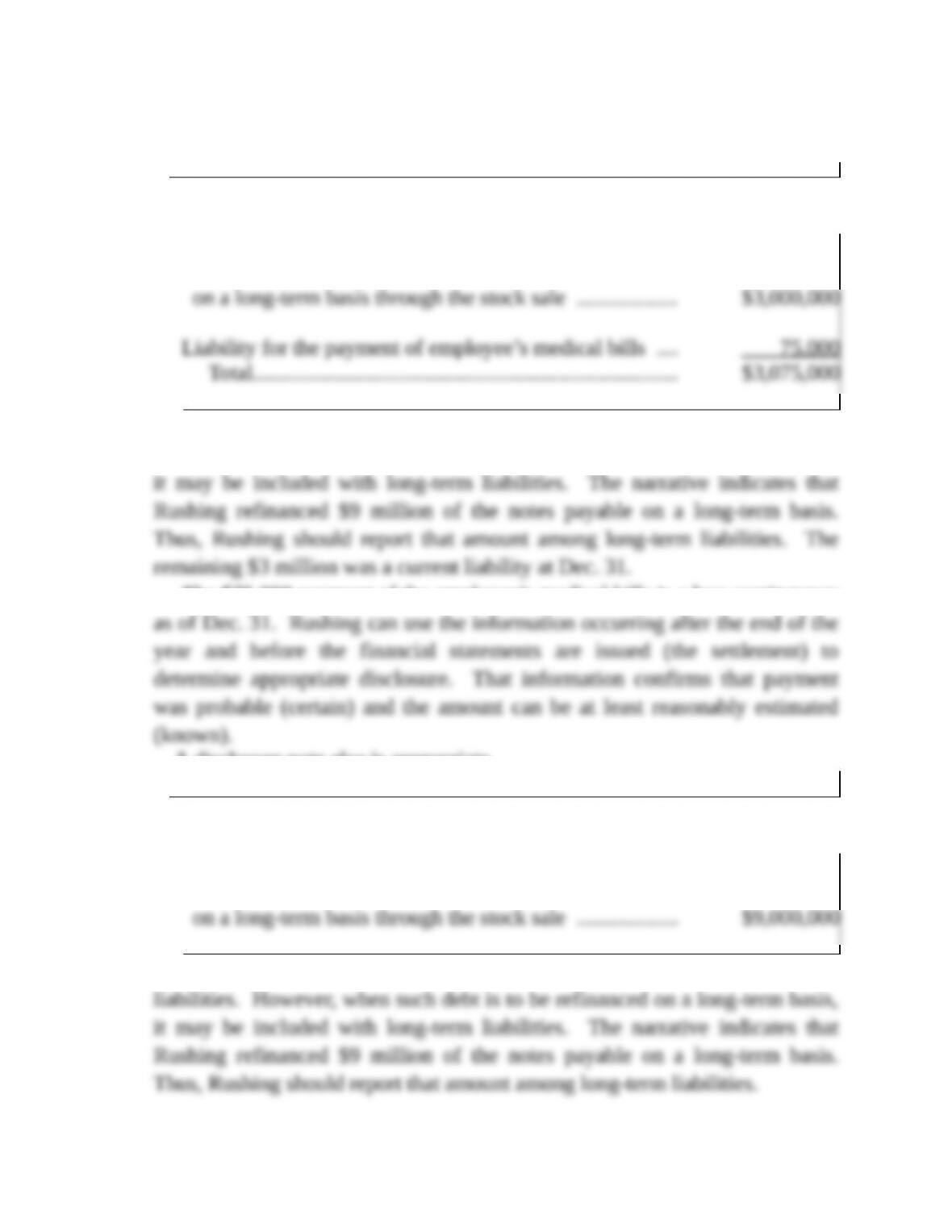
Portion of the notes payable not refinanced
Normally, short-term debt (payable within a year) is classified as current
liabilities. However, when such debt is to be refinanced on a long-term basis,
The $75,000 payment of the employee’s medical bills is a loss contingency
A disclosure note also is appropriate.
Requirement 2
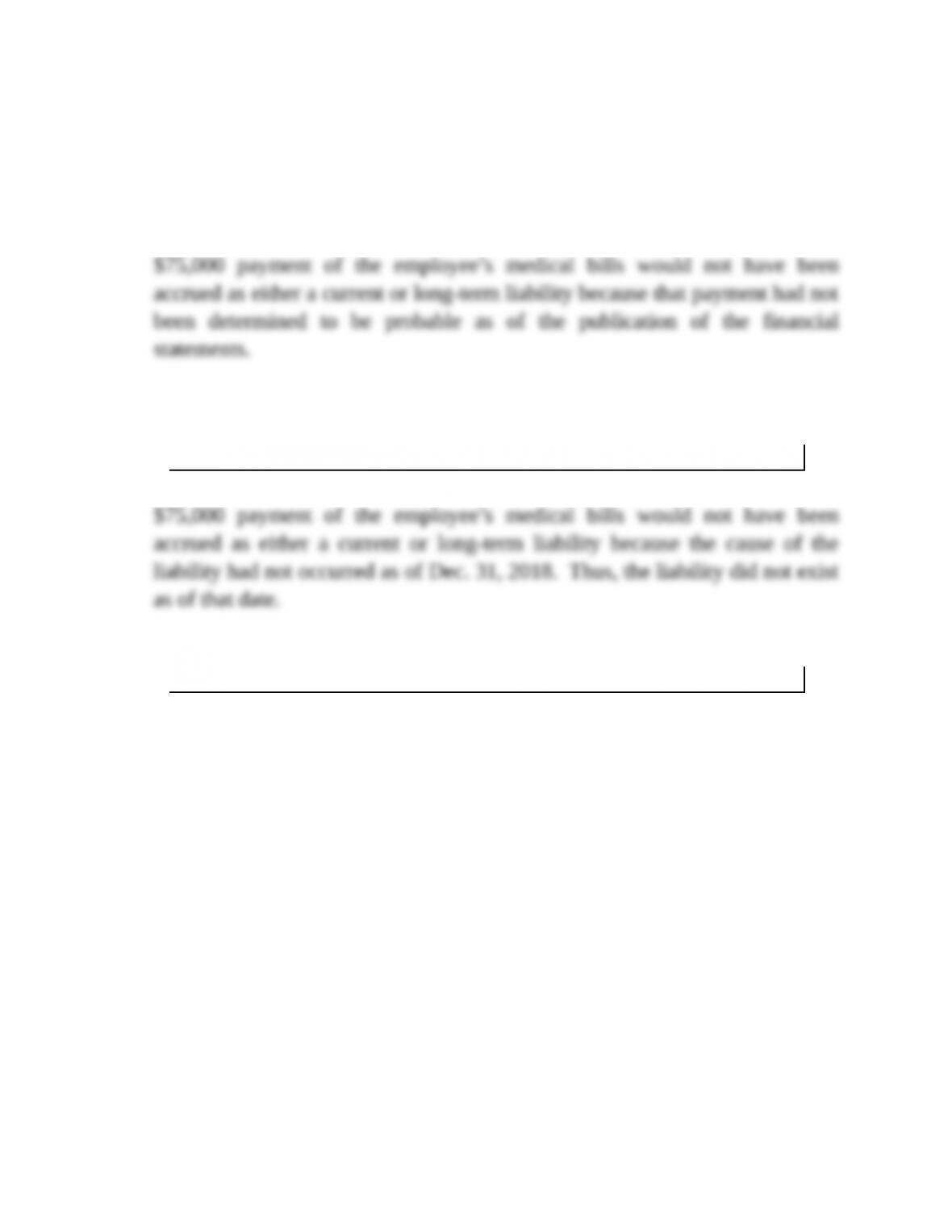
Portion of the notes payable refinanced
Normally, short-term debt (payable within a year) is classified as current
Problem 13–10 (concluded)
Requirement 3
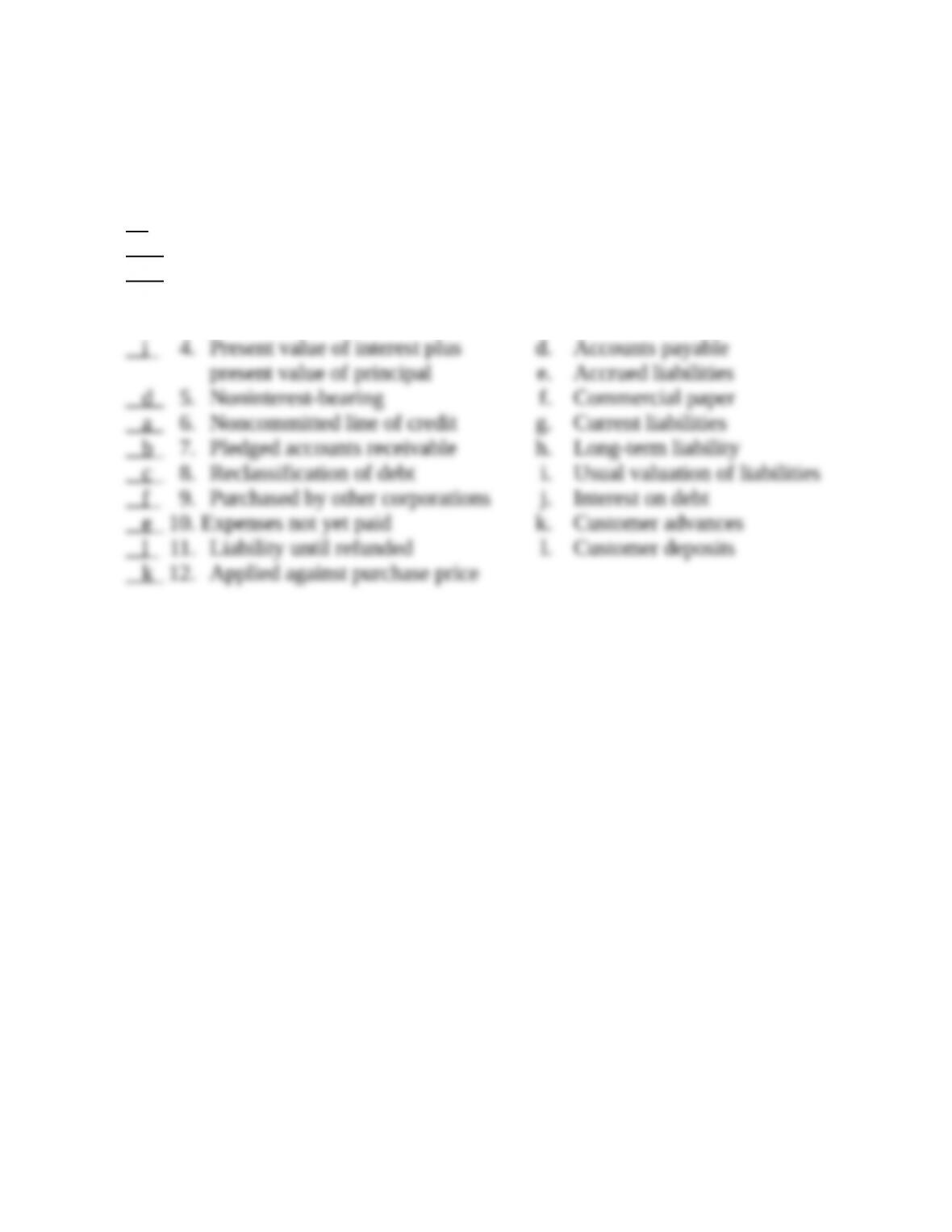
If the settlement agreement had occurred on March 15, 2019, instead, the
Requirement 4
If the work-site injury had occurred on January 3, 2019, instead, the
Problem 13–11
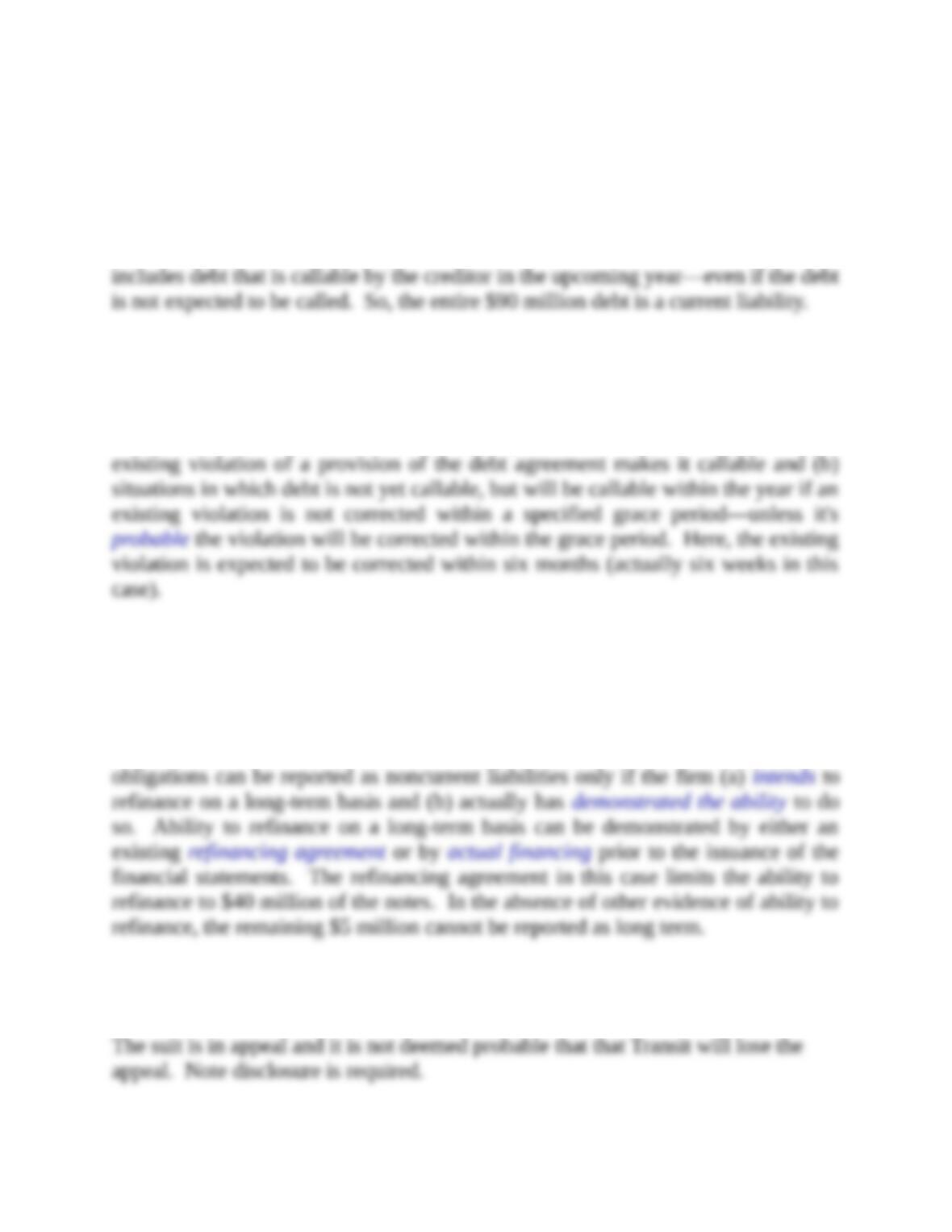
List A List B
j_ 1. Face amount x Interest rate x Time a. Informal agreement
g 2. Payable with current assets b. Secured loan
h 3. Short-term debt to be refinanced c. Refinancing prior to the
with common stock issuance of the
financial statements
Problem 13–12
Requirement 1
The requirement to classify currently maturing debt as a current liability
Requirement 2
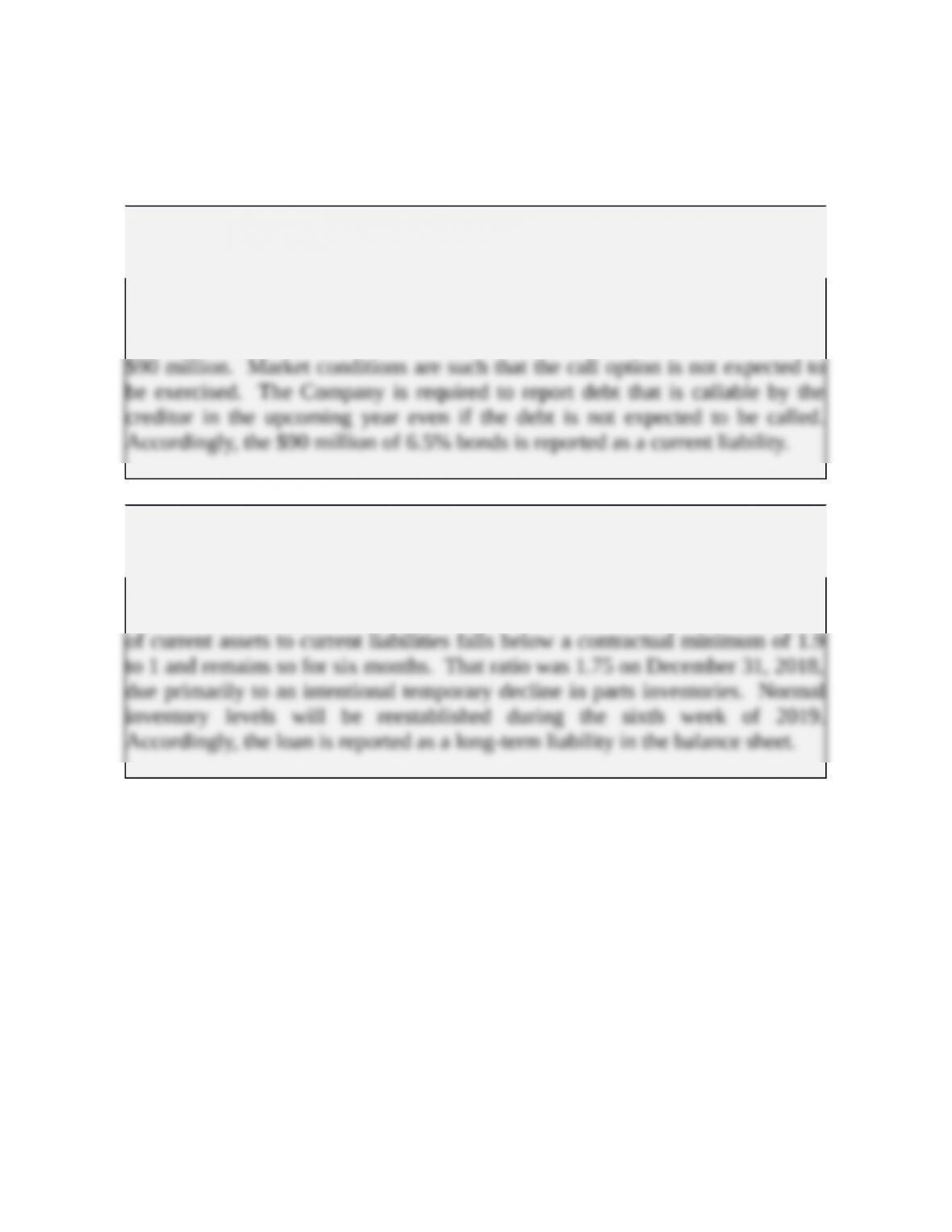
The entire $30 million loan should be reported as a long-term liability because
that amount is payable in 2024. The current liability classification includes (a)
situations in which the creditor has the right to demand payment because an
Requirement 3
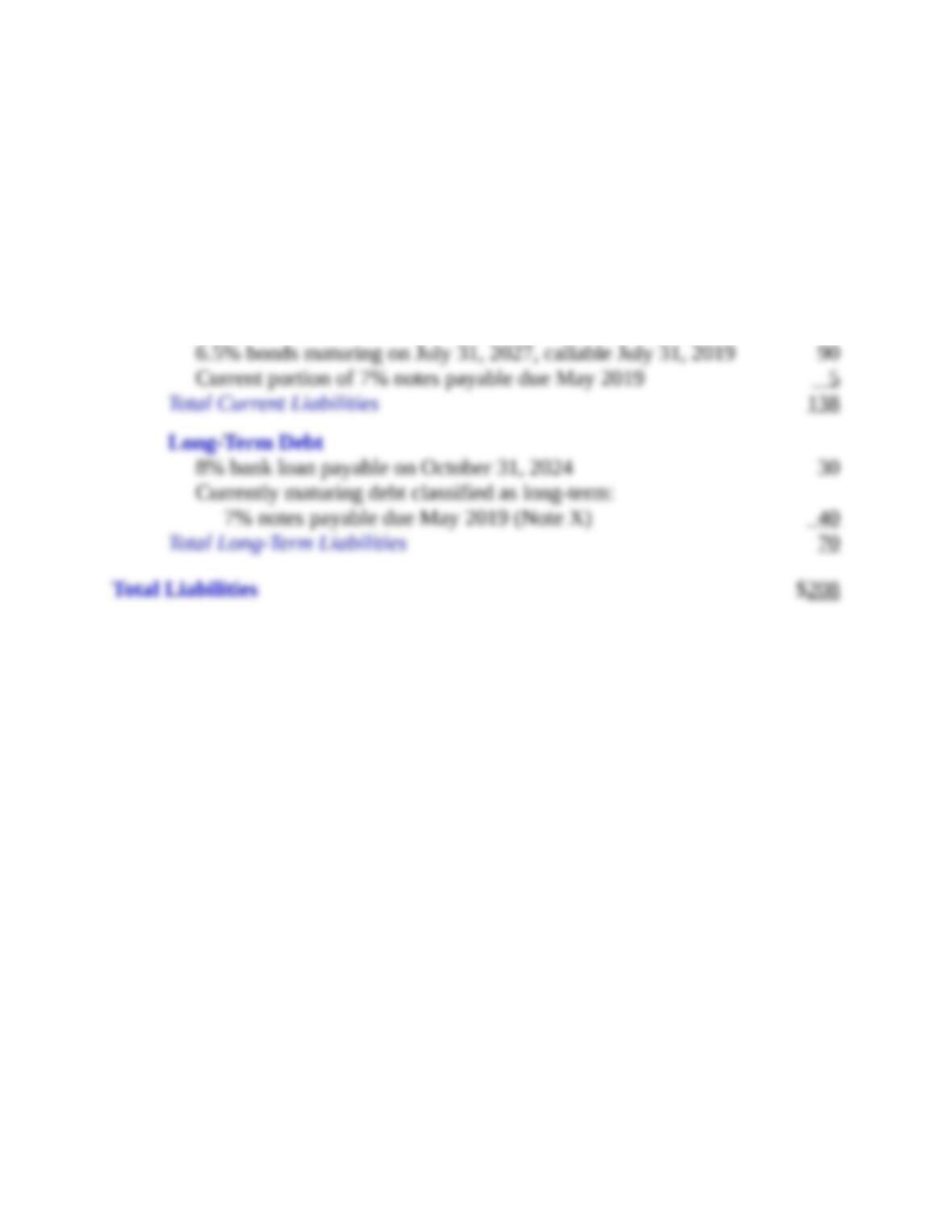
The intent of management is to refinance all $45,000,000 of the 7% notes, but
the refinancing agreement demonstrates the ability only for $40,000,000. $40
million can be reported as long term, but $5 million must be reported as a current
liability. Short-term obligations that are expected to be refinanced with long-term
Requirement 4
The lawsuit resulting from a dispute with a food caterer should not be accrued.
Problem 13–12 (continued)
Requirement 5
December 31, 2018
($ in millions)
Current Liabilities
Accounts payable and accruals $ 43
Problem 13–12 (continued)
Requirement 6
NOTE X: CALLABLE DEBT CLASSIFIED AS CURRENT
Transit has outstanding 6.5% bonds with a face amount of $90 million. The
bonds mature on July 31, 2027. Bondholders have the option of calling
(demanding payment on) the bonds on July 31, 2019, at a redemption price of
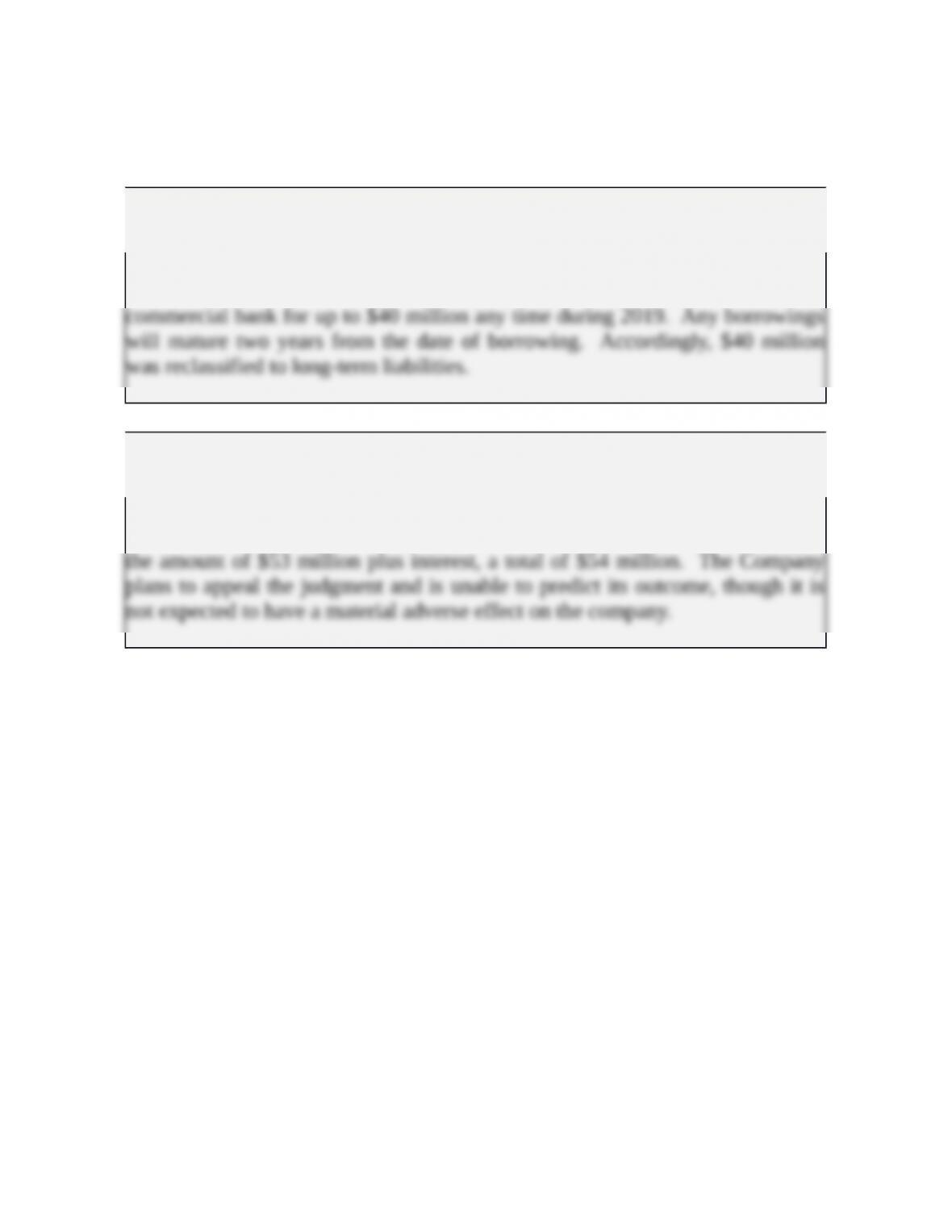
NOTE X: LOAN IN VIOLATION OF DEBT COVENANT
A $30 million 8% bank loan is payable on October 31, 2024. The bank has the
right to demand payment after any fiscal year-end in which the Company’s ratio
Problem 13–12 (concluded)
NOTE X: CURRENTLY MATURING DEBT CLASSIFIED AS LONG–TERM
The Company intends to refinance $45 million of 7% notes that mature in May
of 2019. In February 2019, the Company negotiated a line of credit with a
NOTE X: LAWSUIT
The Company is involved in a lawsuit resulting from a dispute with a food
caterer. On February 13, 2019, judgment was rendered against the Company in