A liability involves the past, the present, and the future. It is a present
responsibility, to sacrifice assets in the future, caused by a transaction or other event
1. are probable, future sacrifices of economic benefits
or long-term liabilities in a classified balance sheet. Current
liabilities are those expected to be satisfied with current assets or by the creation of
In concept, liabilities should be reported at their present values;
that is, the valuation amount is the present value of all future cash
payments resulting from the debt, usually principal and/or interest payments. In this
In practice, liabilities ordinarily are reported at their maturity amounts if payable
within one year because the relatively short time period makes the interest or time
© The McGraw-Hill Companies, Inc., 2018
Solutions Manual, Vol.2, Chapter 13 13–
0
Chapter 13 Current Liabilities and Contingencies
Questions for Review of Key Topics
Question 13–1
Question 13–2
Question 13–3
Answers to Questions (continued)
Lines of credit permit a company to borrow cash from a bank up
to a prearranged limit at a predetermined, usually floating, rate of
interest. The interest rate often is based on current rates of the prime London
Lines of credit can be noncommitted or committed. A noncommitted line of
credit allows the company to borrow without having to follow formal loan procedures
When interest is “discounted” from the face amount of a note at
the time it is written, it usually is referred to as a
“noninterest-bearing” note. Noninterest-bearing notes do, of course entail interest, but
Commercial paper represents loans from other corporations. It
refers to unsecured notes sold in minimum denominations of $25,000
with maturities ranging from 30 to 270 days. The firm would be required to file a
registration statement with the SEC if the maturity is beyond 270 days. The name
The interest rate usually is lower than in a bank loan because commercial paper
© The McGraw-Hill Companies, Inc., 2018
Solutions Manual, Vol.2, Chapter 13 13–
0
Question 13–4
Question 13–5
Question 13–6
Answers to Questions (continued)
during the current period, but not yet paid. The expense and related
liability should be recorded as follows:
This achieves a proper matching of this expense with the revenues it helps
An employer should accrue an expense and the related liability for
employees’ compensation for future absences, like vacation pay, if the
obligation meets each of four conditions: (1) the obligation is attributable to
Customary practice should be considered when deciding whether an obligation
exists. For instance, whether the rights to paid absences have been earned by services
already rendered sometimes depends on customary policy for the absence in question.
Similar concerns also influence whether unused rights to the paid absences can be
carried forward or expire. Although holiday time, military leave, maternity leave, and
jury time typically do not accumulate if unused, if it is customary practice that one can
be carried forward, a liability is accrued if it’s probable employees will be
© The McGraw-Hill Companies, Inc., 2018
Solutions Manual, Vol.2, Chapter 13 13–
0
Question 13–7
Question 13–8
Answers to Questions (continued)
When a company collects cash from a customer as a refundable
deposit or as an advance payment for products or services, a liability
is created obligating the firm to return the deposit or to supply the products or
Gift cards are a particular form of advance collection of
revenues. When the payment is received, the seller debits cash and
credits a deferred revenue liability. Later, deferred revenue is reduced and revenue
Examples of amounts collected for third parties that represent
liabilities until remitted are sales taxes, and payroll-related
The requirement to classify currently maturing debt as a
Short-term obligations can be reported as noncurrent liabilities
Under U.S. GAAP, ability to finance must be demonstrated by
© The McGraw-Hill Companies, Inc., 2018
Solutions Manual, Vol.2, Chapter 13 13–
0
Question 13–9
Question 13–10
Question 13–11
Answers to Questions (continued)
A loss contingency is an existing situation or set of
circumstances involving potential loss that will be resolved when
The likelihood that the future event(s) will confirm the
REASONABLY POSSIBLE—the chance the confirming event will occur is more than
remote but less than likely.
REMOTE—the chance the confirming event will occur is slight.
A liability should be accrued if it is both probable that the
Under U.S. GAAP, the term “contingent liability” is used to
refer generally to contingent losses, regardless of probability.
© The McGraw-Hill Companies, Inc., 2018
Solutions Manual, Vol.2, Chapter 13 13–
0
Question 13–15
Question 13–18
Answers to Questions (concluded)
If one or both of the accrual criteria is not met, but there is at
least a reasonable possibility that an obligation exists (the loss will
1. Manufacturers’ product warranties—these inevitably involve
2. Cash rebates and other premium offers—these inevitably involve expenditures,
The contingent liability for warranties and guarantees usually is
accrued. The estimated warranty (guarantee) liability is credited
and warranty (guarantee) expense is debited in the reporting period in which the
product under warranty is sold. An extended warranty provides warranty protection
Several weeks usually pass between the end of a company’s
fiscal year and the date the financial statements for that year
actually are issued. Any enlightening events occurring during this period should be
© The McGraw-Hill Companies, Inc., 2018
Solutions Manual, Vol.2, Chapter 13 13–
0
Question 13–19
Question 13–20
Question 13–21
Question 13–22
Answers to Questions (continued)
When a contingency comes into existence only after the
year-end, a liability cannot be accrued because none existed at the
end of the year. Yet, if the loss is probable and can be reasonably estimated, the
In U.S. GAAP, the low end of the range is accrued as a liability,
In IFRS, present values must be used to measure a liability
When an assessment is probable, reporting the possible
obligation would be warranted if an unfavorable settlement is at
1. Is the assessment probable? If it is not, no disclosure is warranted.
2. If the assessment is probable, evaluate (a) the likelihood of an unfavorable
© The McGraw-Hill Companies, Inc., 2018
Solutions Manual, Vol.2, Chapter 13 13–
0
Question 13–23
Question 13–26
Answers to Questions (continued)
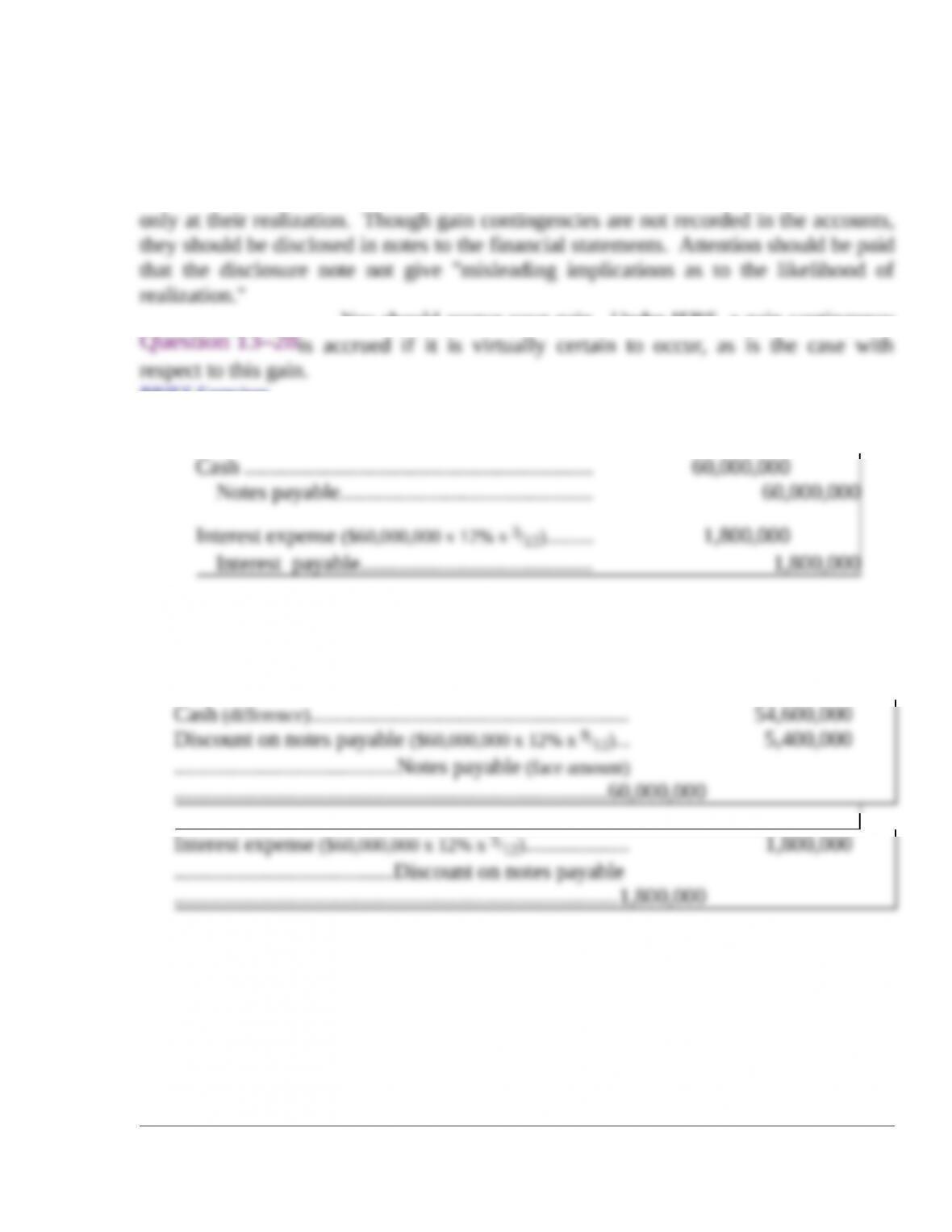
You should not accrue your gain. A gain contingency should
not be accrued. This conservative treatment is consistent with the
general inclination of accounting practice to anticipate losses, but to recognize gains
You should accrue your gain. Under IFRS, a gain contingency
Brief Exercise 13–1
Brief Exercise 13–2
Brief Exercise 13–3
a.
December 31
© The McGraw-Hill Companies, Inc., 2018
Solutions Manual, Vol.2, Chapter 13 13–
0
Question 13–27
BRIEF Exercises

b.
September 30
© The McGraw-Hill Companies, Inc., 2018
Solutions Manual, Vol.2, Chapter 13 13–
0
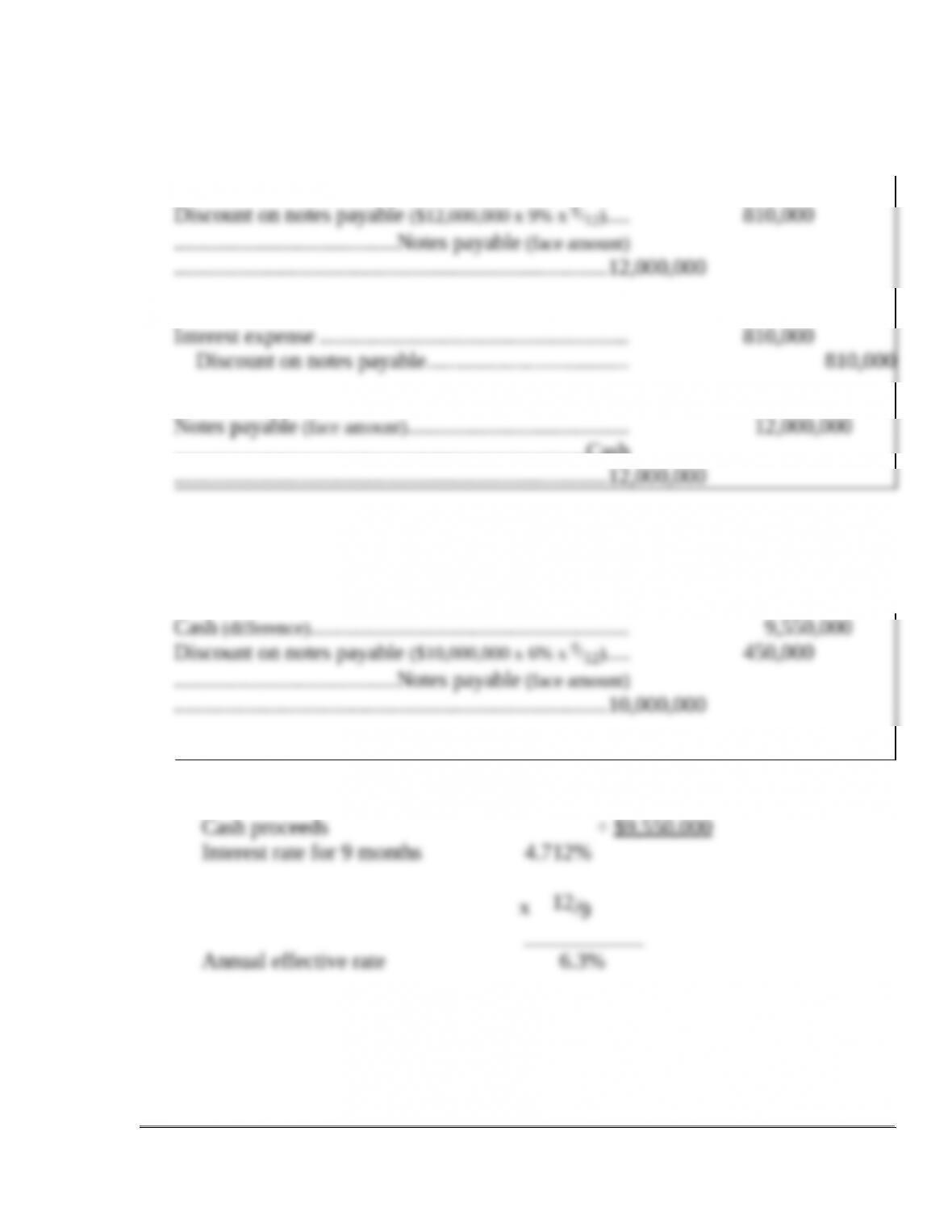
Brief Exercise 13–4
Cash (difference)…………………………………………………. 11,190,000
…………………………………………………………………Cash
Brief Exercise 13–5
Effective interest rate:
Discount ($10,000,000 x 6% x 9/12)$ 450,000
© The McGraw-Hill Companies, Inc., 2018
Solutions Manual, Vol.2, Chapter 13 13–
0

© The McGraw-Hill Companies, Inc., 2018
Solutions Manual, Vol.2, Chapter 13 13–
0