Brief Exercise 12–2
Because S&L Financial is purchasing the bonds for purposes of earning profits on
short-term differences in price, those bonds would be classified as trading
securities. For trading securities, gains and losses from changes in fair values are
recognized in net income in the periods in which they occur.
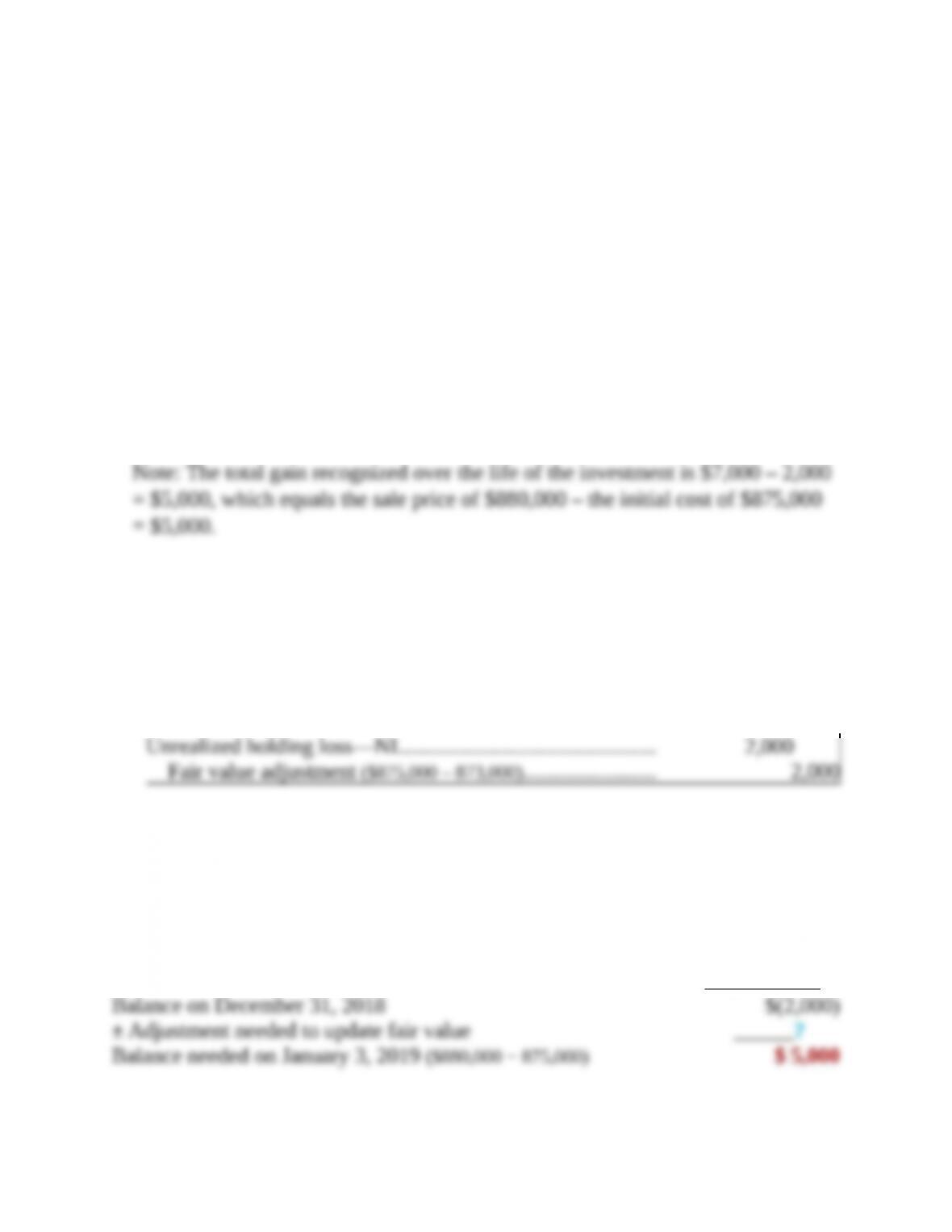
2018 change in fair value: $875,000 – 873,000 = unrealized holding loss of $2,000
included in 2018 net income.
2019 change in fair value: $880,000 – 873,000 = unrealized holding gain of $7,000
included in 2019 net income.
Brief Exercise 12–3
2018
December 31
2019
January 3
Step 1: Adjust to fair value on date of sale:
Fair Value
Adjustment
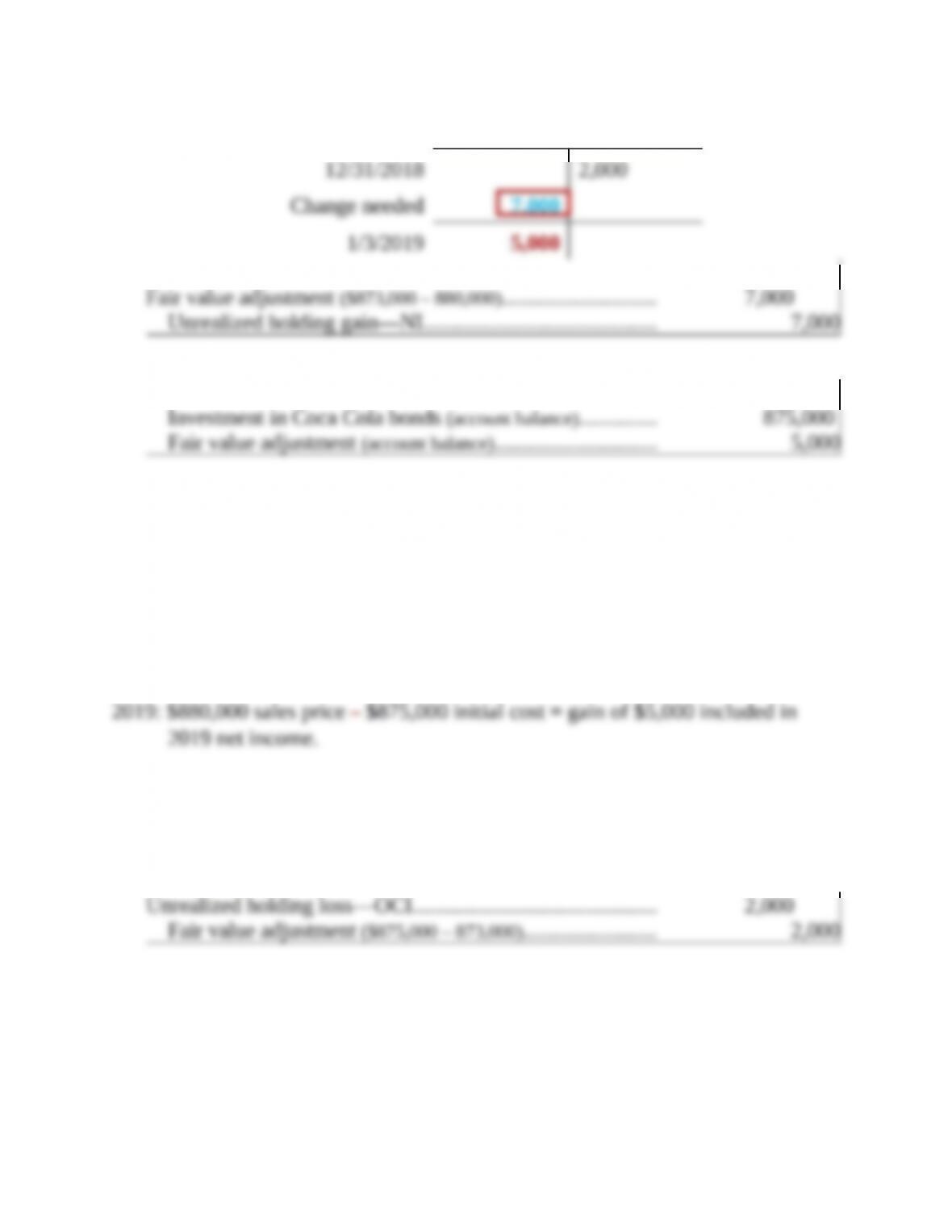
Fair-Value Adjustment
Step 2: Record the sale transaction:
Cash (selling price)………………………………………………………… 880,000
Brief Exercise 12–4
S&L Financial classifies the bonds as available-for-sale investments. For AFS
investments, gains and losses from changes in fair values are recognized in other
comprehensive income in the periods in which they occur, and recognized in net
income only in the period in which they are realized.
2018: no sale, so no effect on net income.
Brief Exercise 12–5
2018
December 31
2019
January 3: Three journal entries:
1. Adjust to fair value on date of sale:
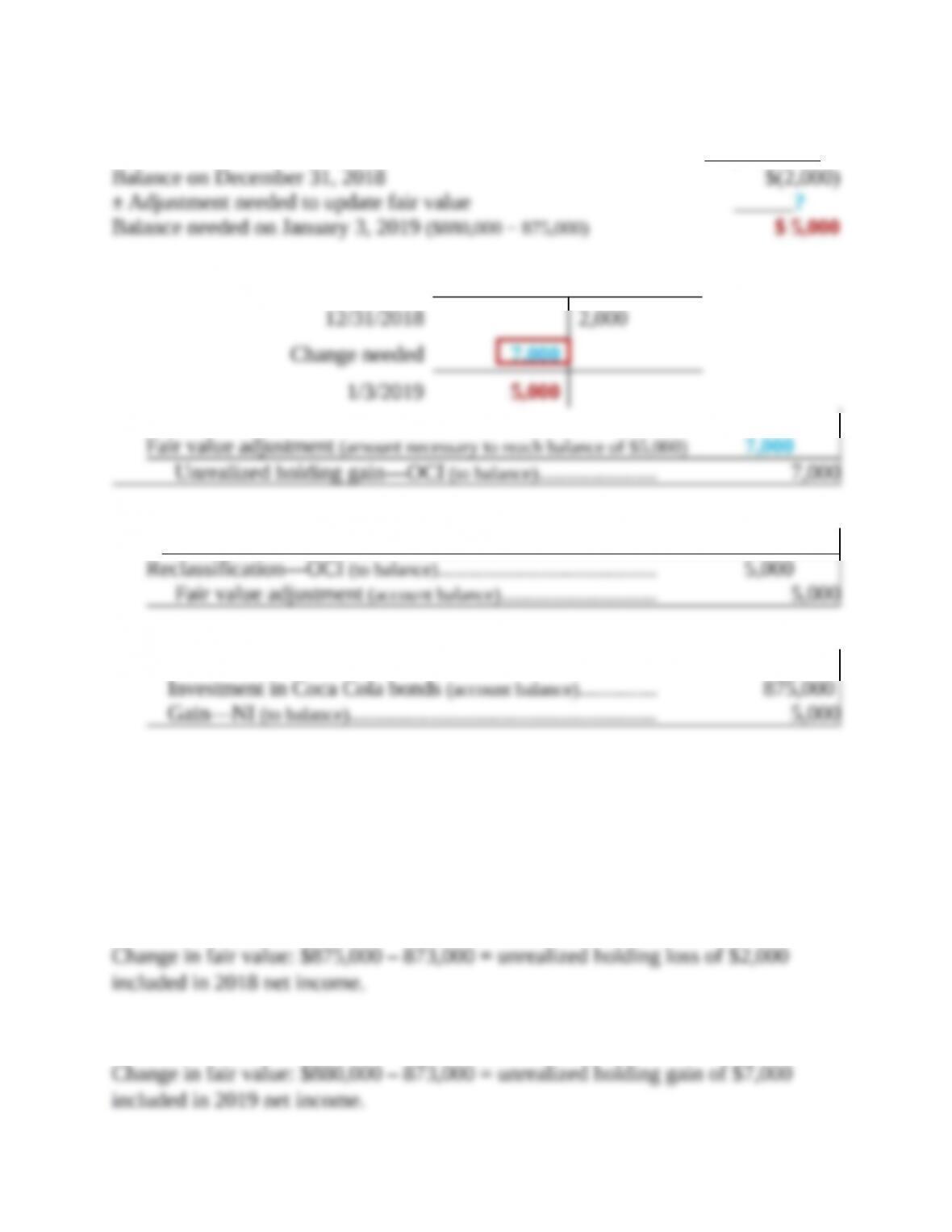
Fair-Value Adjustment
2. Reverse previous fair value adjustments:
3. Record the sale transaction:
Cash (selling price)………………………………………………………… 880,000
Brief Exercise 12–6
Because S&L Financial elected the fair value option for their investment,
unrealized holding gains and losses from changes in fair values are recognized in
net income in the periods in which they occur.
2018
2019
Fair Value
Adjustment

Brief Exercise 12–7
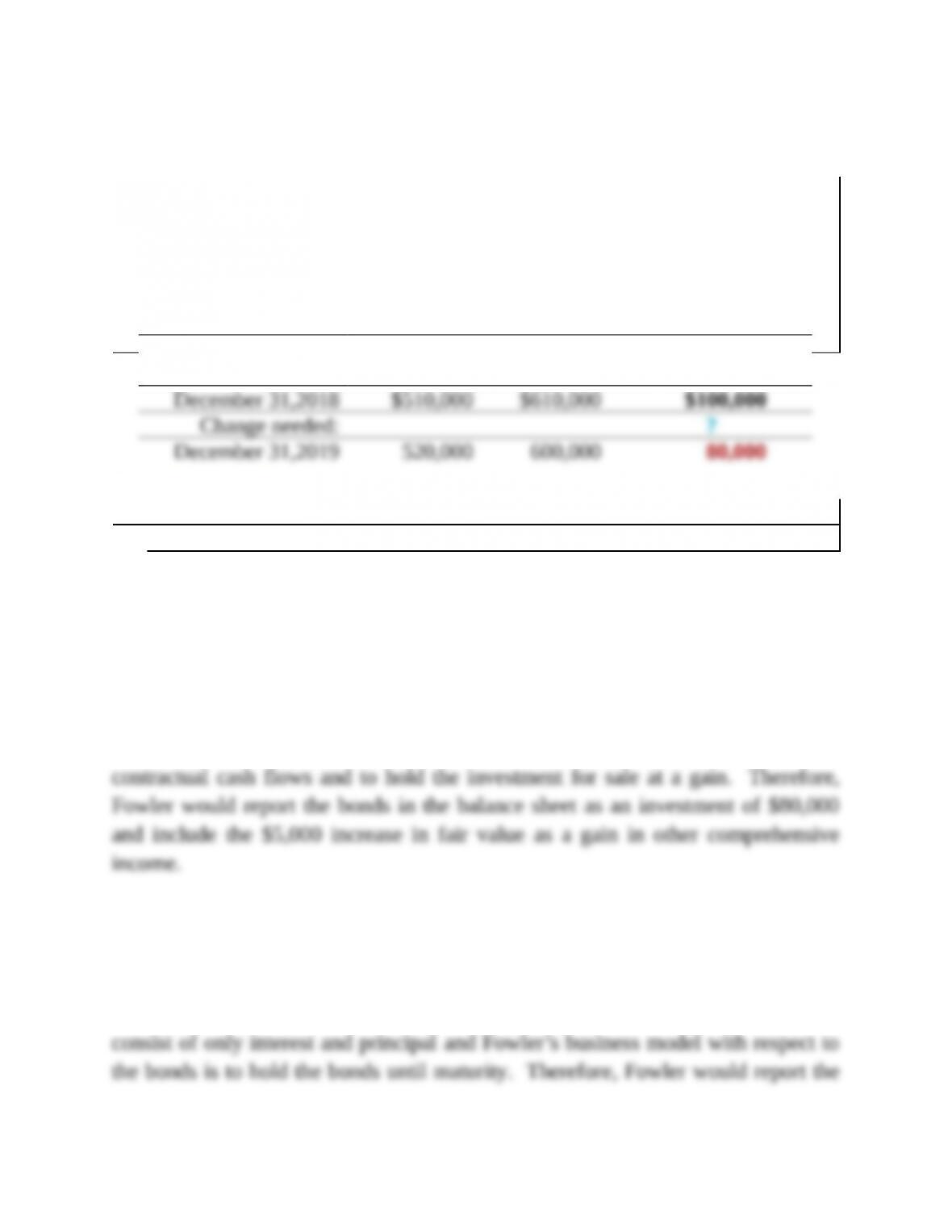
AFS securities are reported at fair value, so in the December 31, 2019 balance
sheet the Microsoft bonds will be reported at $600,000.
Change needed in the fair value adjustment to report the bonds at that fair value:
Fair Value Adjustment
100,000
December 31, 2019
Unrealized holding loss—OCI (to balance)……………………………. 20,000
Fair value adjustment (amount necessary to reach balance of $80,000) 20,000
Brief Exercise 12–8
Fowler would account for the bonds at fair value through other comprehensive
income (FVOCI), because the bonds’ cash flows consist of only interest and
principal, and Fowler’s business model with respect to the bonds is to both collect
Brief Exercise 12–9
Fowler would account for the bonds at amortized cost, because its cash flows
Date
Amortized
Cost Fair Value
Fair Value
Adjustment
Brief Exercise 12–10
Given that the size of Adams’ investment is not sufficient for it to exercise
Brief Exercise 12–11
An investor should account for dividends from an investment not accounted for
Brief Exercise 12–12
An investor should account for dividends from an equity method investee as a
reduction in its investment account. Since investment revenue is recognized as the
investee earns it, it would be inappropriate to again recognize revenue when
Brief Exercise 12–14
Kim doesn’t need to amortize any of the $2 million difference, because the
entire difference relates to land, which does not depreciate. Kim would increase its
Brief Exercise 12–15
The investment account would not change. Instead, the equity method would
start as if the investment had been purchased in the current year for $44 million.

the equity method had been used all along. A disclosure note should describe the
Brief Exercise 12–16
Given Turner’s election of the fair value option, it would account for this
2018
January 2
December 30
December 31
Fair value adjustment ($11.5M – 10M)…………………………….. 1,500,000
Note: A different approach to reach the same outcome would be for Turner to
use equity method accounting throughout the year, and then at the end of the
year make whatever adjustment to fair value is necessary to adjust the
investment account to fair value. Under that approach, Turner would recognize
40% of ICA’s $750,000 income ($300,000) as investment income, it would not
recognize investment income associated with ICA’s dividend, and it would end
Brief Exercise 12–17
LED believes it is more likely than not that it will have to sell the investment
before fair value recovers, so the portion of the impairment that consists of credit
and noncredit losses is not relevant. LED must recognize the entire OTT
impairment in earnings, reducing the carrying value of the LED bonds by crediting
a discount on bond investment account. LED records the impairment of $450,000
and reclassifies previously recognized unrealized losses of $100,000 as follows:
Fair value adjustment…………………………………… 100,000
In the income statement, the entire $450,000 will be shown as an OTT
impairment loss. A $100,000 reclassification adjustment will increase OCI
Brief Exercise 12–18
LED believes it is more likely than not that it will have to sell the investment
before fair value recovers, so the portion of the impairment that consists of credit
and noncredit losses is not relevant. LED must recognize the entire OTT
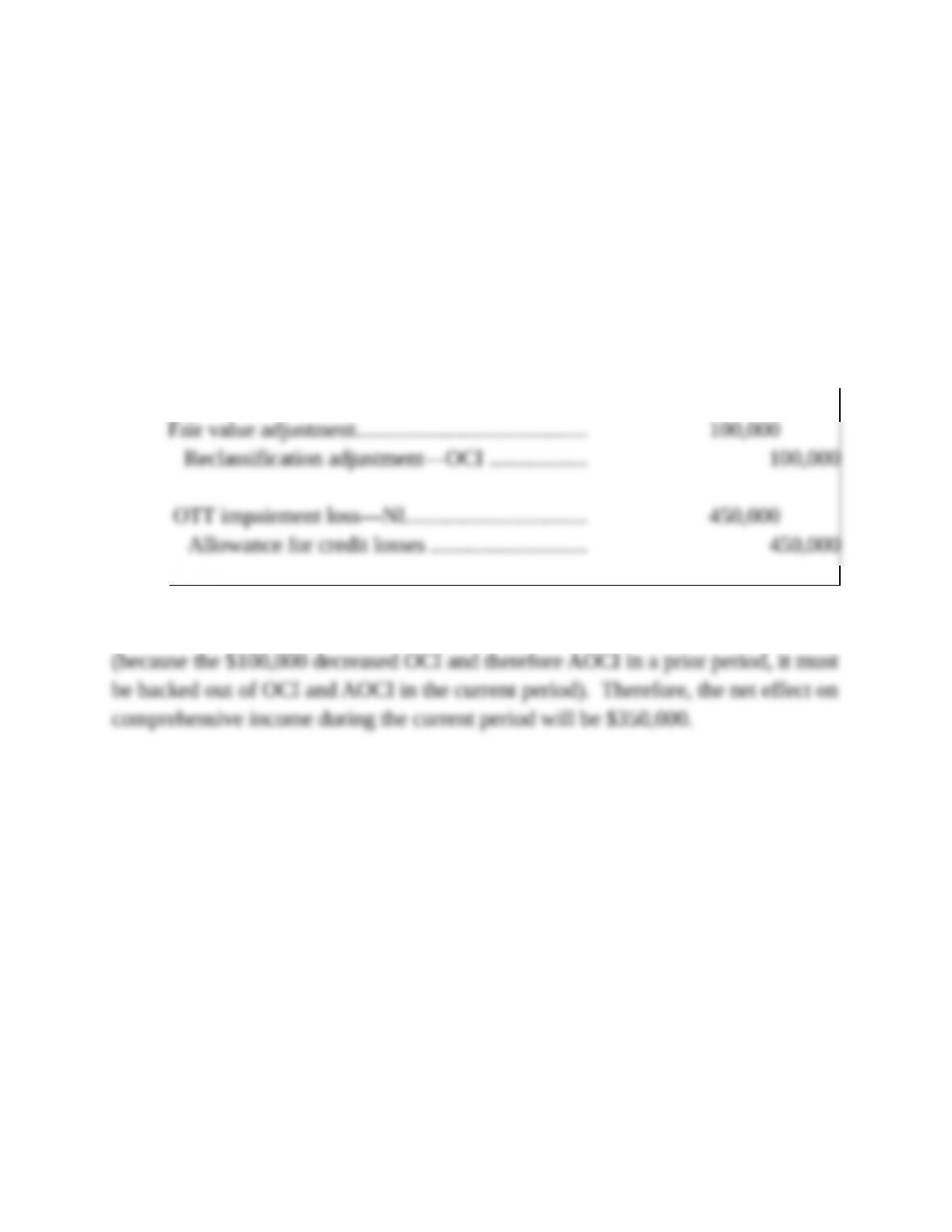
impairment in earnings. Under the AFS Credit Loss Model, LED reduces the
carrying value of the LED bonds indirectly by crediting a contra-asset allowance
account. LED records the impairment of $450,000 and reclassifies previously
recognized unrealized losses of $100,000 as follows:
In the income statement, the entire $450,000 will be shown as an OTT
impairment loss. A $100,000 reclassification adjustment will increase OCI