International Case 12–4
Requirement 1
P. 140 of the 10K includes the following note:
“Interests in other companies
Interests in other companies are measured at fair value. Investments in equity
investments that do not have a quoted market price in an active market and whose
fair value cannot be reliably measured are recognized at cost. For investments
Thus, FCA carries some equity investments as available-for-sale investments.
Prior to ASU 2016-1, U.S. GAAP allowed classification of equity investments as
Research Case 12–5
Answers to the questions will, of course, vary because students will research
The responses should identify securities held that are classified as trading
securities, available-for-sale, or held-to-maturity. If the financial statements were
Although a company is not required to report individual amounts for the three
If securities available-for-sale are held, there may be accumulated unrealized
gains or losses reported in AOCI in the shareholders’ equity section of the balance
Unlike the treatment of securities available-for-sale, unrealized holding gains
The statement of cash flows will report acquisitions or disposals of available for
Real World Case 12–6
Requirement 1
Merck’s 2015 balance sheet lists $13,039 million of investments as
Requirement 2
Accounting for unrealized gains and losses (both temporary and OTT):
“Investments — Investments in marketable debt and equity securities
classified as available-for-sale are reported at fair value. Fair values of the
Company’s investments are determined using quoted market prices in active
markets for identical assets or liabilities or quoted prices for similar assets or
liabilities or other inputs that are observable or can be corroborated by
observable market data for substantially the full term of the assets or
liabilities. Changes in fair value that are considered temporary are reported
net of tax in Other Comprehensive Income (OCI). For declines in the fair
value of equity securities that are considered other-than-temporary,
impairment losses are charged to Other (income) expense, net. The Company
considers available evidence in evaluating potential impairments of its
investments, including the duration and extent to which fair value is less than
cost and, for equity securities, the Company’s ability and intent to hold the
investments. For debt securities, an other-than-temporary impairment has
occurred if the Company does not expect to recover the entire amortized cost
basis of the debt security. If the Company does not intend to sell the impaired
debt security, and it is not more likely than not it will be required to sell the
debt security before the recovery of its amortized cost basis, the amount of
the other-than-temporary impairment recognized in earnings, recorded in
Other (income) expense, net, is limited to the portion attributed to credit loss.
The remaining portion of the other-than-temporary impairment related to
other factors is recognized in OCI.”
Case 12–6 (concluded)
Accounting for realized gains and losses:
“Realized gains and losses for both debt and equity securities are
included in Other (income) expense, net.”
Requirement 3
Investments accounted for using the equity method are described in Note 8,
Requirement 4
Requirement 5
Operating activities section: Cash inflows from dividends are shown in
operations on the statement of cash flows, and equal $50 million for 2015.
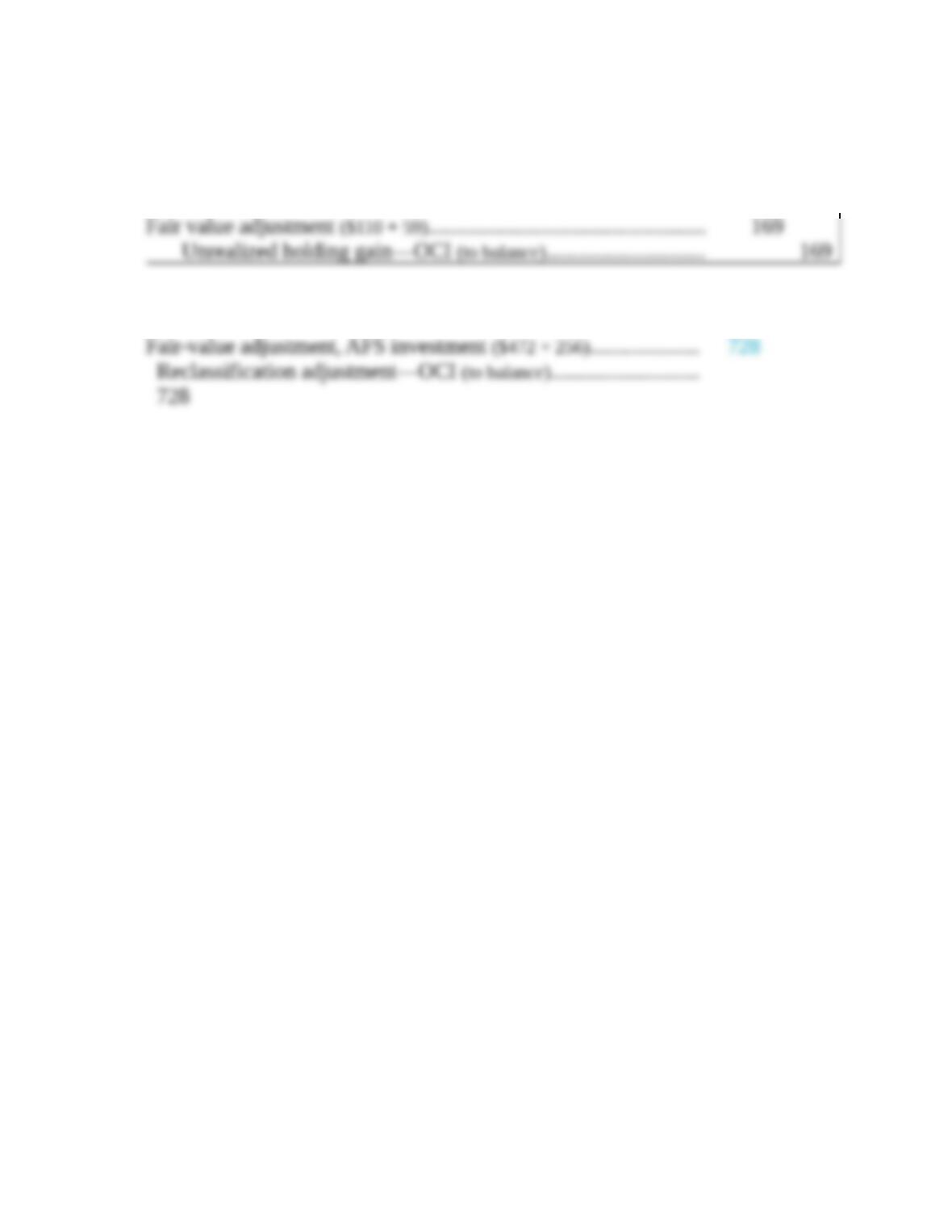
Investing section: Cash outflows from acquiring investments or inflows
from selling them are reported as investing activities in the company’s
comparative statements of cash flows. Whether they are specifically
Real World Case 12–7
Requirement 1
Requirement 2
Trueblood Accounting Case 12–8
A solution and extensive discussion materials accompany each case in the
Deloitte & Touche Trueblood Case Study Series. These are available to instructors
at:
http://www2.deloitte.com/us/en/pages/about-deloitte/articles/trueblood-case-studie
s-deloitte-foundation.html.
Research Case 12–9
From “Recognition and Presentation of Other-Than-Temporary Impairments,”
FASB Staff Position (FSP) No. 115-2 and 124-2 (Norwalk, Conn.: FASB April 9,
2009), pp. 17–19,
1. Need to reduce net income for the full difference between amortized
cost and fair value for debt investments, rather than only for credit
losses, because that better suits the needs of investors: “Messrs.
Linsmeier and Siegel …believe that to the extent there is an
other-than-temporary impairment, it should be measured as the entire
difference between the fair value and the carrying value of the impaired item
with that change fully reflected in net income as an unrealized loss.
a. Messrs. Linsmeier and Siegel believe that investors generally have
opined that their preference is for the fair value of financial
instruments to be reflected in net income. … Messrs. Linsmeier and
b. Messrs. Linsmeier and Siegel also object to bifurcating (dividing) the
2. Likely that there will be fewer OTT impairments given the new
recognition criteria: “Second, Messrs. Linsmeier and Siegel object to the
change in the trigger for the nonrecognition of the full impairment loss in net
income. The previous GAAP requirements permitted nonrecognition of the

Case 12–9 (concluded)
3. Lack of convergence with the IASB: Finally, Messrs. Linsmeier and
Siegel believe that there potentially may be other standard-setting issues that
need to be addressed within the current other-than-temporary impairment
model. However, they would prefer to address those concerns in the joint
Note: This dissent offers interesting opportunities for classroom discussion. Points
that might come up include:
1. Political pressures on the FASB (banks were pushing hard for flexibility in
Target Case
Requirement 1
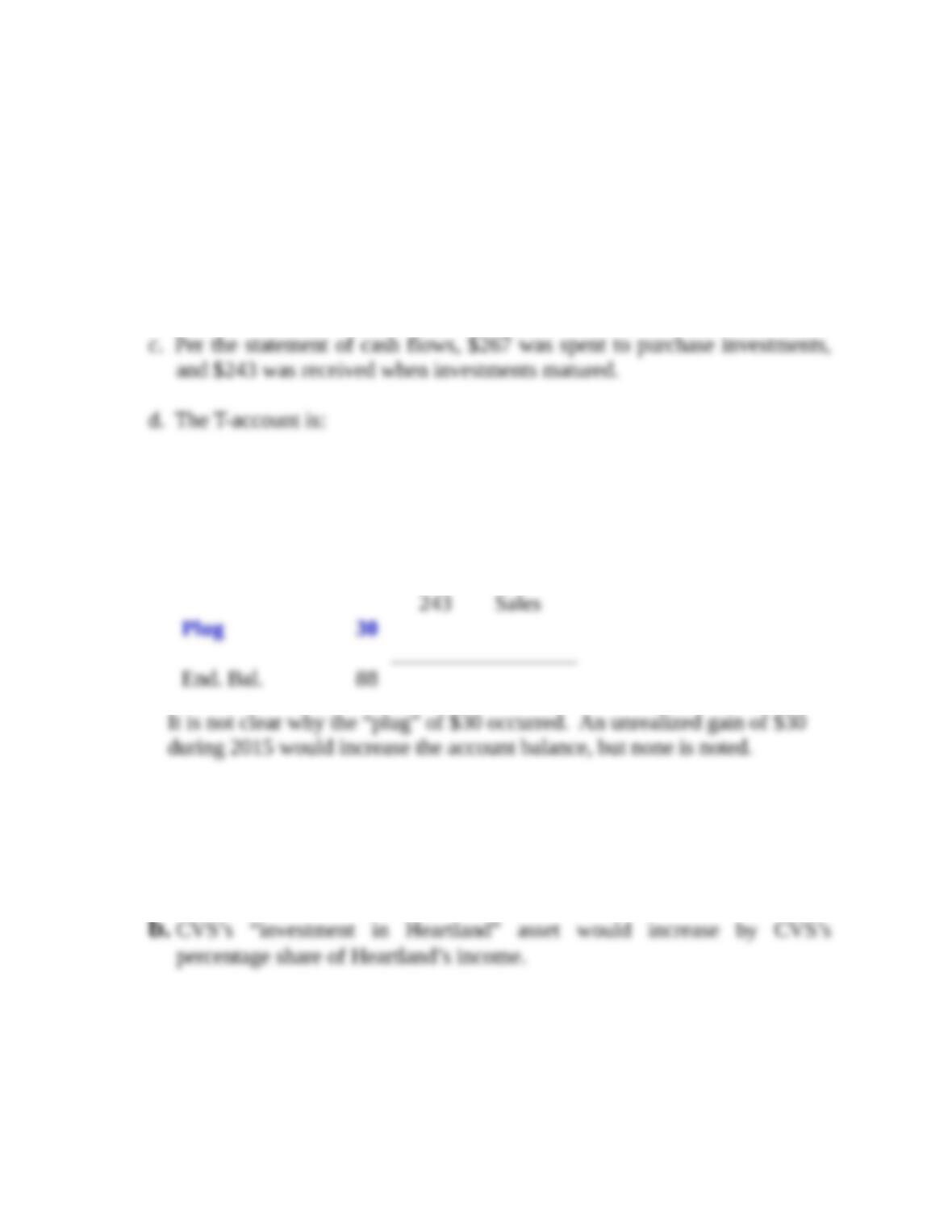
a. Per Note 1, the investments are classified as available-for-sale securities.
b. Per the balance sheet, the investments had a balance of $88 and $34 at
December 31, 2015 and 2014, respectively.
Short-term Investments
__________________________________________
($ in thousands)
Beg. Bal. 34
Purchases 267
Requirement 2
a. CVS’s income would increase by CVS’s percentage share of Heartland’s
income.
Air France-KLM Case
Requirement 1
a. Per note 24 (“Other financial assets”), the balance of investments accounted
for at FVPL is $877 (including “Cash secured” portion) as of December 31,
2015, equal to $406 current marketable securities, $60 non-current
c. Per note 36.4 (“Valuation methods for financial assets and liabilities at their
fair value”), $37 of the $877 balance is estimated using level 1 inputs, and
Requirement 2
a. Per note 24 (“Other financial assets”), the balance of investments accounted
for as available for sale is $432 as of December 31, 2015, including $29
c. Per note 36.4 (“Valuation methods for financial assets and liabilities at their
fair value”), $429 of the $432 is estimated using level 1 inputs, and the
Air France-KLM Case (concluded)
Requirement 3
a. Per note 4.3, “In accordance with IAS 28 “Investments in Associates and
Joint Ventures”, companies in which the Group has the ability to exercise
b. Per note 4.3, “In accordance with IFRS 11 “Join arrangements”, the Group
c. Per note 22 (“Equity affiliates”) and the balance sheet, the carrying value of
Per note 22 and the income statement, AF’s equity-method investments reduced its net income
from continuing operations by $30 during 2015