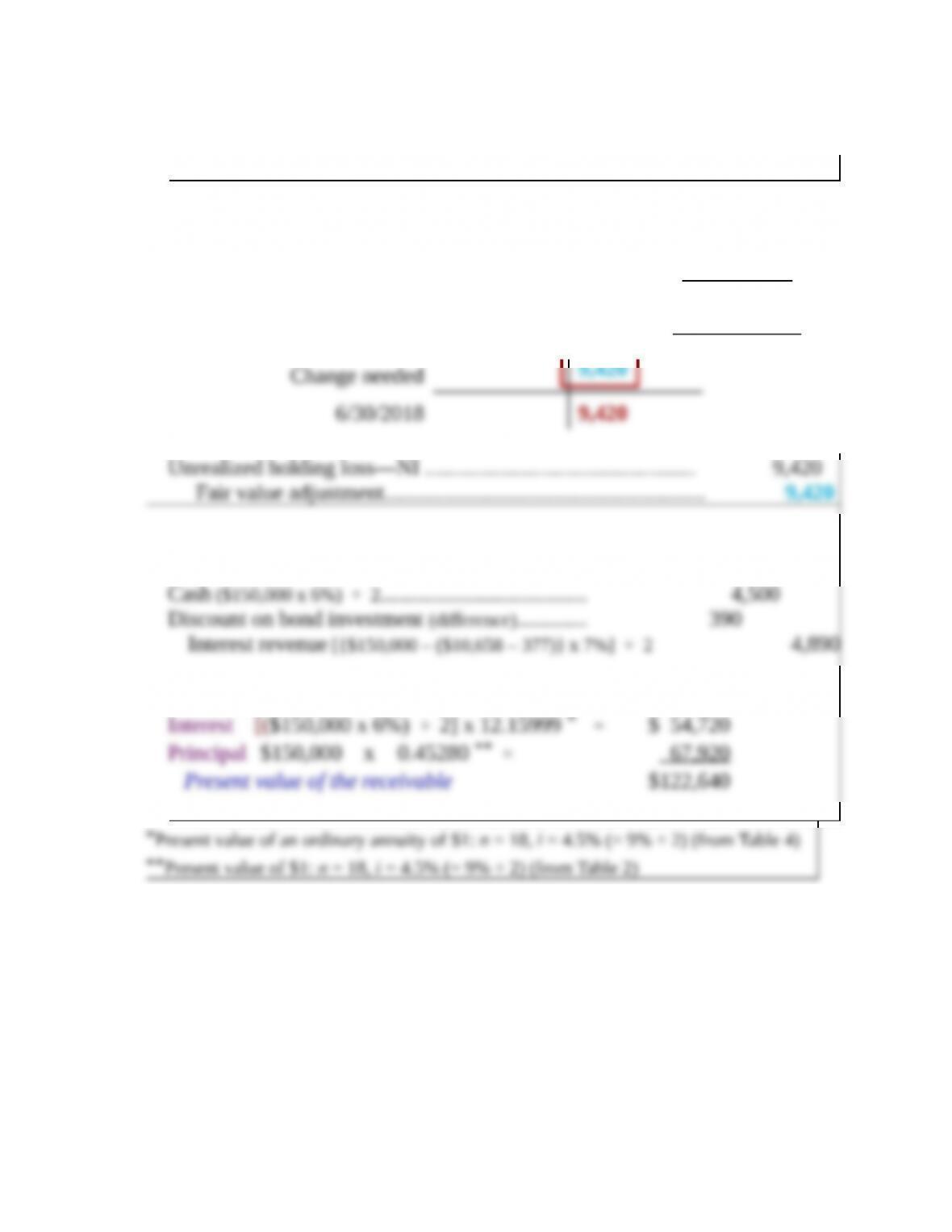
Problem 12–16 (continued)
Need to move from a fair-value adjustment from $0 to ($9,420):
Fair-Value
Adjustment
1/1/2018 0
December 31, 2018
Bond Fair Value at December 31, 2018:
Fair Value
Adjustment
Balance on 1/1/2018 $ 2
± Adjustment needed to update fair value ?
Balance needed on 6/30/2018 ($9,420)
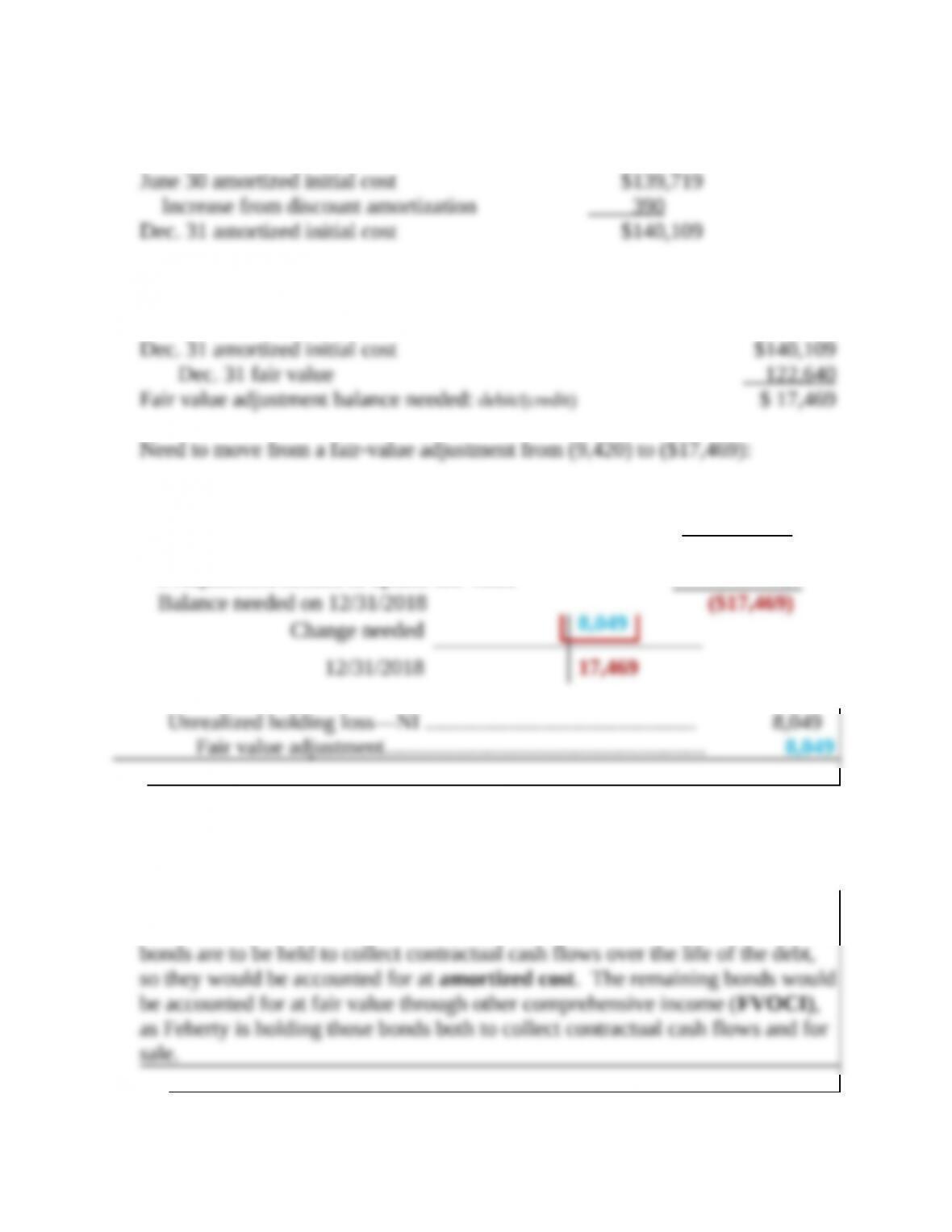
Problem 12–16 (concluded)
Comparing the amortized initial cost with the fair value of the bonds on that
date provides the amount needed to adjust the investment to its fair value.
Fair-Value
Adjustment
Problem 12–17
Requirement 1
The Donald Company bonds include only interest and principal, so Feherty’s
business purpose is relevant for the purpose of classification and reporting. Ten
Fair Value
Adjustment
Balance on 6/30/2018 ($ 9,420)
± Adjustment needed to update fair value ?
The Watson company stock would be accounted for at fair value through
OCI (FVOCI) because that is what Feherty elected. Feherty can make that
irrevocable election, but otherwise, because it does not qualify for the equity
method, would account for the Watson equity investment as FVPL.
Requirement 2
The Donald Company bonds would be reported as follows:
Ten bonds are accounted for at amortized cost. No unrealized gain or
Forty bonds are accounted for at FVOCI. Ten of the bonds were sold at
For the other 30 bonds accounted for at FVOCI, unrealized gains of 30
The Watson Company common stock investment is accounted for at
FVOCI, so an unrealized gain of $5,000 ($30,000 – 25,000) would be included
in other comprehensive income and, therefore, in comprehensive income.
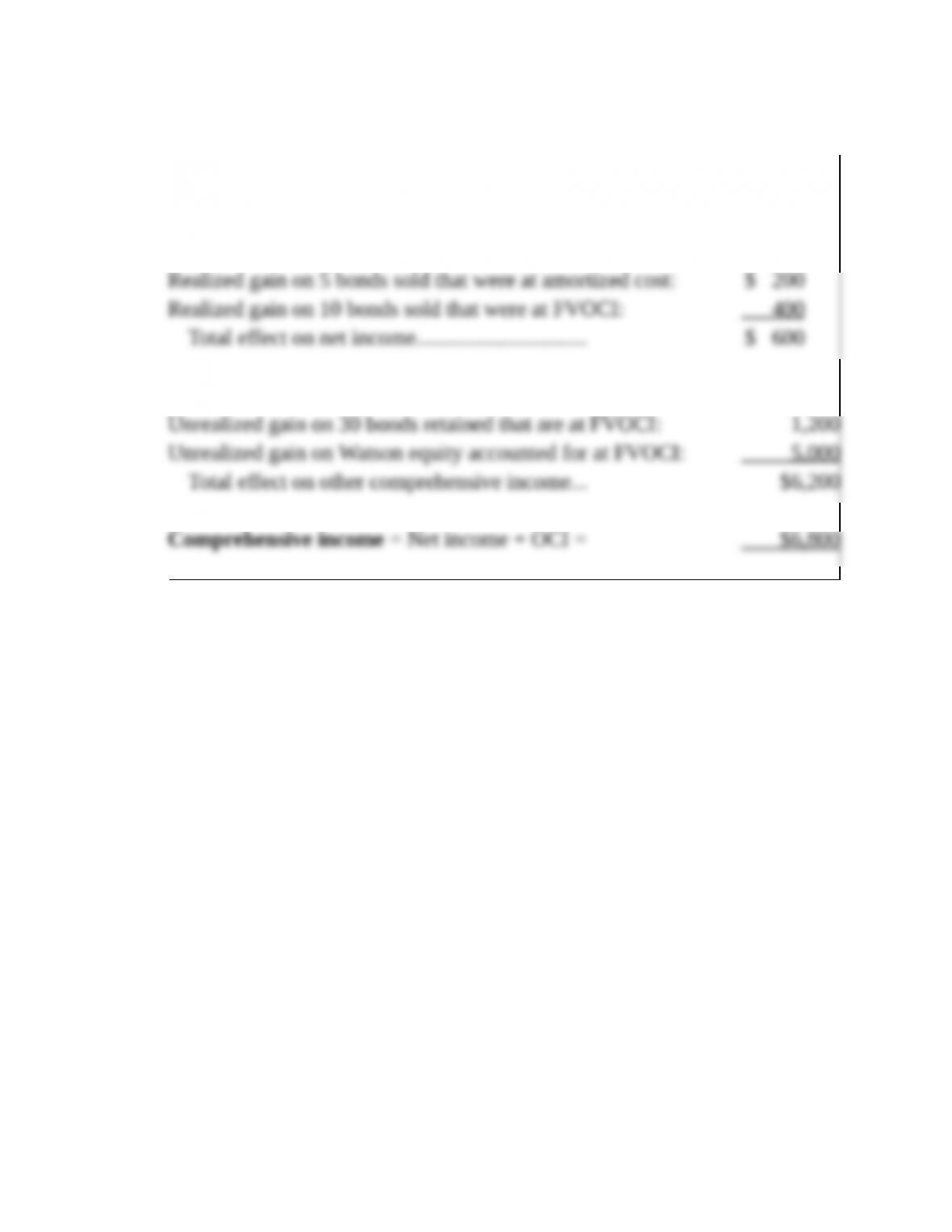
Problem 12–17 (concluded)
Total effects are as follows:
Net income:
Other comprehensive income (OCI):
Problem 12–18
Bee Company Investment
2018: Stewart does not plan to sell the Bee investment, and does not believe it is
more likely than not that it will have to sell the investment before fair value
recovers, so the portion of the impairment that consists of credit and noncredit
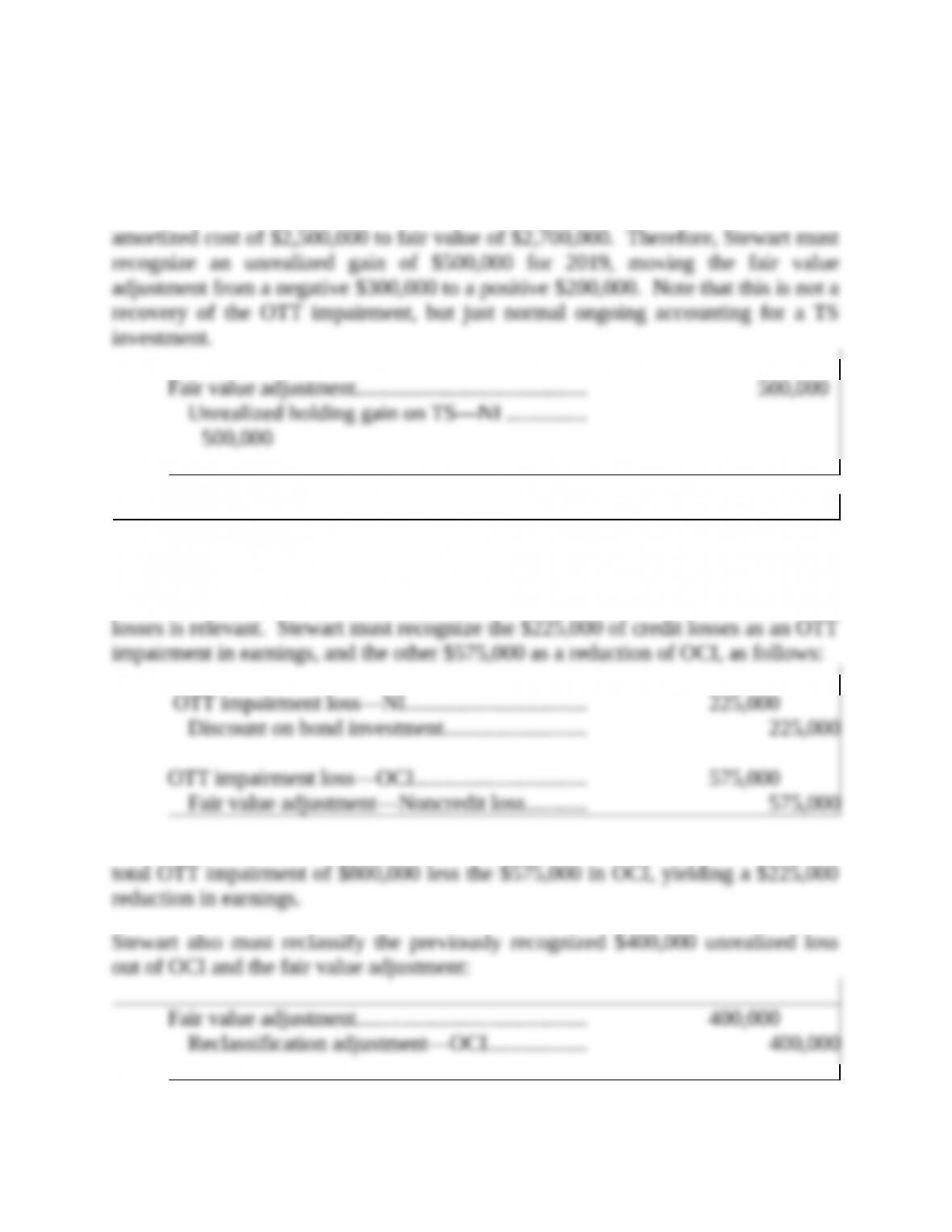
losses is relevant. Stewart must recognize the $240,000 of credit losses as an OTT
impairment in earnings, and the other $260,000 as a reduction of OCI, as follows:
2019: Stewart ignores the change in Bee’s fair value during 2019, as the Bee
investment is accounted for as an HTM investment and fair value changes are not
relevant unless viewed as OTT impairments. GAAP does not allow recovery of
prior OTT impairments when fair value increases. Over the remaining life of the
Oliver Corporation Investment
2018: Stewart accounts for the Oliver investment as a trading security, so OTT
impairment accounting is not relevant. Stewart simply continues to recognize in
Problem 12–18 (continued)
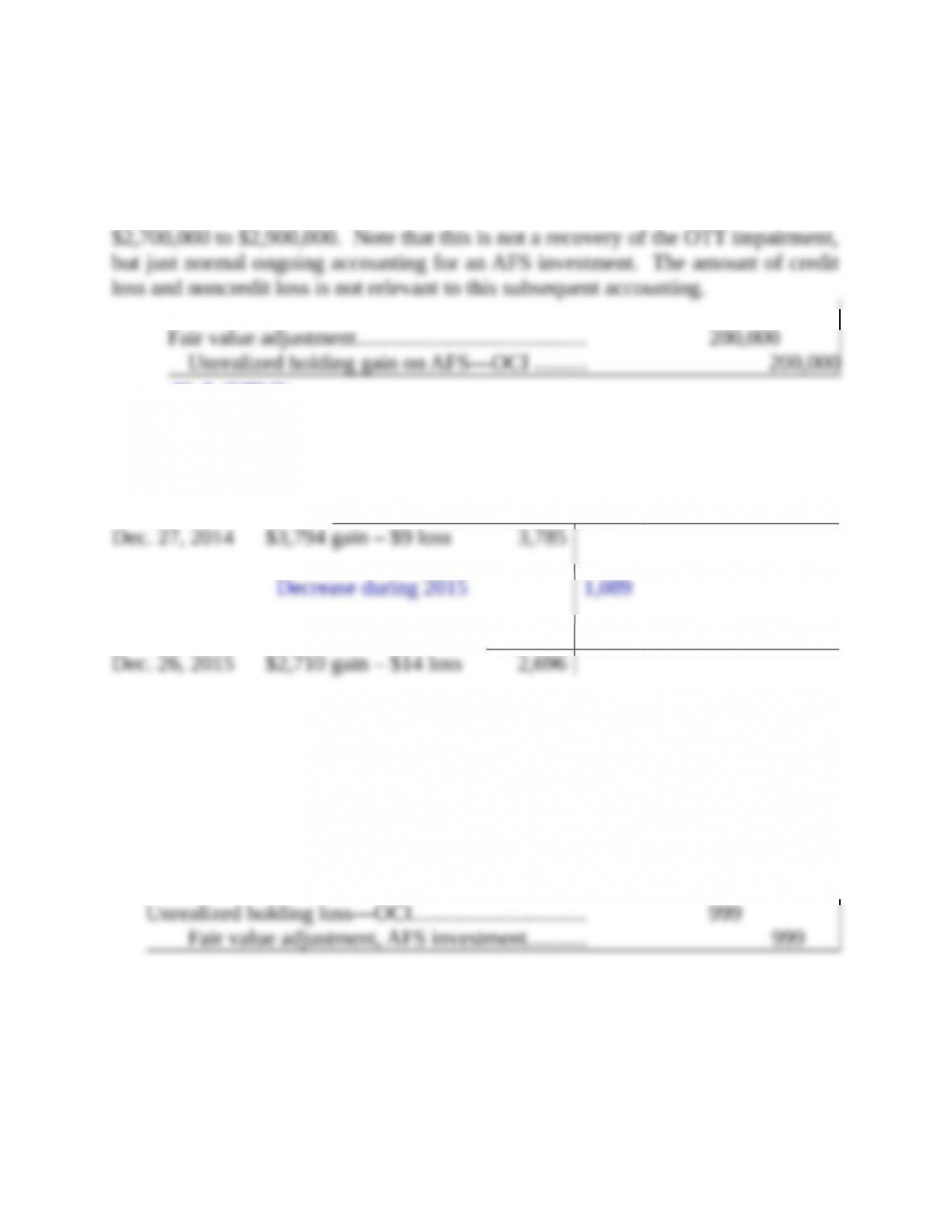
2019: Fair value increased to $2,700,000 during 2019, so Stewart needs to have a
positive fair value adjustment of $200,000 in the balance sheet to adjust from
Jones, Inc Investment
2018: Stewart does not plan to sell the Jones investment, and does not believe it is
more likely than not that it will have to sell the investment before fair value
recovers, so the portion of the impairment that consists of credit and noncredit
However, Stewart still would need to show on the face of the income statement the
Problem 12–18 (concluded)
2019: Stewart continues to treat the Jones investment as AFS. Therefore, Stewart
would show an unrealized gain associated with an increase of fair value from
Real World Case 12–1
Requirement 1
Fair Value Adjustment, AFS Investments
Given the T-account above, the fair value adjustment change during 2015 was a
reduction of $1,089 million.
Requirement 2
Intel would record the following entry to account for unrealized holding gains
and losses associated with its AFS investments:
Actually, Intel would have some gains and some losses recognized in OCI. This
journal entry combines entries made for all AFS investments.
The effect of that journal entry would be to credit (decrease) the T-account.
CASES
Case 12–1 (concluded)
Requirement 3
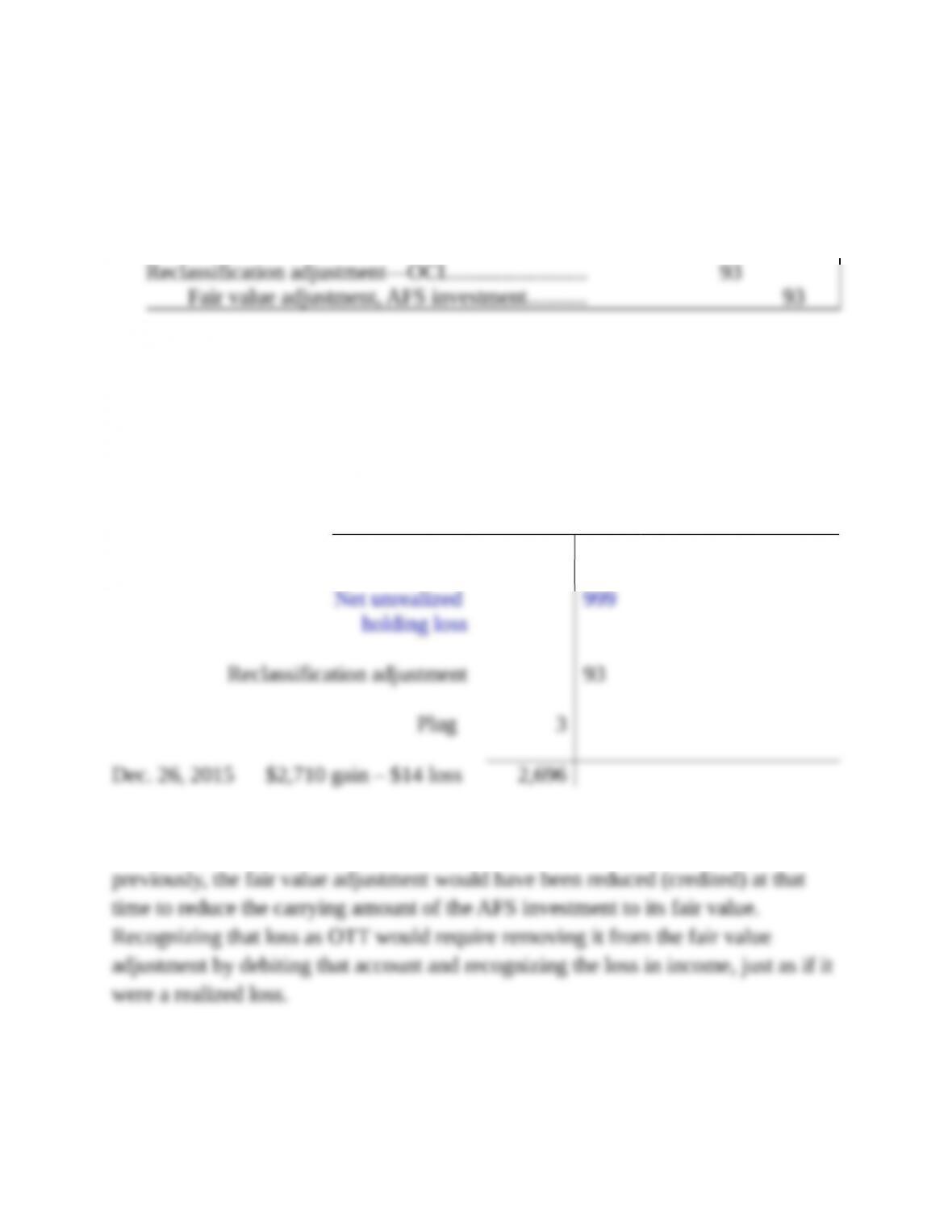
Intel would record the following entry to make its reclassification adjustment:
The fair value adjustment is credited (reduced) by $93 because reclassification is
removing unrealized gains from the fair value adjustment and from OCI. The
effect of that journal entry would be to credit (decrease) the T-account.
Requirement 4
After considering these adjustments, the T-account appears as follows:
Fair Value Adjustment, AFS Investments
Dec. 27, 2014 $3,794 gain – $9 loss 3,785
One possible explanation for the debit plug of $3 is an OTT impairment. As
discussed in Appendix 12B, if an unrealized holding loss had been recognized
Research Case 12–2
The note that describes an investment in securities “available-for-sale” may be
headed by any one of a variety of captions or subsumed within another disclosure
note. Likewise, the caption by which the investments are reported in the balance
sheet can be reported separately as one of several asset titles or included within
another asset caption.
Investments in securities available-for-sale will be reported as current or
noncurrent assets depending on the intent of management regarding the timing of
their eventual sale. Realized gains or losses are reported in the income statement if
any of these securities were sold during any year reported.
Investments in securities available-for-sale are reported at fair value. Unrealized
holding gains and losses from retaining securities during periods of price change
are not included in the determination of income for the period. Rather, they are
accumulated and reported as accumulated other comprehensive income, a separate
component of shareholders’ equity. This means an unrealized holding gain would
increase shareholders’ equity and an unrealized holding loss would decrease
shareholders’ equity. The amounts of unrealized gains and losses will be shown on
a combined statement of comprehensive income that includes net income and other
comprehensive income, or as a separate statement of comprehensive income, or
summarized in the statement and detailed in the notes to the financial statements.
By definition, securities available-for-sale are not acquired for the purpose of
profiting from short-term market price changes, so gains and losses from holding
these securities while prices change are not considered relevant performance
measures to be included in earnings.
Cash outflows from acquiring these investments or inflows from selling them are
reported as investing activities in the company’s comparative statements of cash
flows unless trading securities are included in the operating activities section.
Whether they are specifically identifiable depends on the degree of detail the
company uses in reporting its cash flows. Information on investing activities
assists investors and creditors by indicating the direction the company is directing
its funds.
International Case 12–3
Requirement 1
Satisfied by going to http://www.iasplus.com/standard/ias28.htm.
Requirement 2
Renault’s decision appears appropriate, as the company has significant
Requirement 3
It is not surprising that Renault makes adjustments that take into account the
fair value of Nissan’s assets and liabilities at the time Renault invested in
Requirement 4
Renault’s harmonization adjustments are required by IFRS, which requires that,
“if the associate uses accounting policies that differ from those of the investor,