Question 12–1
Question 12–2
Increases and decreases in the market value between the time a debt security is
acquired and the day it matures to a prearranged maturity value are ignored for a
Question 12–3
GAAP distinguishes between three levels of inputs to fair value determination,
with level 1 being readily observable fair values (for example, from a securities
Question 12–4
For debt investments to be held for an unspecified period of time, fair value
information is more relevant than for investments to be held to maturity. Changes in
fair values are less relevant if the investment is to be held to maturity because sale at
© The McGraw-Hill Companies, Inc., 2018
Solutions Manual, Vol. 1, Chapter 12 12–
%
Chapter 12 INVESTMENTS
Questions for Review of Key Topics

© The McGraw-Hill Companies, Inc., 2018
Solutions Manual, Vol. 1, Chapter 12 12–
%

Answers to Questions (continued)
Question 12–5
The way unrealized holding gains and losses are reported in the financial
statements depends on whether the debt investments are classified as “securities
Question 12–6
Comprehensive income is a more expansive view of the change in shareholders’
equity than traditional net income. It encompasses all changes in equity from
Question 12–7
Unrealized holding gains or losses on trading securities are reported in the income
statement as if they actually had been realized. Trading securities are actively
On the other hand, unrealized holding gains or losses on securities
available-for-sale are not reported in the income statement. By definition, these
© The McGraw-Hill Companies, Inc., 2018
Solutions Manual, Vol. 1, Chapter 12 12–
%

Answers to Questions (continued)
Question 12–8
When acquired, debt securities are assigned to one of the three reporting
classifications: held-to-maturity, trading, or available-for-sale. The appropriateness of
the classification is reassessed at each reporting date. A reclassification should be
1. Into the trading category, any unrealized holding gain or loss should be
2. Into the available-for-sale category, any unrealized holding gain or loss should
3. Into the held-to-maturity category, any unrealized holding gain or loss should be
Question 12–9
Yes. Although a company is not required to report individual amounts for the three
categories of investments—held-to-maturity, available-for-sale, or trading—on the
face of the balance sheet, that information should be presented in the disclosure notes.
© The McGraw-Hill Companies, Inc., 2018
Solutions Manual, Vol. 1, Chapter 12 12–
%
Answers to Questions (continued)
Question 12–10
Under IFRS No. 9, investments in debt securities are classified either as amortized
Question 12–11
Under IFRS No. 9, investments in equity securities are classified as either fair
value through profit and loss (“FVPL”, accounted for like trading securities) or fair
Question 12–12
When a company elects the fair value option for held-to-maturity or
Question 12–13
U.S. GAAP allows companies complete discretion in electing the fair value option
when an investment is made. The only constraint is that the election is irrevocable.
© The McGraw-Hill Companies, Inc., 2018
Solutions Manual, Vol. 1, Chapter 12 12–
%

Answers to Questions (continued)
Question 12–14
The equity method is used when an investor can’t control but can “significantly
influence” the investee. For example, if effective control is absent, the investor still
might be able to exercise significant influence over the operating and financial policies
Question 12–15
The equity method, like consolidation, views the investor and investee as a special
type of single entity. By the equity method, though, the investor doesn’t include
Question 12–16
The investor should account for dividends from the investee as a reduction in the
investment account. Since investment revenue is recognized as the investee earns it, it
© The McGraw-Hill Companies, Inc., 2018
Solutions Manual, Vol. 1, Chapter 12 12–
%
Answers to Questions (continued)
Question 12–17
The equity method attempts to approximate the effects of accounting for the
purchase of the investee as a consolidation. Consolidated financial statements report
acquired net assets at their fair values as of the date the investor acquired the investee.
The accounting in the consolidated financial statements subsequent to the acquisition
date is based on those fair values. So, if Finest had consolidated its acquisition of
Question 12–18
The investment account was decreased by $40,000 (40% x $100,000). Cash
Question 12–19
When it becomes necessary to change from the equity method to another method,
no adjustment is made to the carrying amount of the investment. The equity method is
© The McGraw-Hill Companies, Inc., 2018
Solutions Manual, Vol. 1, Chapter 12 12–
%

Answers to Questions (continued)
Question 12–20
IFRS require that accounting policies of investees be adjusted to correspond to
those of the investor when applying the equity method. U.S. GAAP has no such
Question 12–21
When a company elects the fair value option for a significant-influence investment,
the investment still appears in the balance sheet as a significant-influence investment,
either parenthetically on a single line that includes the total amount of
Question 12–23
These instruments “derive” their values or contractually required cash flows from
some other security or index.
© The McGraw-Hill Companies, Inc., 2018
Solutions Manual, Vol. 1, Chapter 12 12–
%
Answers to Questions (continued)
Question 12–24
Question 12–25
Part of each premium payment the company makes is not used by the insurance
company to pay for life insurance coverage, but rather is “invested” on behalf of the
Question 12–26
If the investor intends to sell the investment, or thinks it will be more likely than
not that it will be required to sell the investment prior to recovering the impairment,
Otherwise, the investor considers whether credit losses exist. If there are no credit
losses, no impairment loss is recognized. On the other hand, if there are some credit
losses, then the investment is written down to fair value in the balance sheet.
© The McGraw-Hill Companies, Inc., 2018
Solutions Manual, Vol. 1, Chapter 12 12–
%
Answers to Questions (continued)
Question 12–27
First, if the investor intends to sell the investment, or thinks it will be more likely
Otherwise, the investor considers whether credit losses exist. If there are no credit
losses, no impairment loss is recognized. On the other hand, if there are some credit
However, only the credit loss component is recognized in net income. Any noncredit
losses are recognized in OCI. In the income statement, the entire impairment loss is
© The McGraw-Hill Companies, Inc., 2018
Solutions Manual, Vol. 1, Chapter 12 12–
%
Answers to Questions (concluded)
Question 12–29
For HTM investments, the CECL model requires companies to recognize
impairments the same way they recognize bad debts for any other note receivable.
They will use a contra-asset account, the allowance for credit losses, to reduce the
For AFS investments, companies won’t apply the CECL model. Instead, they’ll
apply a new AFS Credit Loss model that is very similar to what companies currently
use for OTT impairments. The main difference is that, when companies recognize
Question 12–30
U.S. GAAP and IFRS differ somewhat. Under IFRS No. 9, there is no OTT
designation. Instead, impairments are recognized under the expected credit loss
(ECL) model, and measured either as the 12-month expected credit loss (if the credit
© The McGraw-Hill Companies, Inc., 2018
Solutions Manual, Vol. 1, Chapter 12 12–
%
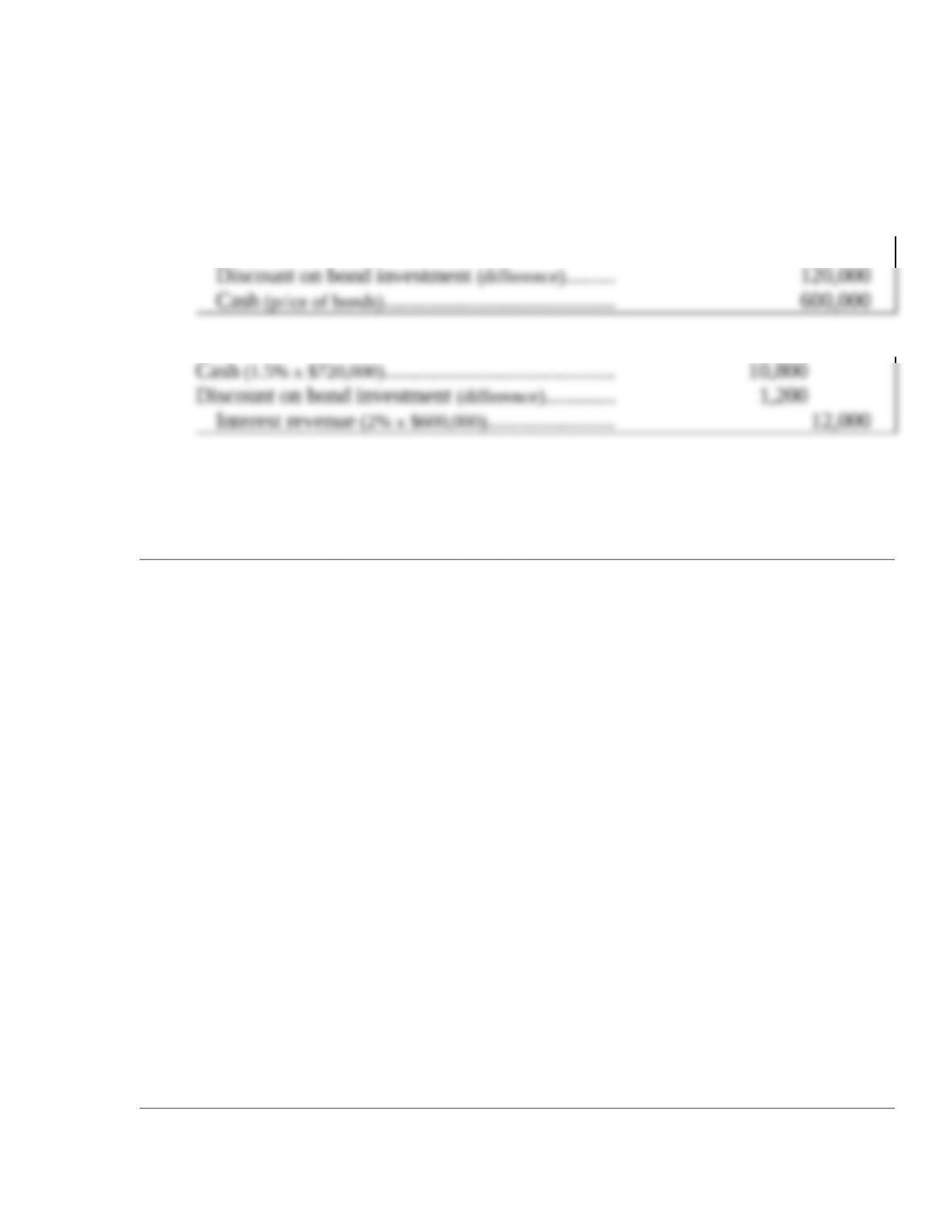
Brief Exercise 12–1
(a)
Investment in bonds (face amount)…………………… 720,000
(b)
© The McGraw-Hill Companies, Inc., 2018
Solutions Manual, Vol. 1, Chapter 12 12–
%
BRIEF EXERCISES