Ethics Case 11–10
Requirement 1
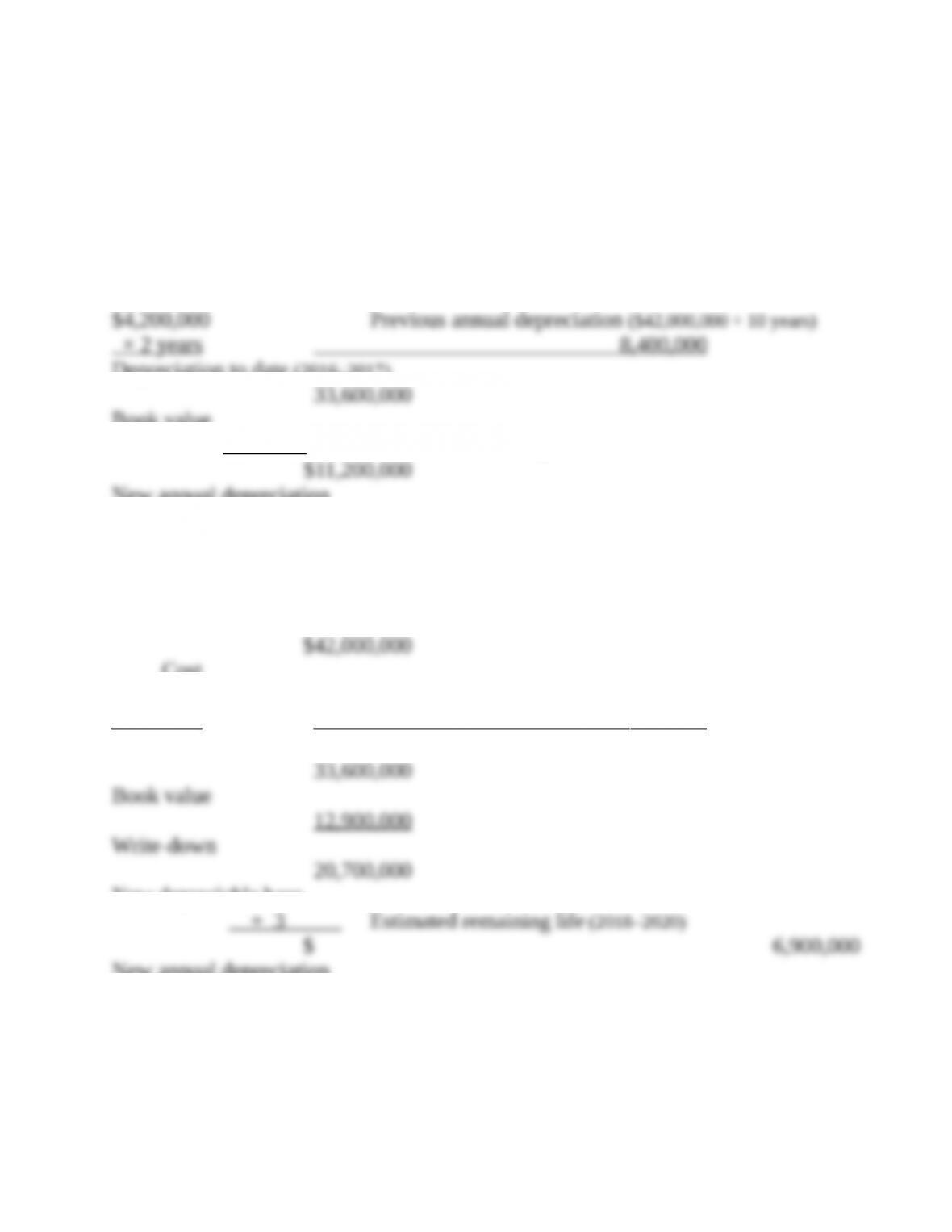
2018 expense using CEO’s approach:
$42,000,000
Cost
Depreciation to date (2016–2017)
Book value
÷ 3 Estimated remaining life (2018–2020)
New annual depreciation
2018 income would include only depreciation expense of $11,200,000.
2018 expense using Heather’s approach:
Cost
$4,200,000 Previous annual depreciation ($42,000,000 ÷ 10 years)
× 2 years 8 ,400,000
Depreciation to date (2016–2017)
New depreciable base
New annual depreciation
2018 income would include depreciation expense of $6,900,000 and an asset
write-down of $12,900,000 for a total income reduction of $19,800,000.

Case 11–10 (concluded)
Requirement 2
Discussion should include these elements.
Facts:
GAAP provides guidance for recording impairment losses on partial
write-downs of property, plant, and equipment and intangible assets remaining in
use. Assets should be written down if there has been a significant impairment of
value such as in decreased product demand and full recovery of book value
through use or resale is not expected. Although the decision and computation to
record an impairment loss often is very subjective and difficult to measure, Heather
is able to estimate an equipment impairment of $12,900,000, presumably using the
best information available. The simple revision in service life approach is clearly
an effort to enhance net income on the part of the CEO.
Ethical Dilemma:
Is Heather’s obligation to challenge the questionable application of revision in
service life more important than her obligation to her boss and to the company’s
effort to reflect a favorable net income?
Who is affected?
Heather
CEO and other managers
Other employees
Shareholders
Potential shareholders
Creditors
Company auditors
Judgment Case 11–11
Requirement 1
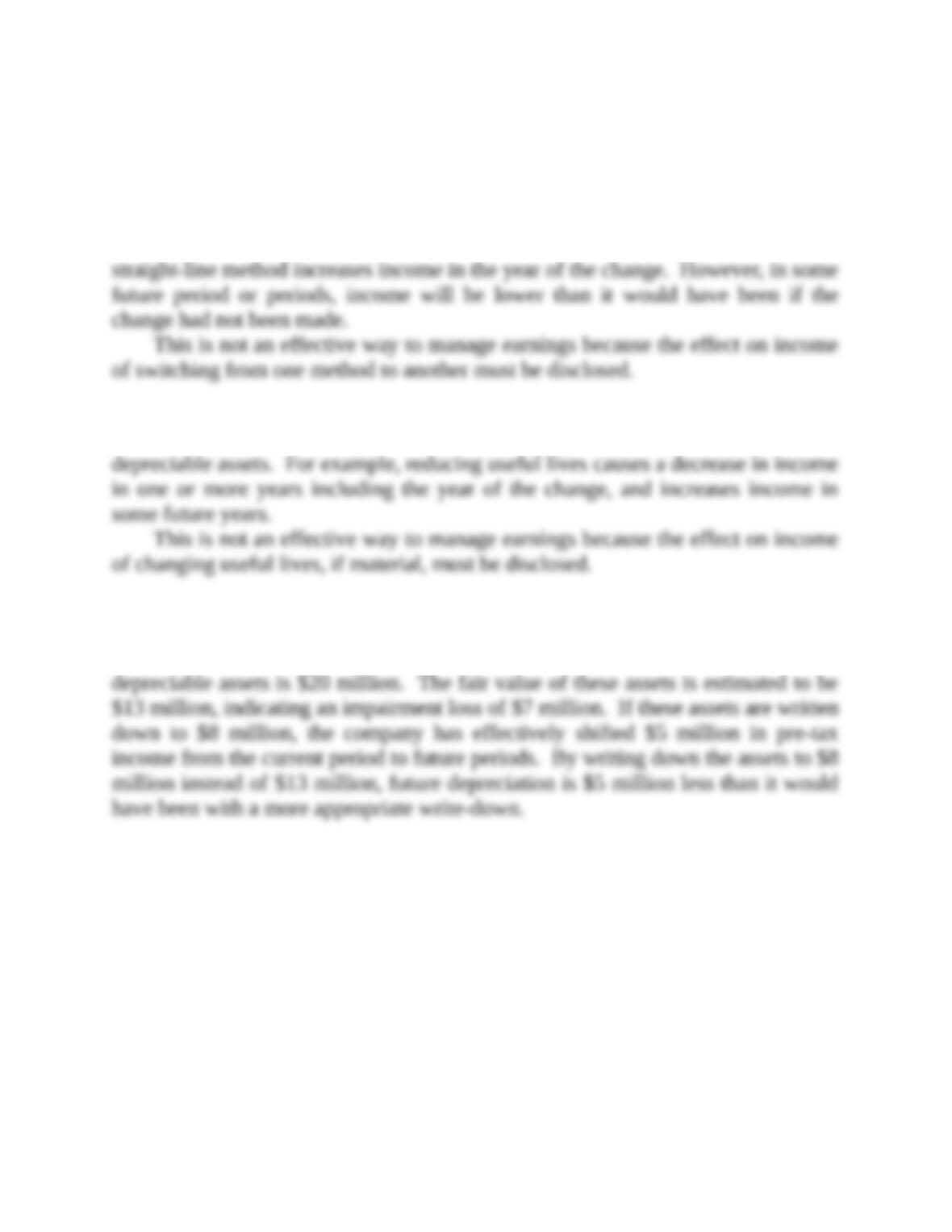
By changing its depreciation method, a company can shift reported income
between periods. For example, a shift from an accelerated method to the
Requirement 2
A company can manage earnings by changing the estimated useful lives of
Requirement 3
One possible approach to answering this question is to assume a company
overstates its impairment loss. For example, assume that the book value of
Trueblood Accounting Case 11–12
A solution and extensive discussion materials can be obtained from the Deloitte
Foundation.
Judgment Case 11–13
Transaction Disposition
1. Transaction is correctly recorded as repairs and maintenance
expense.
2. Transaction is correctly recorded as repairs and maintenance
expense.
3. Transaction is incorrectly recorded. The amount should be
capitalized as part of the cost of the plant.
4. Transaction is incorrectly recorded. The amount should be
capitalized either as part of the cost of the plant or as a
reduction in the accumulated depreciation of the plant.
5. Transaction is correctly recorded as repairs and maintenance
expense.
6. Transaction is correctly recorded as repairs and maintenance
expense.
7. Transaction is incorrectly recorded. The amount should be
capitalized as equipment.
8. Transaction is correctly recorded as repairs and maintenance
expense.
Real World Case 11–14
Requirement 1
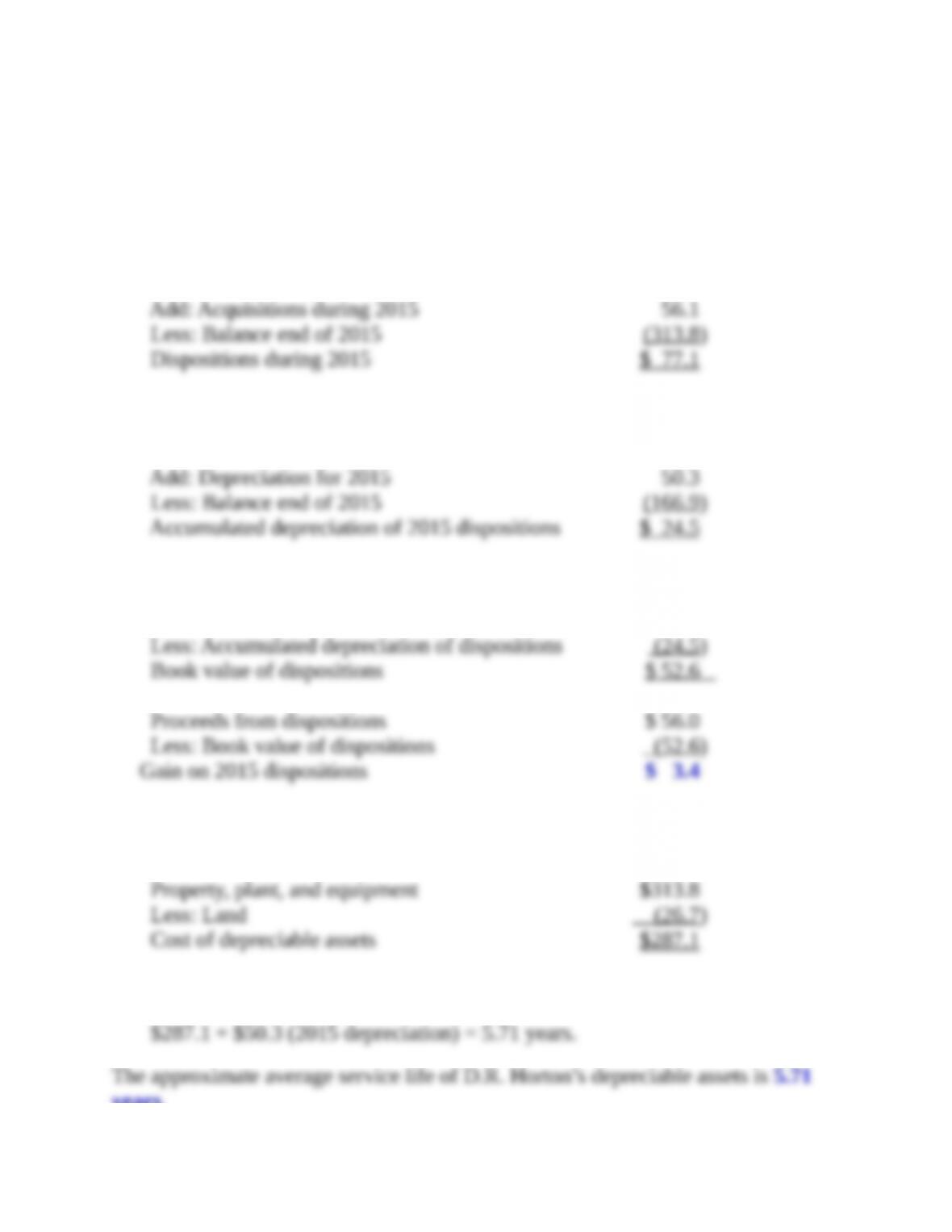
($ in millions)
Property, plant and equipment (Cost):
Balance, beginning of 2015 $334.8
Property, plant, and equipment (Accumulated depreciation):
Balance, beginning of 2015 $ 141.1
Gain (loss) on 2015 dispositions:
Cost of dispositions $77.1
Requirement 2
2015 depreciable assets:
Assuming that D.R. Horton uses the straight-line depreciation method,
years.
Real World Case 11–15
Requirement 3
The following was taken from the company’s 2015 financial statements. Your
results could differ if the company changes any of its policies in years after 2015.
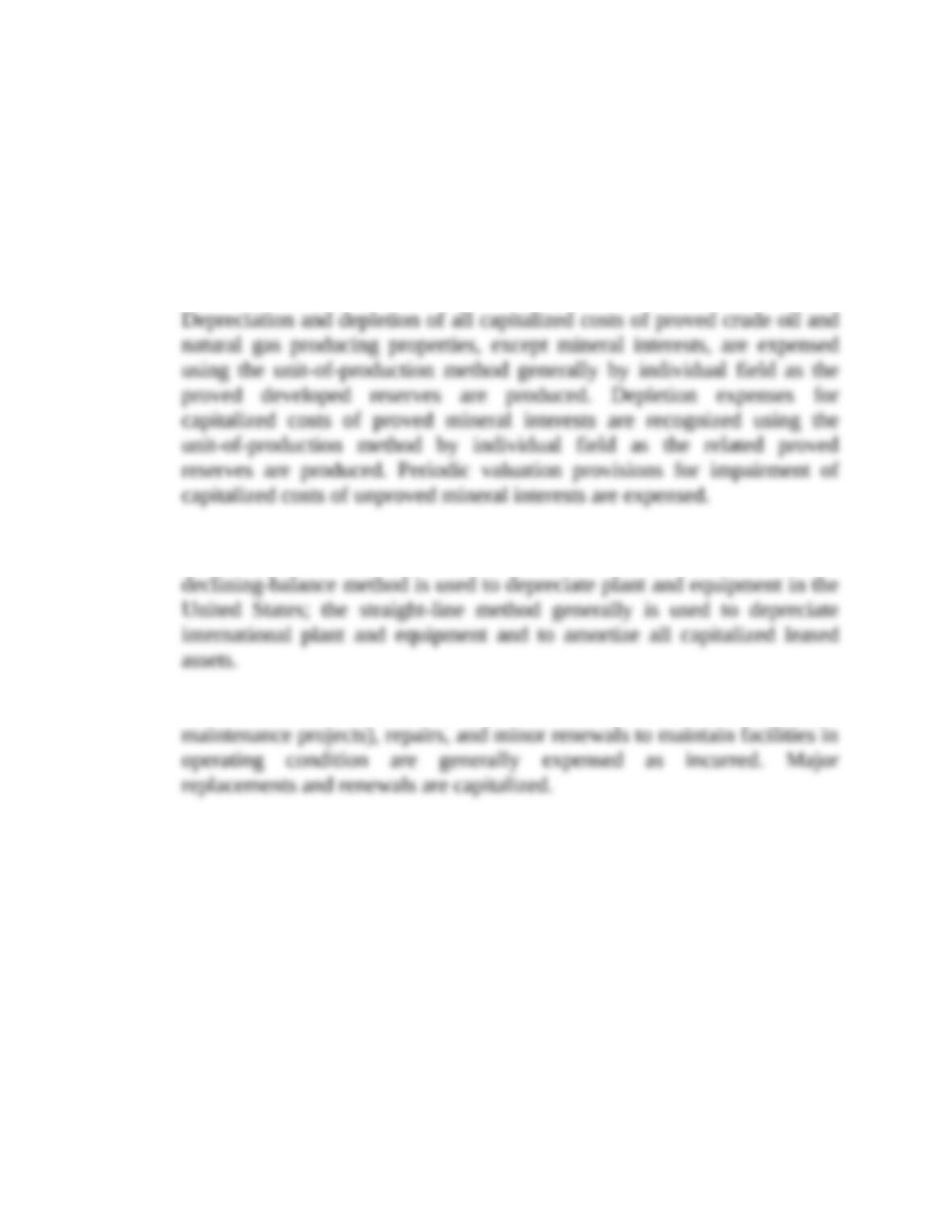
a. The company’s depreciation and depletion policies, disclosed in Note 1.
Summary of Significant Account Policies, are as follows:
The capitalized costs of all other plant and equipment are depreciated or
amortized over their estimated useful lives. In general, the
b. Expenditures for maintenance (including those for planned major
IFRS Case 11–16
Requirement 2
GlaxoSmithKline values its property, plant, and equipment at cost less
provision for depreciation and impairment. IFRS also allows the valuation of these
Requirement 3
For goodwill, impairments of goodwill are not reversed. U.S. GAAP also
does not allow for reversals of goodwill impairment.
Impairment losses on other noncurrent assets are only reversed if there has
Target Case
Requirement 1
Estimated Useful Lives Life (Years)
Buildings and improvements 8-39
Requirement 2
Property and equipment is depreciated using the straight-line method over
estimated useful lives or lease terms if shorter. For income tax purposes,
Requirement 3
Repair and maintenance costs are expensed as incurred.
Requirement 4
Long-lived assets are reviewed for impairment when events or changes in
circumstances, such as a decision to relocate or close a store or make significant
software changes, indicate that the asset’s carrying value may not be recoverable.
Requirement 5
Target reported $277 million in intangible assets, including $133 million for
goodwill. During 2015, Target announced the decision to wind down certain
Air France–KLM Case
Requirement 1
(€ in millions)
December 31, 2015 Before After
Revaluation Revaluation
Flight equipment €18,478 x 10,000/8,743 = €21,135
The entry to revalue the flight equipment and the accumulated depreciation
accounts (and thus the book value) is:
Requirement 2
Requirement 3
IFRS requires that each component of an item of property, plant, and
equipment must be depreciated separately if its cost is significant in relation to the
Air France-KLM Case (concluded)
Requirement 4
Per Note 4.15, fixed assets are tested when there is an indication of
impairment.
Requirement 5
In Note 4.15, AF states that the company deems the recoverable value of the
asset to be the higher of market value less cost of disposal and its value in use. The
Under U.S. GAAP, the measurement of an impairment loss is a two-step
Requirement 6
(€ in millions)
*€1,368-627