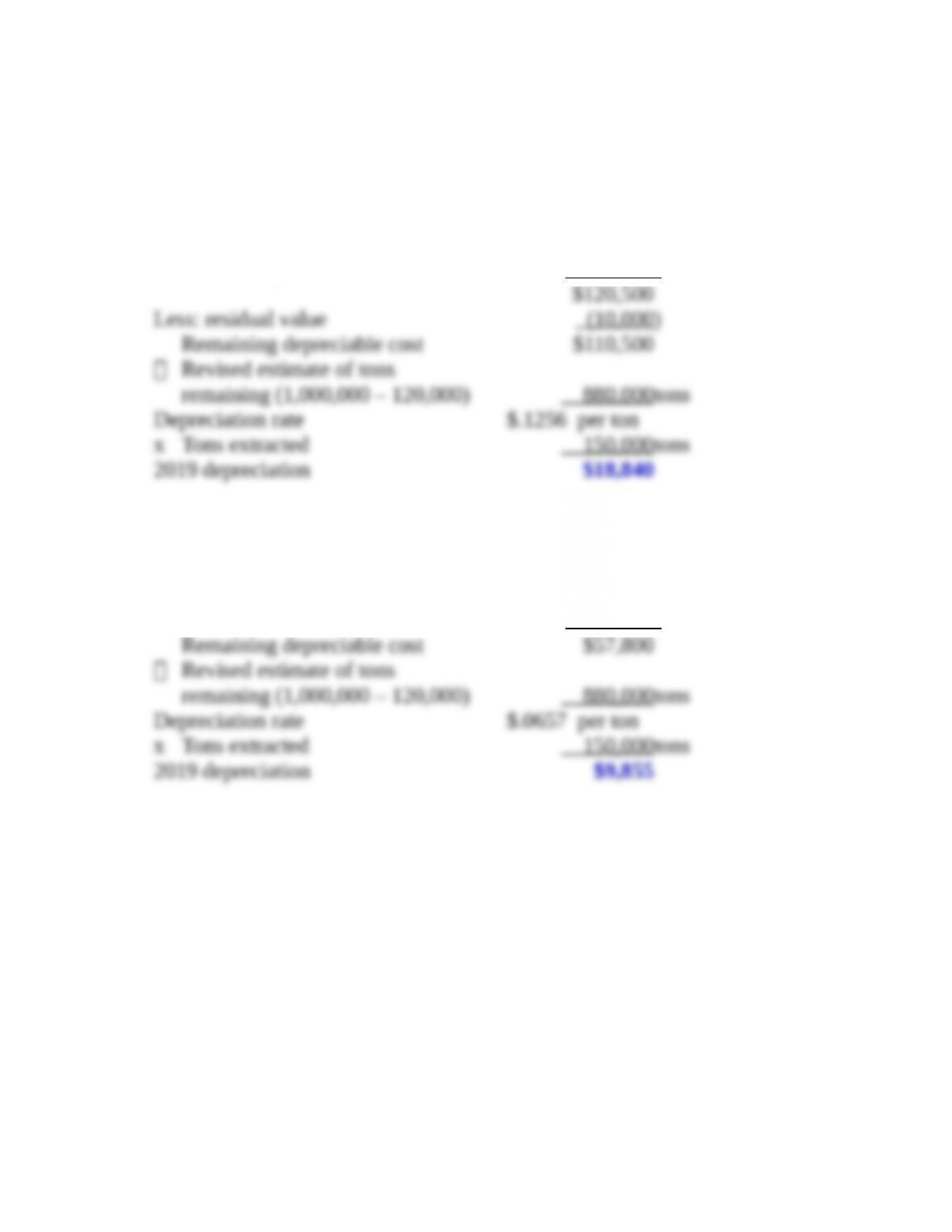
Problem 11–13 (concluded)
2019 Depreciation of equipment:
Original cost $140,000
Less: 2018 depreciation (19 ,500)
2019 Depreciation of structures:
Original cost $68,000
Less: 2018 depreciation (10 ,200)
Analysis Case 11–1
The terms depreciation, depletion, and amortization all refer to the same
process of allocating the cost of property and equipment and finite-life intangible
assets to the periods benefited by their use. However, each term is applied to a
different type of long-lived asset; depreciation is used for plant and equipment,
depletion for natural resources, and amortization for intangibles.
There are differences in determining the factors necessary to calculate
depreciation, depletion, and amortization but the concepts involved are the same.
The service life of plant and equipment and natural resources is limited to physical
CASES
life, while the service life of intangible assets is limited to the asset’s legal or
contractual life, or 40 years, whichever is shorter.
The majority of companies use straight-line depreciation and straight-line
amortization. Natural resources usually are depleted using the units-of-production
method.
Communication Case 11–2
Suggested Grading Concepts and Grading Scheme:
Content (70%)
_______ 50 Explains the concept of depreciation as a process of
cost allocation, not valuation.
______ Rational match versus market fluctuations.
______ Numerical example.
Writing (30%)
_______ 6 Terminology and tone appropriate to the audience of
a company president.
_______ 12 Organization permits ease of understanding.
______ Introduction that states purpose.
______ Paragraphs that separate main points.
Judgment Case 11–3
Requirement 1
Portland should have selected the straight-line depreciation method when
approximately the same amount of an asset’s service potential is used up each
Requirement 2
a. By associating depreciation with a group of machines instead of each
individual machine, Portland’s bookkeeping process is greatly simplified. Also,
b. Portland should divide the depreciable base of each machine by its
Judgment Case 11–4
Requirement 1
a. The capitalized cost for the computer includes all costs reasonable and
b. The objective of depreciation accounting is to allocate the depreciable base
of an asset over its estimated useful life in a systematic and rational manner. This
Requirement 2
The rationale for using accelerated depreciation methods is based on the
assumption that an asset is more productive in the earlier years of its estimated
useful life. Therefore, larger depreciation charges in the earlier years would be
Judgment Case 11–5
There is no necessarily correct answer to the question. The support made for
Information is material if it can have an effect on a decision made by users.
One consequence of materiality is that GAAP needs to be followed only if an item
In this case, is the $70,000 material? Net-of-tax income would be $49,000
higher if the expenditures were capitalized instead of expensed [$70,000 × (1 – .
30)]. This represents a 4.45% increase in income ($49,000 ÷ $1,100,000). The
Communication Case 11–6
There is no right or wrong answer to this case. Both views, expense and
capitalize, can be defended once consideration is given to the materiality issue.
A significant benefit of this case is that it is forcing students to consider the
subjective nature of materiality when applying GAAP.
Integrating Case 11–7
Requirement 1
a. ($ in millions)
Inventory (understatement of 2019 beginning inventory)……… 10
b.
Retained earnings (2017–2018 patent amortization)…………. 6
2019 adjusting entry:
c.
2019 adjusting entry:
($ in millions)
SYD
$30 Cost
18 Depreciation to date, SYD (above)
Case 11–7 (concluded)
Requirement 2
Shareholders’ Net
Assets Liabilities Equity Income Expenses
2017 $640 $330 $310 $210 $150
2017 inventory (12) (12) (12) 12
____ ____ ____ ____ ____
$625 $330 $295 $195 $165
2018 $820 $400 $420 $230 $175
2017 inventory 12 (12)
Judgment Case 11–8
Requirement 1
A change from the sum-of-the-years’-digits method of depreciation to the
straight-line method for previously recorded assets as a result of new information
related to production patterns is a change in accounting principle that is accounted
Requirement 2
A change in the expected service life of an asset arising because of more
experience with the asset is a change in accounting estimate. A change in
Research Case 11–9
Requirement 1
The reference locations for the impairment of property, plant, and equipment
Requirement 2
Property, plant, and equipment and finite-life intangible assets are tested for
Requirement 3
Determining whether to record an impairment loss and actually recording the
loss is a two-step process. The first step is a recoverability test—an impairment
Requirement 4
Property, plant, and equipment and finite-life intangible assets to be sold
a. Management, having the authority to approve the action, commits to a plan
to sell the asset.
b. The asset or asset group is available for immediate sale in its present
condition.
The specific reference for these criteria is FASB ASC 360–10–45–9.

Case 11–9 (concluded)
Requirement 5
Property, plant, and equipment and finite-life intangible assets or groups of