Question 11–1
The terms depreciation, depletion, and amortization all refer to the process of
allocating the cost of property, plant, and equipment and finite-life intangible assets
Question 11–2
The term depreciation often is confused with a decline in value or worth of an
asset. Depreciation is not measured as a decline in value from one period to the
Question 11–3
The process of cost allocation for plant and equipment and finite-life
intangible assets requires that three factors be established at the time the asset is
put into use. These factors are:
1. Service (useful) life—The estimated use that the company expects to receive
from the asset.
Question 11–4
Physical life provides the upper bound for service life. Physical life will vary
according to the purpose for which the asset is acquired and the environment in
Chapter 11 Property, Plant, and Equipment and
Intangible Assets: Utilization and Disposition
QUESTIONS FOR REVIEW OF KEY TOPICS
Answers to Questions (continued)
Question 11–5
The total amount of depreciation to be recorded during an asset’s service life
is called its depreciable base. This amount is the difference between the initial
Question 11–6
Activity-based allocation methods estimate service life in terms of some
Question 11–7
The straight-line depreciation method allocates an equal amount of
depreciable base to each year of an asset’s service life. Accelerated depreciation
Question 11–8
Conceptually, the use of activity-based depreciation methods would provide a
better relation between revenues and expenses. Clearly, the productivity of a plant
asset is more closely associated with the benefits provided by that asset than the
Answers to Questions (continued)
Question 11–9
Companies might use the straight-line method because they consider that the
benefits derived from the majority of plant assets are realized approximately
evenly over these assets’ useful lives. It also is the easiest method to understand
Question 10–10
Property, plant, and equipment may be disposed of by sale or retirement or
abandonment. When an item of property, plant, and equipment is sold, a gain or
loss is recognized for the difference between the consideration received and the
Question 11–11
The group approach to aggregation is applied to a collection of depreciable
assets that share similar service lives and other attributes. For example, group
depreciation could be used for fleets of vehicles or collections of machinery. The
Question 11–12
The allocation of the cost of a natural resource to periods of use is called
Answers to Questions (continued)
Question 11–13
The amortization of finite-life intangible assets is based on the same concepts
as depreciation and depletion. The capitalized cost of an intangible asset that has a
finite useful life must be allocated to the periods the company expects the asset to
Question 11–14
A company can calculate depreciation based on the actual number of days or
months the asset was used during the year. A common simplifying convention is to
Question 11–15
A change in the service life of plant and equipment and finite-life intangible
assets is accounted for as a change in an estimate. The change is accounted for
Answers to Questions (continued)
Question 11–16
A change in depreciation method is accounted for prospectively by simply
depreciating the remaining depreciable base of the asset (book value at date of
change less estimated residual value) over the remaining service life using the new
Question 11–17
If a material error is discovered in an accounting period subsequent to the
period in which the error is made, previous years’ financial statements that were
incorrect as a result of the error are retrospectively restated to reflect the
Answers to Questions (continued)
Question 11–18
Impairment of the value of property, plant, and equipment and intangible
assets results when there has been a significant decline in value below book value.
If there is indication of an impairment, then the loss is measured and recognized as
the amount by which the book value exceeds the fair value of the asset or group of
For intangible assets with indefinite useful lives other than goodwill, if book
value exceeds fair value, an impairment loss is recognized for the differences. For
Question 11–19
Repairs and maintenance are expenditures made to maintain a given level of
Additions involve adding a new major component to an existing asset. These
Improvements are expenditures for the replacement of a major component of
Rearrangements are expenditures to restructure plant and equipment without
Answers to Questions (concluded)
Question 11–20
IFRS allows a company to value property, plant, and equipment (PP&E) and
intangible assets subsequent to initial valuation at (1) cost less accumulated
Question 11–21
Under U.S. GAAP, an impairment loss for property, plant, and equipment and
finite-life intangible assets is measured as the difference between book value and
Question 11–22
Under U.S. GAAP, the measurement of an impairment loss for goodwill is a
two-step process. In step one, we compare the fair value of the reporting unit with
Under IFRS, the measurement of an impairment loss for goodwill is a
one-step process that compares the recoverable amount of the cash-generating unit
Question 11–23
Brief Exercise
11–1
Depreciation is a process of cost allocation, not valuation. Koeplin should not
record depreciation of $18,000 for year one of the machine’s life. Instead, it
BRIEF EXERCISES

Brief Exercise 11–2
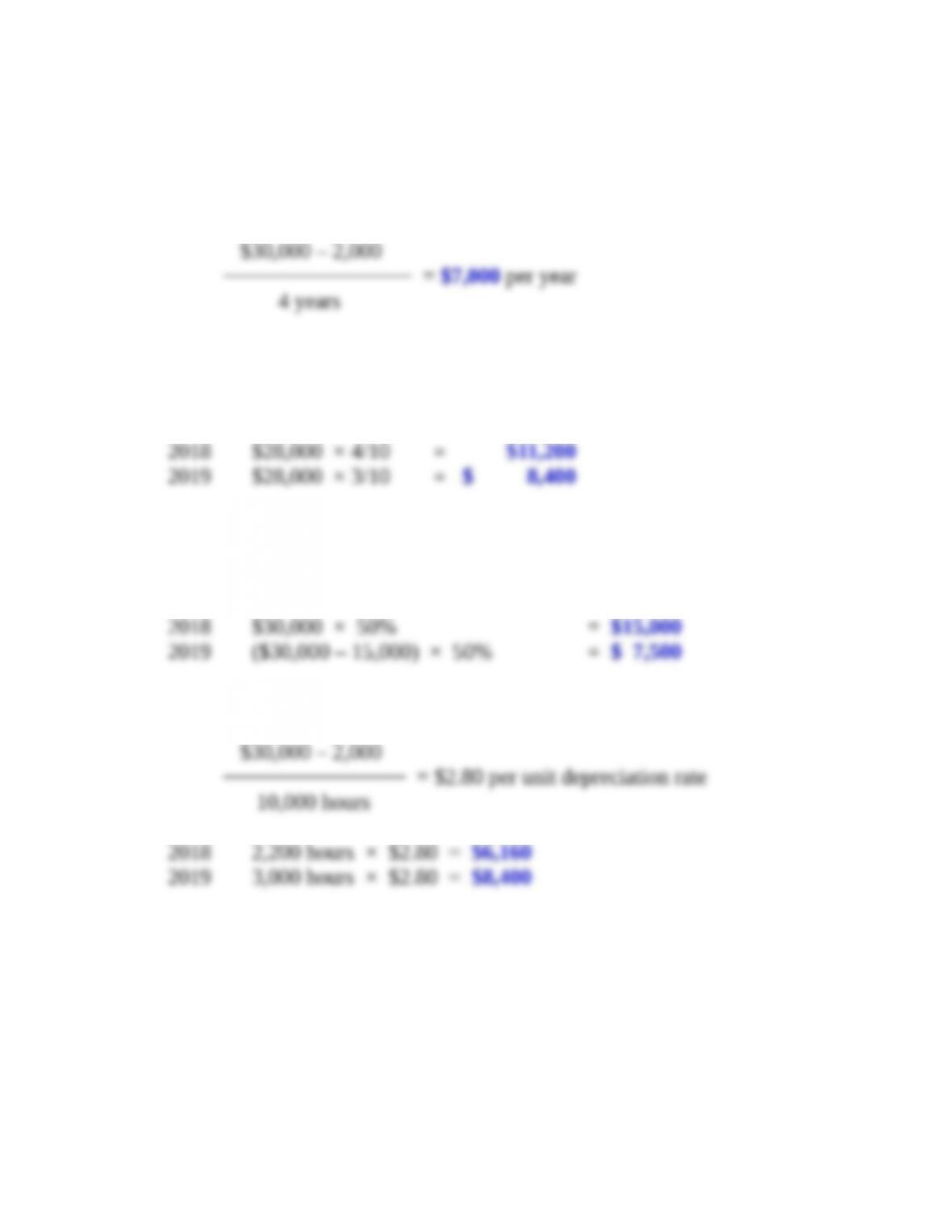
a. Straight-line:
b. Sum-of-the-years’ digits:
Sum-of-the-digits is ([4 (4 + 1)] ÷ 2) = 10
c. Double-declining balance:
Straight-line rate is 25% (1 ÷ 4 years) × 2 = 50% DDB rate