Judgment Case 10–1
Requirement 1
All costs necessary to bring the land to its condition for use should be
capitalized as the cost of the land. This should include the following costs:
Purchase price.
Title insurance.
Requirement 2
Requirement 3
In general, property, plant, and equipment and intangible assets received in
exchange for other nonmonetary assets should be valued at the fair value of the
The new machine acquired by exchanging an older, similar machine generally
CASES
Research Case 10–2
Requirement 1
The appropriate accounting treatment for asset retirement obligations is specified
in FASB ASC 410–20 “Asset Retirement Obligations.” Section 410–20–25
Usually, the fair value is estimated by calculating the present value of estimated
future cash outflows. Section 410–20–30–1 describes the approach to be used in
calculating present value. Traditionally, the way uncertainty has been considered in
Requirement 2
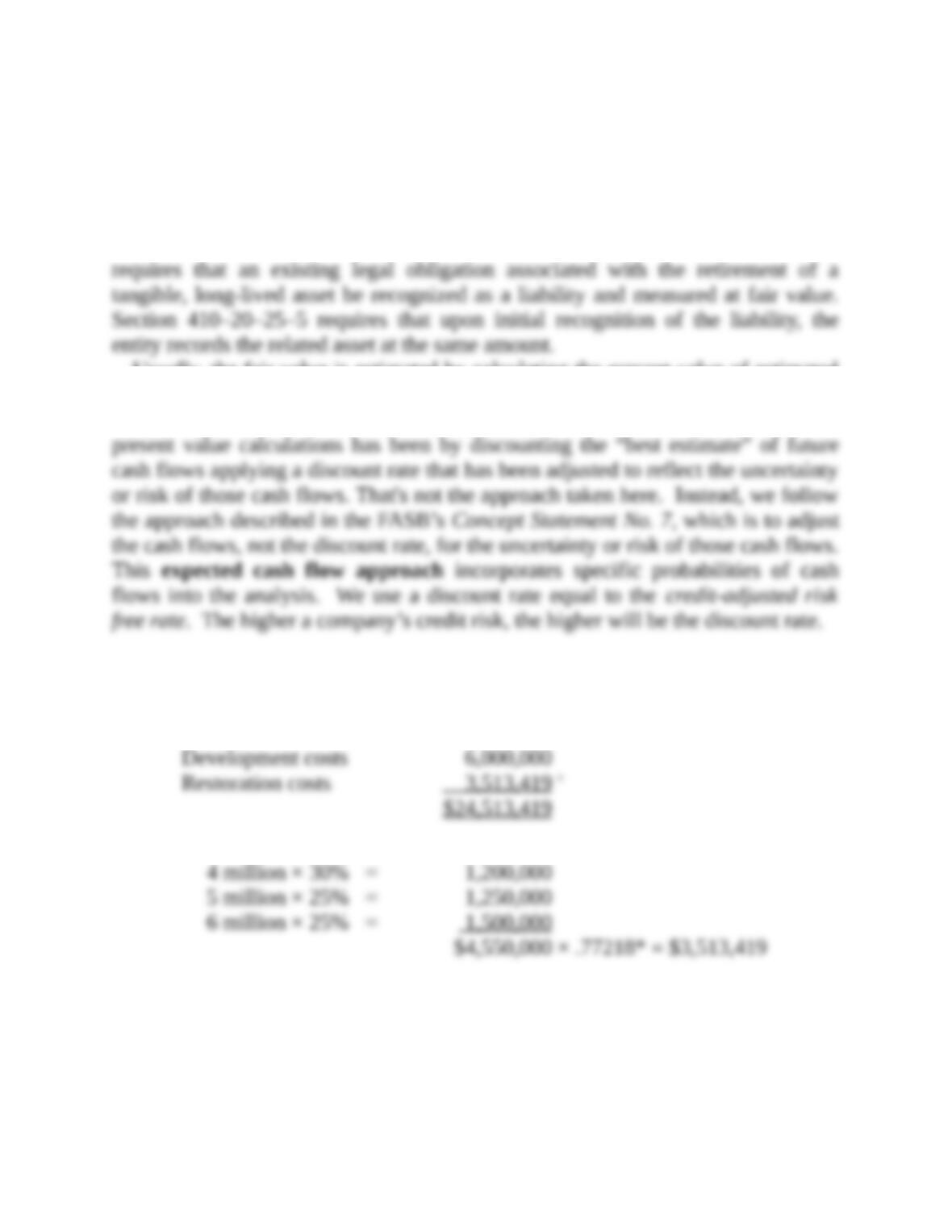
The cost of the coal mine is $24,513,419, determined as follows:
Mining site $15,000,000
†$3 million × 20% = $ 600,000
*Present value of $1, n = 3, i = 9%
Case 10–2 (continued)
Requirement 3
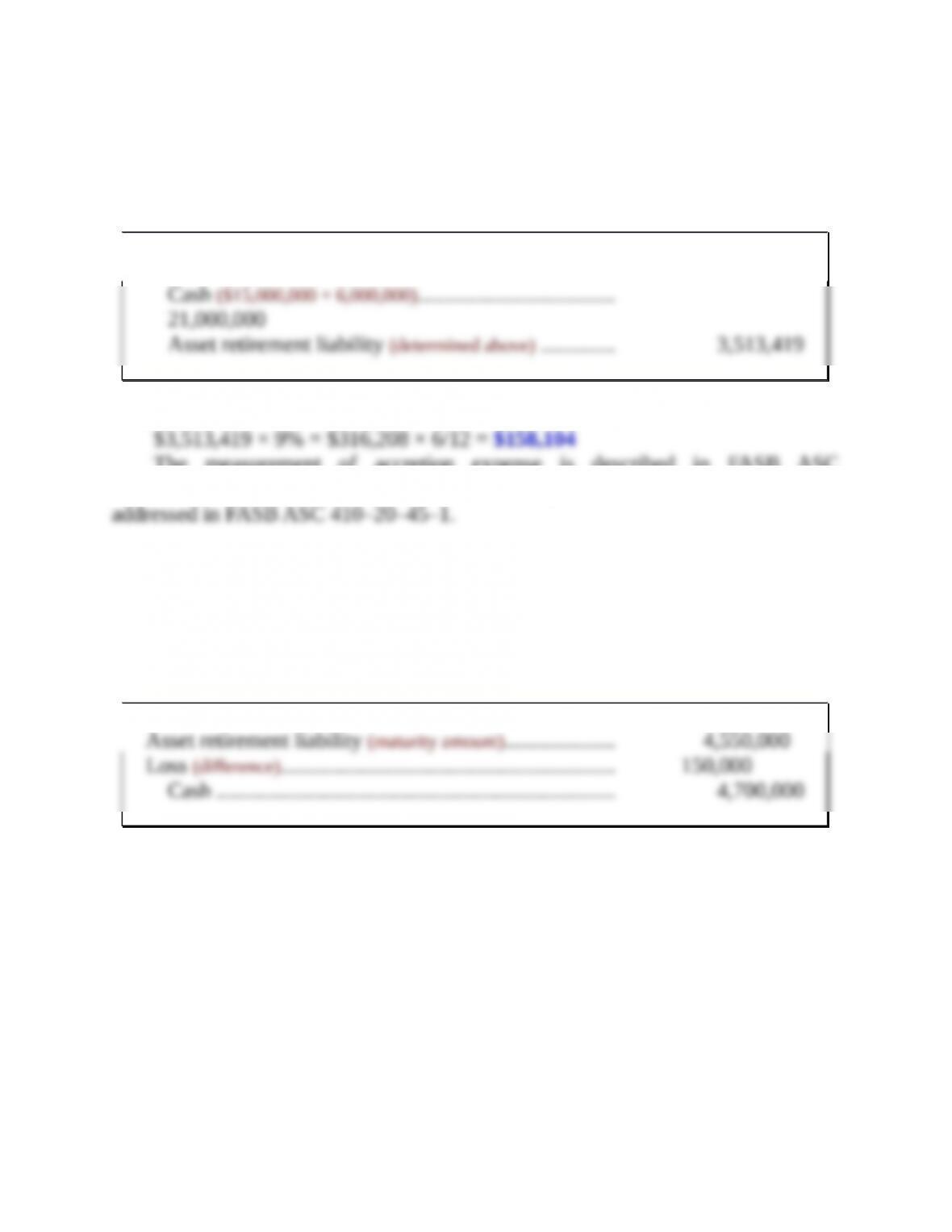
Coal mine (determined above)………………………………….. 24,513,419
Requirement 4
The measurement of accretion expense is described in FASB ASC
410–20–35–5. The classification of accretion expense in the income statement is
Requirement 5
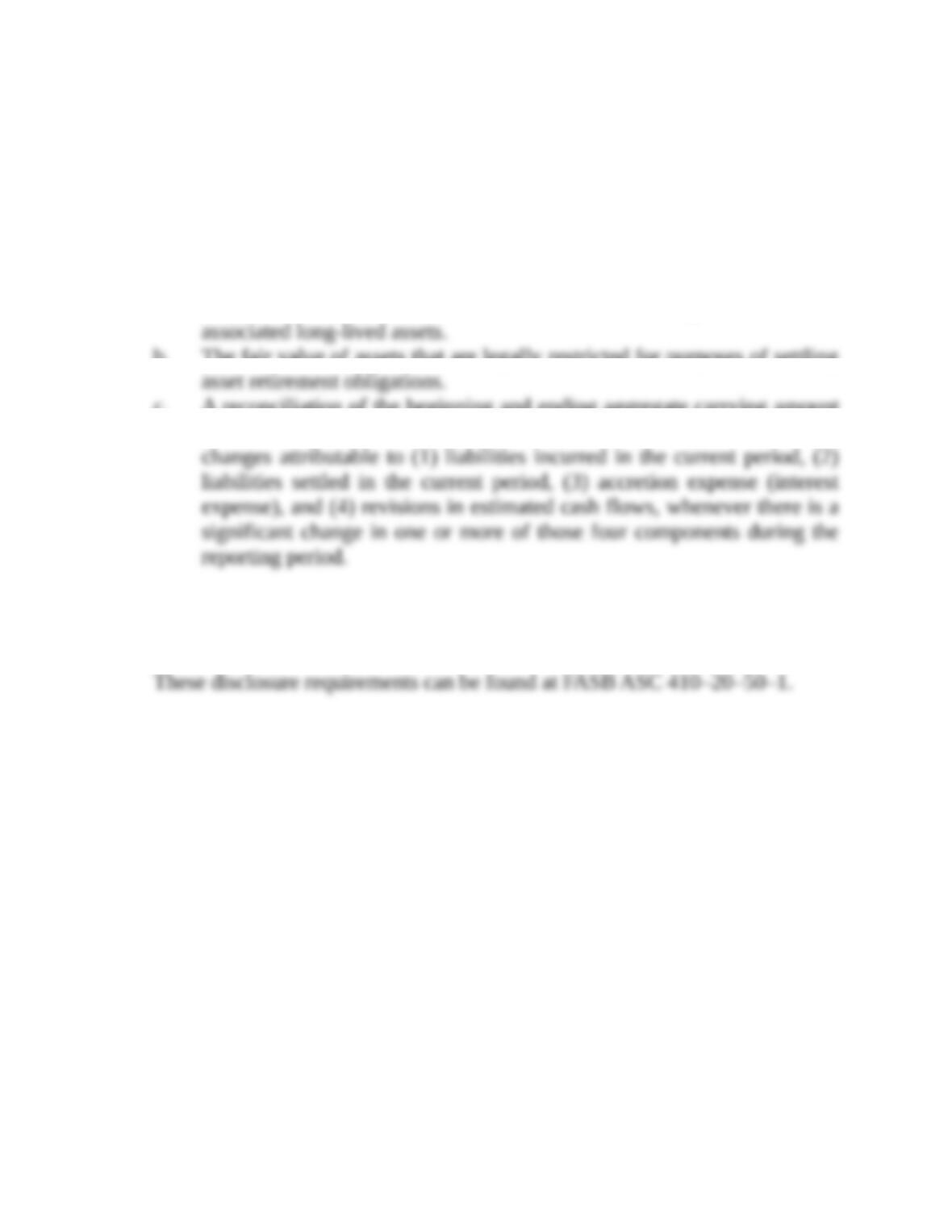
If the actual restoration costs are more (less) than the recorded liability at the
retirement date, a loss (gain) on retirement of the obligation is recognized for the
difference.
Case 10–2 (concluded)
Requirement 6
An entity shall disclose the following information about its asset retirement
obligations:
a. A general description of the asset retirement obligations and the
b. The fair value of assets that are legally restricted for purposes of settling
c. A reconciliation of the beginning and ending aggregate carrying amount
(book value) of asset retirement obligations showing separately the
If the fair value of an asset retirement obligation cannot be reasonably
estimated, that fact and the reasons therefore shall be disclosed.
Judgment Case 10–3
Requirement 1
Requirement 2
The treatment of manufacturing overhead cost and its allocation between
construction projects and normal production is a difficult issue. One alternative is
A second alternative is to assign overhead on the same basis that is used for
the regular manufacturing process. For example, all overhead costs might be
Requirement 3
Generally accepted accounting principles provide specific guidelines for the
treatment of interest costs incurred during construction. These guidelines pertain
The construction of equipment by the Chilton Company appears to qualify for
Judgment Case 10–4
Requirement 1
Only assets that are constructed as discrete projects qualify for interest
capitalization. Assets qualifying for capitalization exclude inventories that are
Requirement 2
The capitalization period for a self-constructed asset starts when (1)
expenditures (materials, labor, and overhead) have been made and (2) interest cost
borrowings related to the construction project. The capitalization period ends
Requirement 4
One method that could be used to determine the appropriate interest rate(s) to
be used in capitalizing interest is the specific interest method. If debt financing
has been obtained specifically for the construction project, its interest rate is
Sometimes it is difficult to associate specific borrowings with projects. In
Case 10–4 (concluded)
Requirement 5
The three steps used to determine the amount of interest capitalized during a
period are:
1. Determine the average accumulated expenditures for the period.
Research Case 10–5
(Note: This case requires the student to reference a journal article.]
Requirement 2
Goodwill does meet the criteria in Concepts Statement No. 5 for initial
Requirement 3
Real World Case 10–6
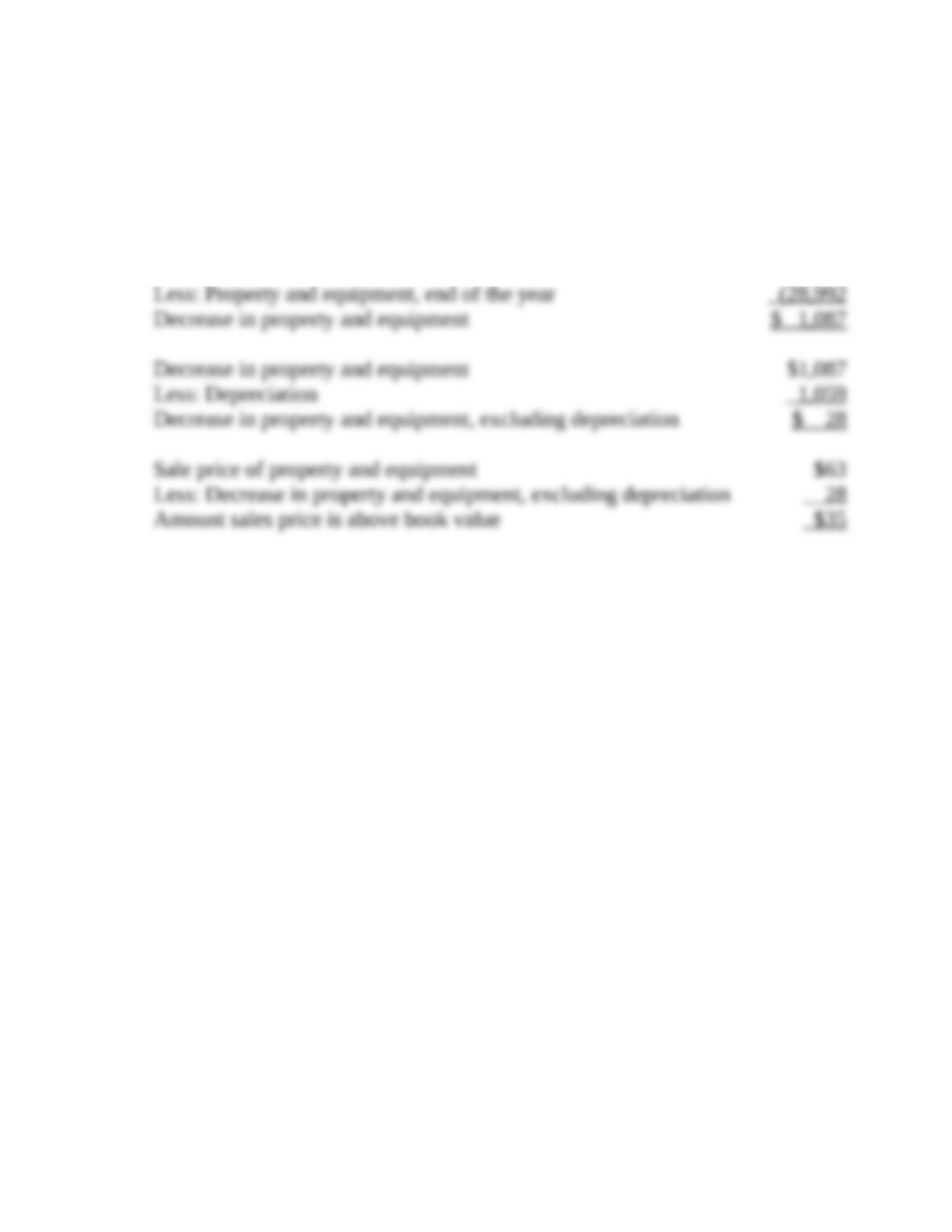
($ in thousands)
Property and equipment, beginning of the year $ 27,694
Add: Additions 2,385
Judgment Case 10–7
Requirement 1
Goodwill represents the unique value of a company as a whole over and above
all identifiable tangible and intangible assets. This value results from a company’s
Requirement 2
The controller would be correct in her valuation of goodwill only if the total
fair value of all of the identifiable net assets (assets less liabilities) of Georgia, Inc.
Judgment Case 10–8
Requirement 1
A company undertakes an R&D project because it believes the project will
eventually provide benefits that exceed the current expenditures. Unfortunately,
though, it’s difficult to predict which individual research and development projects
will ultimately provide benefits. In fact, only one in ten actually reach commercial
2. Large firms may tend to have more R&D activities occurring simultaneously,
creating a portfolio effect. That is, the number of successful R&D projects
3. Earnings-based management compensation schemes may be more prevalent in
4. Smaller companies may be more dependent on debt financing. Debt covenants