Exercise 10–18
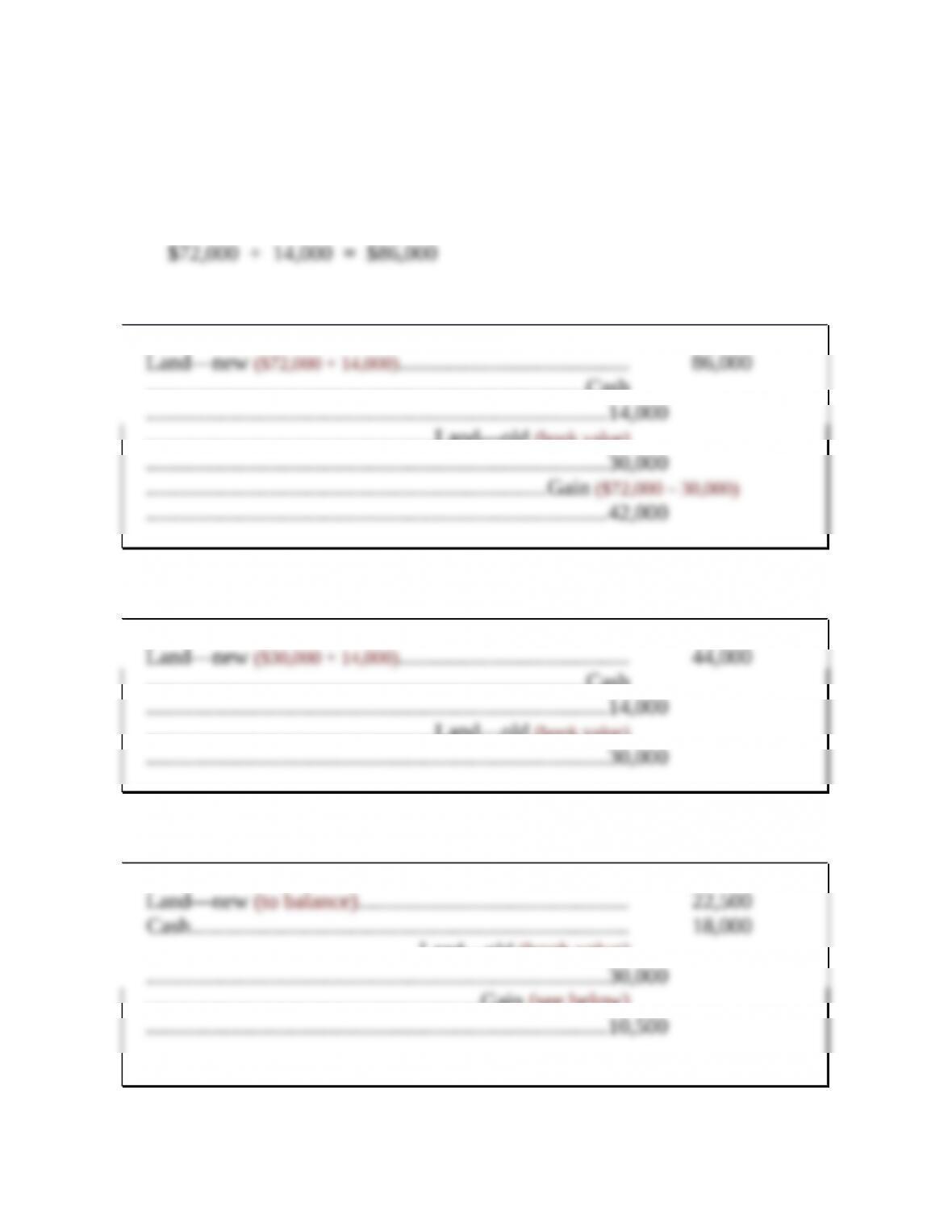
Requirement 1
Fair value of old land + Cash given = Fair value of new land
Requirement 2
……………………………………………………………………..Cash
……………………………………………..Land—old (book value)
Requirement 3
……………………………………………………………………..Cash
……………………………………………..Land—old (book value)
Requirement 4
…………………………………………..Land—old (book value)
…………………………………………………….Gain (see below)

Gain = (fair value given – book value given) × (cash received ÷ total fair value
received)
a The fair value received will equal the fair value given in an even exchange.
Exercise 10–19
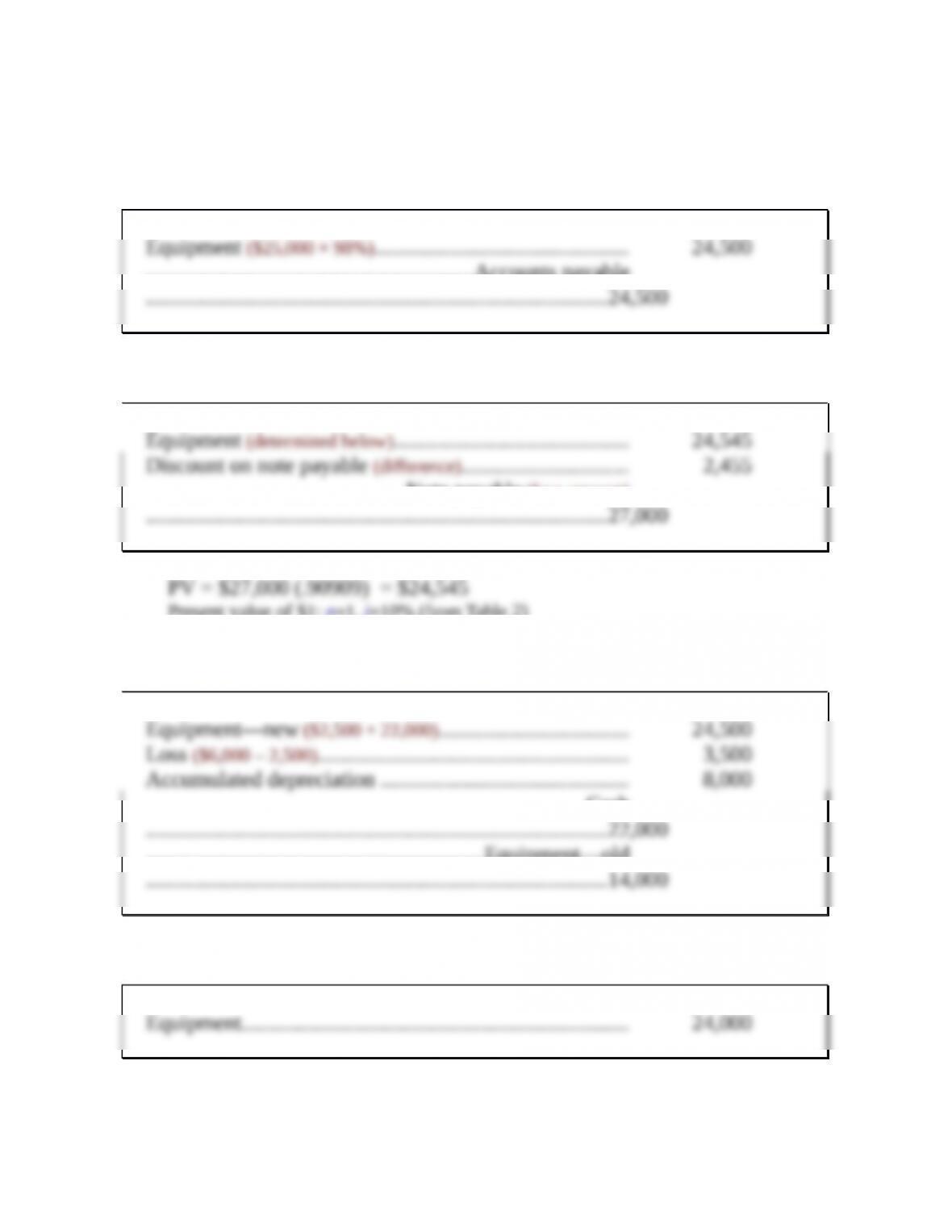
1. To record the purchase of equipment on account.
……………………………………………………Accounts payable
2. To record the acquisition of equipment in exchange for a note.
………………………………………..Note payable (face amount)
Present value of $1: n=1, i=10% (from Table 2)
3. To record the exchange of old equipment for new equipment.
……………………………………………………………………..Cash
……………………………………………………..Equipment—old
4. To record the acquisition of equipment by the issuance of stock.
……………………………………………………….Common stock
Exercise 10–20
Requirement 1
The Codification topic number for nonmonetary transactions is FASB ASC
Requirement 2
The specific citations that describe the required disclosures for nonmonetary
Requirement 3
An entity that engages in one or more nonmonetary transactions during a period
shall disclose in financial statements for the period all of the following:
a. The nature of the transactions
In accordance with paragraph 845–10–50–1, entities shall disclose, in each period’s
Exercise 10–21
The FASB Accounting Standards Codification® represents the single source of
authoritative U.S. generally accepted accounting principles. The specific citation
for each of the following items is:
1. The disclosure requirements in the notes to the financial statements for
depreciation on property, plant, and equipment:
Equipment–Overall–Disclosure.”
Because of the significant effects on financial position and results of operations
a. Depreciation expense for the period.
b. Balances of major classes of depreciable assets, by nature or function, at the
balance sheet date.
Exercise 10–21 (continued)
2. The criteria for determining commercial substance in a nonmonetary
exchange:
FASB ASC 845–10–30–4: “Nonmonetary Transactions–Overall–Initial
Measurement.”
A nonmonetary exchange has commercial substance if the entity’s future cash
flows are expected to significantly change as a result of the exchange. The
a. The configuration (risk, timing, and amount) of the future cash flows of the
asset(s) received differs significantly from the configuration of the future cash
b. The entity-specific value of the asset(s) received differs from the
entity-specific value of the asset(s) transferred, and the difference is significant
A qualitative assessment will, in some cases, be conclusive in determining that

Exercise 10–21 (continued)
3. The disclosure requirements for interest capitalization:
FASB ASC 835–20–50–1: “Interest Capitalization–Overall–Disclosure.”
An entity shall disclose the following information with respect to interest cost
in the financial statements or related notes:
a. For an accounting period in which no interest cost is capitalized, the amount
of interest cost incurred and charged to expense during the period
b. For an accounting period in which some interest cost is capitalized, the total
Exercise 10–21 (concluded)
4. The elements of costs to be included as R&D activities:
FASB ASC 730–10–25–2: “Research & Development–Overall–Recognition.”
Elements of costs shall be identified with research and development activities as
follows: a. Materials, equipment, and facilities. The costs of materials (whether from
the entity’s normal inventory or acquired specially for research and development
activities) and equipment or facilities that are acquired or constructed for research and
b. Personnel. Salaries, wages, and other related costs of personnel engaged in
c. Intangible assets purchased from others. The costs of intangible assets that are
purchased from others for use in research and development activities and that have
alternative future uses (in research and development projects or otherwise) shall be
accounted for in accordance with Topic 350. The amortization of those intangible
d. Contract services. The costs of services performed by others in connection with the
e. Indirect costs. Research and development costs shall include a reasonable