Exercise 1–2
Requirement 1
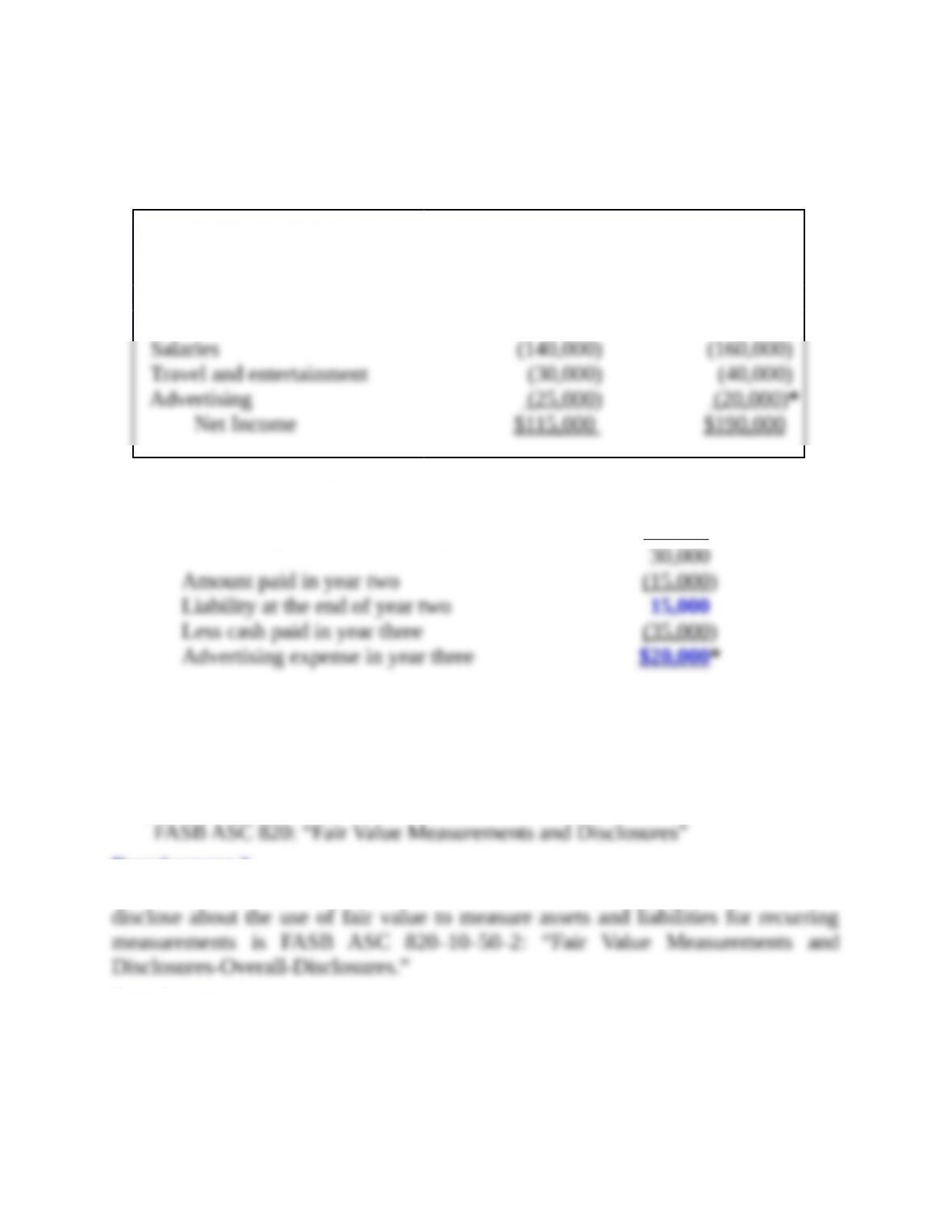
Year 2 Year 3
Revenues $350,000 $450,000
Expenses:
Rent ($80,000 2) (40,000) (40,000)
Requirement 2
Amount owed at the end of year one $ 5,000
Advertising costs incurred in year two 25 ,000
Exercise 1–3
Requirement 1
Requirement 2
The specific citation that describes the information that companies must
Requirement 3
The disclosure requirements are:
a. The fair value measurements at the reporting date
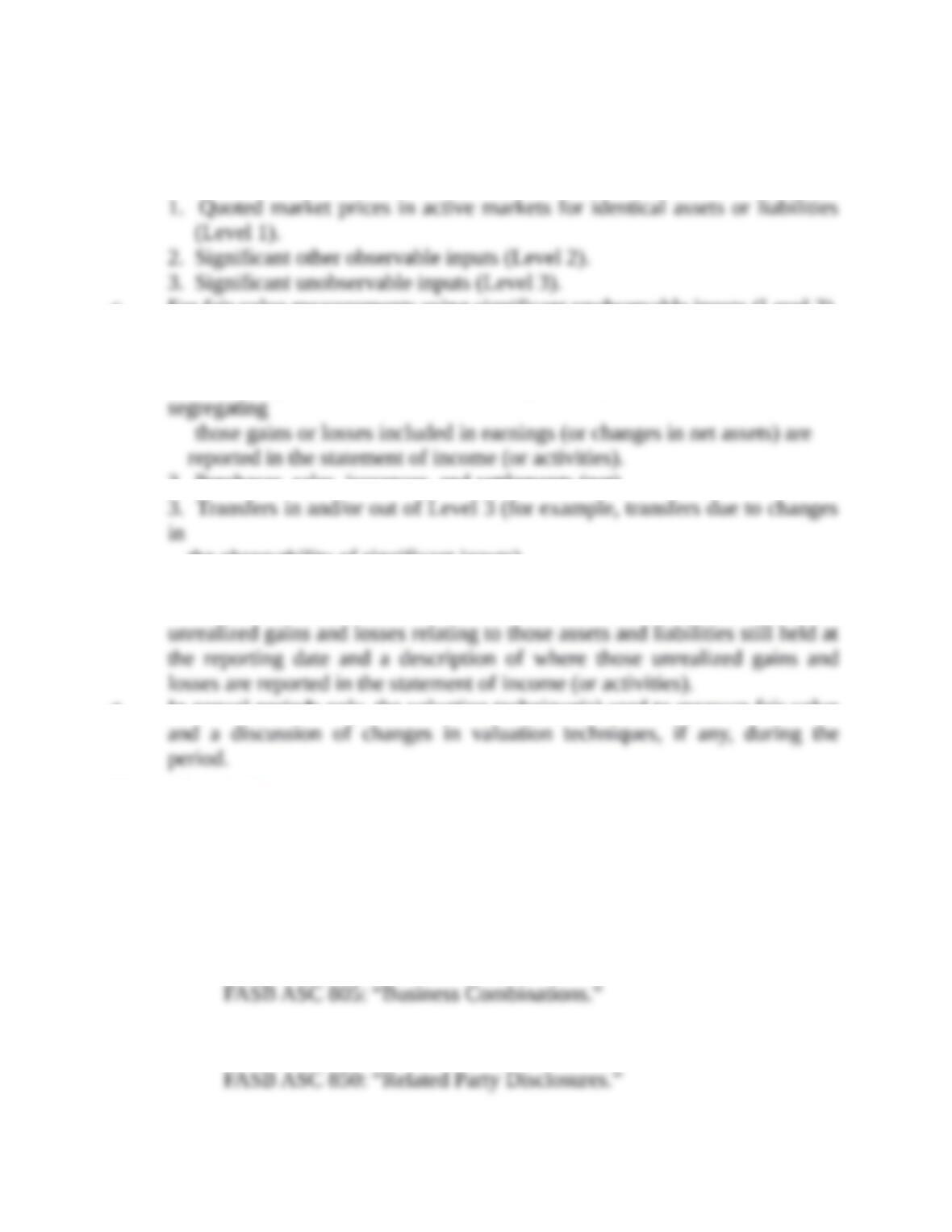
b. The level within the fair value hierarchy in which the fair value
measurements in their entirety fall, segregating fair value measurements
using any of the following:
c. For fair value measurements using significant unobservable inputs (Level 3),
a reconciliation of the beginning and ending balances, separately presenting
changes during the period attributable to any of the following:
1. Total gains and losses for the period (realized and unrealized),
2. Purchases, sales, issuances, and settlements (net).
the observability of significant inputs).
d. The amount of the total gains or losses for the period in (c)(1) included in
earnings (or changes in net assets) that are attributable to the change in
e. In annual periods only, the valuation technique(s) used to measure fair value
Exercise 1–4
The FASB Accounting Standards Codification represents the single
source of authoritative U.S. generally accepted accounting principles.
The specific citation for each of the following items is:
1. The topic number for business combinations:
2. The topic number for related-party disclosures:
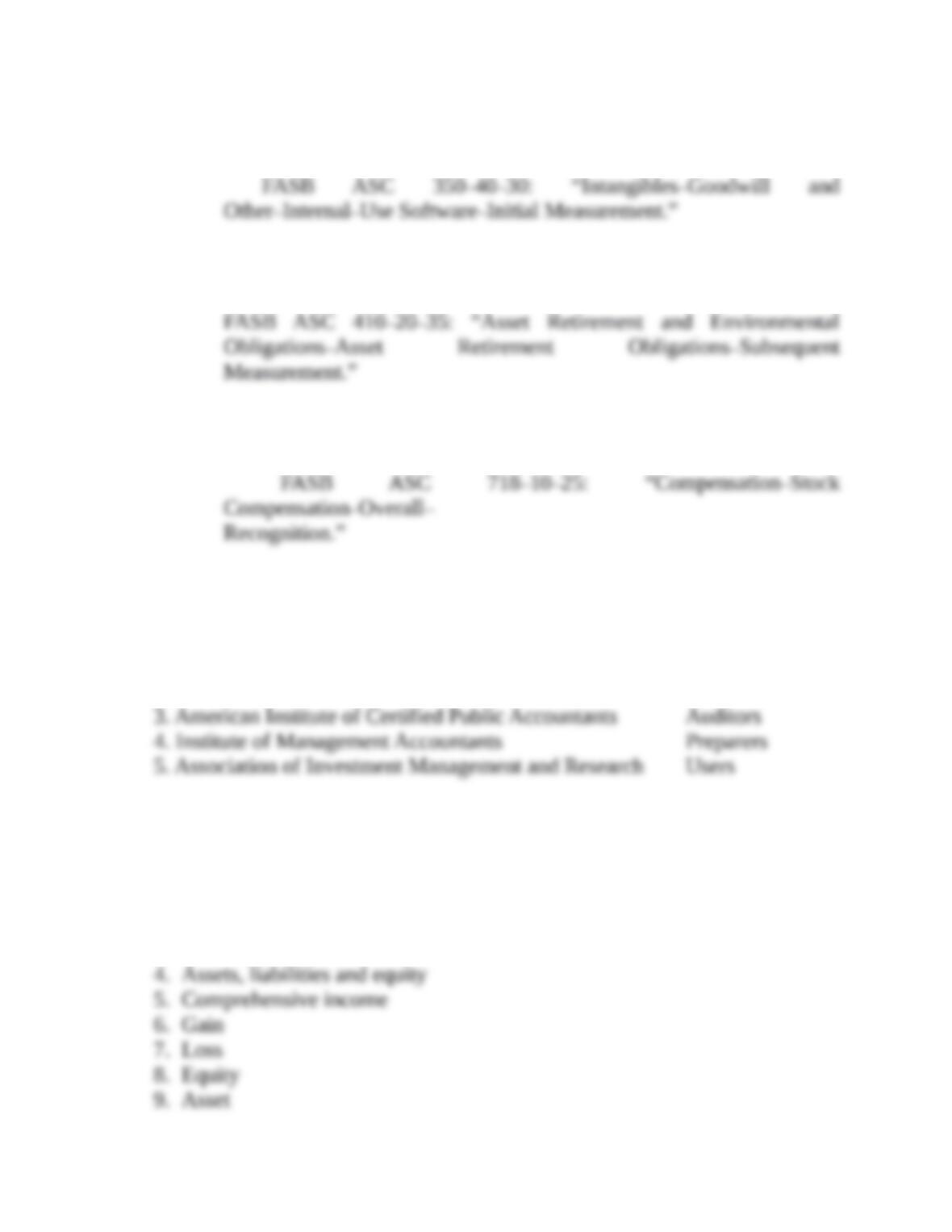
3. The topic, subtopic, and section number for the initial
measurement of internal-use software:
4. The topic, subtopic, and section number for the subsequent
measurement of asset retirement obligations:
5. The topic, subtopic, and section number for the recognition of
stock compensation:
Exercise 1–5
Organization Group
1. Securities and Exchange Commission Users
2. Financial Executives International Preparers
Exercise 1–6
1. Liability
2. Distribution to owners
3. Revenue
Exercise 1–7
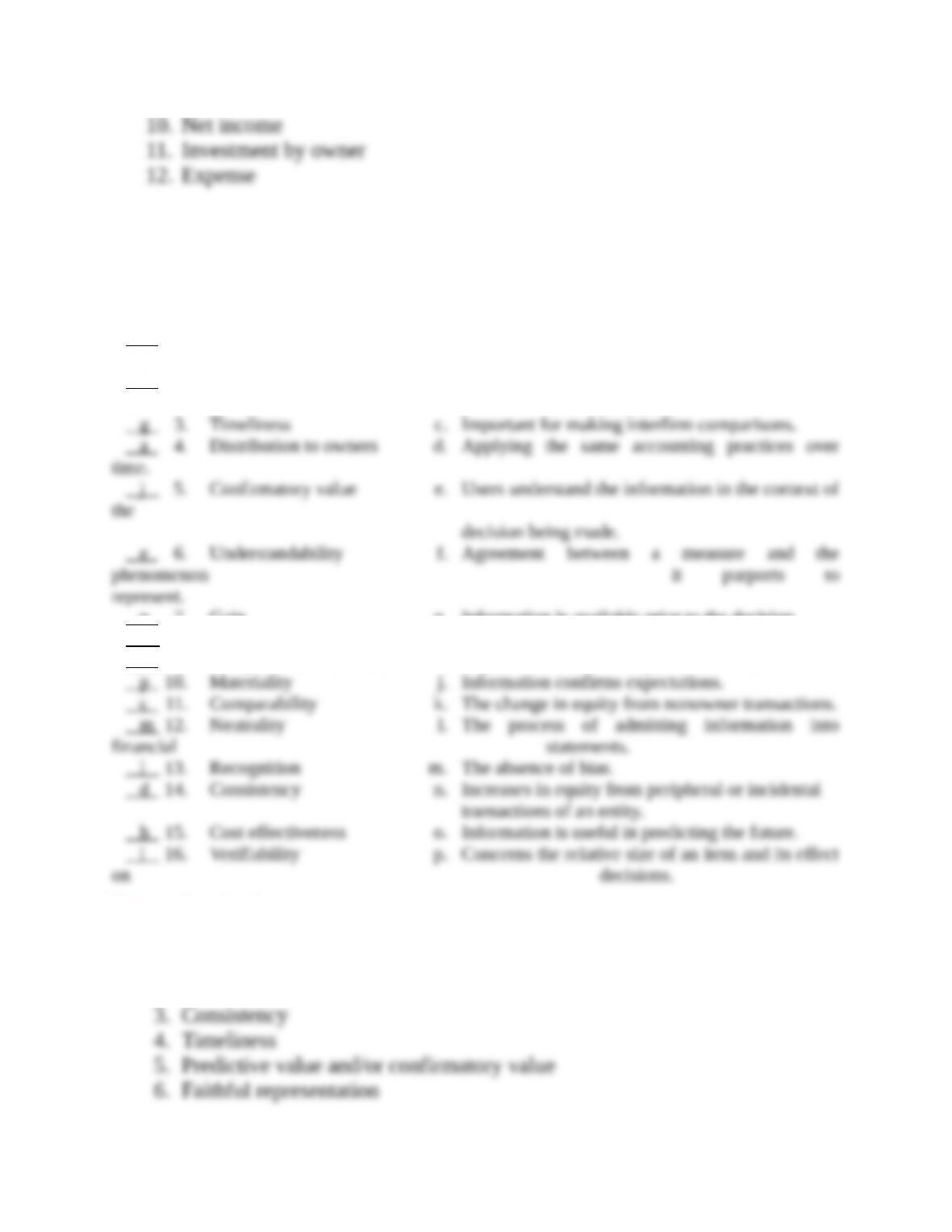
List A List B
o 1. Predictive value a. Decreases in equity resulting from transfers to
owners.
h 2. Relevance b. Requires consideration of the costs and value of
information.
n 7. Gain g. Information is available prior to the decision.
f 8. Faithful representation h. Pertinent to the decision at hand.
k 9. Comprehensive income i. Implies consensus among different measurers.
Exercise 1–8
1. Materiality
2. Neutrality
Exercise 1–9
List A List B
d 1. Expense recognition a. The enterprise is separate from its owners and
other entities.
g 2. Periodicity b. A common denominator is the dollar.
e 3. Historical cost principle c. The entity will continue indefinitely.
Exercise 1–10
1. The economic entity assumption
2. The periodicity assumption
Exercise 1–11
1. The historical cost (original transaction value) principle
2. The periodicity assumption
Exercise 1–12
1. Disagree — Monetary unit assumption
2. Disagree — Full disclosure principle
3. Agree — Expense recognition
Exercise 1–13
1. Disagree — This is a violation of the historical cost (original
transaction value) principle.
2. Disagree — This is a violation of the economic entity assumption.
Exercise 1–14
Statement Concept
1. d. Monetary unit assumption
2. h. Full-disclosure principle
3. g. Expense recognition
Exercise 1–15
1. b
2. d
Judgment Case 1–1
Requirement 1
In the 1934 Securities Act, Congress gave the SEC the job of setting
accounting and reporting standards for companies whose securities are publicly
traded. However, the SEC, a government-appointed body, always has
Requirement 2
1. SEC employees may not have the expertise necessary to set accounting
standards.
Research Case 1–2
Requirement 2
The 1933 Act has two basic objectives:
1. To require that investors be provided with material information concerning
2. To prevent misrepresentation, deceit, and other fraud in the sale of securities.
CASES
Requirement 3
EDGAR:
EDGAR, the Electronic Data Gathering, Analysis, and Retrieval system,
performs automated collection, validation, indexing, acceptance, and forwarding of
Research Case 1–3
Requirement 1
The mission of the Financial Accounting Standards Board is to establish and
improve standards of financial accounting and reporting for the guidance and
Requirement 2
Requirement 3
The FASB receives many requests for action on various financial accounting
and reporting topics from all segments of a diverse constituency, including the
The FASB is alert to trends in financial reporting through observation of
published reports, liaison with interested organizations, and from recommendations
The Board turns to many other organizations and groups for advice and
information on various matters, including its agenda. Among the groups with
.
Research Case 1–4
Requirement 1
The IASB is committed to developing, in the public interest, a single set of
high-quality, understandable, and enforceable global accounting standards that
Requirement 2
Requirement 3
The answers to this question will vary depending on the date the research is
Requirement 4
Research Case 1–5
Requirement 2
In 1978, China’s enterprise reform program was initiated. Prior to 1978, all
business enterprises were state owned and run. Now, China’s companies exhibit a
Requirement 3
The author feels that the accounting environment in China differs
However, even though this information might be relevant, it would not
possess faithful representation. For example, how could we objectively measure
It is important that each student actively participate in the process of arriving
at a solution. Domination by one or two individuals should be discouraged.