Problem A-3 (continued)
Requirement 6
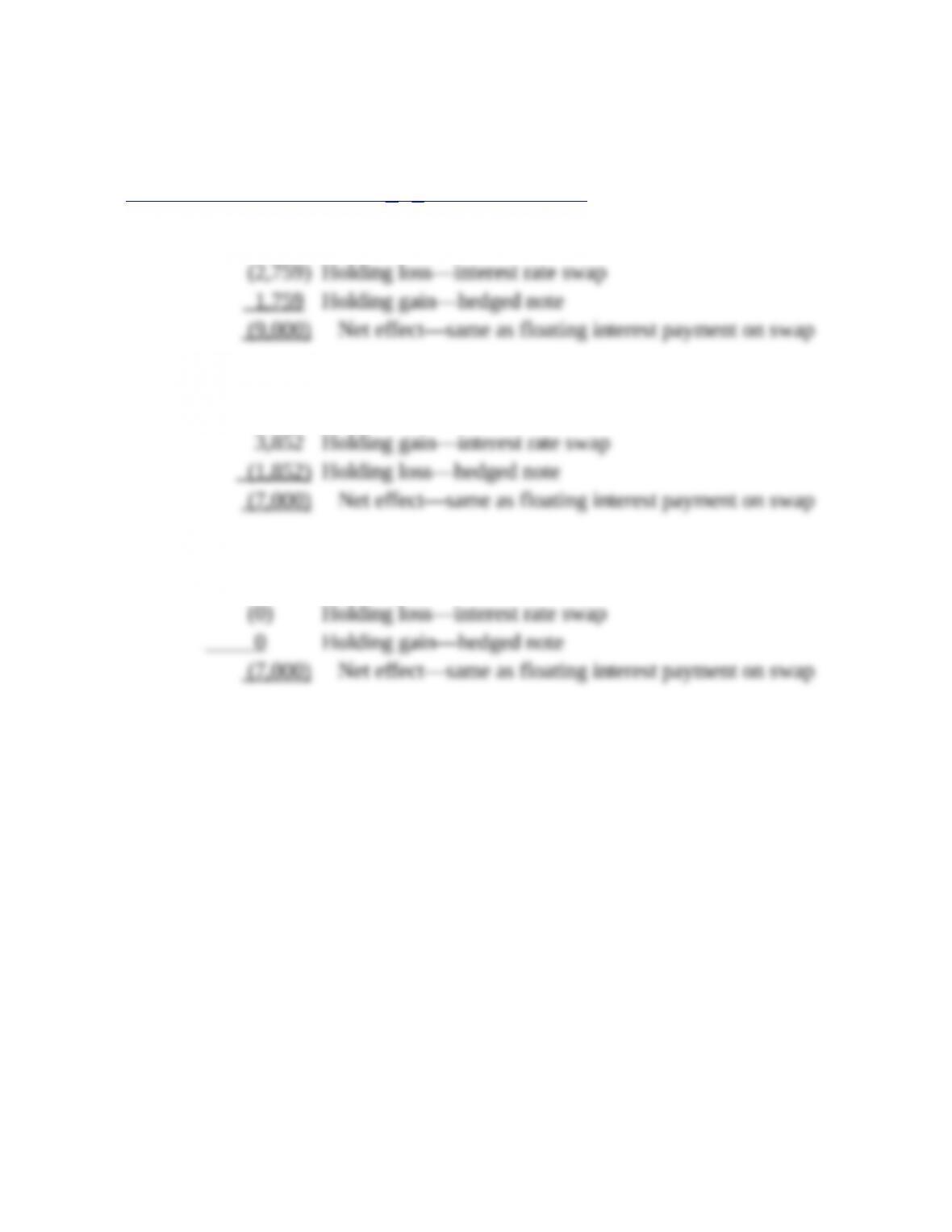
Income Statement ( )
2018 (8,000) Interest expense
2019 (8,842) Interest expense
(158) Interest expense
2020 (7,065) Interest expense
65 Interest revenue
Problem A–3 (concluded)
Requirement 7
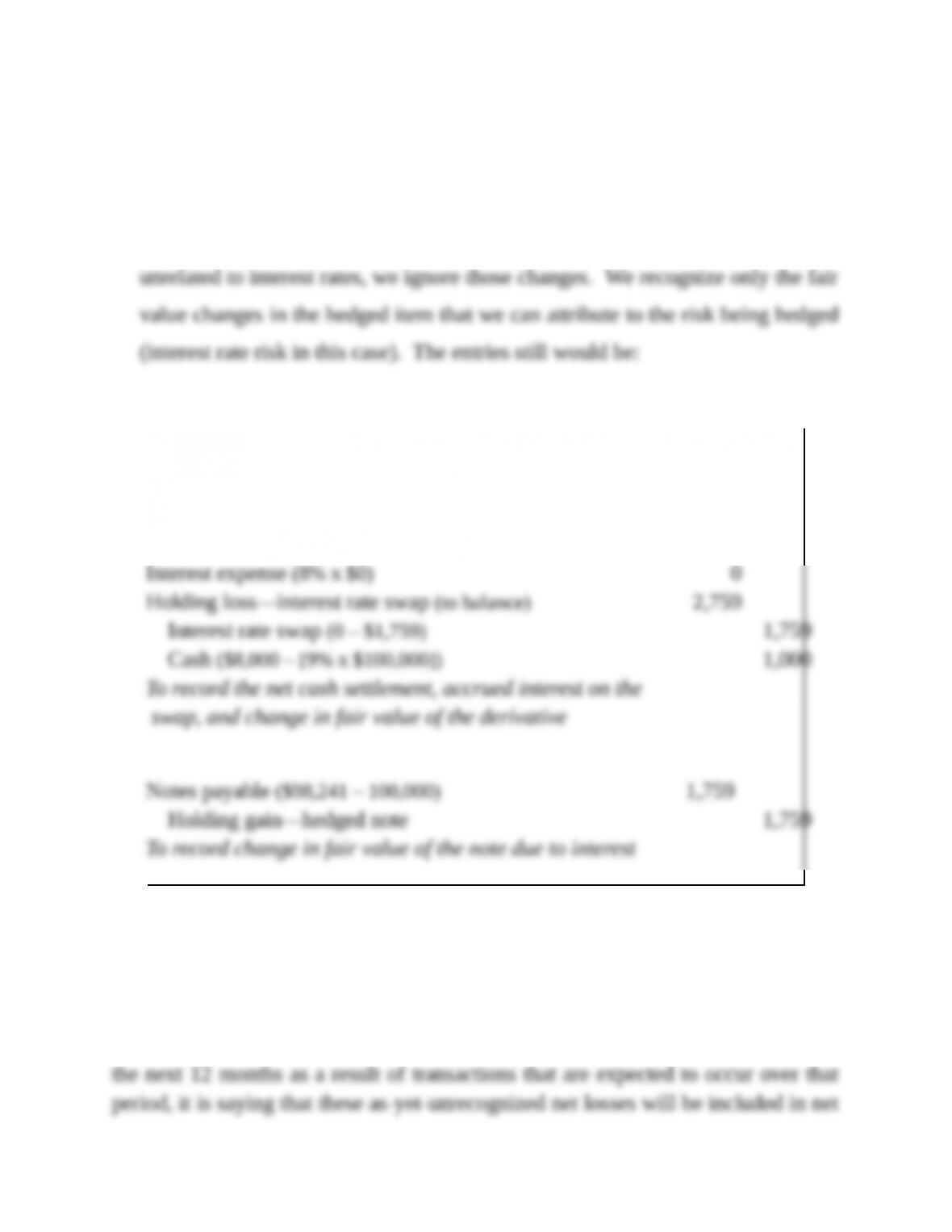
Your entries would not be affected. When a note’s fair value changes by an
amount different from that of a designated hedge instrument for reasons
Interest expense (8% x $100,000) 8,000
Cash 8,000
To record interest
Real World Case A–1
Requirement 1
When Johnson & Johnson indicates that it expects that substantially all of the
balance of deferred net losses on derivatives will be reclassified into earnings over
CASES
Requirement 2
A gain or loss from a “fair value” hedge is recognized immediately in earnings
along with the loss or gain from the item being hedged. On the other hand, a gain
Communication Case A–2
Depending on the assumptions made, different views can be convincingly
defended. The process of developing and synthesizing the arguments likely will be
more beneficial than any single solution. Each student should benefit from
participating in the process, interacting first with his or her partner, then with the
class as a whole. It is important that each student actively participate in the
process. Domination by one or two individuals should be discouraged.
Hedging means taking an action that is expected to produce exposure to a
particular type of risk that’s precisely the opposite of an actual risk to which the
company already is exposed. Under existing hedge accounting, if the contract
meets specified hedging criteria, the income effects of the hedge instrument and
the income effects of the item being hedged should be recognized at the same time.
Arguments raised may focus on a variety of issues including:
•Which hedges should qualify for special accounting? Hedges of risk of
loss? Hedges that reduce the variability of outcomes?
•Should treatment be different for fair value hedges and cash flow hedges?
•Should only risk exposures arising from existing assets or liabilities qualify
for special accounting? Should anticipated transactions be included also?
•To what extent, if any, must there be correlation between the gains and
losses on the hedge instrument and the item being hedged?
•How should any deferred gain or loss be classified prior to recognition?
Real World Case A–3
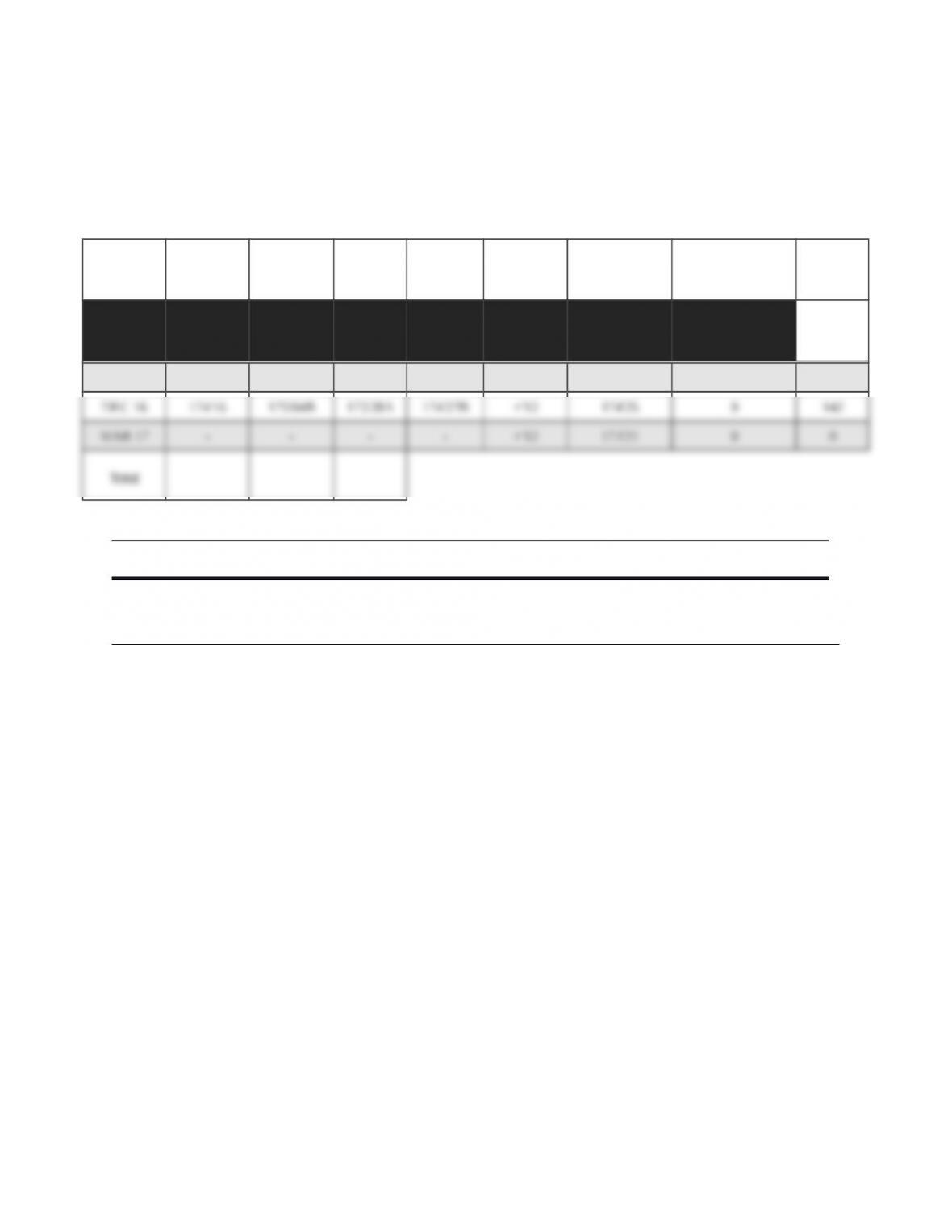
The following is a copy of the U.S. Treasury Bond Futures: Settlement Prices as of
July 7, 2016:
Month Open High Low Last Change Settle Estimated Volume
Prior Day
Open
Interest
Month Open High Low Last Change Settle Estimated Volume
Prior Day
Open
Interest
SEP 16 176’08 176’22 175’09 176’10 +’12 176’08 243,967 568,609
U.S. TREASURY BOND FUTURES SETTLEMENTS
Research Case A–4
[Note: This case requires the student to reference a journal article. Authoritative
accounting literature references are to pre-Codification standards.]
Requirement 1
According to the authors, the primary problems or issues the FASB was attempting
to address with the standard are the following:
Previous accounting guidance for derivatives and hedging was incomplete.
Only a few types of derivatives used today were specifically addressed in
accounting standards. SFAS No. 52, “Foreign Currency Translation,”
addresses forward foreign exchange contracts, and SFAS No. 80,
“Accounting for Futures Contracts,” addresses exchange-traded futures
Previous accounting guidance for derivatives and hedging was inconsistent.
Under the previous accounting guidance (FASB standards and EITF
consensuses), the required accounting treatment may have differed
depending on the type of instrument used in hedging and the type of risk

Case A–4 (concluded)
Previous accounting guidance for derivatives and hedging was complex. The
lack of a single, comprehensive approach to accounting for derivatives and
hedging made the accounting guidance very complex. The incompleteness
Effects of derivatives were not apparent. Under the previous varied
practices, derivatives may or may not have been recognized in the financial
statements. If recognized in the financial statements, realized and unrealized
Requirement 2
In considering the issues, the FASB made four fundamental decisions that became
the cornerstones of the proposed statement. According to the article, those
fundamental decisions were:
Derivatives are assets or liabilities and should be reported in the financial
statements.

Hedge accounting should be provided for only qualifying transactions, and