Solutions to Chapter 9
Using Discounted Cash-Flow Analysis to Make Investment Decisions
1. Gross revenues from new chip = 12 million $25 = $300 million
Cost of new chip = 12 million $8 = $96 million
2. Incremental cash flows are answers b and d:
3.
a. If the oce space would have remained unused in the absence of the proposed project,
b. One reasonable approach would be to assess a cost to the space equal to the rental
4. Net income = ($74 $42 $10) [0.35 ($74 $42 $10)] = $22 $7.7 = $14.3
million
a. Revenues cash expenses taxes paid = $74 $42 $7.7 = $24.3 million
9-:
Copyright © 2018 McGraw-Hill Education. All rights reserved. No reproduction or distribution without the prior written consent of
McGraw-Hill Education.
5. Net income = ($7 $4 $1) [0.35 ($7 $4 $1)] = $2 $0.7 = $1.3 million
6. a. False. As long as the firm has taxable income to shield, the depreciation tax shields
b. False. Regardless of the actual financing, you should view the project as if it were
7. Revenue $160,000
Rental costs 30,000
8. a. Revenue – rental costs – variable costs – taxes
9-:
Copyright © 2018 McGraw-Hill Education. All rights reserved. No reproduction or distribution without the prior written consent of
McGraw-Hill Education.
b. Net income + depreciation = $45,500 + $10,000 = $55,500
c. [(Revenue – rental costs – variable costs) (1 – 0.35)] + (depreciation 0.35)
9. a. The machinery associated with the electric motor project is an appropriate incremental
costs. The warehouse extension would be included only to the extent that the decision
b. If the R&D costs have been spent then they fall into the category of a sunk costs and
c. The increase in working capital, exhibited here as an investment in inventories, is an
d. This note speci$es that cash !ows are in real terms, instead of nominal, and therefore
e. The indirect costs should be scrutinized in two ways. First, they should be strictly
f. The marketing and administrative costs should be strictly incremental costs contingent
g. Depreciation expense in a non-cash expense and therefore should not reduce project
9-:
Copyright © 2018 McGraw-Hill Education. All rights reserved. No reproduction or distribution without the prior written consent of
McGraw-Hill Education.
h. Financing decisions should be separate from the investment decision. The project cash
i. Income should be adjusted for all items mentioned above.
j. The tax loss carry forwards may not be realized if the firm has other profitable business
k. The net cash !ow calculation should be adjusted for all items aforementioned.
l. The net present value calculation should re!ect correctly calculated cash !ows. Also,
10. Revenue $120,000
Variable costs 40,000
11.
9-:
Copyright © 2018 McGraw-Hill Education. All rights reserved. No reproduction or distribution without the prior written consent of
McGraw-Hill Education.
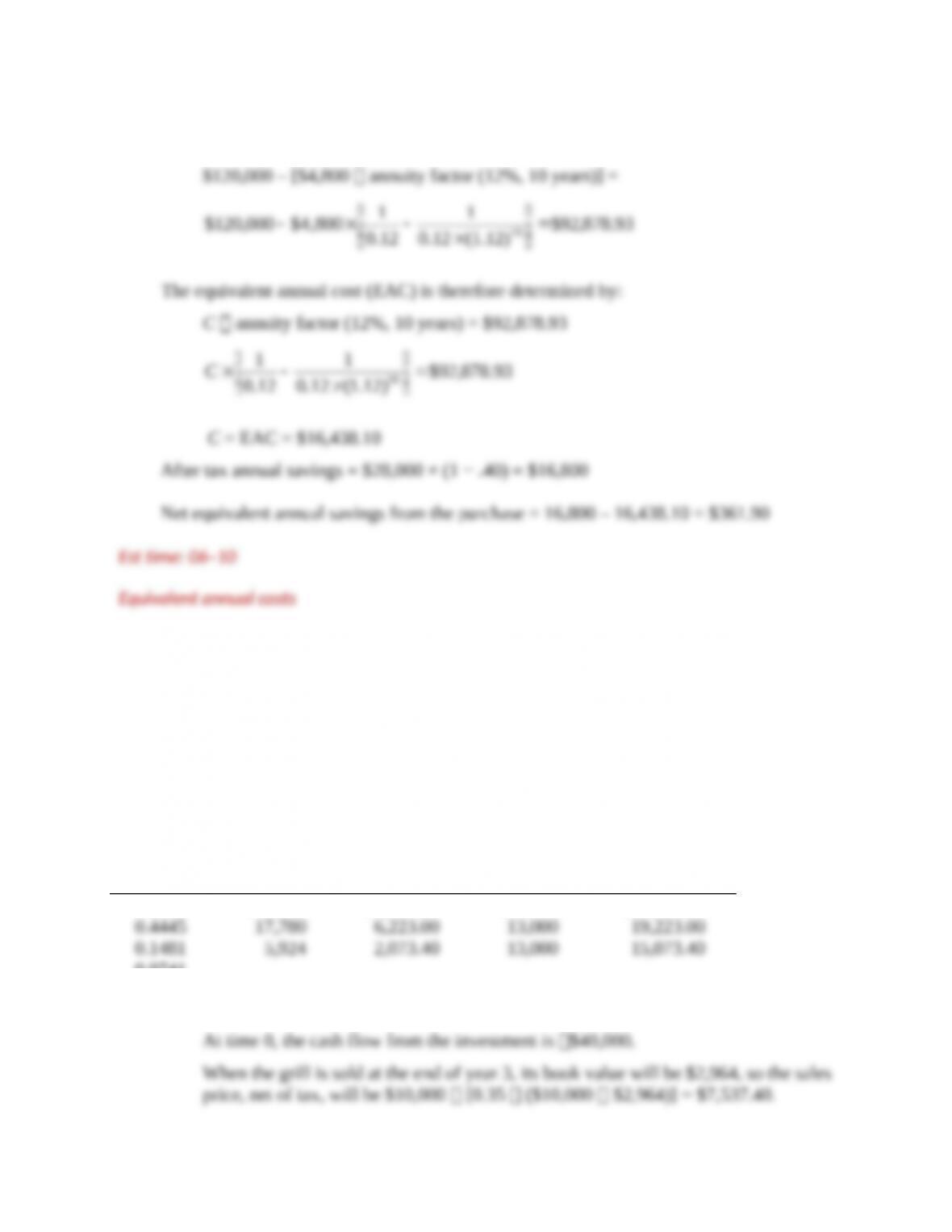
If the firm uses straight-line depreciation, the present value of the cost of buying, net of
the annual depreciation tax shield (which equals $12,000 0.40 = $4,800), is:
12. a. In the following table, we compute the impact on operating cash flows by summing the
value of the depreciation tax shield (depreciation tax rate) plus the net-of-tax
improvement in operating income [$20,000 (1 – tax rate)]. Although the MACRS
depreciation schedule extends out to 4 years, the project will be terminated when the
machine is sold after 3 years, so we need to examine cash flows for only 3 years.
MACRS Depreciation Depreciation
0.35
Operating
Income
(1 – 0.35)
Contribution to
Operating Cash
flow
0.3333
$13,332
$4,666.20
$13,000
$17,666.20
0.0741
b. Total cash flow = operating cash flow + cash flow associated with investments.
9-:
Copyright © 2018 McGraw-Hill Education. All rights reserved. No reproduction or distribution without the prior written consent of
McGraw-Hill Education.
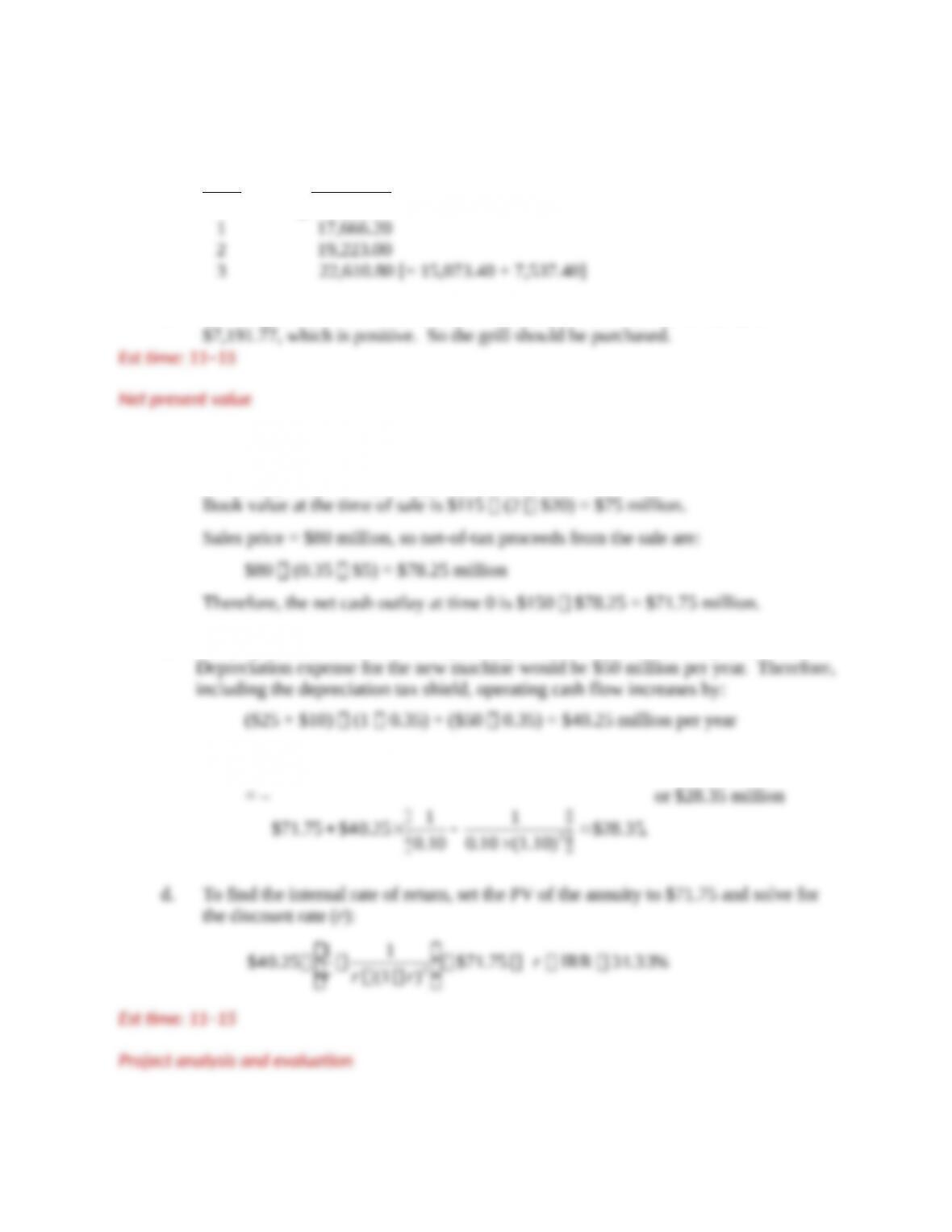
Therefore, total cash flows are:
Time Cash Flow
0$40,000.00
c. The net present value of this cash-flow stream, at a discount rate of 12%, is
13. a. Annual depreciation is ($115 $15)/5 = $20 million.
b. The project saves $10 million in operating costs and increases sales by $25 million.
c. NPV = $71.75 + [$40.25 annuity factor (10%, 3 years)]
9-:
Copyright © 2018 McGraw-Hill Education. All rights reserved. No reproduction or distribution without the prior written consent of
McGraw-Hill Education.
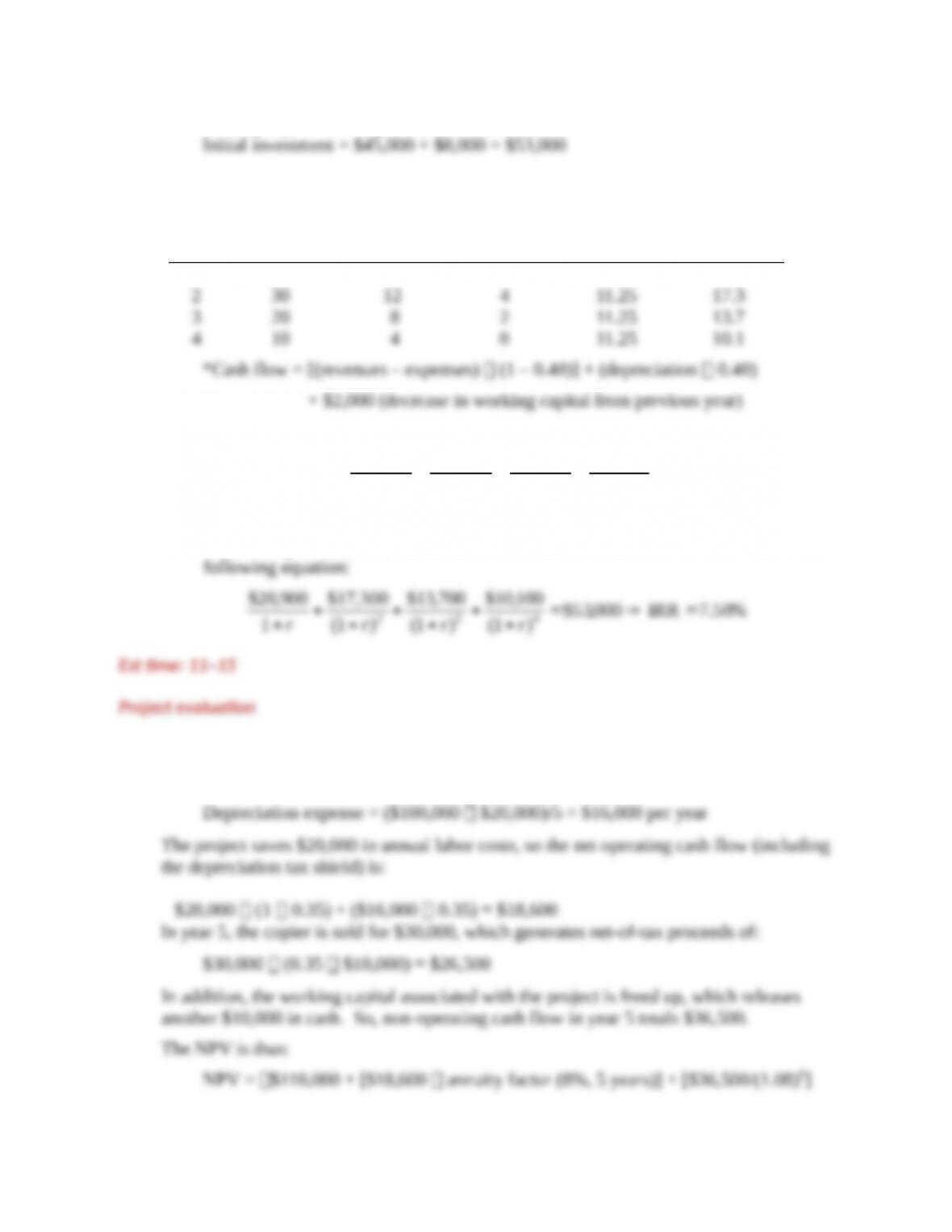
14. a. Working capital = 20% $40,000 = $8,000
b.
All figures in thousands of dollars
Year Revenues Expenses Working
Capital Depreciation Cash Flow*
1
40
16
6
11.25
20.9
c.
71.377,4$
12.1
100,10$
12.1
700,13$
12.1
300,17$
12.1
900,20$
000,53$NPV 432
d. To compute IRR, use trial and error or a financial calculator to solve for r in the
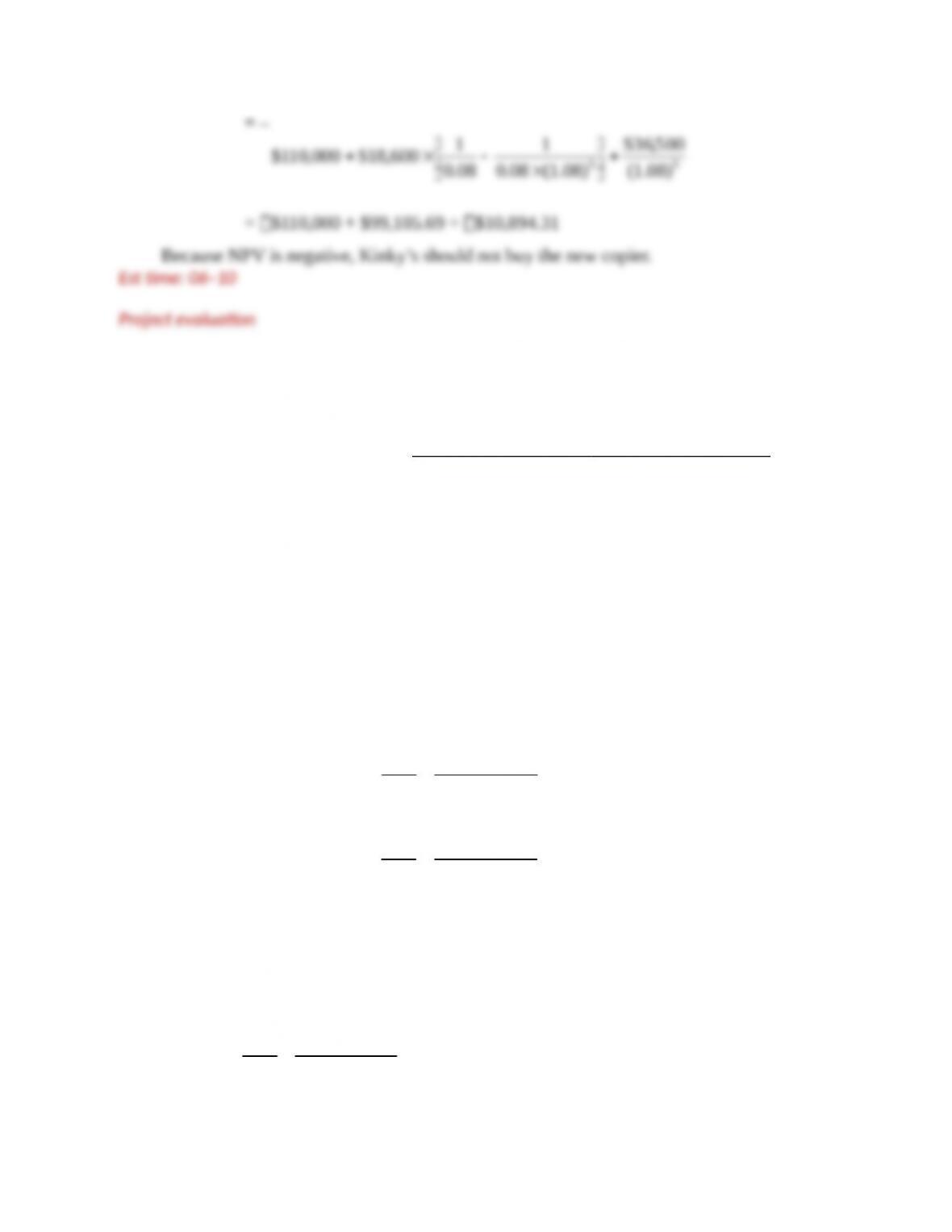
15. The initial investment is $100,000 for the copier plus $10,000 in working capital, for a
total outlay of $110,000.
9-:
Copyright © 2018 McGraw-Hill Education. All rights reserved. No reproduction or distribution without the prior written consent of
McGraw-Hill Education.
16. Find the equivalent annual cost of each alternative:
Quick and Dirty Do-It-Right
Operating costs $1 million $1 million
Investment $10 million $12 million
Project life 5 years 8 years
Annual depreciation $2 million $1.5 million
Depreciation tax shield $0.700 million $0.525 million
PV(depreciation tax shield)* $2.523 million $2.608 million
Net capital cost† $7.477 million $9.392 million
EAC of net capital cost* $2.074 million $1.891 million
*Annuity discounted at 12%; number of years = project life.
†Investment – PV(depreciation tax shield).
The present value of the depreciation tax shield for each alternative is computed as
follows:
million 523.2$
)12.1(12.0
1
12.0
1
million 700.0$PV
5
million 608.2$
)12.1(12.0
1
12.0
1
million 525.0$PV
8
The equivalent annual cost (EAC) for each alternative is computed by solving for “C” as
follows:
a.
million 074.2$EACmillion 477.7$
)12.1(12.0
1
12.0
1
5
CC
9-:
Copyright © 2018 McGraw-Hill Education. All rights reserved. No reproduction or distribution without the prior written consent of
McGraw-Hill Education.
17. All figures are on an incremental basis:
Labor savings $125,000
9-:
Copyright © 2018 McGraw-Hill Education. All rights reserved. No reproduction or distribution without the prior written consent of
McGraw-Hill Education.