Solutions to Chapter 8
Net Present Value and Other Investment Criteria
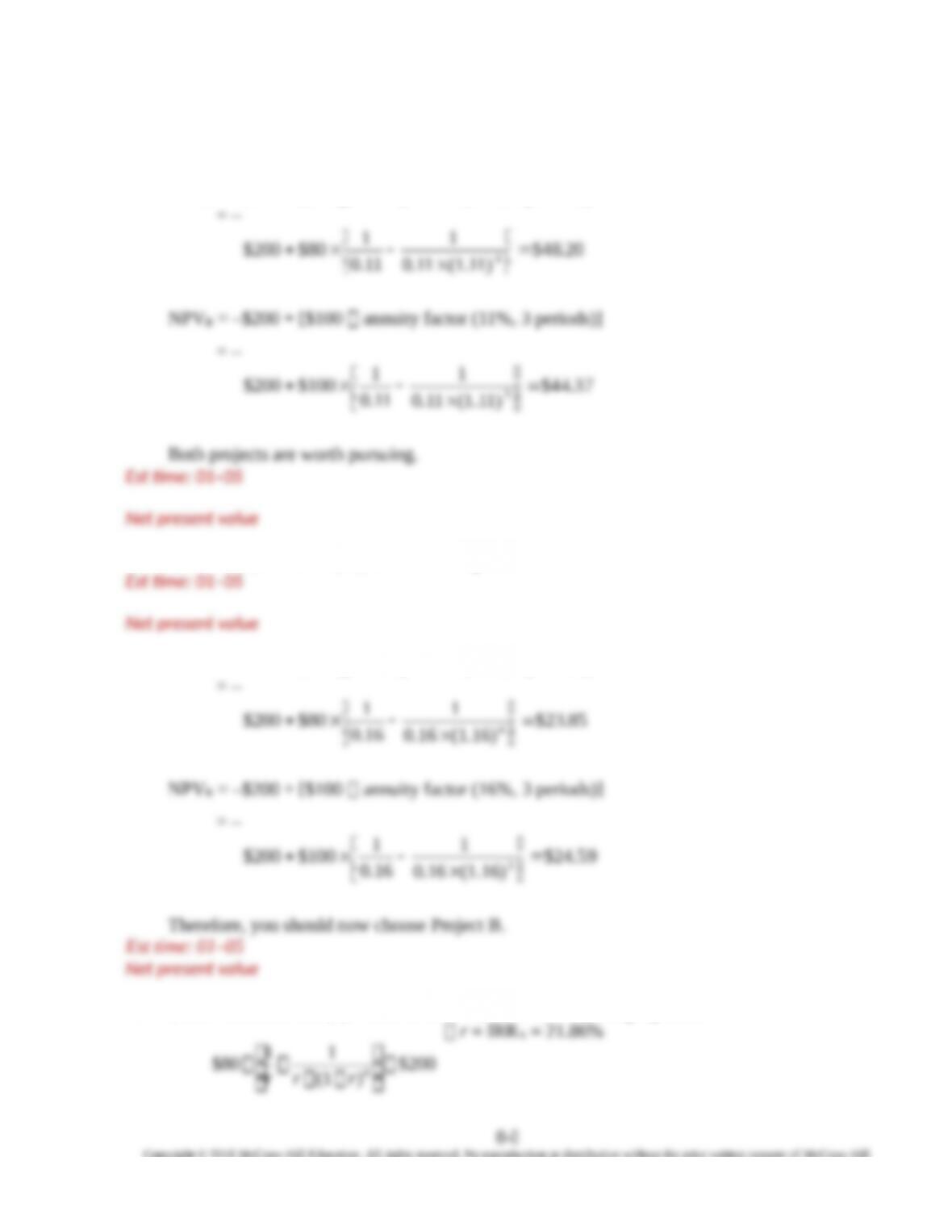
1. NPVA = –$200 + [$80 annuity factor (11%, 4 periods)]
2. Choose Project A, the project with the higher NPV.
3. NPVA = –$200 + [$80 annuity factor (16%, 4 periods)]
4. IRRA = discount rate (r), which is the solution to the following equation:
Copyright © 2018 McGraw-Hill Education. All rights reserved. No reproduction or distribution without the prior written consent of McGraw-Hill
Education.
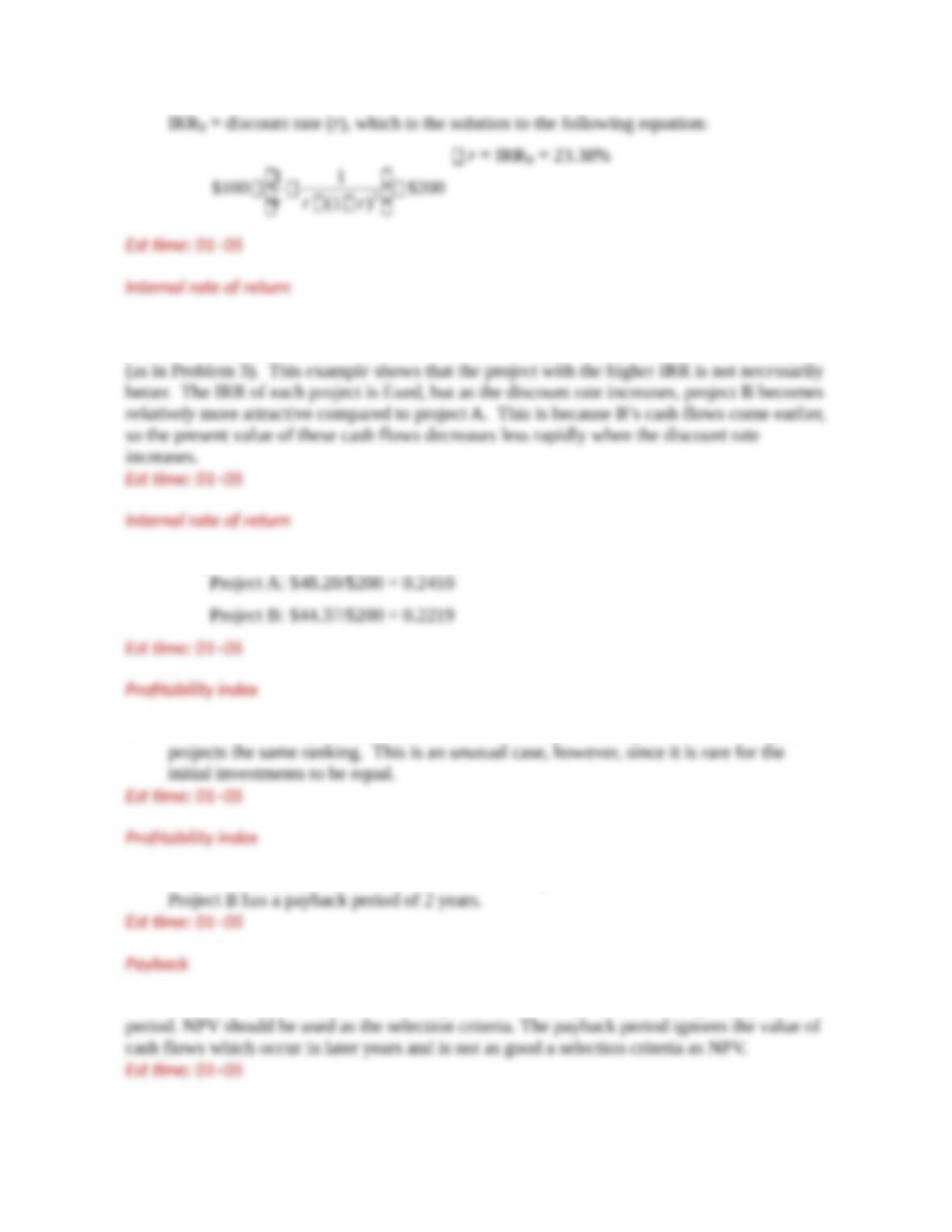
5. No. Even though project B has the higher IRR, its NPV is lower than that of project A
when the discount rate is lower (as in Problem 1) and higher when the discount rate is higher
6. The profitability indexes are as follows:
7. In this case, with equal initial investments, both the profitability index and NPV give
8. Project A has a payback period of $200/$80 = 2.5 years.
9. No. In this case, Project A has the higher NPV and project B has the higher payback
8-6
Copyright © 2018 McGraw-Hill Education. All rights reserved. No reproduction or distribution without the prior written consent of McGraw-Hill
Education.
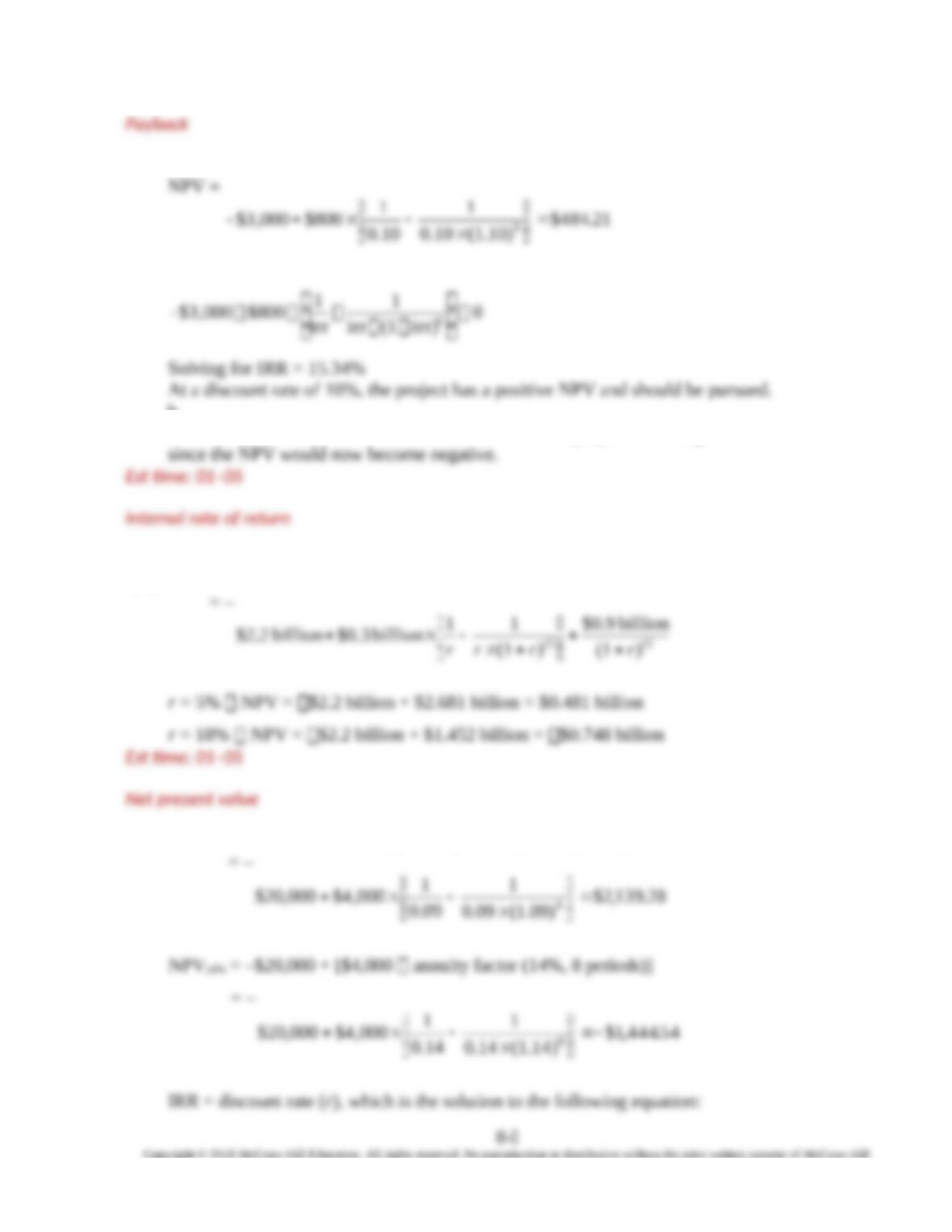
10. a.
b.
If the discount rate rises above the IRR of 15.34% the project is no longer attractive
11. NPV = $2.2 billion + [$0.3 billion annuity factor (r, 15 years)] [$0.9 billion/(1 +
r)15]
12. NPV9% = –$20,000 + [$4,000 annuity factor (9%, 8 periods)]
Copyright © 2018 McGraw-Hill Education. All rights reserved. No reproduction or distribution without the prior written consent of McGraw-Hill
Education.
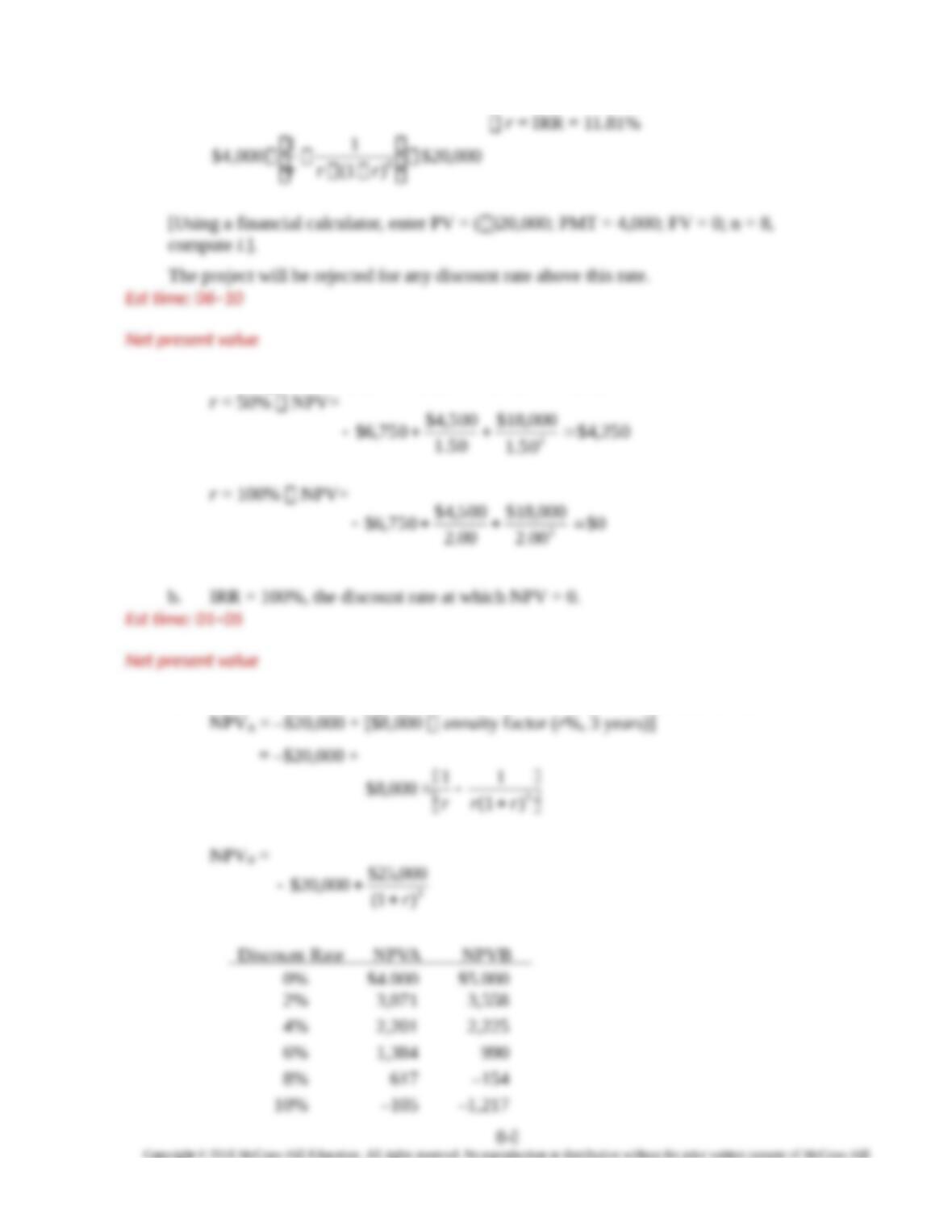
13. a. r = 0% NPV = –$6,750 + $4,500 + $18,000 = $15,750
14. a. NPV for each of the two projects, at various discount rates, is tabulated below.
Copyright © 2018 McGraw-Hill Education. All rights reserved. No reproduction or distribution without the prior written consent of McGraw-Hill
Education.
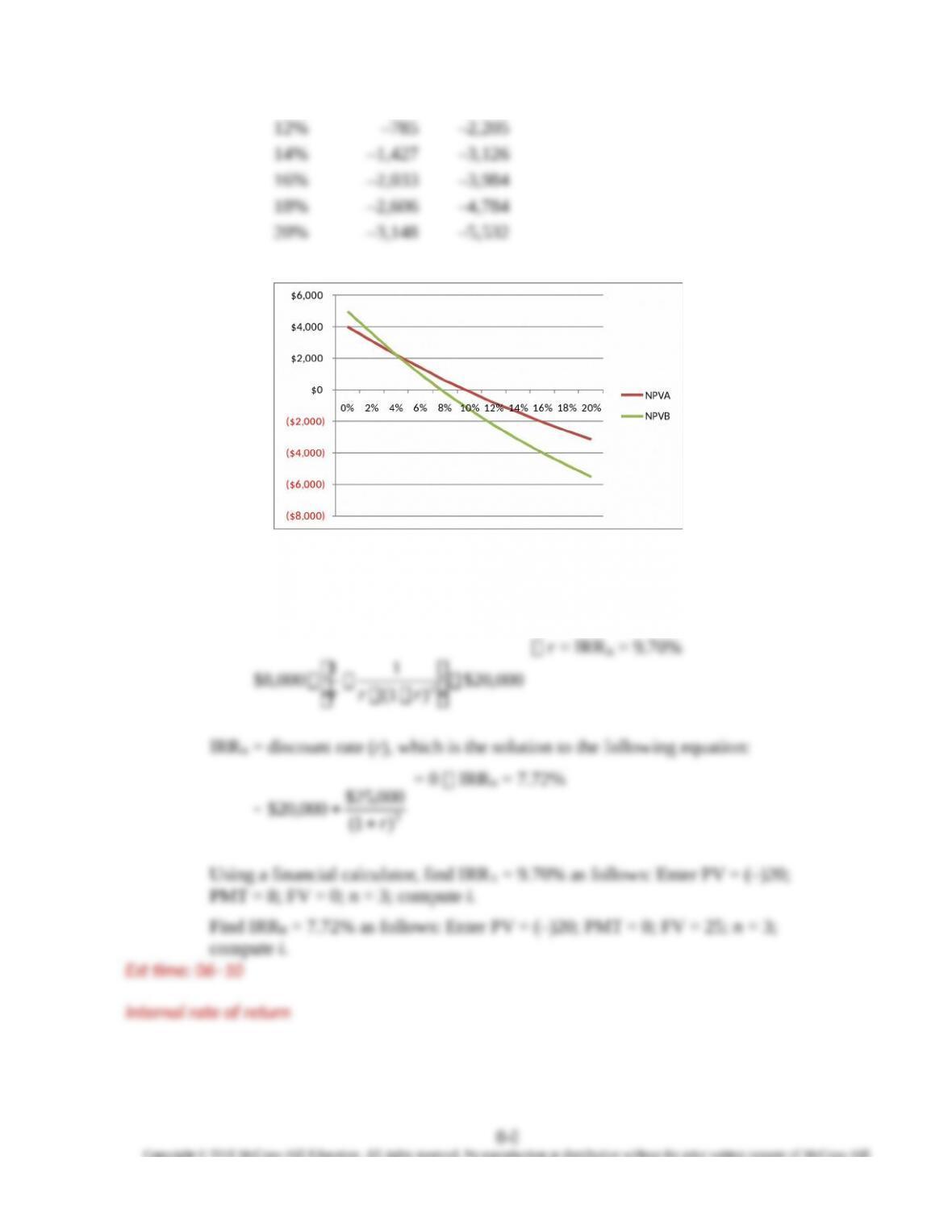
From the NPV profile, it can be seen that Project A is preferred over Project B if
the discount rate is above 4%. At 4% and below, Project B has the higher NPV.
b. IRRA = discount rate (r), which is the solution to the following equation:
Copyright © 2018 McGraw-Hill Education. All rights reserved. No reproduction or distribution without the prior written consent of McGraw-Hill
Education.
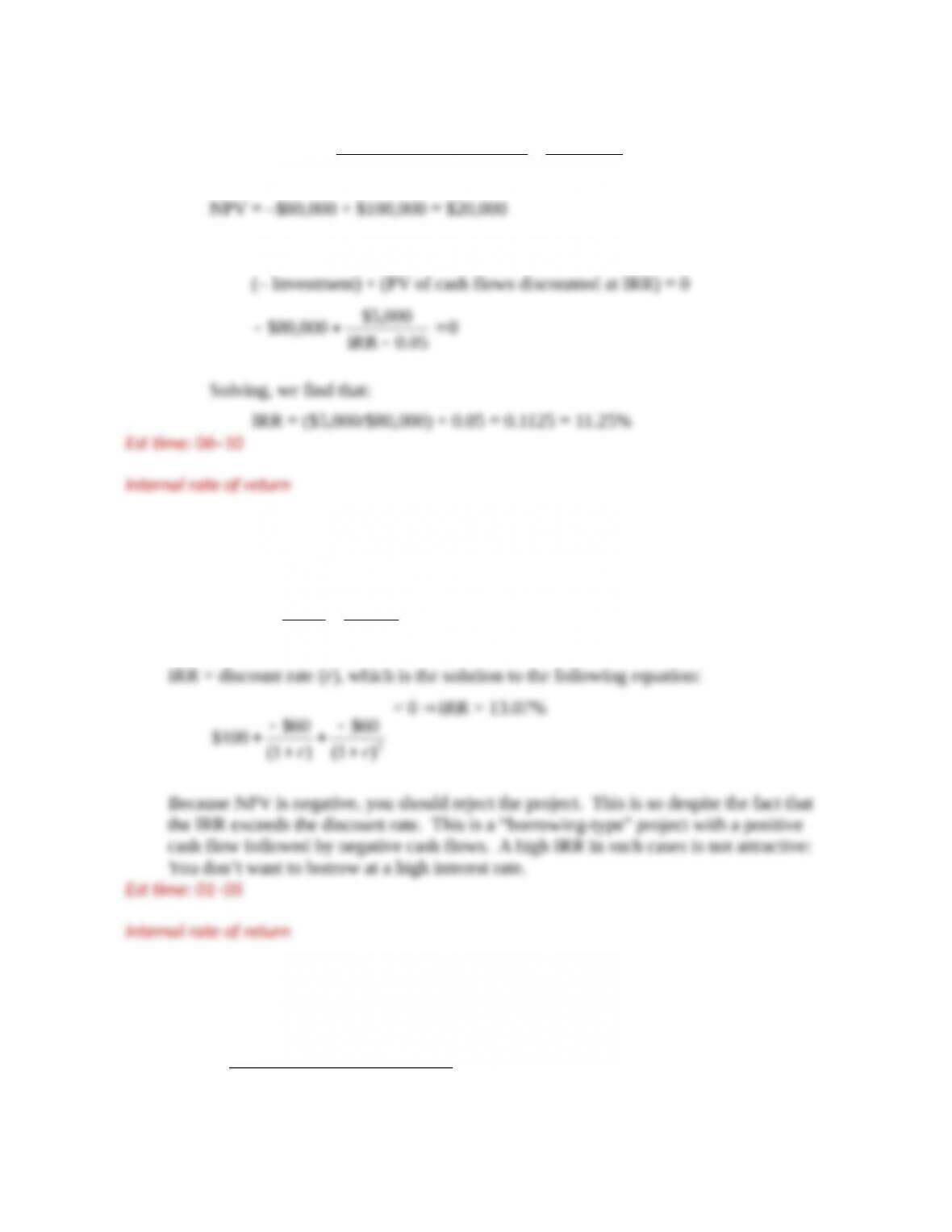
15. a. Present value =
Cash flow at end of year $5,000 $100, 000
Discount rate – growth rate 0.10 0.05
= =
–
b. Recall that the IRR is the discount rate that makes NPV equal to zero:
16.
40.1$
)12.1(
60$
12.1
60$
100$NPV 2
17.
a.
Time Cash flow
0
$ 5 million
1 30 million
8-6
Copyright © 2018 McGraw-Hill Education. All rights reserved. No reproduction or distribution without the prior written consent of McGraw-Hill
Education.
2
28 million
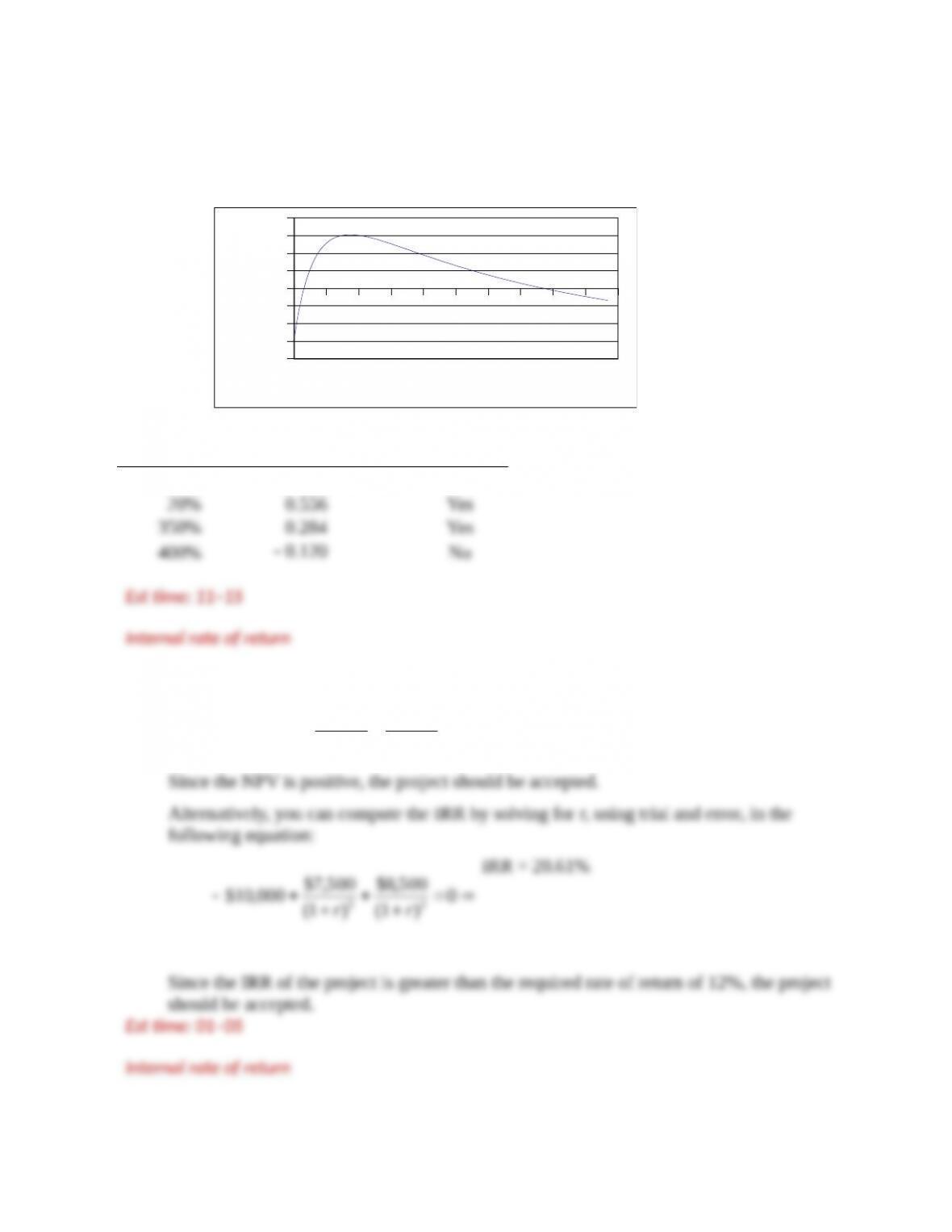
The graph below shows a plot of NPV as a function of the discount rate.
NPV = 0 when r equals (approximately) either 15.61% or 384.39%. These are the
two IRRs.
0% 50% 100% 150% 200% 250% 300% 350% 4 00% 4 50% 500%
-4
-3
-2
-1
0
1
2
3
4
Disco unt rat e
NPV
b.
Discount Rate NPV Develop?
10% $0.868 million No
18.
09.029,2$
12.1
500,8$
12.1
500,7$
000,10$NPV 32
8-6
Copyright © 2018 McGraw-Hill Education. All rights reserved. No reproduction or distribution without the prior written consent of McGraw-Hill
Education.
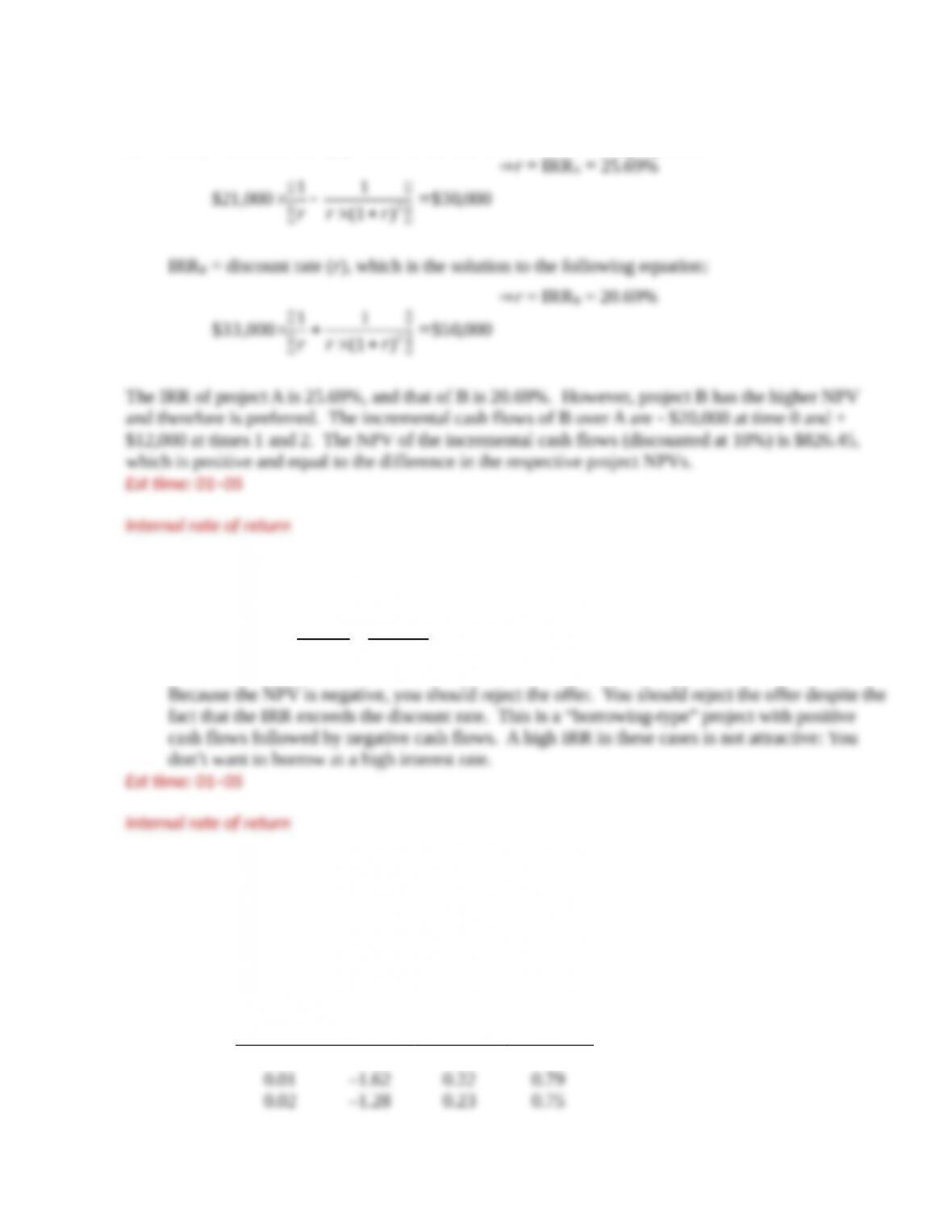
19. IRRA = discount rate (r), which is the solution to the following equation:
20.
70.197$
)12.1(
000,11$
12.1
000,4$
000,5$NPV
2
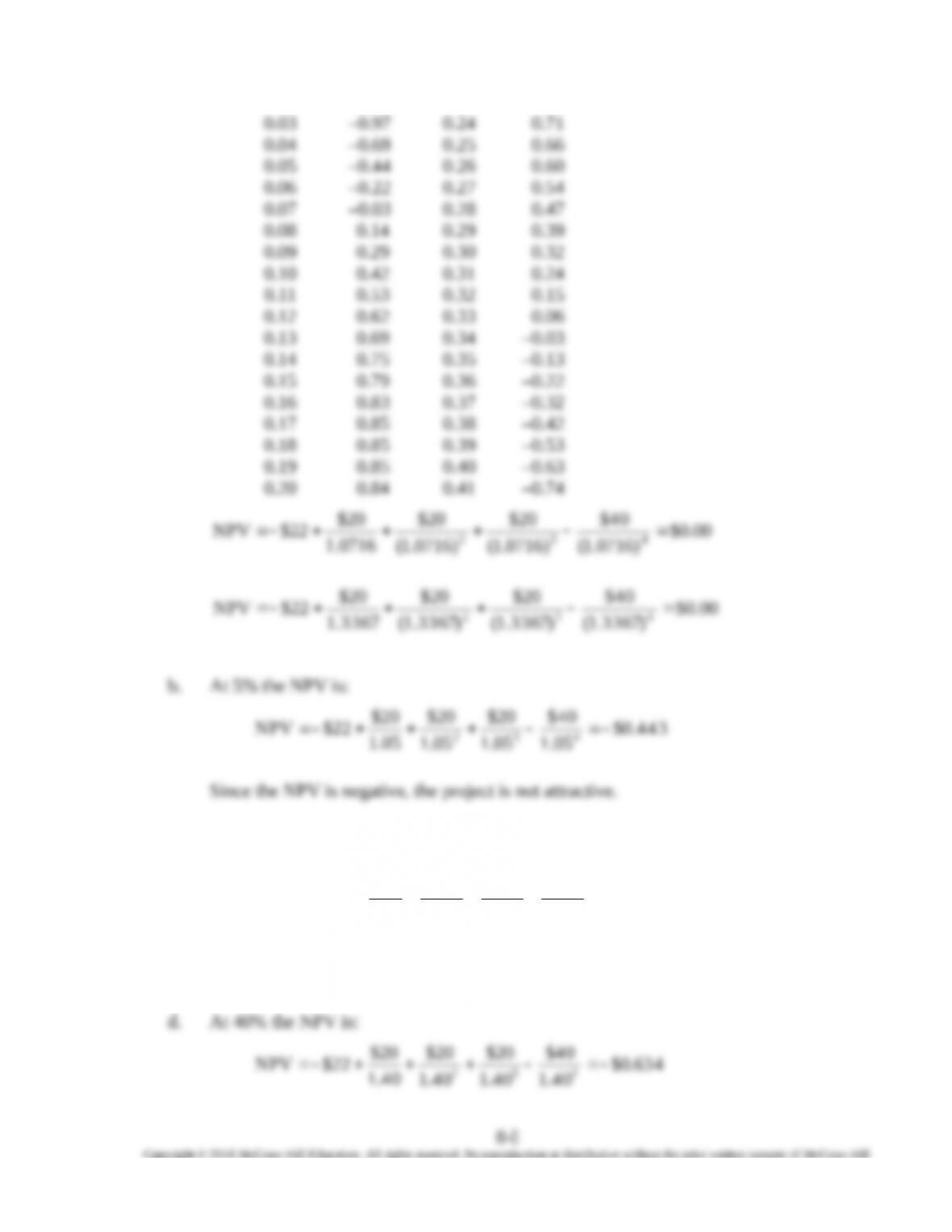
21. a. The following table shows the NPV profile of the project. NPV is zero at an interest
rate between 7% and 8%, and it is also equal to zero at an interest rate between 33% and 34%.
These are the two IRRs of the project. You can use your calculator to confirm that the two
IRRs are, more precisely, 7.16% and 33.67% (as shown below the table).
Discount
Rate NPV
Discount
Rate NPV
0.00 –2.00 0.21 0.82
8-6
Copyright © 2018 McGraw-Hill Education. All rights reserved. No reproduction or distribution without the prior written consent of McGraw-Hill
Education.
c.
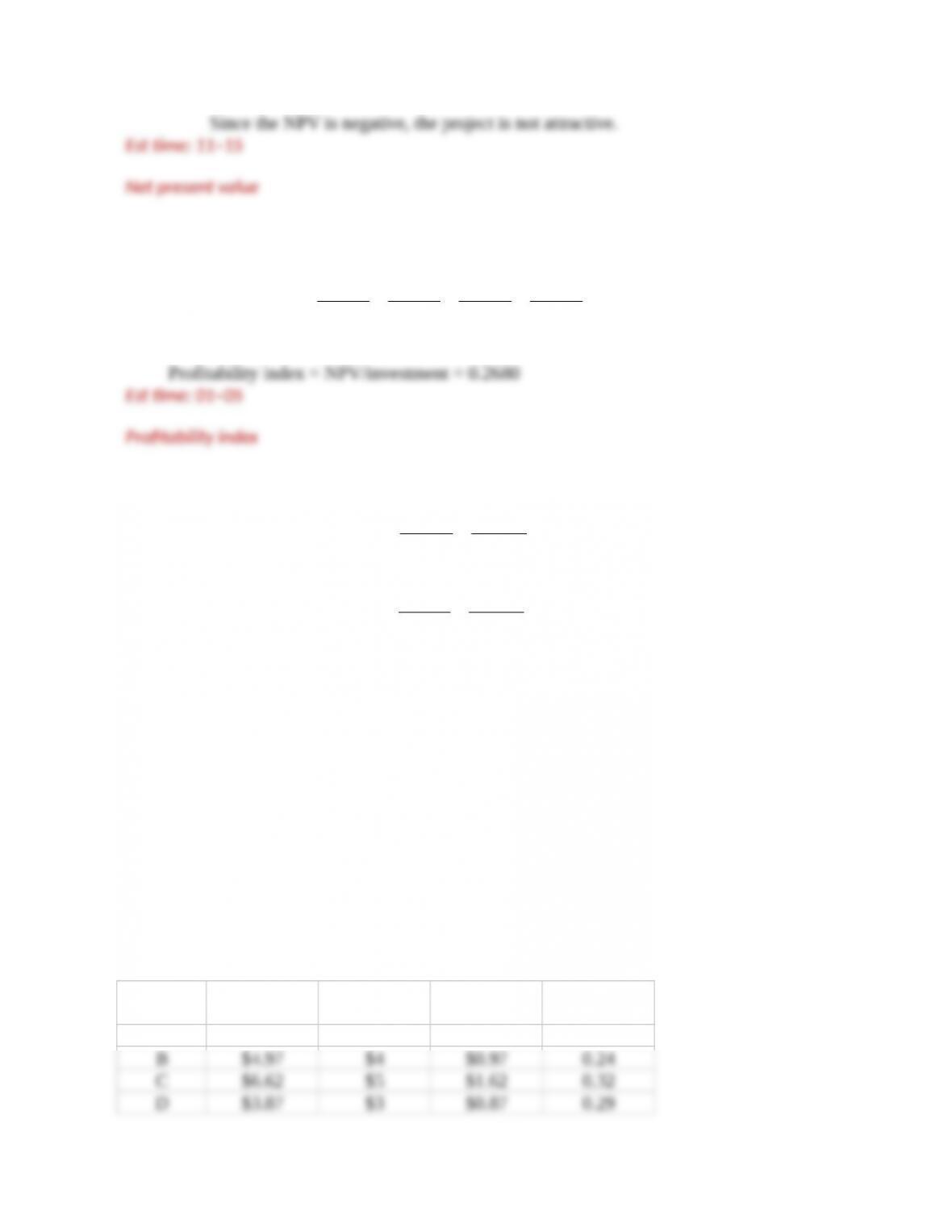
At 20% the NPV is:
840.0$
20.1
40$
20.1
20$
20.1
20$
20.1
20$
22$NPV
432
Since the NPV is positive, the project is attractive.
Copyright © 2018 McGraw-Hill Education. All rights reserved. No reproduction or distribution without the prior written consent of McGraw-Hill
Education.
22.
38.680,2$
09.1
000,5$
09.1
000,5$
09.1
000,3$
09.1
000,3$
000,10$NPV
432
23. a. The net present values of the project cash flows are:
58.345$
)22.1(
200,1$
22.1
000,2$
100,2$NPV
2
A
31.241$
)22.1(
728,1$
22.1
440,1$
100,2$NPV
2
B
The initial investment for each project is $2,100.
Profitability index (A) = $345.58/$2,100 = 0.1646
Profitability index (B) = $241.31/$2,100 = 0.1149
b. You should undertake both projects, as each has a positive profitability index.
If capital rationing limits your choice, you should undertake project A for its higher
profitability index.
Est me: 06–10
Profitability index
24. a. First, find the profitability index of each project.
Project PV of
Cash flow
Investment NPV Profitability
Index
A
$3.79
$3
$0.79
0.26
8-6
Copyright © 2018 McGraw-Hill Education. All rights reserved. No reproduction or distribution without the prior written consent of McGraw-Hill
Education.
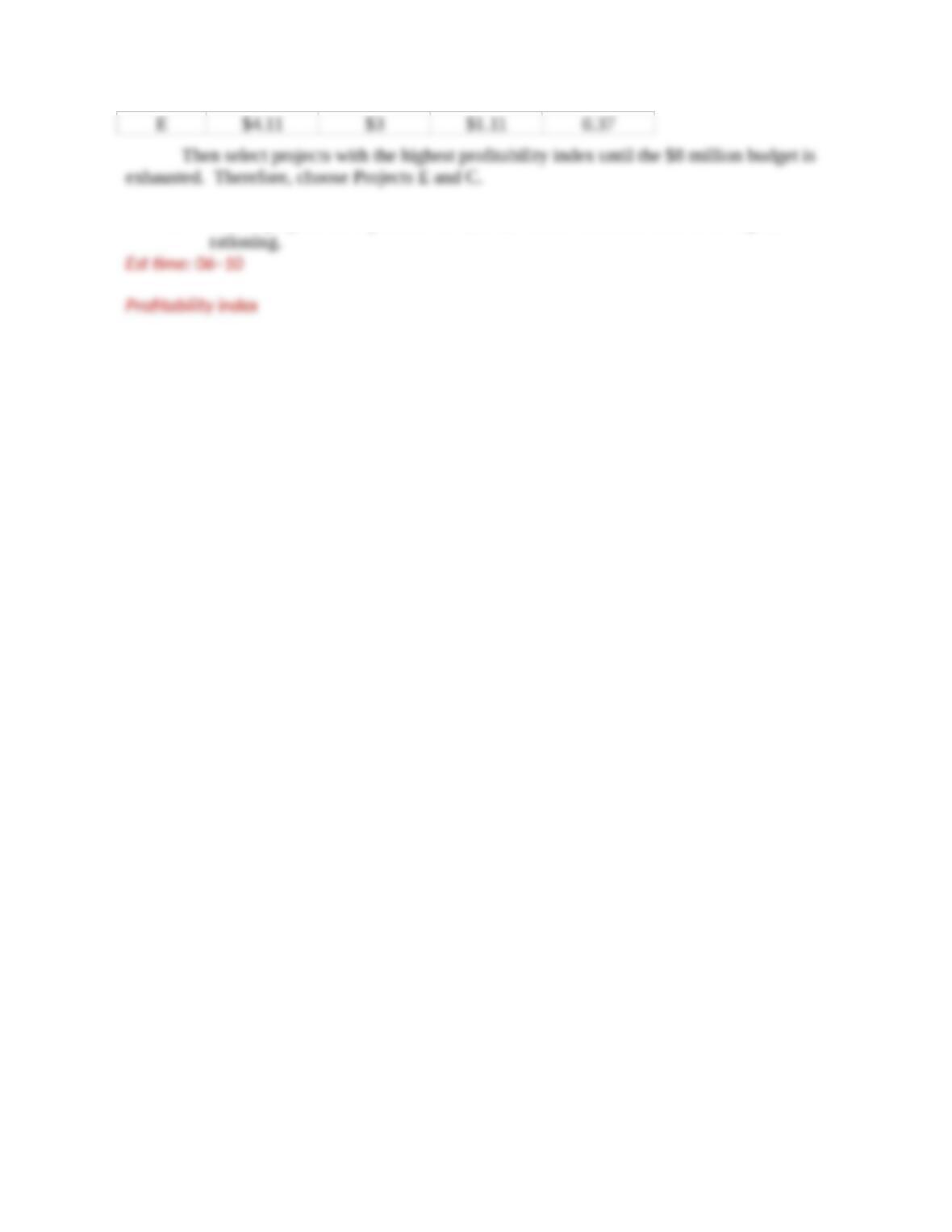
b. All the projects have positive NPV, so all will be chosen if there is no capital
8-6
Copyright © 2018 McGraw-Hill Education. All rights reserved. No reproduction or distribution without the prior written consent of McGraw-Hill
Education.