
28.
59.16$
)12.1(
18$
)12.1(
50.2$
12.1
2$
32
0P
Est time: 01–05
Nonconstant-growth stock
29. a. DIV1 = $2 1.20 = $2.40

32. a.
2
221
0
)1(
DIV
1
DIV
r
P
r
P

Sustainabl
e
Growth Rate
Intrinsic
Value (PV)
% Change
in PV
5.00% 34.7
4
6.00% 42.5
3
22.42%
6.50% 48.0
9
13.08%
7.00% 55.5
1
15.43%
7.50% 65.9
0
18.71%
8.00% 81.4
8
23.64%
8.50% 107.4
4
31.87%
9.00% 159.3
7
48.33%
d. DIV1/P0 = $1.20/$34.738 = 0.0345 = 3.45%
e. Next year the price will be:
012.37$
)10.1(
5456.43$0736.2$
)10.1(
728.1$
10.1
44.1$
32
1
P
f.
%00.101000.0
738.34$
)738.34$012.37($20.1$gain capital DIV
0
1
P
r
34.
a.,b. P4 = DIV5/(r g) = [DIV4 (1 + g)]/(r g)
53.42$
)10.1(
95.54$0736.2$
)10.1(
728.1$
)10.1(
44.1$
10.1
20.1$
432
0
P
c. The percentage change in the value of the firm increases at a faster rate with each
1% increase in the assumed final growth rate, g. The intrinsic value is more
7-3
Copyright © 2018 McGraw-Hill Education. All rights reserved. No reproduction or distribution without the prior written consent of
McGraw-Hill Education.

35. Under the competitive environment assumption, Table 4.7 is reproduced here:
Year l 2 3 4 5 6 7 8 9 10
Asset
value
10.
00
11.2
0
12.5
4
14.0
5
15.3
1
16.6
9
18.1
9
19.2
9
20.4
4
21.6
7
Earnin
gs 1.20 1.34 1.51 1.69 1.84 1.92 2.00 2.03 1.64 1.73
Net
investmen
t
1.20 1.34 1.51 1.26 1.38 1.50 1.09 1.16 1.23 1.30
Free
cash ow
(FCF)
0.00 0.00 0.00 0.42 0.46 0.42 0.91 0.87 0.41 0.43
Return
on equity
(ROE)
0.12 0.12 0.12 0.12 0.12 0.115 0.11 0.105 0.08 0.08
Asset
growth
rate
0.12 0.12 0.12 0.09 0.09 0.09 0.06 0.06 0.06 0.06
Earnin
gs growth
rate
0.12 0.12 0.12 0.09 0.04 0.04 0.01 -0.19 0.06
The present value of the cash flows for the first ten years is computed:
PV = FCF1 / (1 + r) + FCF2 / (1 + r)2 + FCF3 / (1 + r)3 + FCF4 / (1 + r)4 + FCF5 / (1 + r)5 +
The present value of the horizon value, computed as of year 10, is:
PVH = [$0.4334
×
(1 + .06) / (.1 – .06)] / 1.110
Therefore,
36. a. Earnings = DIV1 = $4
7-4
Copyright © 2018 McGraw-Hill Education. All rights reserved. No reproduction or distribution without the prior written consent of
McGraw-Hill Education.
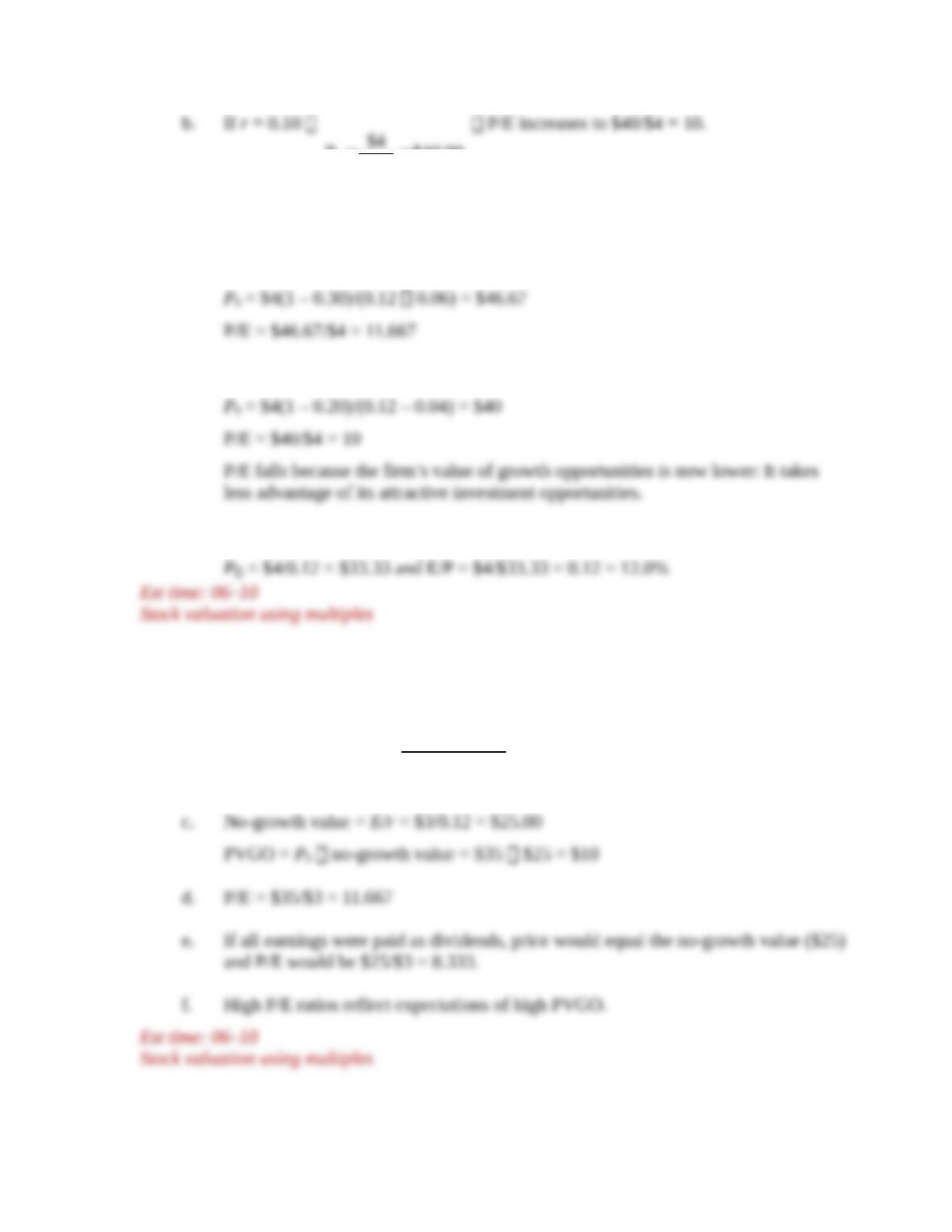
00.40$
10.0
4$
0
P
Est time: 01–05
Stock valuation using multiples
37. a. g = 20% 0.30 = 6%
b. If the plowback ratio is reduced to 0.20 g = 20% 0.20 = 4%
c. If the plowback ratio = 0 g = 0 and DIV1 = $4
38. a. g = ROE plowback ratio = 20% 0.30 = 6%
b. E = $3, r = 0.12
00.35$
06.012.0
)30.01(3$
0
P
7-5
Copyright © 2018 McGraw-Hill Education. All rights reserved. No reproduction or distribution without the prior written consent of
McGraw-Hill Education.

39. Since the firm is earning only the 8% that investors require, Rance Electric’s P/E
ratio would simply be the inverse of their return:
Return=E
P
P
Eratio
Return=8
100
100
8=12.5
This would not hold true for a firm that had investment opportunities yielding more
than the required cost of equity capital.
Est time: 01–05
Stock valuation using multiples
40. a. Plowback ratio = 0 DIV1 = $4 and g = 0
41. a. P0 = DIV1/(r g) = $5/(0.10 – 0.06) = $125
7-6
Copyright © 2018 McGraw-Hill Education. All rights reserved. No reproduction or distribution without the prior written consent of
McGraw-Hill Education.
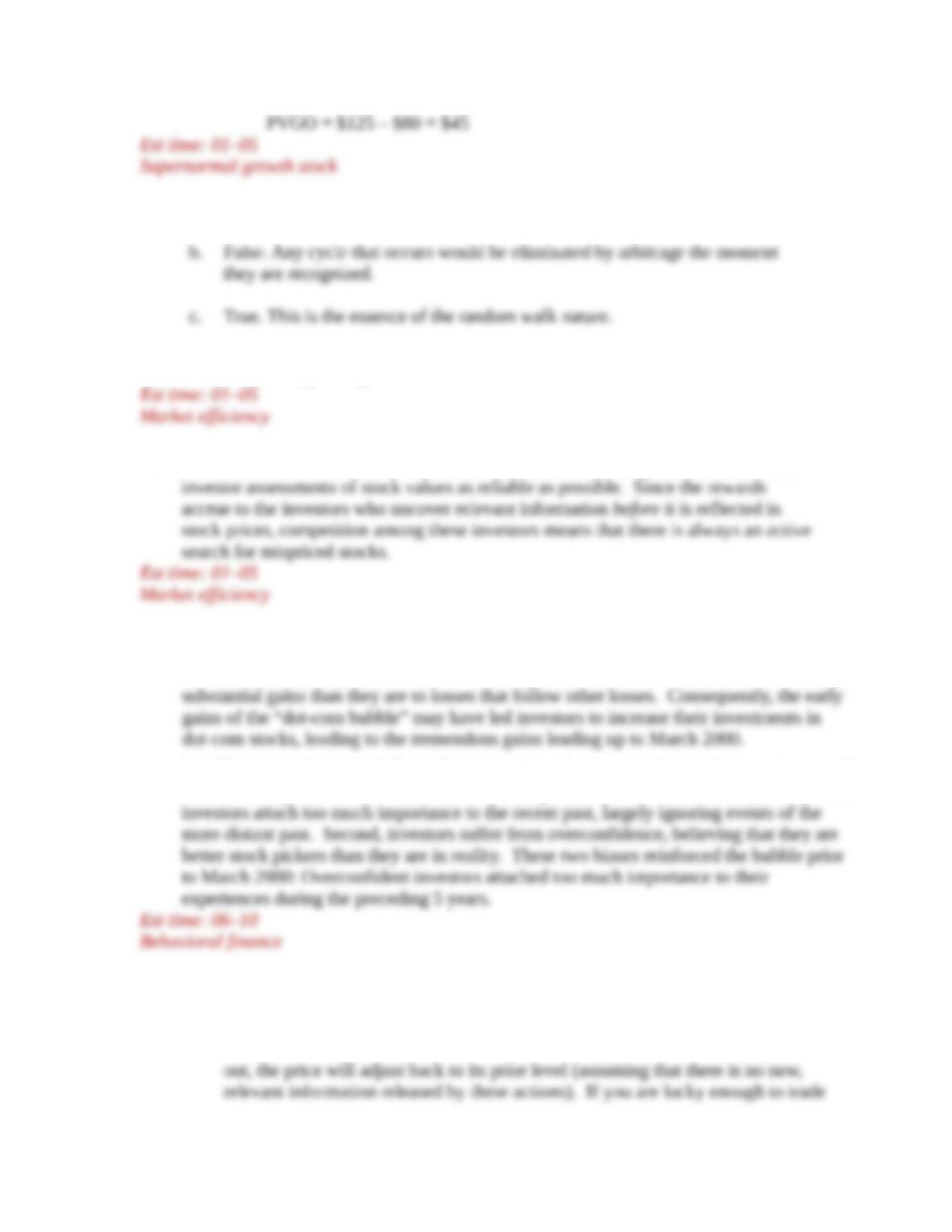
42. a. False. The levels of successive stock prices are related.
43. weak, semistrong, strong
44. The statement is correct. The search for information and insightful analysis makes
45. The two broad areas of investors’ behavioral biases are their attitudes toward risk and
their assessments of probabilities. Investors appear to be less averse to losses following
In addition, psychologists believe that investors make two mistakes in their assessment of
stock market probabilities. First, when assessing the future of stock market performance,
46. a. An individual can do crazy things and not affect the efficiency of financial
markets. An irrational person can give assets away for free or offer to pay twice
the market value. However, when the person’s supply of assets or money runs
7-7
Copyright © 2018 McGraw-Hill Education. All rights reserved. No reproduction or distribution without the prior written consent of
McGraw-Hill Education.
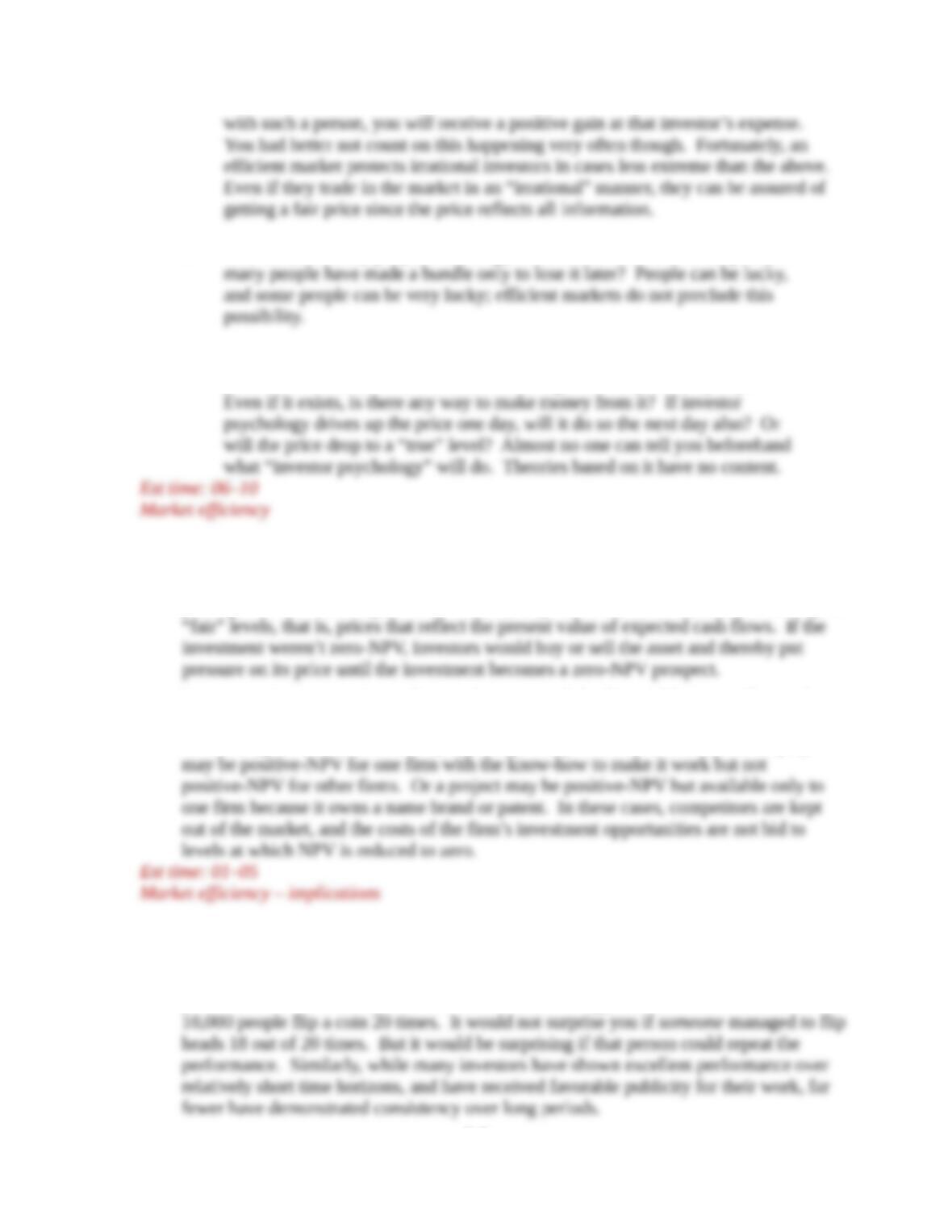
b. Yes, and how many people have dropped a bundle? Or more to the point, how
c. Investor psychology is a slippery concept, more often than not used to explain
price movements that the individual invoking it cannot personally explain.
47. Investments in financial markets, such as stocks or bonds, are available to all
participants in the marketplace. As a result, the prices of these investments are bid up to
In contrast, investments in product markets are made by firms with various forms of
protection from full competition. Such protection comes from specialized knowledge,
name recognition and customer loyalty, and patent protection. In these cases, a project
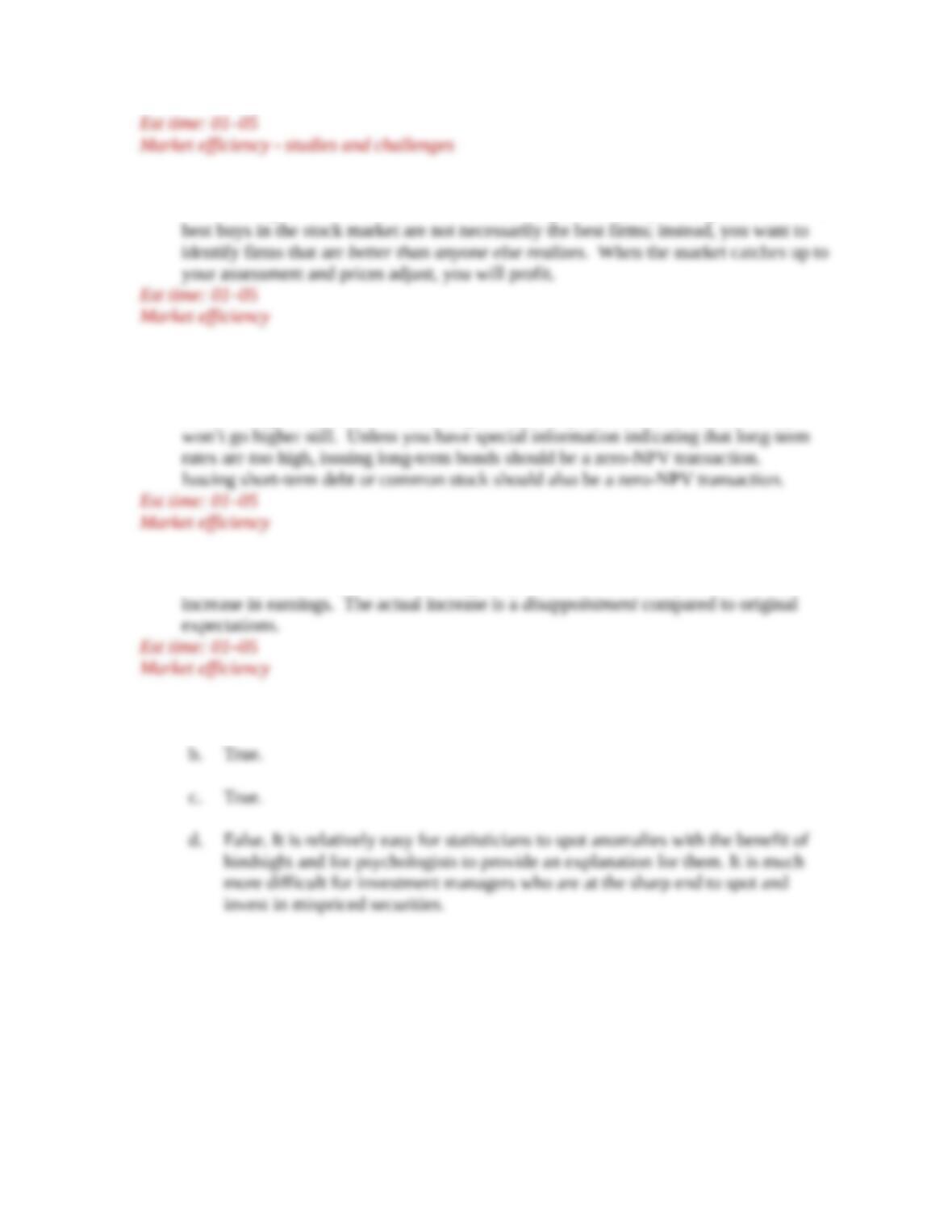
48. There are several thousand mutual funds in the United States. With so many
professional managers, it is no surprise that some managers will demonstrate brilliant
performance over various periods of time. As an analogy, consider a contest in which
7-8
Copyright © 2018 McGraw-Hill Education. All rights reserved. No reproduction or distribution without the prior written consent of
McGraw-Hill Education.
49. If the firm is stable and well run, its price will reflect this information and the stock may
not be a bargain. There is a difference between a good company and a good stock. The
50. Remember the first lesson of market efficiency: The market has no memory. Just
because long-term interest rates are high relative to past levels does not mean they
51. The stock price will decrease. The original price reflects an anticipation of a 25%
52. a. True.
7-9
Copyright © 2018 McGraw-Hill Education. All rights reserved. No reproduction or distribution without the prior written consent of
McGraw-Hill Education.