2. The interest rate per 3 months is 6%/4 = 1.5%.
3. a. Using the annuity table, the annuity factor is 11.4699. The annual payment on the
4. The monthly payment is based on a $100,000 loan:
61.028,1$PMT000,100$
)01.1(0.01
1
0.01
1
360
CC
5. The loan repayment is an annuity with present value equal to $4,248.68. Payments are
made monthly, and the monthly interest rate is 1%. We need to equate this expression to the
amount borrowed ($4,248.68) and solve for the number of months (t).
5-7
Copyright © 2018 McGraw-Hill Education. All rights reserved. No reproduction or distribution without the prior written consent of McGraw-Hill
Education.
2468.248,4$
)01.1(0.01
1
0.01
1
$200
t
t
months, or 2 years
Using a financial calculator, enter PV = ()4,248.68, FV = 0, i = 1%, PMT = 200; compute n =
24.
The effective annual rate on the loan is (1.01)12 1 = 0.1268 = 12.68%.
Est time: 06–10
Interest rates
6. r = 0.5% per month
7. EAR = e0.06 1 = 1.0618 1 = 0.0618 = 6.18%
8. a. With PV = $9,000 and FV = $10,000, the annual interest rate is determined by solving
b. With PV = $8,000 and FV = $10,000, the annual interest rate is determined by solving the
9.
a. You borrow $1,000 and repay the loan by making 12 monthly payments of $100.
b. The effective annual rate is (1.02923)12 1 = 0.41302 = 41.302%.
5-7
Copyright © 2018 McGraw-Hill Education. All rights reserved. No reproduction or distribution without the prior written consent of McGraw-Hill
Education.
10. Since the $20 initiation fee is taken out of the proceeds of the loan, the amount actually
borrowed is $1,000 $20 = $980.
11. After 1 year, each dollar invested at First National will grow to:
$1 (1.031)2 = $1.0630
12.
a. If the payment is denoted C, then:
90.202$PMT000,8$
)]12/10.0(1[)12/10.0(
1
)12/10.0(
1
48
CC
b. The monthly interest rate is 0.10/12 = 0.008333 = 0.8333%.
13. $100 e 0.10 8 = $222.55
14.
APR Compounding
Period
Effective
Annual Rate
5-7
Copyright © 2018 McGraw-Hill Education. All rights reserved. No reproduction or distribution without the prior written consent of McGraw-Hill
Education.
a. 12% 1 month
b. 8% 3 months
c. 10% 6 months
Est time: 01–05
Simple and compound interest
15.
Effective Rate
Compounding
Period Per-Period Rate APR
a. 10.00% 1 month
b. 6.09% 6 months
1.0609(1/2) 1 =
c. 8.24% 3 months
1.0824(1/4) 1 =
Est time: 06–10
Simple and compound interest
16. APR = 1% × 52 = 52%
17. Semiannual compounding means that the 8.6% loan really carries interest of 4.3%per
half year. Similarly, the 8.4% loan has a monthly rate of 0.7%.
APR Compounding
Period Effective Annual Rate
8.6% 6 months
8.4% 1 month
1.00712 1 = 0.0873 =
18. Use trial and error to solve the following equation for r:
5-7
Copyright © 2018 McGraw-Hill Education. All rights reserved. No reproduction or distribution without the prior written consent of McGraw-Hill
Education.
%599.1000,8$
)1(
11
$240
48
r
rrr
Using a financial calculator, enter PV = ()8,000; n = 48; PMT = 240, FV = 0; then
compute r = 1.599% per month.
APR = 1.599% 12 = 19.188%
The effective annual rate is (1.01599)12 1 = 0.2097 = 20.97%.
Est time: 06–10
Interest rates
19. According to the Rule of 72, at an interest rate of 6%, it will take 72/6 = 12 years for
your money to double. For it to quadruple, your money must double and then double again.
This will take approximately 24 years.
20. a. Using a financial calculator, solving for the r. Enter PV = 1.20; n = 4; PMT = 0, FV
= 1.41; then compute r = 4.11% per year.
b. Using a financial calculator, solving for the r. Enter PV = 0.91; n = 4; PMT = 0,
c. FV= 1.41 x (1+.0411)14=2.48
21. $80,000/(236.5/25) = $8,456.66. Her real income increased by $2,456.66.
22.
a. The real interest rate is (1.06/1.02) – 1 = 3.92%.
Copyright © 2018 McGraw-Hill Education. All rights reserved. No reproduction or distribution without the prior written consent of McGraw-Hill
Education.
b. If cash flow is level in nominal terms, use the 6% nominal interest rate to discount.
23. (1 + nominal interest rate) = (1 + real interest rate) (1 + inflation rate)
a. 1.03 1.0 = 1.03 nominal interest rate = 3.00%
24. Real interest rate =
1
rateinflation 1
rateinterest nominal 1
25. a. $1 million will have a real value of $1 million/(1.03)50 = $228,107.
b. At a real rate of 2%, this can support a real annuity of:
950,13$PMT107,228$
)02.1(0.02
1
0.02
1
20
CC
[To solve this on a financial calculator, enter n = 20, i = 2, PV = 228,107, FV = 0; then
compute PMT.]
Est time: 11–15
Annuities
26. (1+1.10)12 – 1 = 7,355.83 = 735.583%
27.
a. PV=
39.182,228$
)10.1(0.10
1
0.10
1
$30,000
15
b. The present value of the retirement goal is:
5-7
Copyright © 2018 McGraw-Hill Education. All rights reserved. No reproduction or distribution without the prior written consent of McGraw-Hill
Education.
c. 1.00 (1.04)30 = $3.24
d. We repeat part (a) using the real interest rate: (1.10/1.04) – 1 = 0.0577, or 5.77%.

25
1 1
PV $30,000 $530,638
0.0286 0.0286 (1.0286)
é ù
= ´ – =
ê ú
´
ë û
The real annual savings must be
50
1.0286 1 $530,808 PMT $4,902.40
0.0286
C C
b. If the real amount saved is $4,908.08 and prices rise at 5% per year, then the amount
saved at the end of 1 year, in nominal terms, will be:
$4,908.08 1.05 = $5,147.52
c. If the real amount saved is $4,908.08 and prices rise at 5% per year, then the amount
saved at the end of 50 year, in nominal terms, will be:
$4,908.08 (1.05)50 = $55,712.78
d. If the real amount spent is $30,000 and prices rise at 5% per year, then the amount
spent in their first year of retirement, will be:
$30,000 (1.05)50 = $344,021.99
e. If the real amount spent is $30,000 and prices rise at 5% per year, then the amount
spent in their last year of retirement, will be:
$30,000 (1.05)75 = $1,164,980.58
Est time: 16–20
Nominal and real returns
29. a. First, calculate the present value of all lifetime expenditures.
General living expenses of $50,000 per year for 50 years:
796,912$
)05.1(0.05
1
0.05
1
$50,000
50
Apartment rental of $16,000 for 8 years:
411,103$
)05.1(0.05
1
0.05
1
$16,000
8
Home purchase of $250,000 in 9 years:
PV = $250,000/(1.05)9 = $161,152
5-7
Copyright © 2018 McGraw-Hill Education. All rights reserved. No reproduction or distribution without the prior written consent of McGraw-Hill
Education.
Summing the present value of all lifetime expenditures gives $1,367,939 = 912,796 +
103,411 + 161,152 + 30,000 + 18,417 + 11,307 + 6,941 + 4,261 + 2,616 + 44,295 +
34,707 + 38,036.
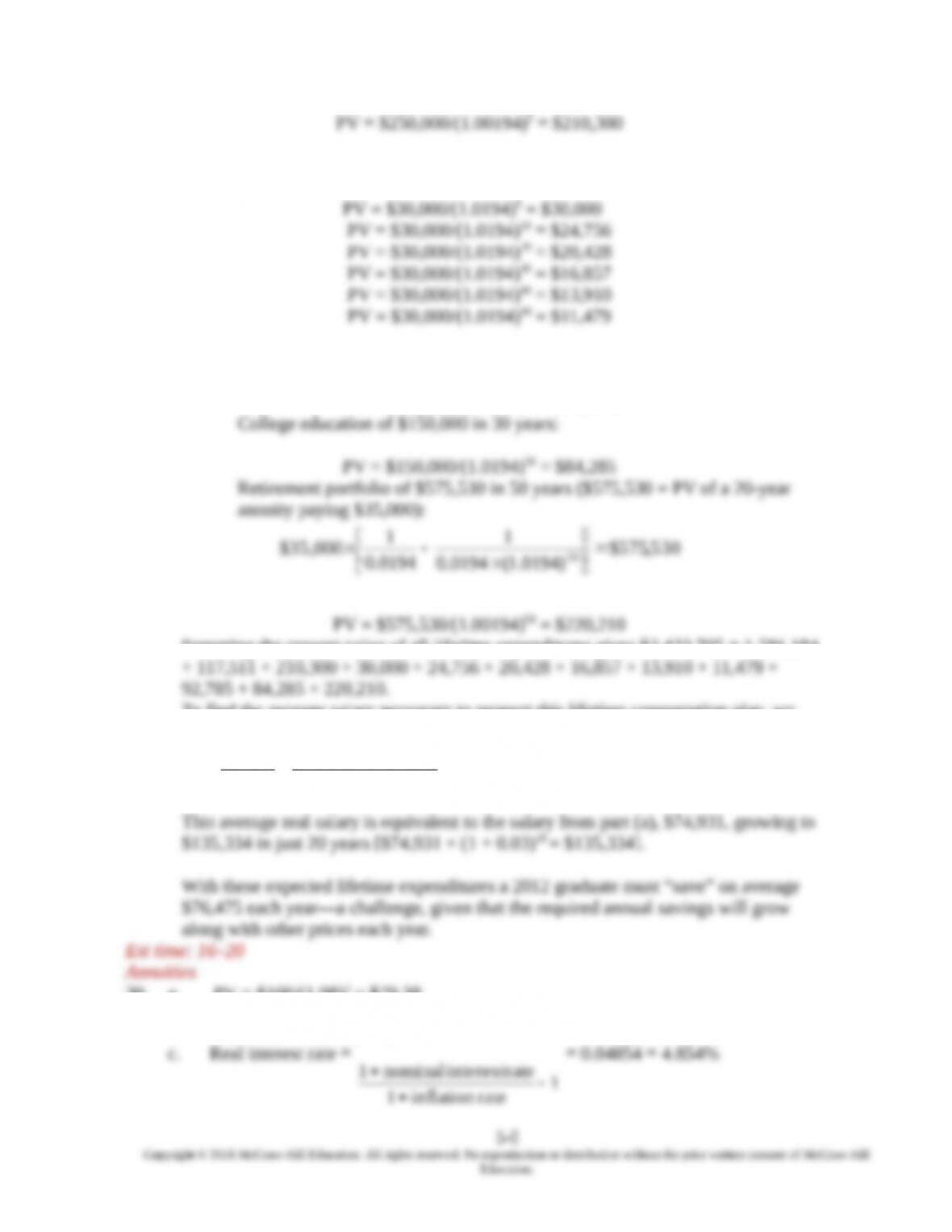
Five automobile purchases of $30,000 in each of years 0, 10, 20, 30, 40, and
50:
College education of $150,000 in 25 years:
PV = $150,000/(1.0194)25 = $92,785
Summing the present value of all lifetime expenditures gives $2,433,705 = 1,591,184
To find the average salary necessary to support this lifetime consumption plan, we
solve for the 50-year payment with the same present value:
475,76$PMT705,433,2$
)0194.1(0.0194
1
0.0194
1
50
CC
30. a. PV = $100/(1.08)3 = $79.38
b. Real value = $100/(1.03)3 = $91.51

31.
Est time: 16–20
Present value – multiple cash flows
5-7
Copyright © 2018 McGraw-Hill Education. All rights reserved. No reproduction or distribution without the prior written consent of McGraw-Hill
Education.