Solutions to Chapter 23
Options
1. A call option gives its owner the opportunity to buy a stock at a specific price which is
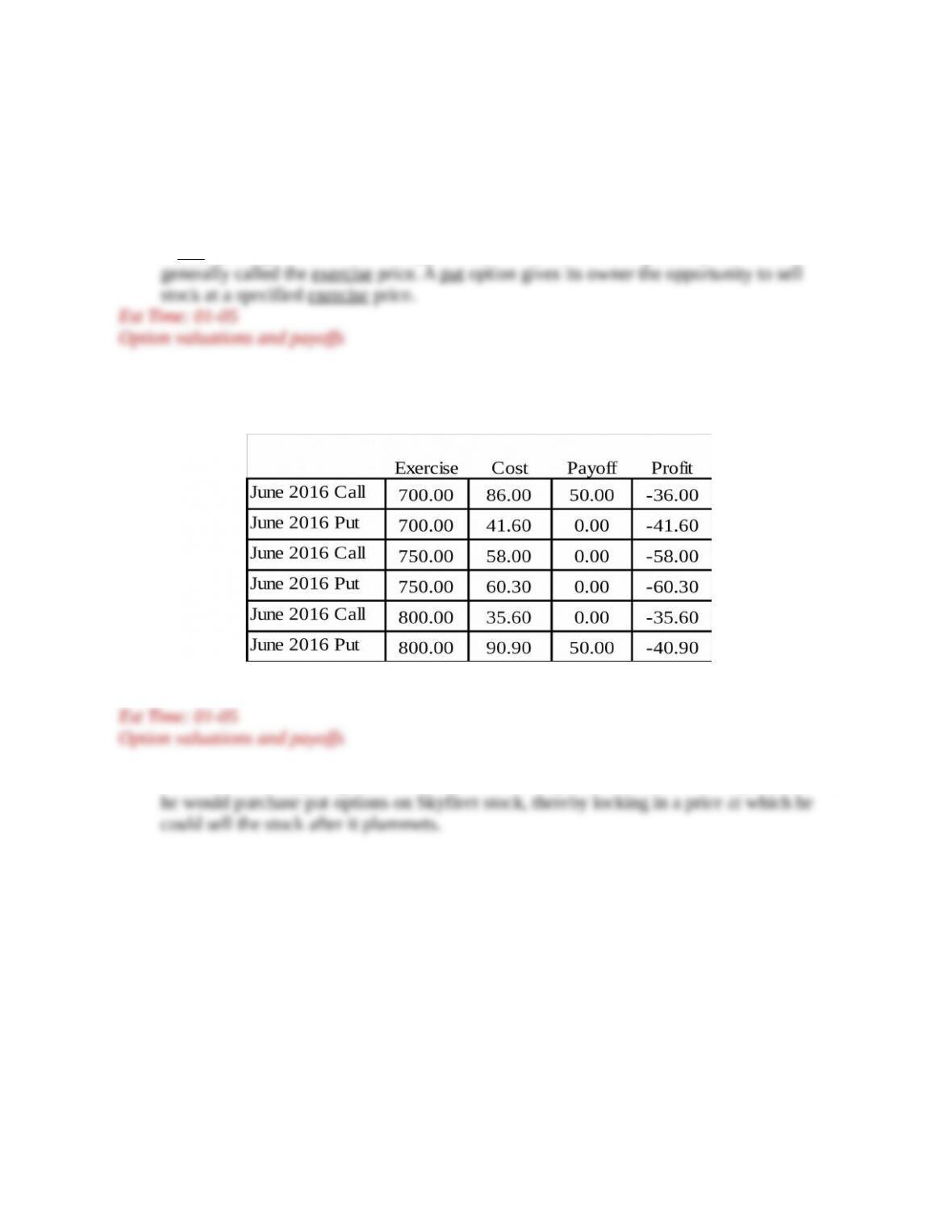
2. Payoff and profit if stock price on expiration date = $750:
3. Le Chiffre is anticipating a decline in the value of Skyfleet. To monetize this premonition,
4. a. Payoff and profit if stock price on expiration date = $780:
23-1
Copyright © 2018 McGraw-Hill Education. All rights reserved. No reproduction or distribution without the prior written consent of
McGraw-Hill Education.
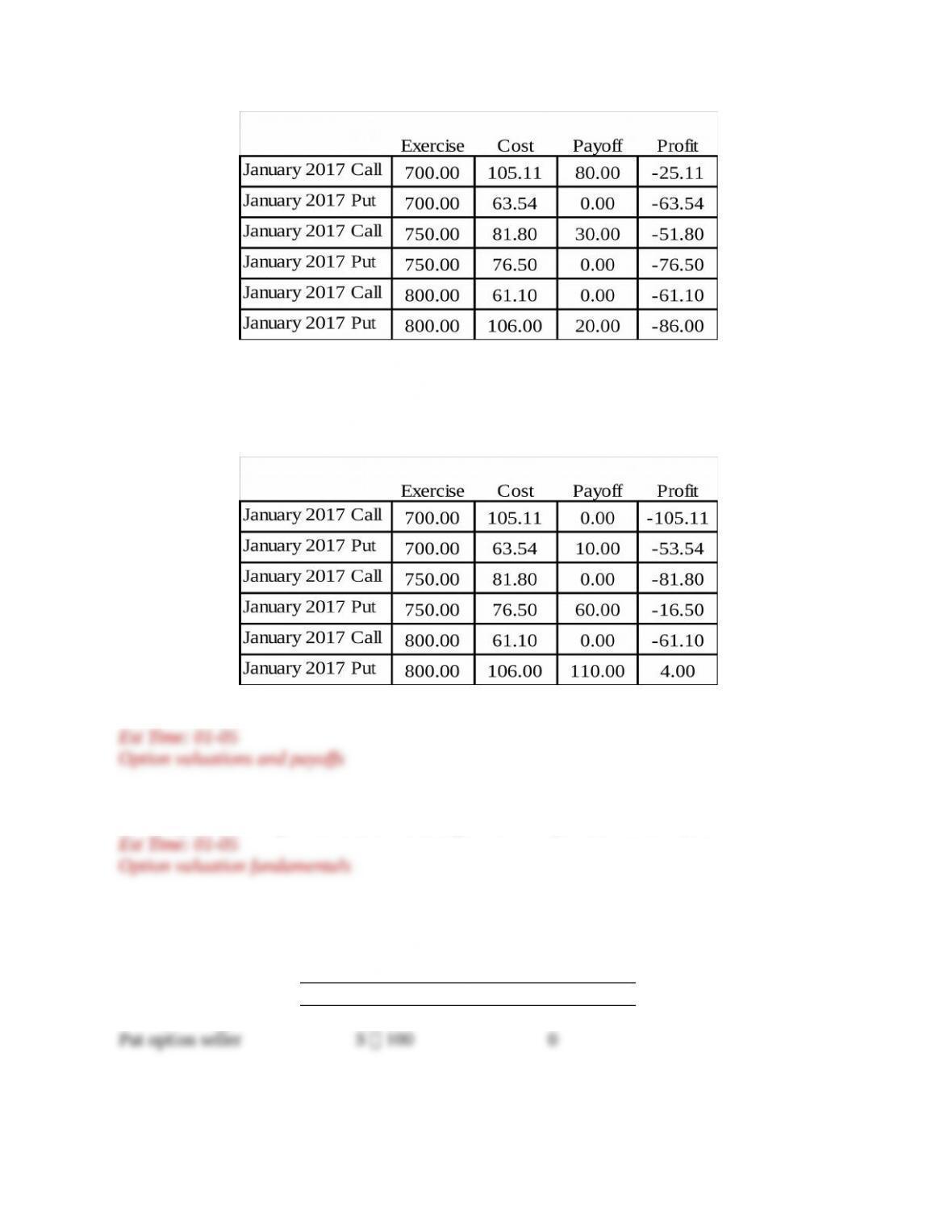
b. Payoff and profit if stock price on expiration date = $690:
c. The January 2017 options have more time value relative to the June 2016 options.
5. Figure 23-7a represents a call seller; Figure 23-7b represents a call buyer.
6. Consider options with an exercise price of $100. Call the stock price at the expiration
date S.
Payoff to Option Position at Expiration
S 100 S 100
Call option buyer
0
S – 100
Put option seller
S 100
0
23-2
Copyright © 2018 McGraw-Hill Education. All rights reserved. No reproduction or distribution without the prior written consent of
McGraw-Hill Education.
While it is true that both call buyers and put sellers hope that the stock price increases, the
7.
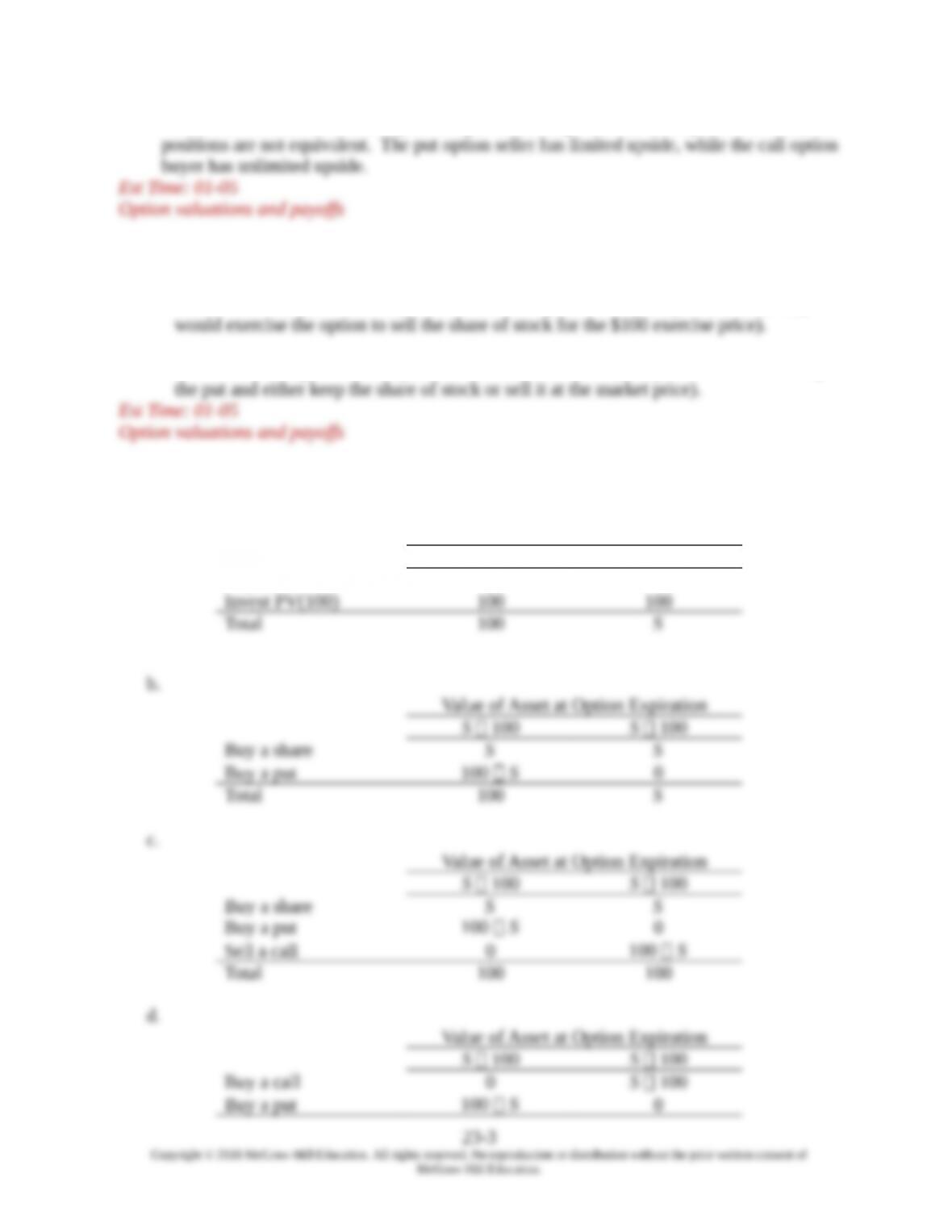
a. The value of the portfolio is equal to the exercise price of the put option, $100 (i.e., you
b. The value of the portfolio is equal to the value of the stock (i.e., you would throw away
8. Consider options with an exercise price of $100. Call the stock price at the expiration
date S.
a.
Value of Asset at Option Expiration
S 100 S 100
Buy a call
0
S – 100
Invest PV(100) 100 100
Total
100
S
b.
Value of Asset at Option Expiration
S 100 S 100
Buy a share
S
S
Buy a put 100 S0
Total
100
S
c.
Value of Asset at Option Expiration
S 100 S 100
Buy a share
S
S
Buy a put
100 S
0
Sell a call 0 100 S
Total
100
100
d.
Value of Asset at Option Expiration
S 100 S 100
Buy a call
0
S 100
Buy a put 100 S0
23-3
Copyright © 2018 McGraw-Hill Education. All rights reserved. No reproduction or distribution without the prior written consent of
McGraw-Hill Education.
Total
100 S
S 100
Est Time: 06-10
Option valuations and payoffs
9.
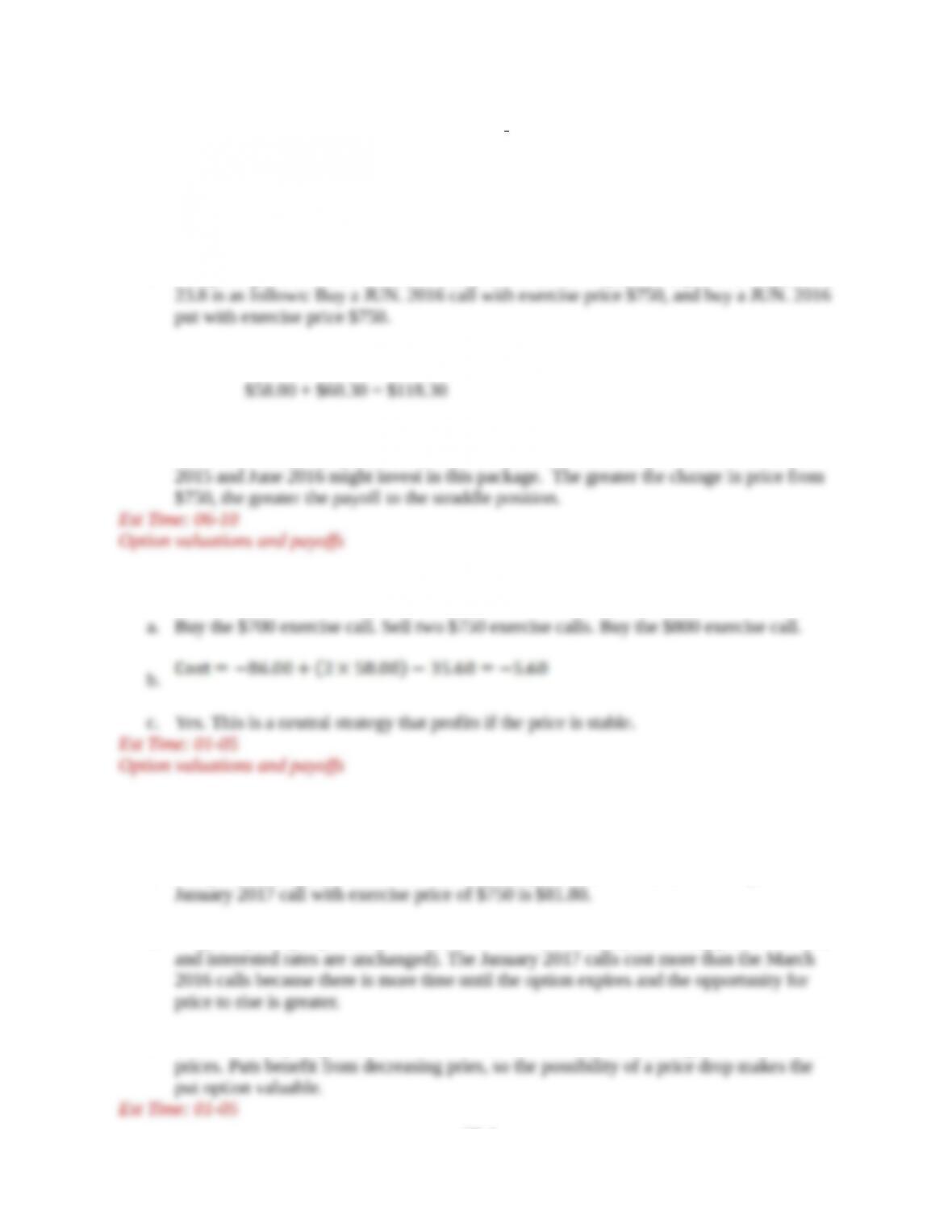
a. The package of investments that would provide the set of payoffs depicted in Figure
b. Table 23.2 shows that in July this package would have cost:
c. Table 23.2 indicates that in December 2015 the price of Alphabet was $750. An investor
who believed that the price of Alphabet would vary considerably between December
10.
11.
a. The price of the March 2016 call with exercise price of $750 is $42.00. The price of the
b. Option pricing is primarily a function of time and volatility (assuming price, exercise,
c. This is true of put options as well. Price fluctuations can result in higher or lower stock
23-4
Copyright © 2018 McGraw-Hill Education. All rights reserved. No reproduction or distribution without the prior written consent of
McGraw-Hill Education.
12.
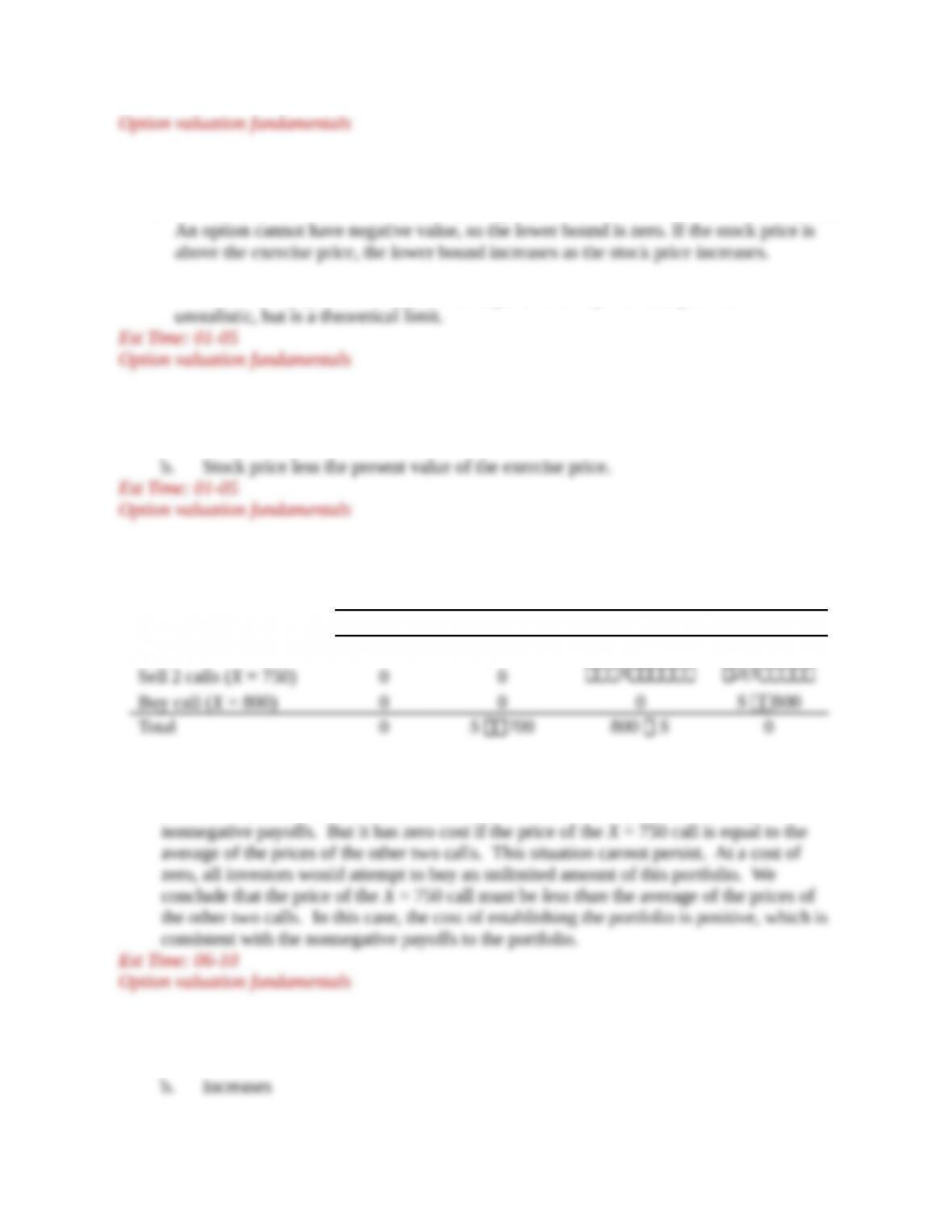
a. The option price cannot fall below (iii) the greater of zero or stock price – exercise price.
b. You will never pay more than (i) the stock price for an option. This price is somewhat
13. a. Zero.
14. Let X denote the exercise price and S the stock price at expiration:
Payoff to Option Position at Expiration
S 700 700 S 750 750 S 800 S 800
Buy call (X = 700) 0 S 700 S 700 S 700
2(S
Notice that if S is between 700 and 800 at option expiration, the total payoff to the
portfolio is positive. Otherwise, the total payoff is zero. This portfolio has only
15. a. Decreases
23-5
Copyright © 2018 McGraw-Hill Education. All rights reserved. No reproduction or distribution without the prior written consent of
McGraw-Hill Education.
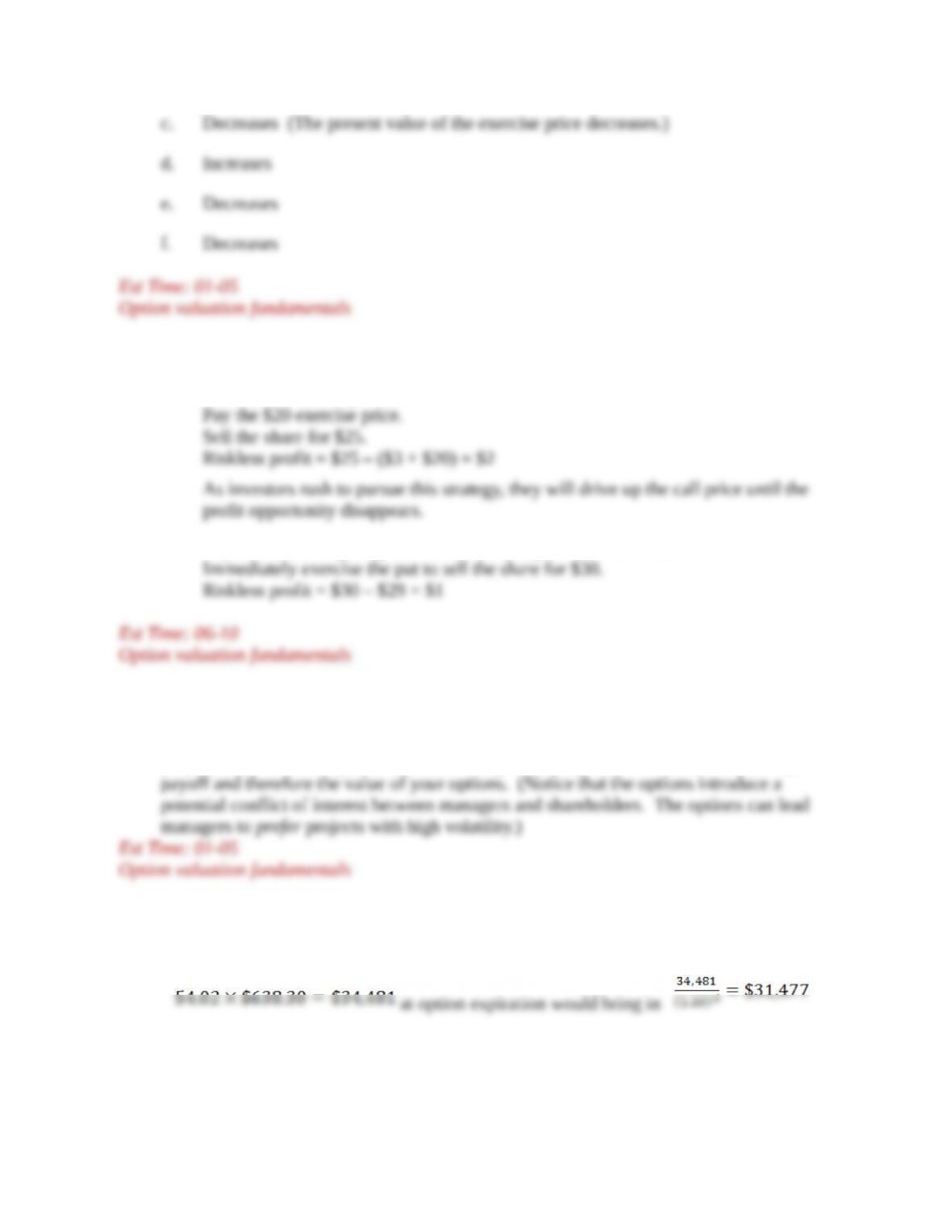
16. a. Buy a call option for $3.
Exercise the call to purchase stock.
b. Buy a share and a put option for a total outlay of $25 + $4 = $29.
17. One component of an option value is the volatility of the asset price. In this case, the
riskier project has more upside potential. Thus, the option is more valuable with the riskier
project. You will be tempted to choose the high-risk proposal. This increases the expected
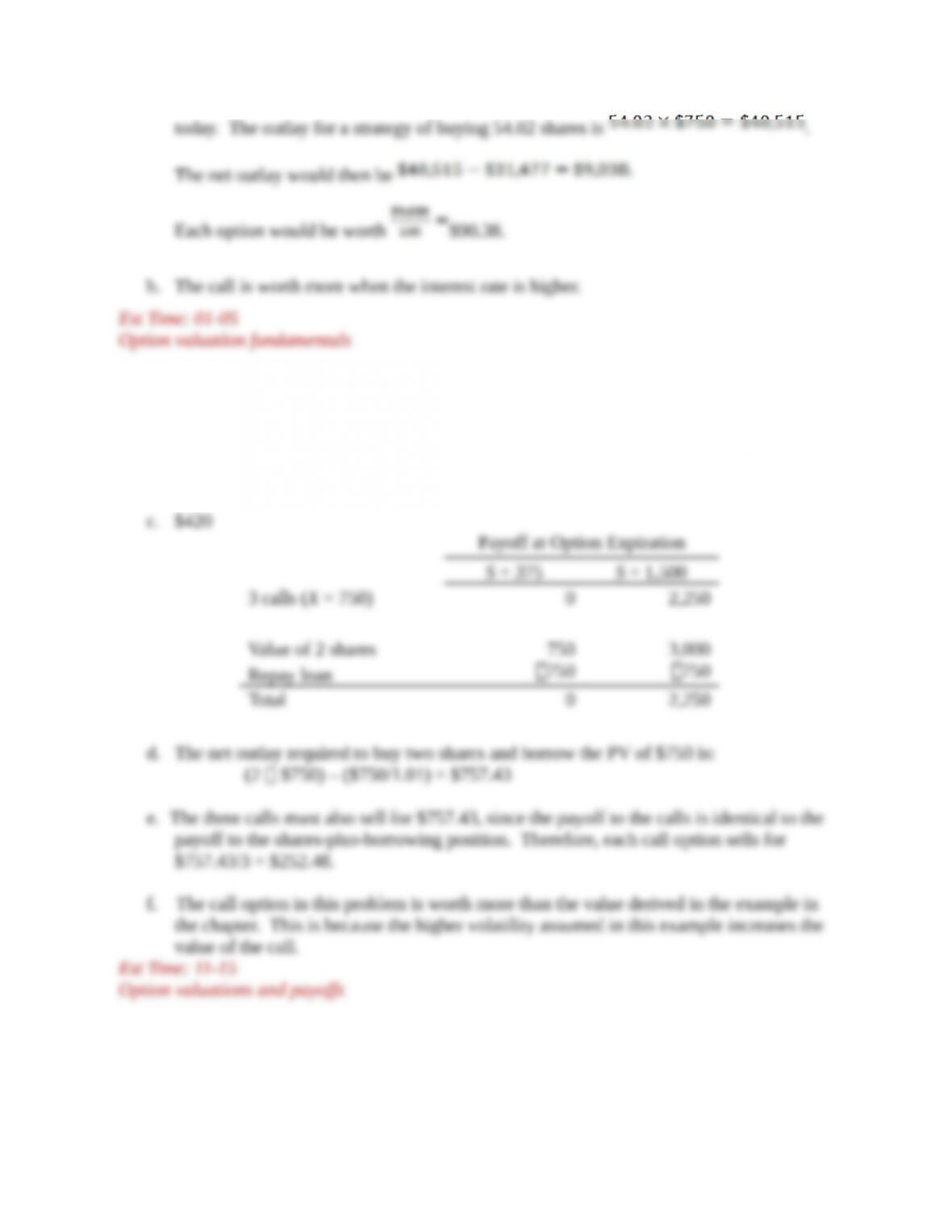
18. a.Return to the example in the chapter. If the interest rate is 20%, then your promise to pay
23-6
Copyright © 2018 McGraw-Hill Education. All rights reserved. No reproduction or distribution without the prior written consent of
McGraw-Hill Education.
19.
a. If the stock price is $1,500, then the call will be worth $1,500 – $750 = $750.
b. If the stock price is $375, then the call will be worthless.
20. Value of the call option using Excel Spreadsheet Solution is $8.77.
23-7
Copyright © 2018 McGraw-Hill Education. All rights reserved. No reproduction or distribution without the prior written consent of
McGraw-Hill Education.
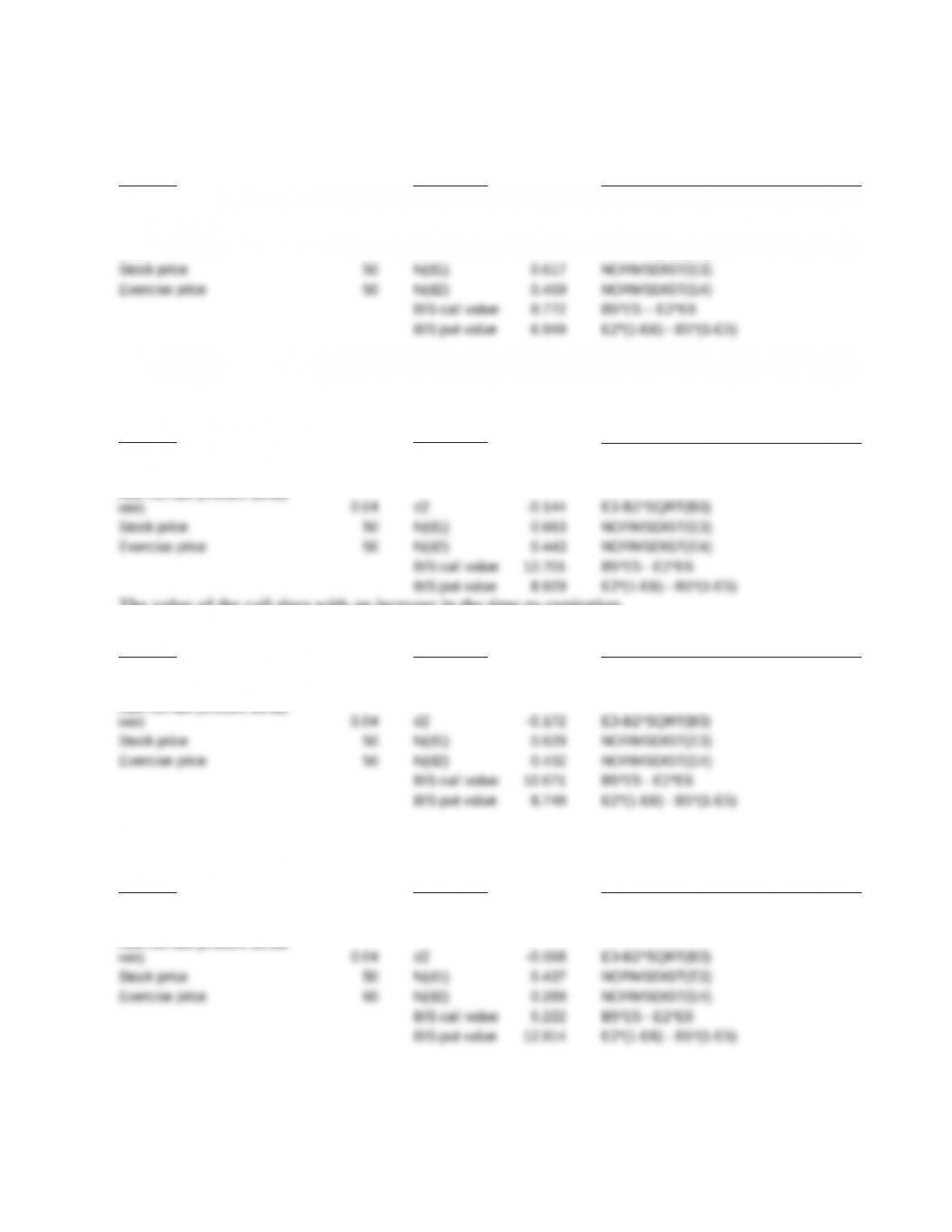
a.
INPUTS OUTPUTS FORMULA FOR OUTPUT IN COLUMN E
Standard deviation (annual) 0.4000 PV(Ex. Price) 48.077 B6/(1+B4)^B3
Maturity (in years) 1.000 d1 0.298 (LN(B5/E2)+(0.5*B2^2)*B3)/(B2*SQRT(B3))
Risk-free rate (effective annual
rate) 0.04 d2 -0.102 E3-B2*SQRT(B3)
b. and c.
INPUTS OUTPUTS FORMULA FOR OUTPUT IN COLUMN E
Standard deviation (annual) 0.4000 PV(Ex. Price) 46.228 B6/(1+B4)^B3
Maturity (in years) 2.000 d1 0.422 (LN(B5/E2)+(0.5*B2^2)*B3)/(B2*SQRT(B3))
Risk-free rate (effective annual
The value of the call rises with an increase in the time to expiration.
INPUTS OUTPUTS FORMULA FOR OUTPUT IN COLUMN E
Standard deviation (annual) 0.5000 PV(Ex. Price) 48.077 B6/(1+B4)^B3
Maturity (in years) 1.000 d1 0.328 (LN(B5/E2)+(0.5*B2^2)*B3)/(B2*SQRT(B3))
Risk-free rate (effective annual
The value of the call rises with an increase in volatility (standard deviation).
INPUTS OUTPUTS FORMULA FOR OUTPUT IN COLUMN E
Standard deviation (annual) 0.4000 PV(Ex. Price) 57.692 B6/(1+B4)^B3
Maturity (in years) 1.000 d1 -0.158 (LN(B5/E2)+(0.5*B2^2)*B3)/(B2*SQRT(B3))
Risk-free rate (effective annual
The value of the call falls with an increase in the exercise price.
23-8
Copyright © 2018 McGraw-Hill Education. All rights reserved. No reproduction or distribution without the prior written consent of
McGraw-Hill Education.
INPUTS OUTPUTS FORMULA FOR OUTPUT IN COLUMN E
Standard deviation (annual) 0.4000 PV(Ex. Price) 48.077 B6/(1+B4)^B3
Maturity (in years) 1.000 d1 0.754 (LN(B5/E2)+(0.5*B2^2)*B3)/(B2*SQRT(B3))
Risk-free rate (effective annual
rate) 0.04 d2 0.354 E3-B2*SQRT(B3)
The value of the call rises with an increase in the stock price.
INPUTS OUTPUTS FORMULA FOR OUTPUT IN COLUMN E
Standard deviation (annual) 0.4000 PV(Ex. Price) 47.170 B6/(1+B4)^B3
Maturity (in years) 1.000 d1 0.346 (LN(B5/E2)+(0.5*B2^2)*B3)/(B2*SQRT(B3))
Risk-free rate (effective annual
rate) 0.06 d2 -0.054 E3-B2*SQRT(B3)
21. a. The implied volatility for the option in Problem 28 is 43.82%.
INPUTS OUTPUTS FORMULA FOR OUTPUT IN COLUMN E
Standard deviation (annual) 0.4382 PV(Ex. Price) 48.077 B6/(1+B4)^B3
b. The implied volatility for the option in Problem 28 falls. For example, the implied
volatility falls to 41.19% if the call option price is only $9. The value of a call option
falls if expected volatility is lower.
INPUTS OUTPUTS FORMULA FOR OUTPUT IN COLUMN E
Standard deviation (annual) 0.4119 PV(Ex. Price) 48.077 B6/(1+B4)^B3
Copyright © 2018 McGraw-Hill Education. All rights reserved. No reproduction or distribution without the prior written consent of
McGraw-Hill Education.
22. a. The January 2017 calls with an exercise of $750 costs $81.80. If Alphabet rises to
b. If Alphabet declines to $614.75.00, then the profit on the call will be valueless. This
c. The option carries more risk.
23. a. Call
b. Put
24.
a. This is a 5-year call option. The exercise price is $120 per barrel, the price at which the
b. This is a put option to abandon the restaurant for an exercise price of $5 million. The
25. a.The price support system gives farmers the right to sell their crops to the government.
b. The exercise price is equal to the support price.
23-10
Copyright © 2018 McGraw-Hill Education. All rights reserved. No reproduction or distribution without the prior written consent of
McGraw-Hill Education.
26. The projects would give the United States the ability to “buy” energy for the fixed cost of
the synthetic fuels. This is a call option with the exercise price equal to the cost of
27. a. At an 8% yield to maturity, a 10-year, 6% coupon bond ordinarily would sell for:
b. The bond is also worth more than the shares it can be converted into. This is because the
bond has a “floor” value equal to its value as a “straight” 6% coupon bond. Even if the
28.
a. If the portfolio value exceeds the threshold, the manager’s bonus is proportional to the
difference between the portfolio value and the threshold. If the stock price is below the
b. Such contracts could induce managers to increase portfolio risk, since that would
29. a. Rank and File has an option to put (sell) the stock to the underwriter.
b. The value of the option depends on the volatility of the stock value, the length of the
23-11
Copyright © 2018 McGraw-Hill Education. All rights reserved. No reproduction or distribution without the prior written consent of
McGraw-Hill Education.
30.
a. Because the depositor receives a zero rate of return if the market declines and a
b. In this case, the depositor has in effect purchased a put option from the bank. To hedge,
31. The FDIC pays out an amount equal to deposits minus bank assets if assets are insufficient
23-12
Copyright © 2018 McGraw-Hill Education. All rights reserved. No reproduction or distribution without the prior written consent of
McGraw-Hill Education.